Week - 10 Hyperelastic Material Models
OBJECTIVE :
From the given material data, calculate the Mooney Rivlin and Ogden material constants and compare the both using stress-strain data from a Dog bone specimen tensile test with 100 percent strain. The given data is the engineering stress-strain in MPa/(mm/mm). The comparison should be shown from the d3hsp file and using simulation.
Theory:
A hyperelastic or Green elastic material is a type of constitutive model for ideally elastic material for which the stress–strain relationship derives from a strain energy density function. The hyperelastic material is a special case of a cauchy elastic material.
For many materials, linear elastic models do not accurately describe the observed material behaviour. The most common example of this kind of material is rubber, whose stress-strain relationship can be defined as non-linearly elastic, isotropic, incompressible and generally independent of strain rate. Hyperelasticity provides a means of modeling the stress–strain behavior of such materials. The behavior of unfilled, vulcanized elastomers often conforms closely to the hyperelastic ideal. Filled elastomers and biological tissues are also often modeled via the hyperelastic idealization.
Ronald Rivlin and Melvin Mooney developed the first hyperelastic models, the Neo-Hookean and Mooney-Rivlin solids. Many other hyperelastic models have since been developed. Other widely used hyperelastic material models include the Ogden model and the Arruda-Boyce model.
Procedure:
* keyword setup:
Boundary condition is given on the model with motion set on the one side and arresting the required degrees of freedom on the other side.
MAT 077_O Material as been set up giving density, poison ratio and giving constant order( N value), Load curve is also given.
Section of 1.5 mm thickness and material is assigned to part.
Defining the curve, giving the material curve and load curve for assigning the material and in motion set respectively.
Control hourglass, implicit auto, implicit general and termination is defined.
Database binary d3plot, ascii option and extent binary is defined according to the required load step.
Mooney – Rivlin material constants:
* Using the MAT77_H-Hyperelastic_rubber, the material card as been set up with giving the SW, SGL and ST values where giving 1 for each reads the curve in the engineering stress and engineering strain form. If it is zero then it is force and displacements values.
* Giving the N values where it represents the order of polynomial for which the constants are required to solve.
* In the d3hsp file we get the data of constants and stretch and true stress values so by using this data we can plot the graph for different constants and we can compare of all the constants and whichever curve is matching with experimental curve then that constant is taken for further process.
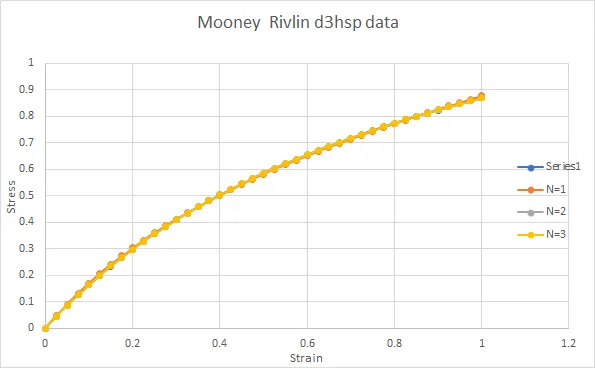
* The obtained constants are then entered to the material keyword file one by one and simulation is set to run for each case separatly with default keyword file.
* From the simulation results we get the true stress and true strain values and then we convert this data into engineering stress and strain.
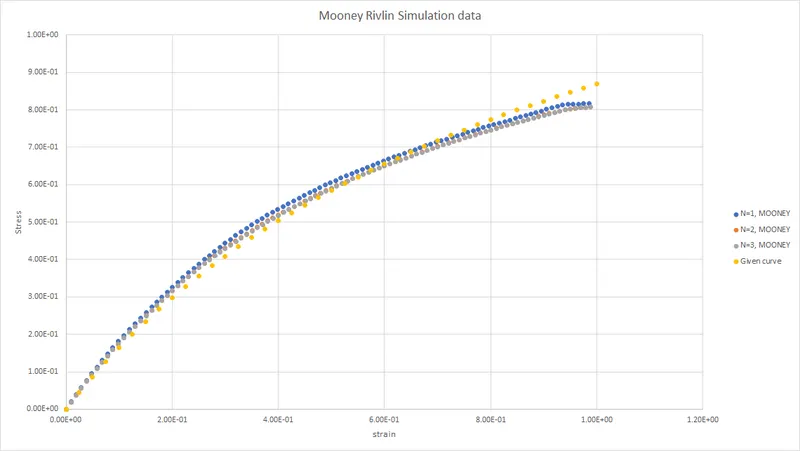
* From the above graph all 3 mooney rivlin constants equally close to the actual data so we can take any of the constants for material modeling.
|
N=1 |
|
Mooney constant c1 = 0.1768E+00 |
|
Mooney constant c2 = 0.1474E+00 |
|
N=2 |
|
Hyper elastic Constant C10= 0.2595E+00 |
|
Hyper elastic Constant C01= 0.4594E-01 |
|
Hyper elastic Constant C11= -0.2092E-01 |
|
Hyper elastic Constant C20= 0.2913E-02 |
|
Hyper elastic Constant C02= 0.1016E-02 |
|
Hyper elastic Constant C30= 0.0000E+00 |
|
N=3 |
|
Hyper elastic Constant C10= 0.2611E+00 |
|
Hyper elastic Constant C01= 0.4420E-01 |
|
Hyper elastic Constant C11= -0.6076E-02 |
|
Hyper elastic Constant C20= -0.2667E-02 |
|
Hyper elastic Constant C02= -0.9966E-02 Hyper elastic Constant C30= 0.1565E-03 |
Ogden material constant:
* Procedure is similar to Mooney – Rivlin material constant and constant values are
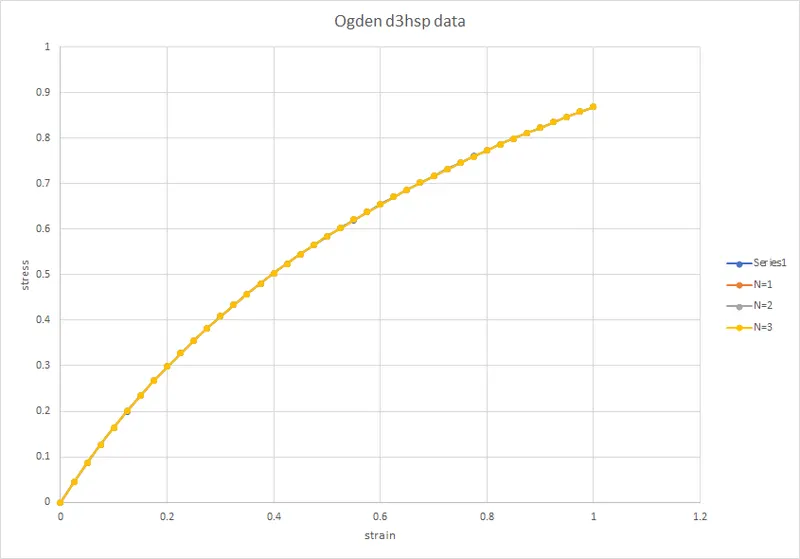
* The obtained constants are then entered to the material keyword file one by one and simulation is set to run for each case separatly with default keyword file.
* From the simulation results we get the true stress and true strain values and then we convert this data into engineering stress and strain.
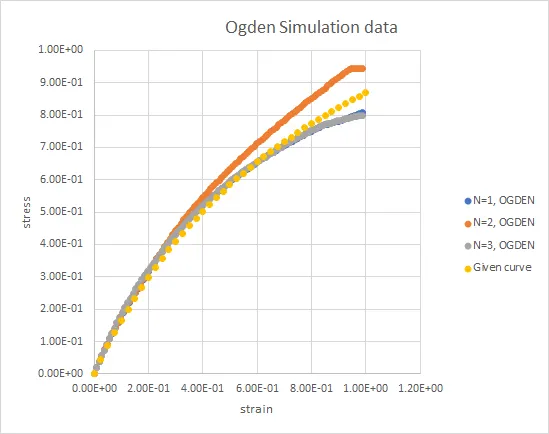
* From the above graph N=1 ogden constants is close to the actual data so we can take N1 polynomial constant for material modeling.
|
N=1 |
|
mu(1) = 9.1076025585232E-01 alpha(1) = 1.3427238694706E+00 |
|
N=2 |
|
mu(1) = 9.1564733498464E-01 alpha(1) = 1.3399091807896E+00 |
|
mu(2) = 2.2259556593837E+00 alpha(2) = -1.8434703015661E-03 |
|
N=3 |
|
mu(1) = -3.1842608038997E-02 alpha(1) = 1.93E+00 |
|
mu(2) = 2.6137537530451E-01 alpha(2) = 1.5503338135517E+00 |
|
mu(3) = 6.8199188165234E-01 alpha(3) = 1.2887845124363E+00 |

CONCLUSION :
* As defined in the objective the stress-strain data from a Dog bone specimen tensile test result are used to model the curve with 100 percent strain then Mooney Rivlin and Ogden material constants are calculated and got the best fitted curve for further process.
* In Mooney rivlin constants all 3 mooney rivlin constants equally close to the actual data so we can take any of the constants for material modeling but N1 is prefered because it doesn't involve many polynomial equations.
* In ogden constants N=1 is prefered because it is close to the actual data so we can take N1 polynomial constant for material modeling.
Note: All the data of material curve is attached in the excel.