Week - 10 Hyperelastic Material Models
OBJECTIVE
- Use the given material data to build a hyper elastic material cards using Ls-Dyna
- Build Mooney Rivlin and Ogden material card by finding their constants using d3hsp file
- Perform uniaxial tensile test on Dogbone specimen with 100% strain (i.e. strain = 1) and compare the stress strain data in above cases
THEORY
- Hyper elastic materials are the material which has the capability to stretch with more than 100 % strain without any sort of failure.
- These material are hard to replicate as the strain value are high. These materials have Poisson’s ratio of almost 0.5. Although keeping 0.5 poisson’s ratio creates instability so for simulation purpose the value is assigned that is almost equal to 0.5 but not 0.5 like 0.4999, 0.4995 etc
- Various material models like Mooney Rivlin, Ogden, Yeoh etc are used to model these materials.
- These materials can be defined using strain energy vs stretch relations, where strain energy is the area under stress-strain graph.
- Here we will discuss modelling of Mooney Rivlin and Ogden material using the given stress strain data.
PROCEDURE
Mooney Rivlin Material
Material Card
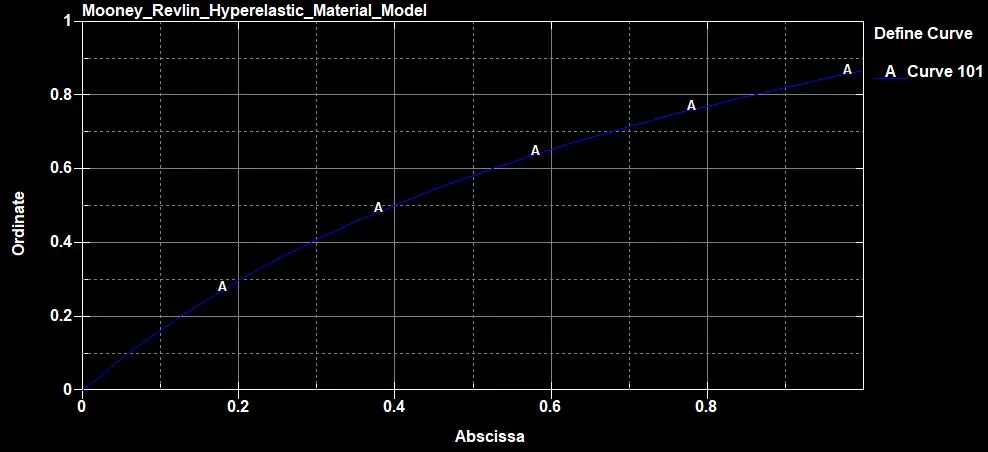
- Using the material data given generate a curve as an input for the hyper-elastic material card.
- Use MAT77 hyper elastic material keyword and assign basic material properties. Make sure that the Poisson Ratio of the material is 0.49<PR<0.4999. The properties considered for the study are as follows. Also in LCID refer to the curve generated before.
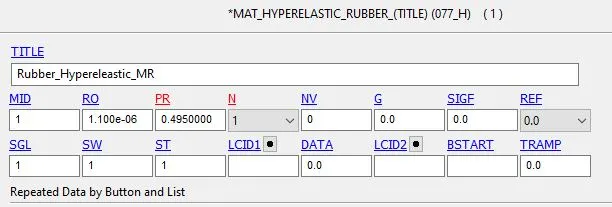
- Here the value of N define the different powers of material model considered. So N=1 is use to find C10 and C01 and so on for N=2 and N=3. These values are called Mooney Constants and can be extracted from d3hsp file.
|
N = 1 |
C1 |
1.76800E-01 |
|
C2 |
1.47400E-01 |
|
|
N = 2 |
C10 |
2.59500E-01 |
|
C01 |
4.59400E-02 |
|
|
C11 |
-2.09200E-02 |
|
|
C20 |
2.91400E-03 |
|
|
C02 |
1.01600E-03 |
|
|
N = 3 |
C10 |
2.61100E-01 |
|
C01 |
4.42000E-02 |
|
|
C11 |
-6.07400E-03 |
|
|
C20 |
-2.66700E-03 |
|
|
C02 |
-9.96800E-03 |
|
|
C30 |
1.56500E-04 |
- Once we have these value, we input them in the material card and run the required simulation.
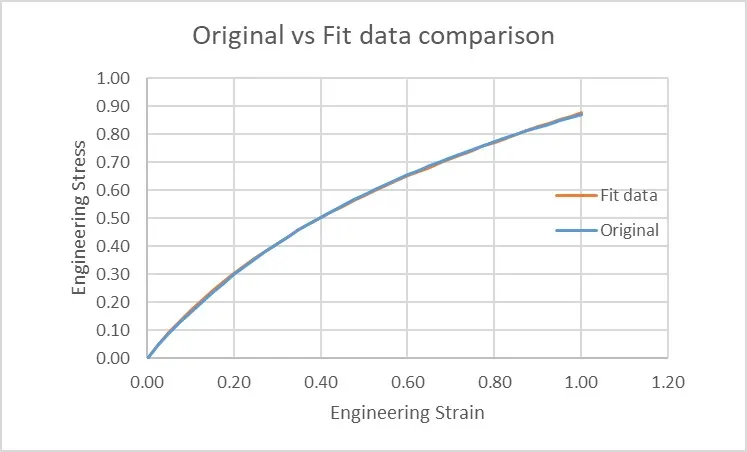
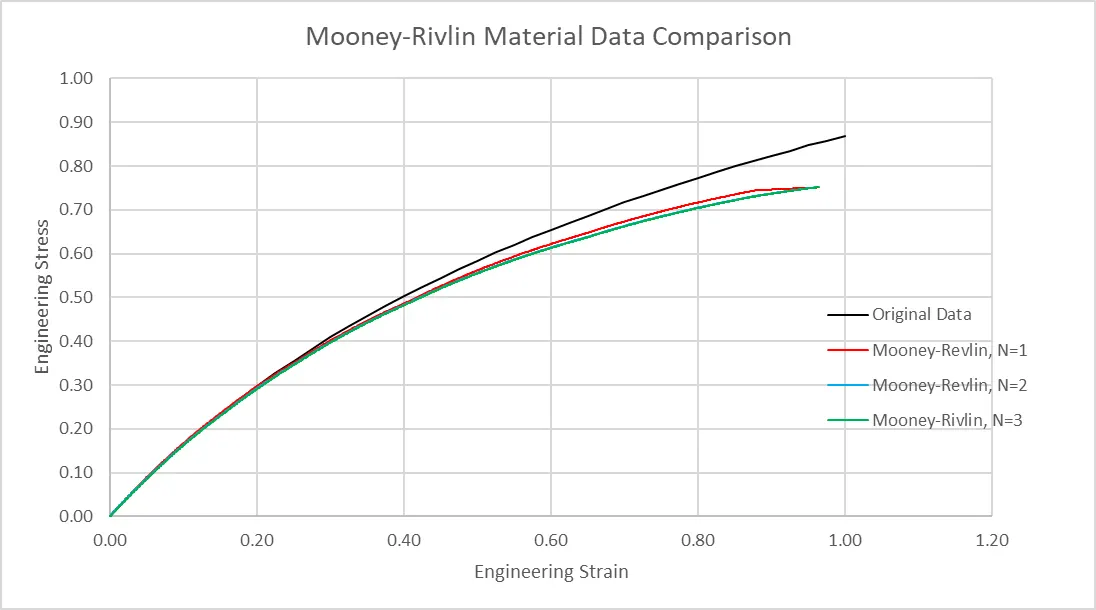
- During this process in order to check fit of the material data, stretch and true stress values can also be extracted from d3hsp for each case and compared to input data. For N=1, below image shows the fit data comparison.
Part
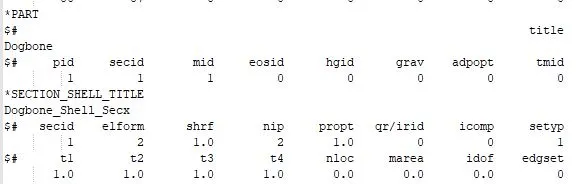
- Create a shell section for the dogbone specimen.
- Assign both section id and material card to part
Boundary Condition.
- Since we are simulating the uniaxial tensile test, we need to bind one side of the specimen. Also the centre nodes of both the sides are also bound in all direction other than tensile to ensure the specimen doesn’t ward off from its position.
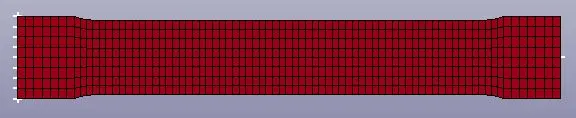
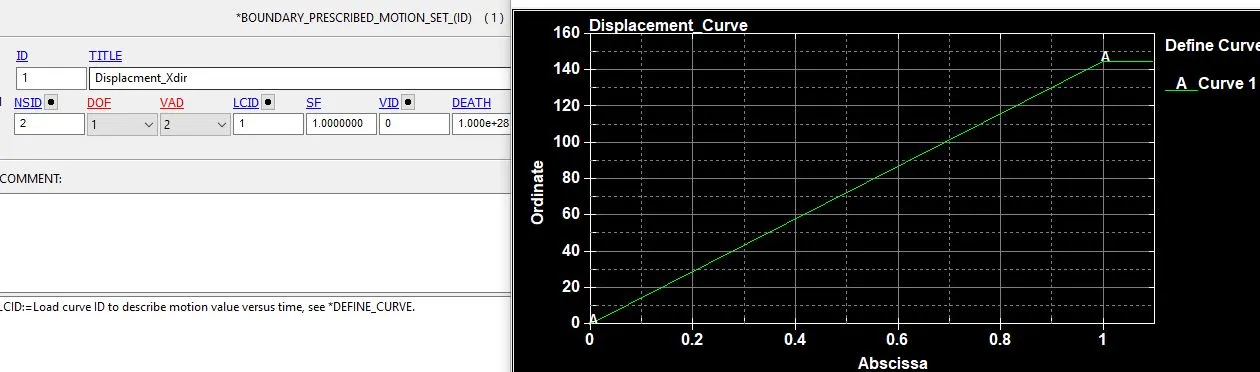
- Now in this study we are expecting the study for the material undergoing 100 % strain which means strain = 1. Thus the displacement required is equal to the length of specimen. This can be done using a curve and prescribed boundary motion card.
Control and Database
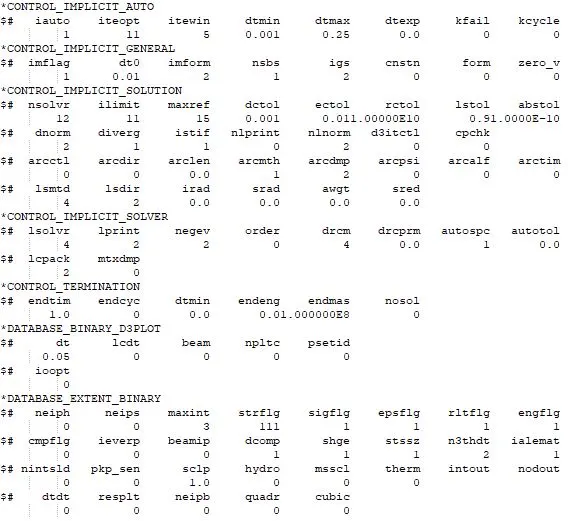
- Since this is a static simulation and we are concerned with only end result, we will be proceeding this activity using implicit simulation.
- We will use CONTROL_IMPLICIT_GENERAL, CONTROL_IMPLICIT_AUTO, and CONTROL_IMPLICIT_SOLUTION AND CONTROL_IMPLICIT SOLVER to define the solver type and time step info.
- Use d3plot to write the output of the simulation. Also use extent_binary to write the strain details.
RESULTS
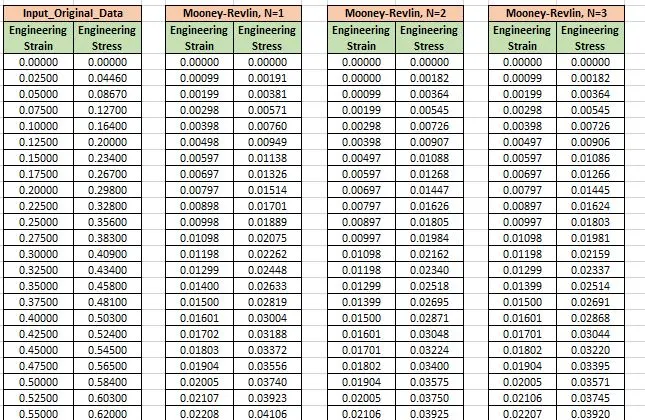
- The stress strain data has been extracted for each values of N which are attached below.

- These value are compared with the original stress strain curve input for material validation. The detailed data can be seen in excel sheet
OGDEN MATERIAL
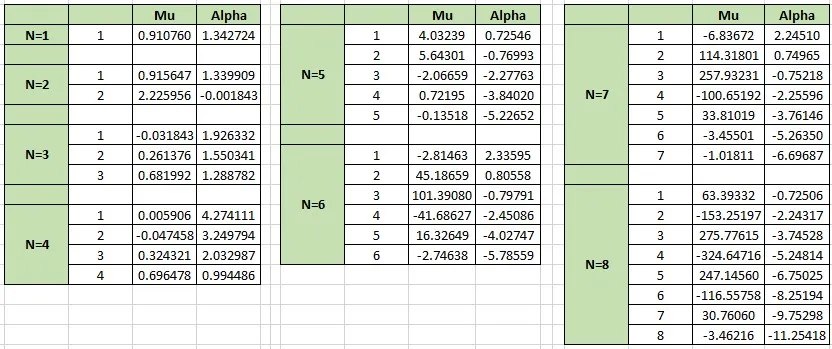
- Same procedure is followed for building ogden material model using MAT77 O Ogden Rubber The difference is instead of 3 different values of N in mooney rivlin material model, here we have 8 different values of N and the constant are Alpha and Mu.
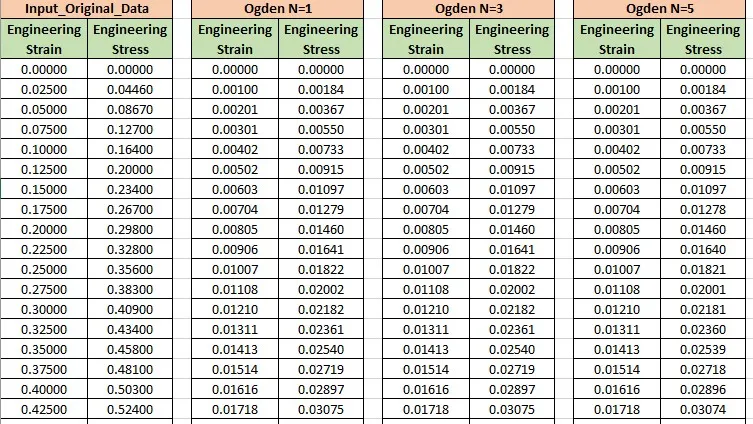
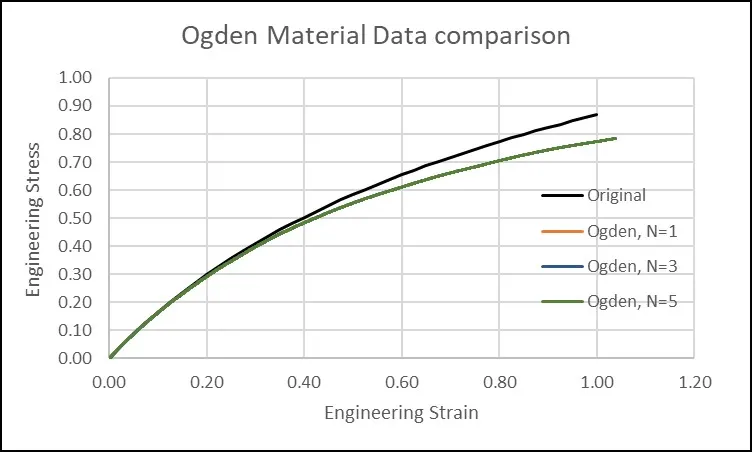
- The values of the constant are extracted in similar manner using uniaxial tensile simulation. And same procedure is repeated for stress strain data.
- Here we see data comparison for N=1, 3 and 5.
NOTE
- If convergence issues arise for higher values of N, then the same can be resolved or optimized using different value of parameters like ITEOPT, ITWIN, DTMIN and DTMAX by altering the no of iteration and step size in CONTROL_IMPLICIT _AUTO
CONCLUSION
The above exercise gives us understanding the detailed process involved in generating a hyper elastic material card. Also here we have taken 0.495 Poisson’s ratio. The solution can be checked for different values of Poisson’s ratio which will give different material constant values and thus a more accurate material card can generated for practical applications.