Week - 10 Hyperelastic Material Models
Aim:
The aim of this challenge is to Calculate Mooney Rivilin & Ogden material Constants and compare the Stress-strain data obtained from simulation with measured value.
1. Overview of Hyperelastic Materials:
Hyperelastic materials are class of materials that undergo nonlinear Elastic deformation. The Stress strain response of typical Hyperelastic material is given below.
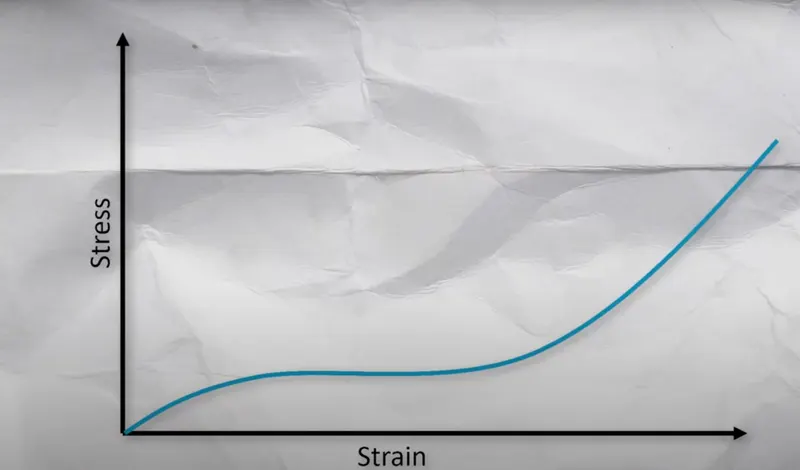
The Common hyperelastic materials are 1. Rubber 2. Elastomer 3. Soft-tissue 4. Foams. The workdone on the Hyperelastic material is completely recoverable upon unloading. Hence the workdone on Hyperelastic materials are thermodynamically reversible process. For Most of Metals, the Linear Portion of the Engineering stress strain curve is characterized by Elastic Modulus or Young's modulus which is constant, this also indicate the fact that the Metals have constant stiffness in the elastic region. But if we take hyperelastic material the stiffness will vary depending upon the strain as shown below, Hence it is not possible to model the hyperelastic material with constant Elastic modulus as we do for most of metals.Hence Hyperelastic materials require different modelling approach compared to metals.
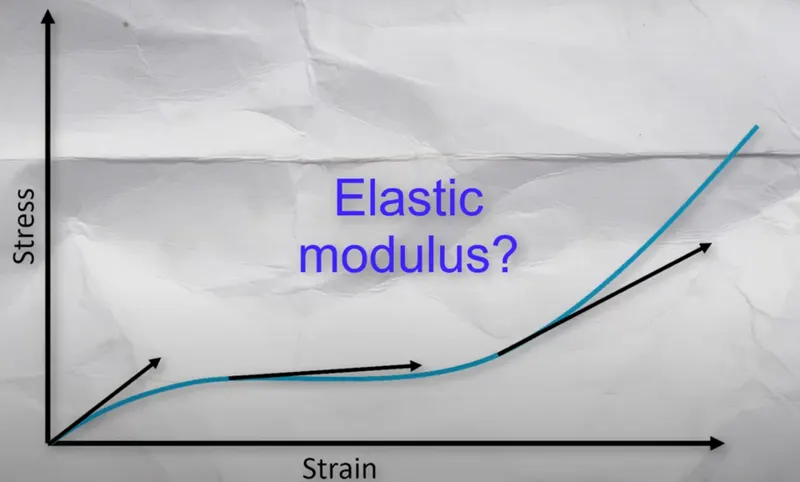
Three principle Characteristics of Hyperelastic Materials are:
1. Soft Materials.
2. Non-linear Elastic Behaviour.
3. Work done on the Elastic Material is completely reversible.
4. Most of the Hyperelastic Materials are fully incompressible.
1.1 Basics of Modelling Hyperelastic Materials:
It is understood that the Workdone on the Hyperelastic material is stored within the material inform of strain Energy and the Strain energy is completely recoverable upon unloading. Hence we can say that the Strain Energy due to loading and unloading the hyperelastic material is constant and hence the Deformation is thermodynamically reversible. This is the basics of modelling the Hyperelastic materials. The Hyperelastic model usually model the Strain Energy of Hyperelastic material as a function of Strain Tensor. Since the Hyperelastic model undergo Extensive deformations, the Coordinate system reference for strain Tensor will also deform. It is expensive task to update the Strain Tensor coordinate reference system based on deformation of Hyperelastic Materials, because the stiffness of Hyperelastic material is not constant. Hence the Strain Invariants are used to model the Hyperelastic materials. The Strain Invariants are Quantities of Strain Tensor which are independant of Coordinate transformations. It is also important to note that whether the body undergoes shear, Tensile or Compressible loading, the state of strain can be described using the Strain Invariants.
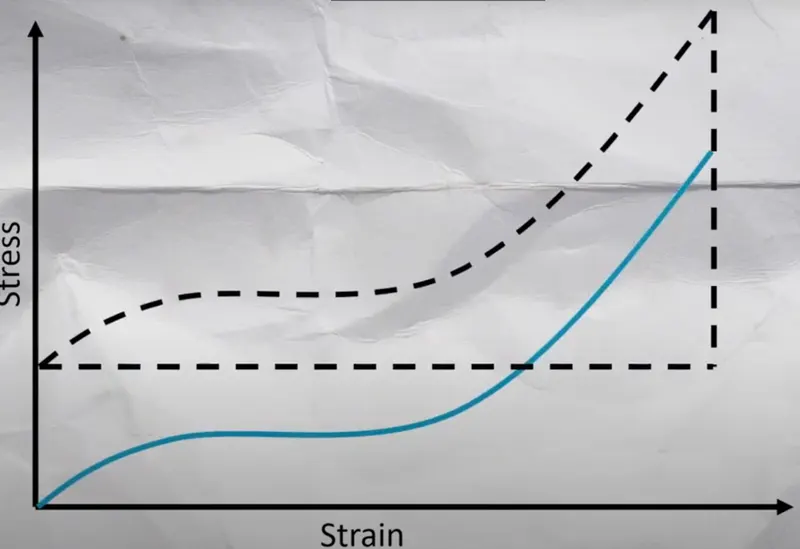
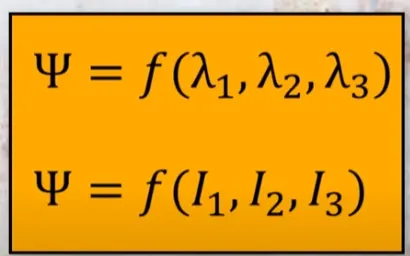
Hence the Strain Energy functional can be described in two ways:
1. Strain Energy as a function of Principle Stretch.
2. Strain Energy as a function of Strain Invariants.
The Strain Energy Function can ofen Expressed as two Terms,
1. Volumetric Term
2. Deviotoric Term
The Volumetric Term doesn't cause changes in shape of the stress element, it can only cause changes in Size (Volume) of Stress element. Hence the stress which causes the Volumetric Deformation are called Hydrostatic Stress.
Deviatoric Stress are responsible for Changes in Shape of Stress Elements and it doesn't cause any change in Volume of Stress Element.
It is important to note that the stress developed in the body depend on the mode of Deformation (Strain). In general there are three modes of deformation that can characterize the Deviotoric behaviour of materials.
1. Uniaxial Tension
2. Uniaxial Compression
3. Shear Loading
As we can see from the Chart that stress experienced by the Hyperelastic material depend upon the mode of Deformation.
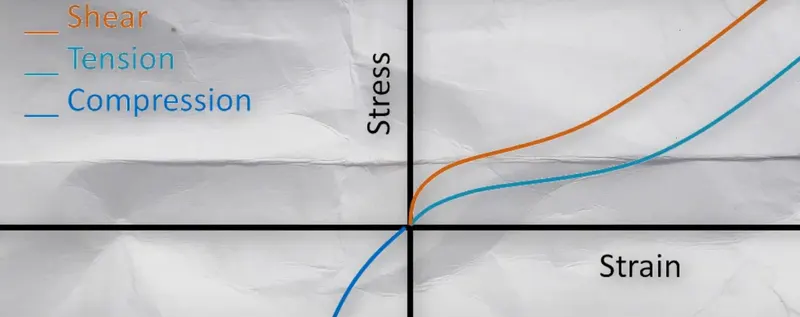
Hence we need to know the Strain Tensor which will characterize the three different Deformation modes. The Strain tensor for different modes of deformation is obtained from principle stretch. The principle stretch will be different for different modes of deformation. If there is no change in length along one principle direction, then the Principle stretch in that direction is 1. If there is tension along one principle direction, then the principle strech along that direction will be greater than 1. If there is compression along one principle direction, then the principle strecth along that direction will be less than 1. Since the Strech is calculated along the principle directions the shear stress is Zero.
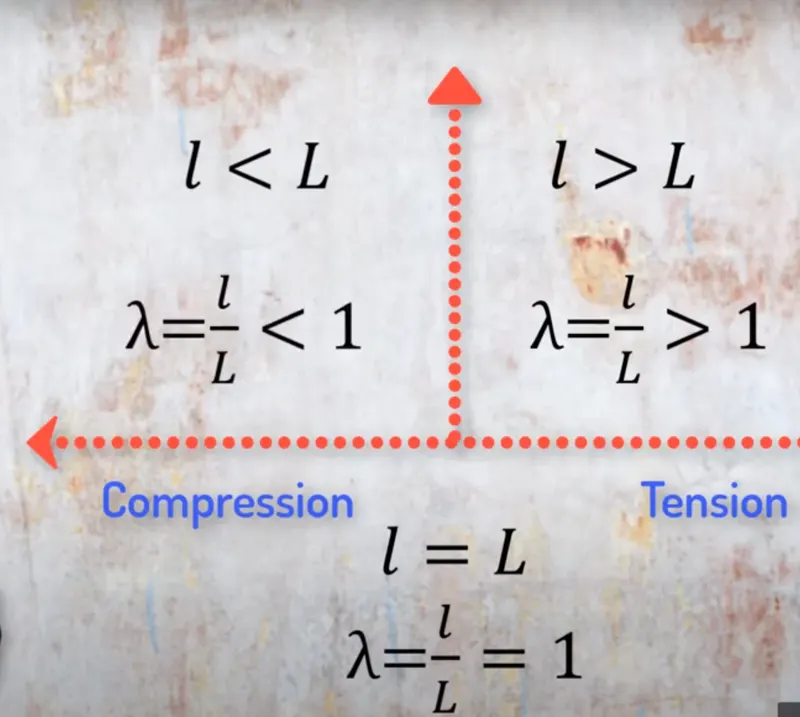
The Principle Stretch is related to the Strain by the formula Stretch = 1+engineering strain, we can calculate the Strain tensor with the help of Principle stretch. In this way we obtain the Strain Tensor which is dependant on the mode of deformation. Principle stretch are not the only way to model the strain tensor dependant on the mode of deformation, other way to get the strain tensor dependant on the mode of deformation is by using "Strain Invariants".
As discussed before the Strain Tensor doesn't vary as the reference coordinate system changes, so whether the body undergoes compression, tensile or Shear, the State of deformation can be defined by using "Strain Invariants".
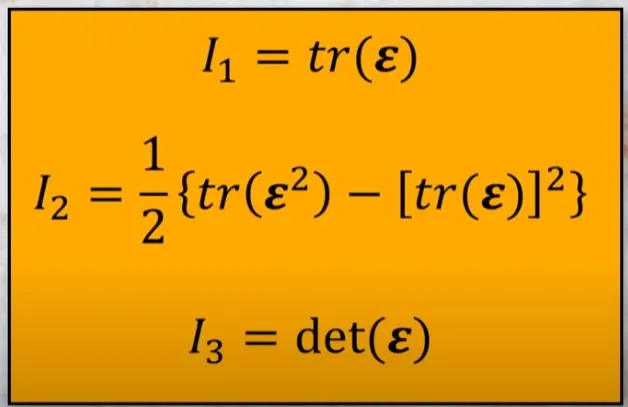
Hence the Strain Energy Can be expressed as the function of Principle stretch or Strain Invariants.
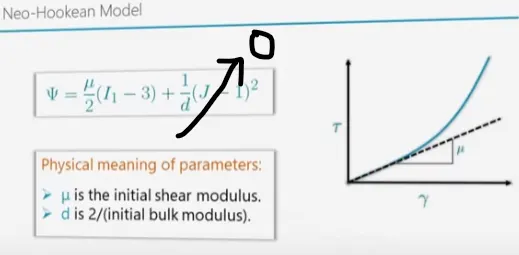
1.1.1Neo-Hookian Hyperelastic Model:
The Neo-Hookian Hyperelastic model is given by Where I1 is the First Strain Variant There are two material constants in the Neo-hookian Model First is μ (the Initial Shear Modulus) and other is d which is called as compressability Constant. If the Material to be modelled is incompressable(Rubber) then the Right side of equation goes to zero.
1.1.2Mooney Rivilin Model:
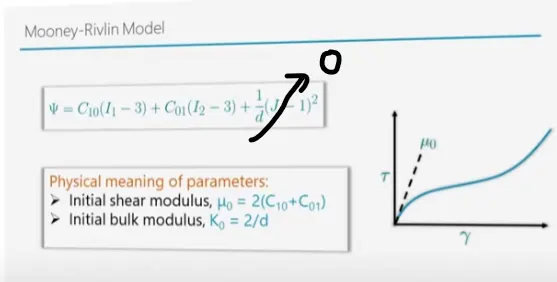
The Mooney-Rivilin Model involves two strain invariants I1 & I2 and also Two fitting Parameters. Mooney Rivilin Model can handle more Nonlinearity compared with simple Neo-hookian model. It also involves two material constants, μ & d.
1.1.3Ogden Material Model:
The Ogden Material model is given below, this model is defined using principle stretches otherthan Strain invariants. There are three material constants μ , d & α (alpha)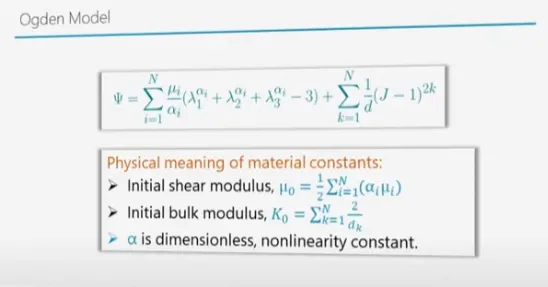
The Usage of Incompressible term d for modelling the incompressible rubber like material is very important. If the Value of d becomes Zero, the Material beomes fully incompressible, Hence inorder to model incompressible material the value of d has to be lower. This can be done by increasing the Initial bulk modulus few orders of terms higher than initial shear modulus.
1.1.4 Testing & Material Validation of Hyperelastic Materials:
In General we will do some testing to calculate the material constants from test data. The Material constants for Metals such as Young's modulus, Tangent Modulus can be calculated from the simple uniaxial simple tension test. As discussed earlier there are different modes of deformation, the deviotoric behaviour of metal can be described by testing the metal in one deformation mode (Uniaxial Tensile mode) But incase of Hyperelastic material, the deviotoric behaviour cannot be expressed by testing the material in one deformation mode. Hence we need to test the Hyperelstic material in more than one deformation mode to model the deviotoric behaviour correctly. In General Hyperelastic material need to be tested in Uniaxial tension, Uniaxial Compression and Simple Shear to model the deviatoric behaviour correctly.To calibrate the Volumetric behaviour of hyperelastic material, the Volumetric Test is also necessary.
2. Plotting the Data
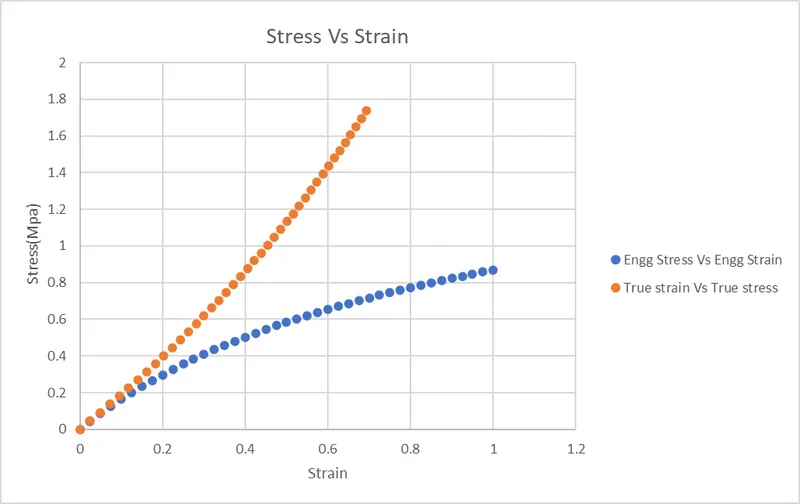
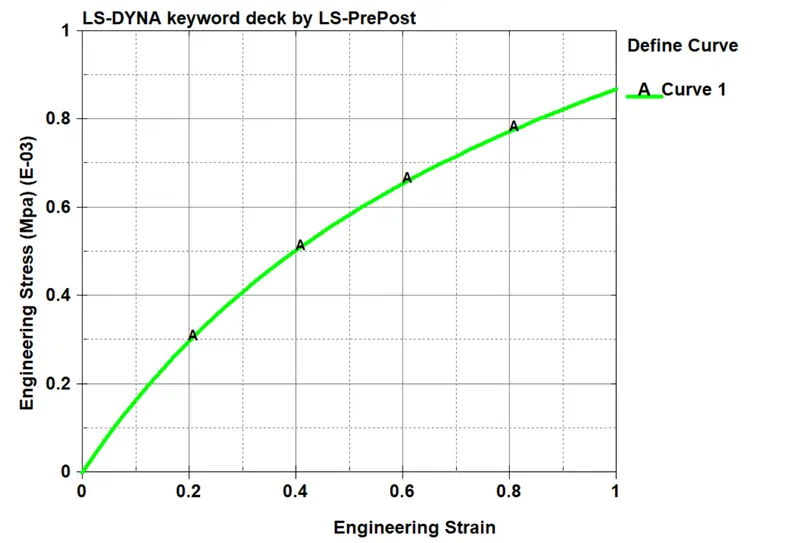
The data provided by skill lync is engineering stress-strain curve. The engineering stress-strain curve is converted to true stress strain curve. As you can see from the Curve is non linear.
3. Simulation Setup for Mooney Rivilin Model simulation & Validation:
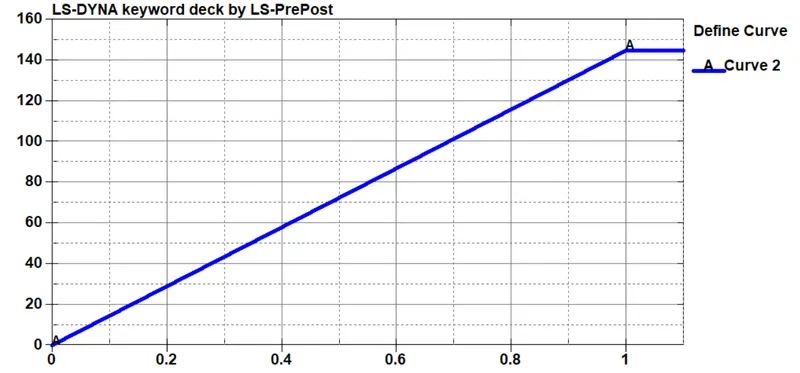
Given Data from skill lync shows the strain is 100%, Hence the boundary conditions are set to experience 100% strain. The overall length of the Tensile test specimen is 145mm, Hence the displacement is set to 145mm to experience 100% strain.
The MAT-077 is selected for Hyperelastic Material and following material properties are provided. You can see that N is set to 1.
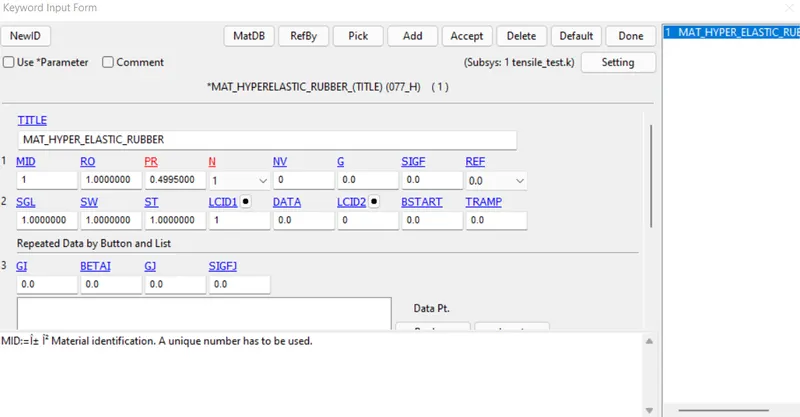
Under LCID1, the engineering stress strain curve is provided and hence the Values SGL, SW & ST are set to 1.
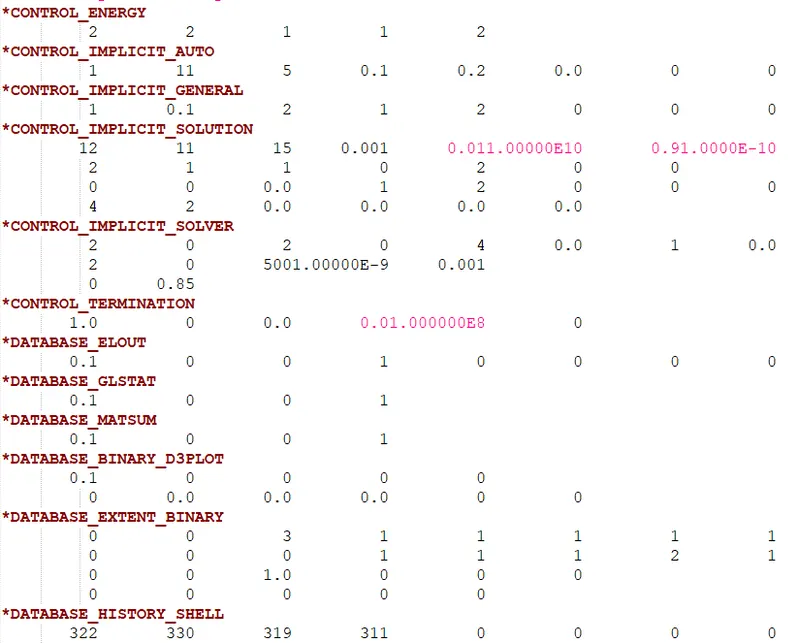
The Implicit Solver settings & Output binary files settings are provided as below,
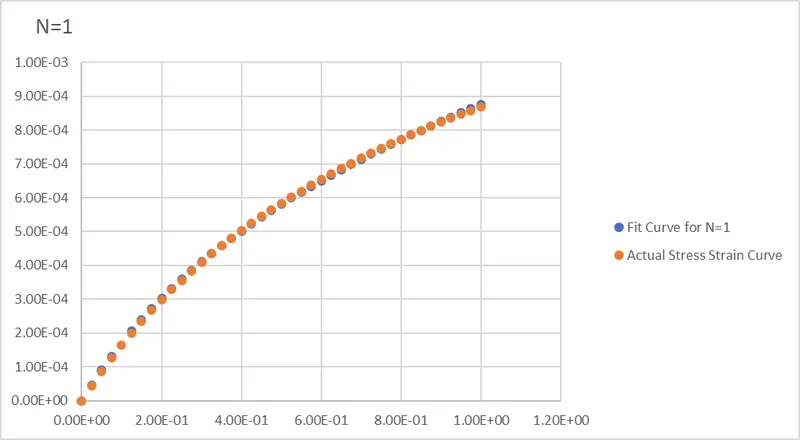
Mooney_Rivilin Constants(N=1)
The Mooney_Rivilin Constants are found out from d3hsp file, the values are provided below,
C10 = 1.76e-4
C01 = 1.49e-4
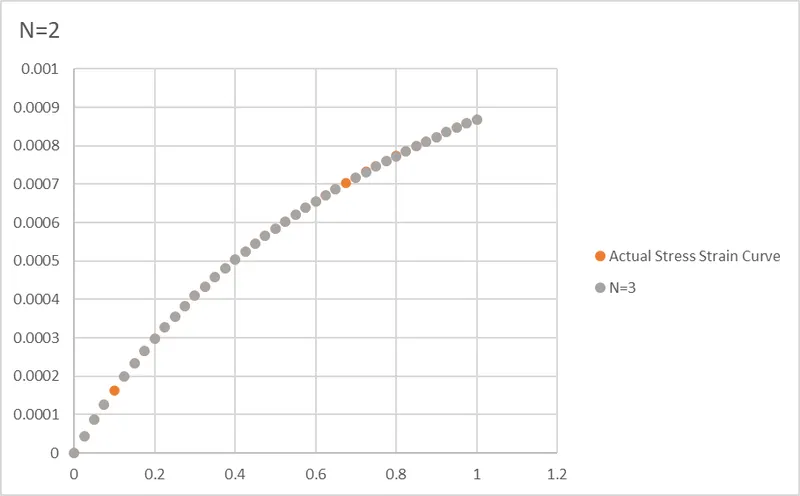
Mooney_Rivilin Constants(N=2)
The Mooney_Rivilin Constants are found out from d3hsp file, the values are provided below
| C01 | 2.55E-04 |
| C10 | 5.04E-05 |
| C11 | -2.55E-05 |
| C20 | 4.10E-06 |
| C02 | 6.87E-06 |
| C30 | 0.00E+00 |
| N | 2.00E+00 |
Mooney Rivilin Constants(N=3)
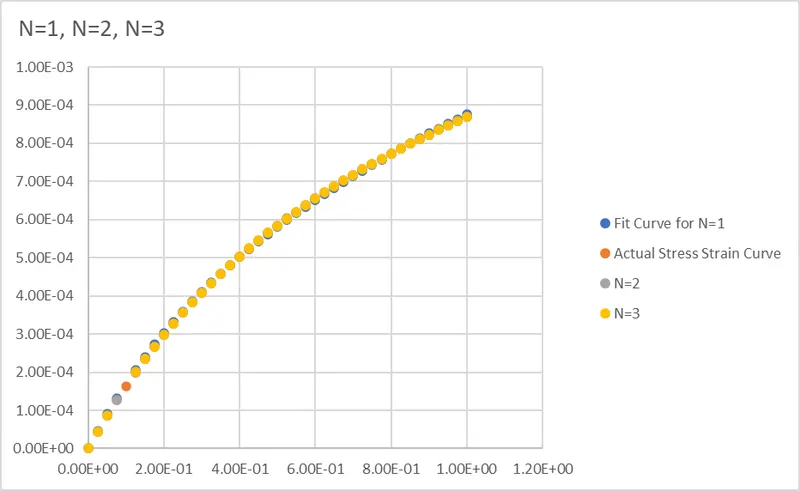
The Mooney_Rivilin Constants are found out from d3hsp file, the values are provided below
| C10 | 2.56E-04 |
| C01 | 4.98E-05 |
| C11 | -2.07E-05 |
| C20 | 2.32E-06 |
| C02 | 3.36E-06 |
| C30 | 4.99E-08 |
Validation for N=3
The Computed Material Constants from above step are input to MAT77 and the simulation is again performed for Validation process.

At timestep =0
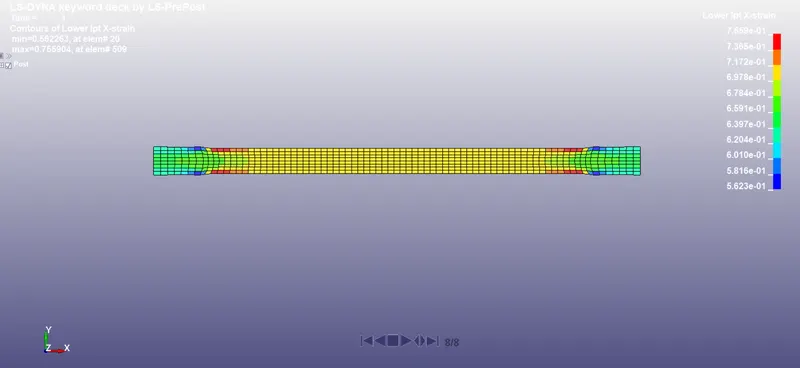
At timestep=1
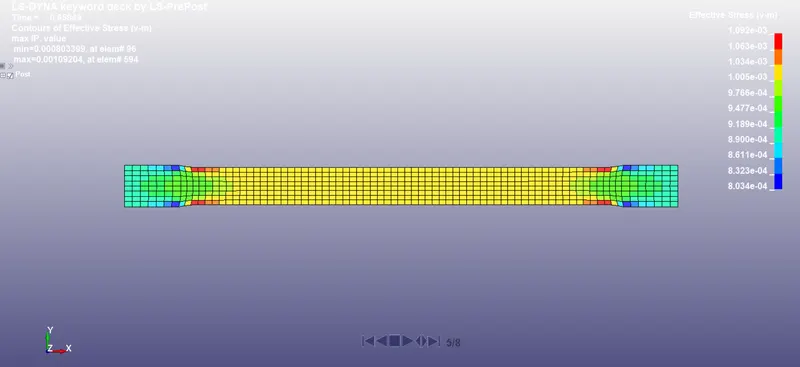
Max True Strain = 7.559e-1
Max Vonmisses Stress Plot
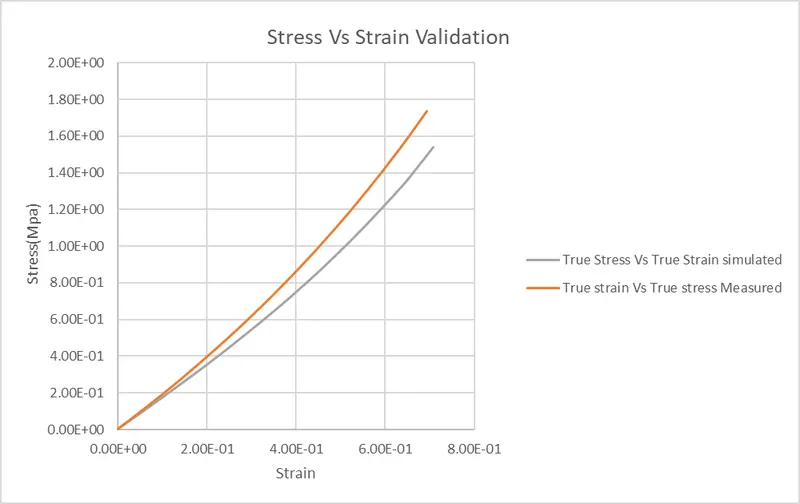
The Stress & Strain are recorded for Element 311 and ploted inform of graph. There are some deviations between the measured & Simulated curve.
4. Simulation Setup for ogden Model simulation & Validation:
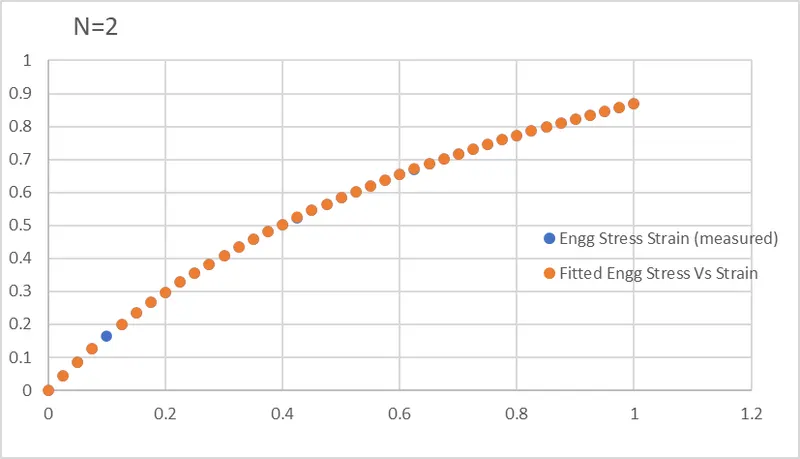
The Simulation is performed with Ogden material Model, by setting N=2 the Material constants obtained as follows,
| mu(1) | 9.06E-04 |
| mu(2) | 2.28E-03 |
| alpha(1) | 1.35E+00 |
| alpha(2) | 1.87E-03 |
The Fit Curve closely resembles the Input Stress strain response.
By Setting N=3, the following values of material constants were observed,
| mu(1) | 2.59E-04 | alpha(1) | 1.70E+00 |
| mu(2) | 9.28E-04 | alpha(2) | 9.77E-01 |
| mu(3) | 8.55E-04 | alpha(3) | -1.47E-01 |
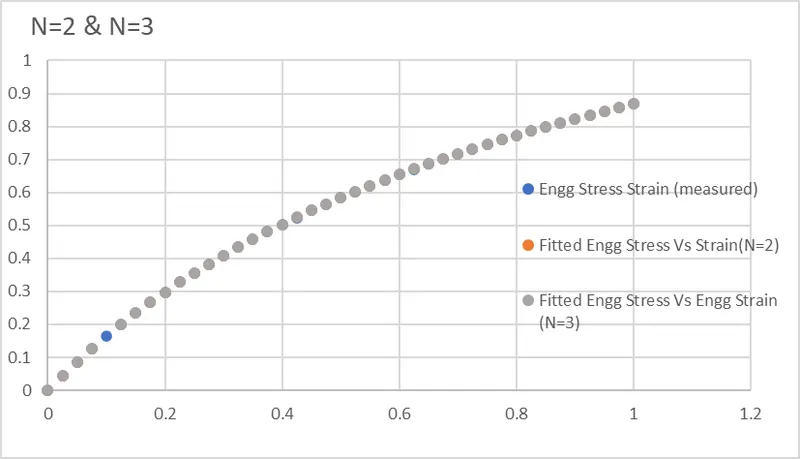
Validation for N=3
The Stress & Strain are recorded for Element 311 and ploted inform of graph. There are some deviations between the measured & Simulated curve.
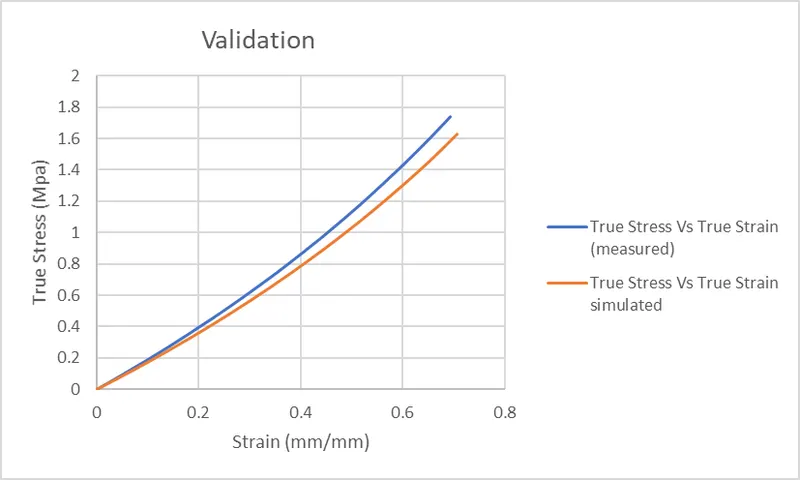
Conclusion:
1. Both Ogden Material Model & Mooney Rivilin model can be used to solve the problem under study
2. Mesh refinement is needed inorder to have accurate matching between measured and simulated results.