Week 10 Bullet penetrating a Bucket Challenge
Explicit Dynamic Analysis of Bullet penetration on a Bucket:
AIM:
To study and perform explicit dynamic analysis for bullet penetration on a bucket operation. There will be three different analyses on the same operation with different type of displacement and get results for Equivalent stress, Equivalent elastic strain and the total deformation in the model and grid dependency test was also performed to optimize the element size for better accuracy.
Case 1: Aluminium Alloy NL for bucket
Case 2: Stainless Steel NL for bucket
Case 3: Titanium Alloy NL for bucket
DYNAMIC ANALYSIS SETUP FOR BULLET PENETRATION ON A BUCKET OPERATION:
I. GEOMETRY:
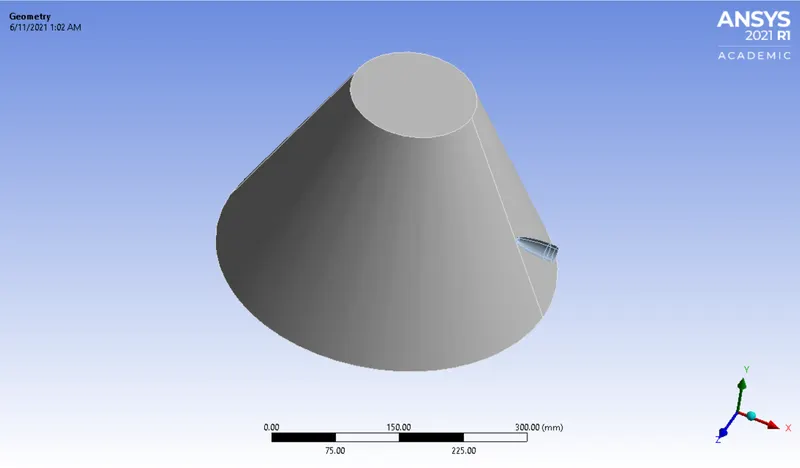
The CAD model of explicit analysis operation is imported in Ansys dynamic structural environment. Then, the model is generated and checked if any abnormalities are present in the model. Generally, we have to perform three individual tests and according to that we have to analyze the results. These type of analyses are usually carried to develop the material which can resist the bullet up to some extent. So, the material can be used as bullet-proof. Thus, by comparing the behaviour of different material on penetration of the bullet, we can find or develop a bullet proof material. After that, we have taken as bullet as a rigid behaviour object, as we have to analyze the result on the bucket.
II. MATERIALS:
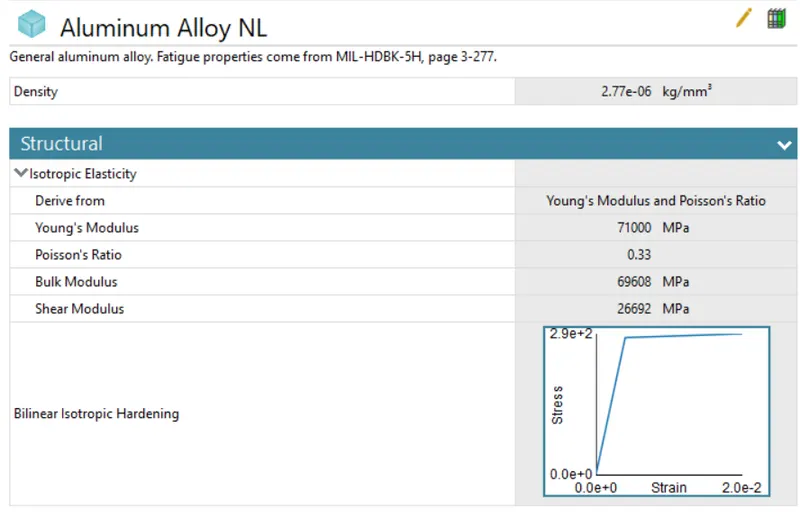
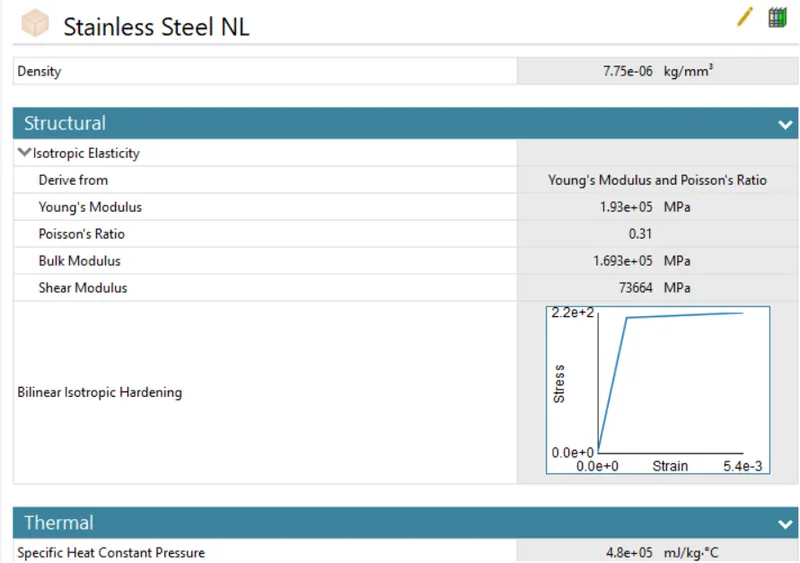
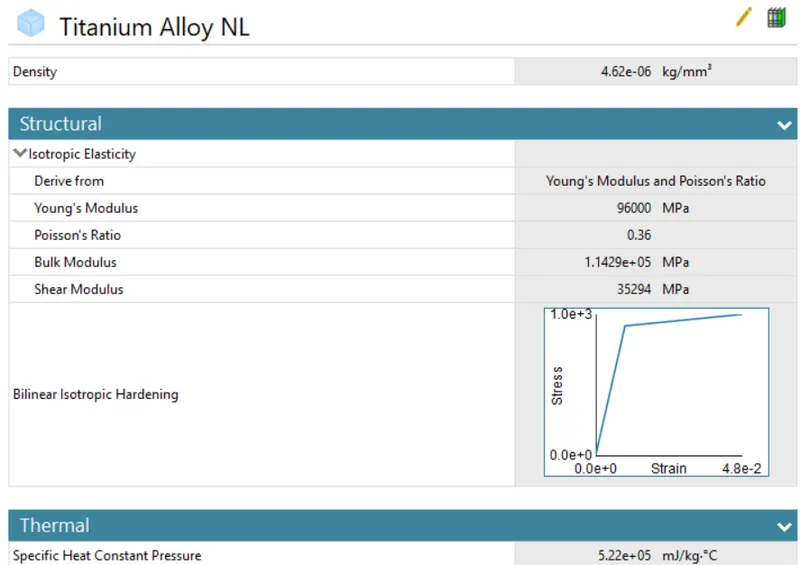
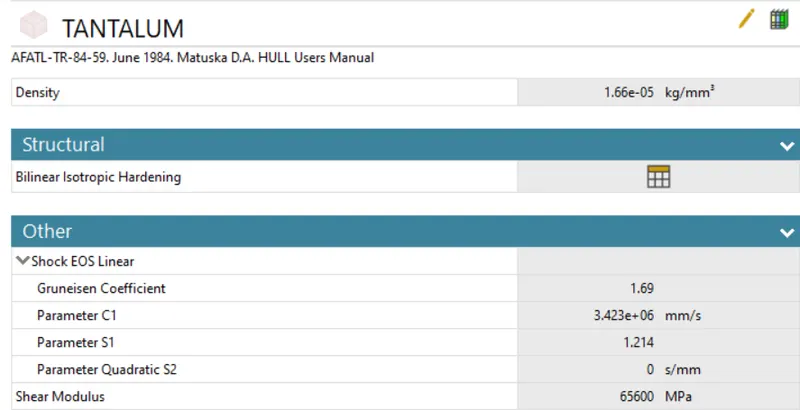
Below are the materials which is used to perform analysis for the dynamic analysis of specimen. The analysis is carried out for each material individually.
Bullet: Tantalum Explicit material
Case 1: Bucket - Aluminium Alloy NL
Case 2: Bucket - Stainless Steel NL
Case 3: Bucket - Titanium Alloy NL
The details of each material has been carried out below as shown in the image:
III. CONNECTION DETAILS:
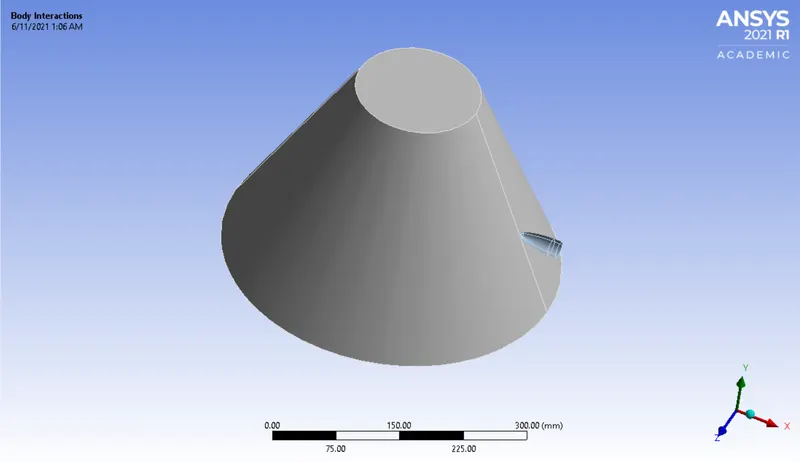
Body Interactions:
In this type the advanced contact definition is selected as trajectory with formulation of penalty. The sliding contact of setup is discrete surface.
IV. MESH:
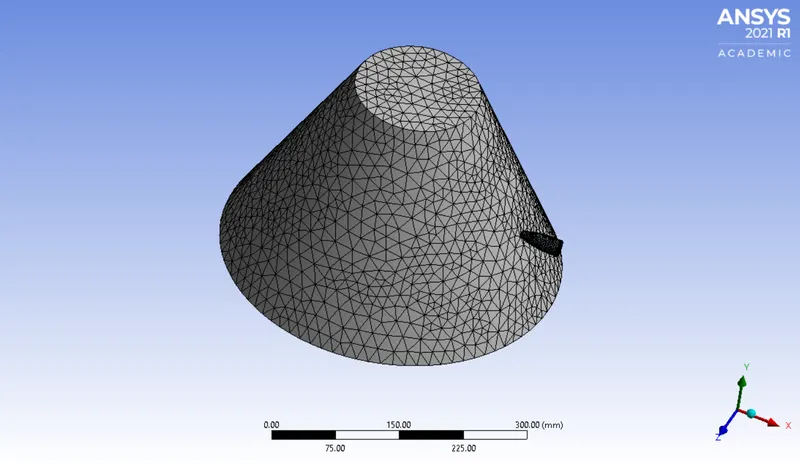
- Basically, we have preferred default mesh for whole setup.
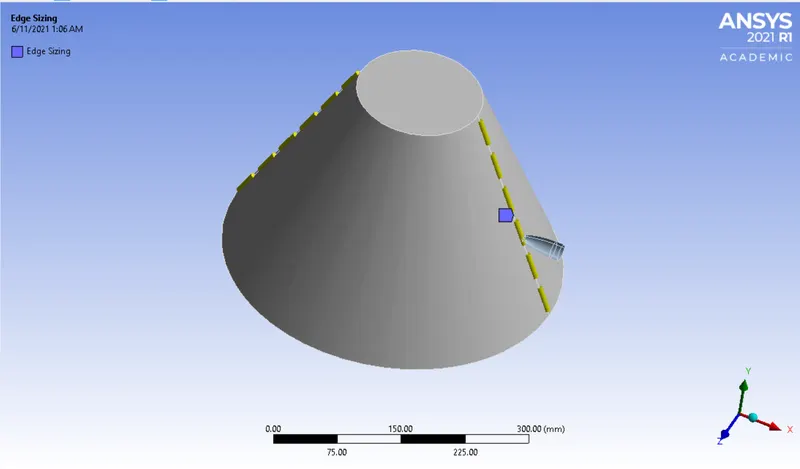
- As, we have to do edge sizing for the critical part, hence we have selected 2 edges of bucket as critical part with number of divisions as 6.
- Likethat, we have generated the fine mesh which is sufficient to carrry out simulation which gives desired results.
V. ANALYSIS SETTINGS AND BOUNDARY CONDITIONS:
A. ANALYSIS SETTINGS:
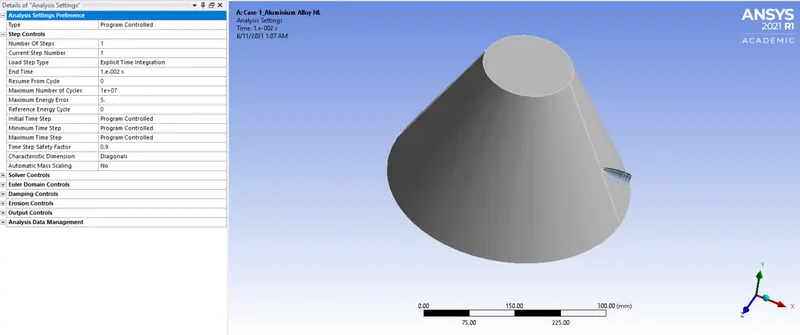
For this analysis the number of steps is set to 1 with maximum number of cycles is 1e+07 and end time is 1e-2 and it is defined by time, hence initial, maximum and minimum time will be program controlled.
B. BOUNDARY CONDITIONS:
1. Fixed Support:
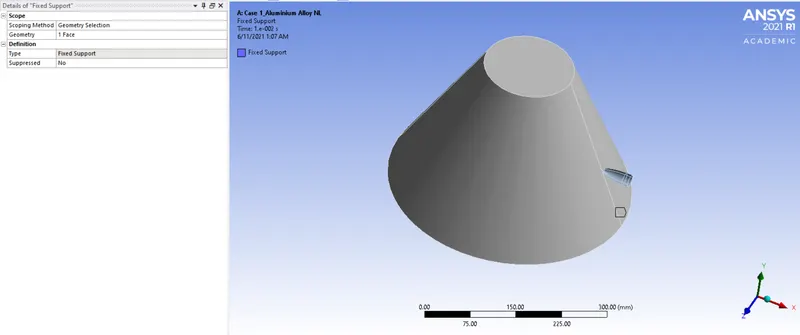
Basically, we have to fix the part so to analyze the results. Therefore, we have fixed the 1 face of bucket section as its geometric selection and we have selected it as fixed type support.
2. Velocity:
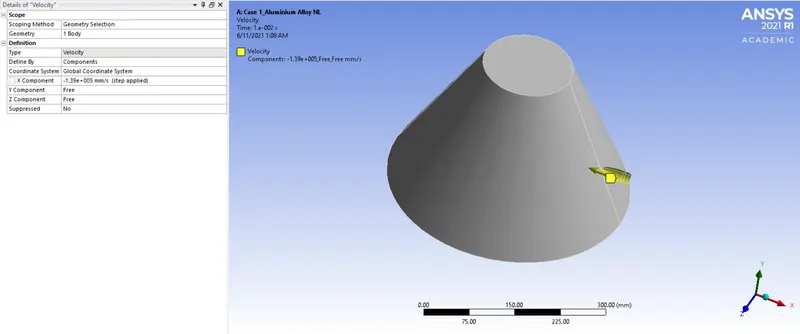
As, we have to select the body of bullet as its geometric selection part. Then its type is specified by velocity and its coordinate system is defined by 'Global coordinate system'. Then, its Y and Z component gets value as constant and X component value gets linear direction displacement in tabular form.
VI. POST-PROCESSING RESULTS:
Now, we have to compare the strain, deformation and stress on the basis of different materials. Then, we have to analyze the result for total deformation, equivalent stress and strain for dynamic analysis for bullet with a bucket operation. The results are as shown below:
Case 1: Bucket - Aluminium Alloy NL
I. Total Deformation:
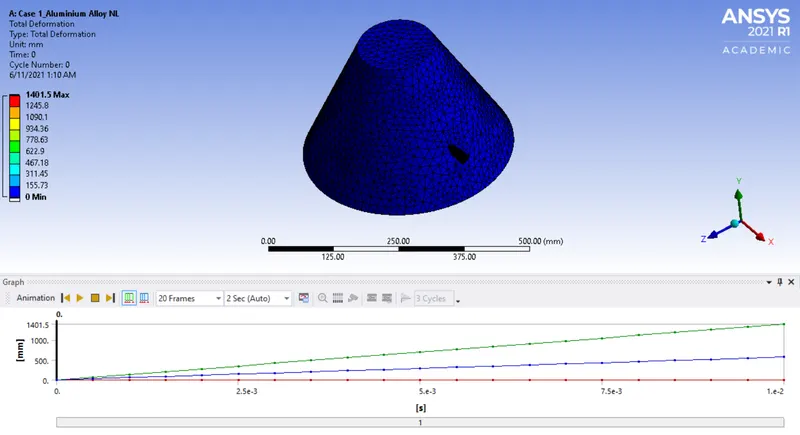
- Here the deformation is the distance traveled by the bullet, which is maximum 1401.5 mm
II. Equivalent stress:
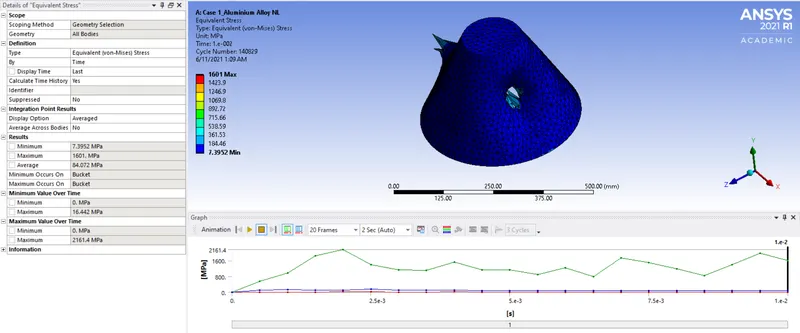
- Here maximum stress is 1601 MPa
- At 1e-2 s, when the bullet starts to penetrate, we can see some spikes in plot.
- Maximum stress is generating when the bullet impacts on the bucket.
- When bullet enters the bucket, stress is 2125 MPa at 1e-3 s.
- When bullet exists the bucket, stress is maximum upto 2734 MPa at 4e-3 s.
Case 2: Bucket - Stainless Steel NL
I. Total Deformation:
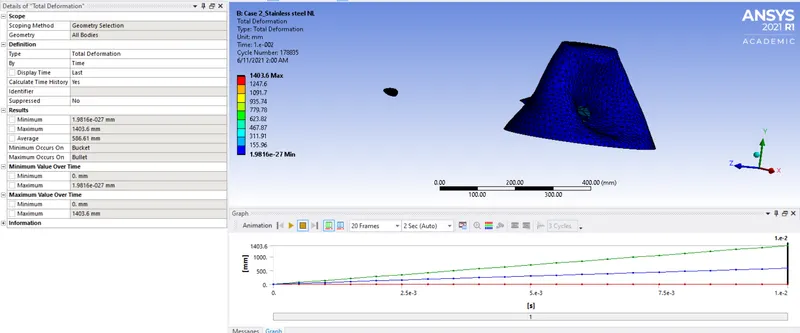
- Here the deformation is the distance traveled by the bullet, which is maximum 1403.6 mm
II. Equivalent stress:
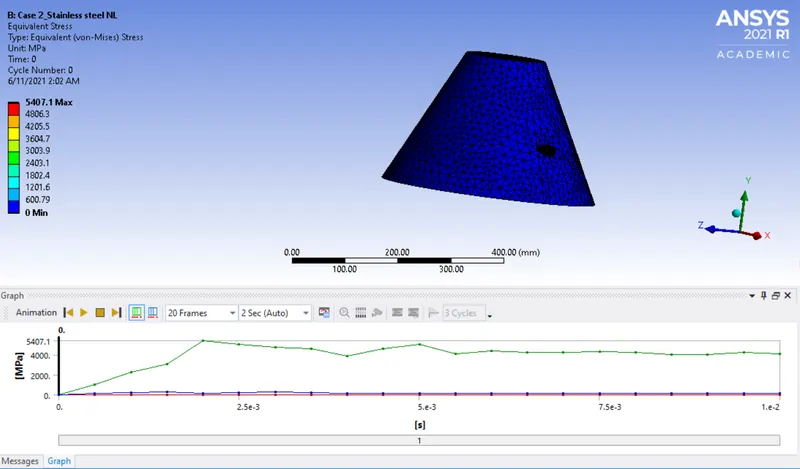
- Here maximum stress is 5407.1 MPa
- At 1e-2 s, when the bullet starts to penetrate, we can see some spikes in plot.
- Maximum stress is generating when the bullet impacts on the bucket.
- When bullet enters the bucket, stress is 3405 MPa at 1e-3 s.
- When bullet exists the bucket, stress is maximum upto 3869 MPa at 3e-3 s.
Case 3: Bucket - Titanium Alloy NL
I. Total Deformation:
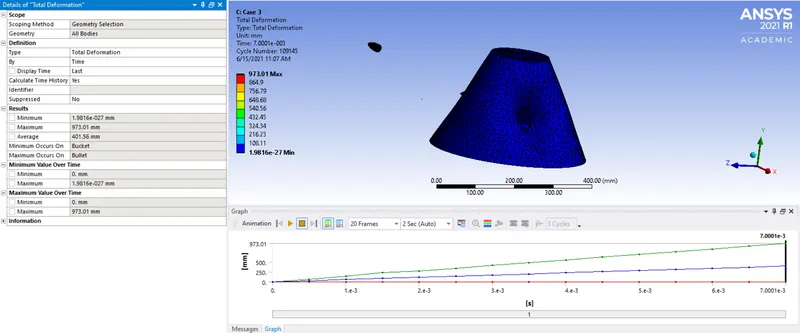
- Here the deformation is the distance traveled by the bullet, which is maximum is 973.01 mm
II. Equivalent stress:
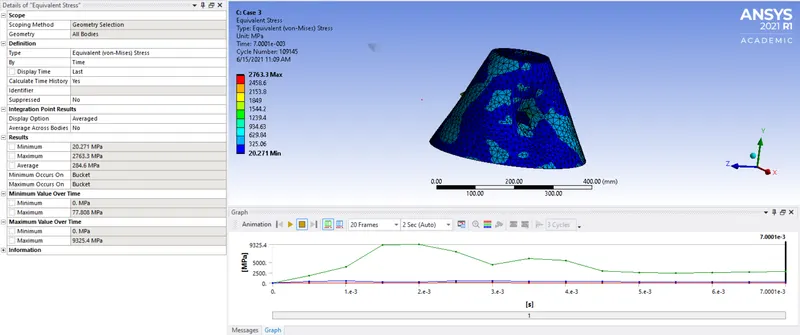
- Here maximum stress is 2763.3 MPa.
- At 5e-4 s, when the bullet starts to penetrate, we can see some spikes in plot.
- Maximum stress is generating when the bullet impacts on the bucket.
- When bullet enters the bucket, stress is 3772.5 MPa at 5e-4 s.
- When bullet exists the bucket, stress is maximum upto 3798 MPa at 2.5e-3 s.
VII. POST-PROCESSING RESULTS:
|
Parameters |
Case 1 |
Case 2 |
Case 3 |
|
Maximum Total Deformation |
1390 mm |
1390 mm |
973.01 mm |
|
Minimum Total Deformation |
1.9816e-027 mm |
1.9816e-027 mm |
1.9816e-027 mm |
|
Maximum Equivalent stress |
566.65 MPa |
7145.8 MPa |
2763.3 MPa |
|
Minimum Equivalent stress |
7.0331 MPa |
16.135 MPa |
20.271 MPa |
- By comparing the stress results, we can see that aluminium alloy NL gives the minimum stress on bullet penetration in Case_1.
- In Case_2 Stainless Steel NL, stress is little higher compared to Aluinium Alloy NL.
- In Case_3, with Titanium Alloy NL, stress generation is maximum.
- It means, bullet cannot penetrate very easily to Titanium Alloy.
CONCLUSION:
- From the results, we can conclude that Titanium Alloy has the highest strength and higher young's modulus, so the stress is also getting higher. So it is capable to resist penetration.
- On the real time testing of the different material, we can also see the deviation of the bullet on penetration and in some cases, it may trap or captured by the material also.
- Generally the materials like Kevlar are use as bullet proofing, which resist the bullet easily and also light in weight.
- Main objective of these type of analyses is to find the material for damage reduction and deviation.
- Damage reduction reduces the damage a bullet does per inch of the material it passes through.
- Deviation determines how much the bullet changes the direction per inch of the material it passes through.
- Effect of penetration depends on the thickness and the density with increase in stress.
- In our case, for titanium alloy, we can observe the stretching of the material on penetration due to its flexibility.
- So, high strength and density also decrease the penetration with increase in stress.
- In Titanium Alloy NL case, stress is higher, which means the plastic deformation of the material is large. So the resistance to the penetration will also be higher.
- So, due to high strength and high density, it gives less penetration gives the less damage.