Week 10 Bullet penetrating a Bucket Challenge
Aim: To simulate a bullet penetrating through a bucket using ansys workbench.
Objective: To simulate a bullet penetrating into a bucket. You will need to use 3 different non linear materials for the bucket and analyse their behaviour for the same velocity of bullet. Apply the conditions for bullet as mentioned in the video itself. Upload animation files to show the behaviour in the three cases.
Procedure:
- After opening Ansys Workbench, use explicit dynamics as the mode of analysis for simulation.
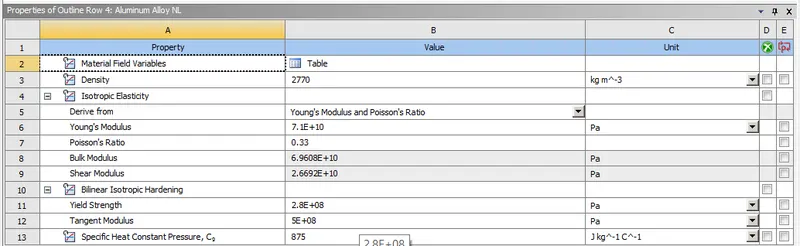
- Now, add five materials for simulation i.e. Stainless Steel NL, Titanium Alloy NL, Aluminium Alloy NL, Alloy 1100-O for bucket and Tantalum for bullet from the engineering data tab in project menu.
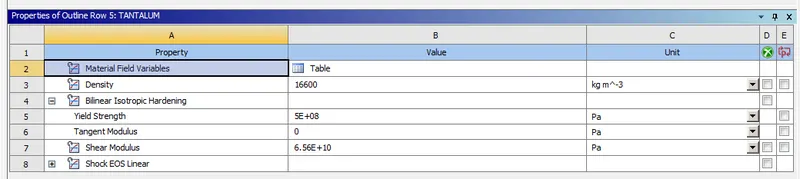
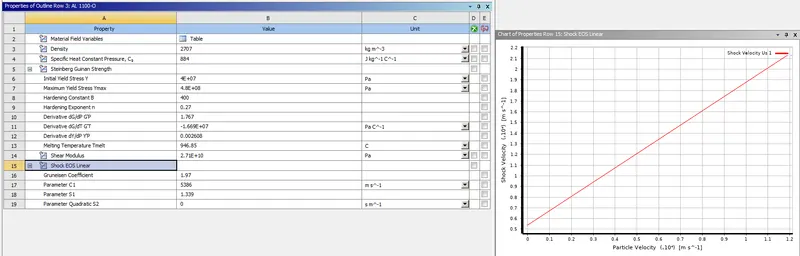
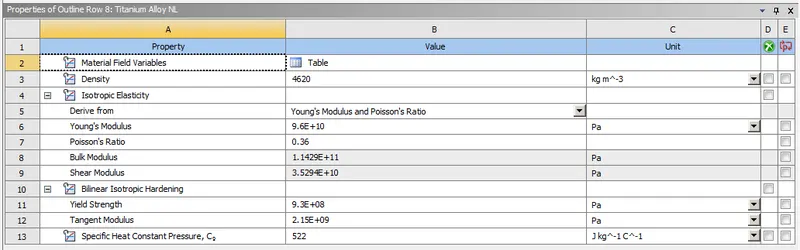
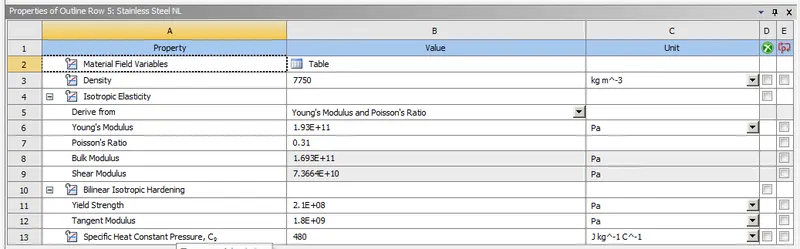
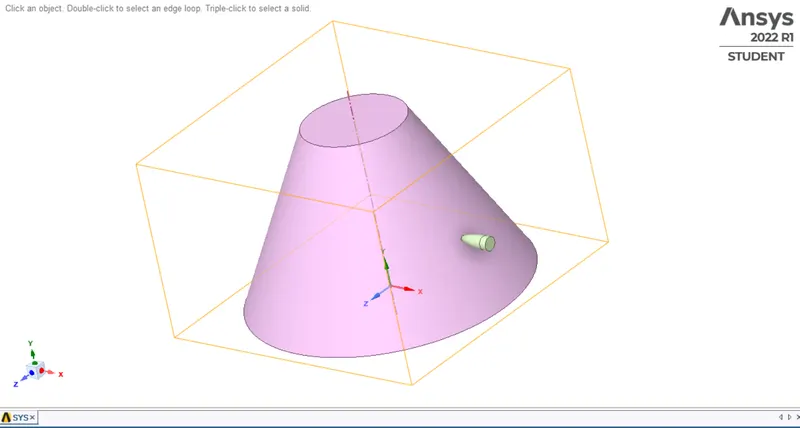
- Import the model provided and check the geometry in the Ansys Spaceclaim for any abnormalities.
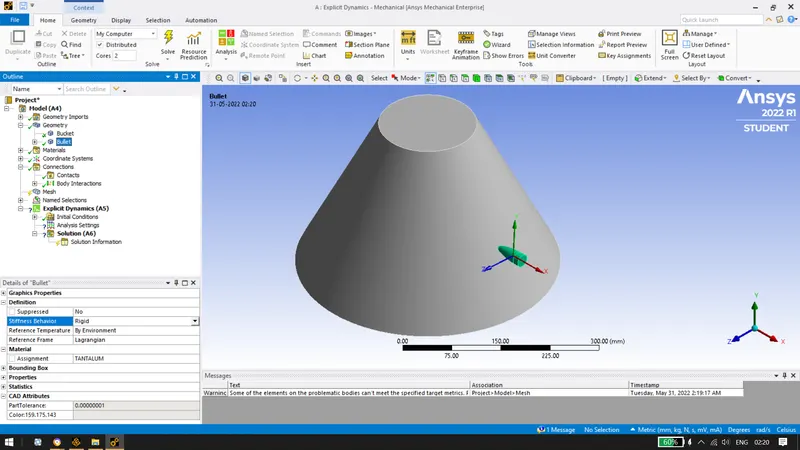
- Now in Ansys mechanical, Rename the two components as bucket and bullet. Assign materials to bucket and bullet where bullet is rigid and bucket is flexible.
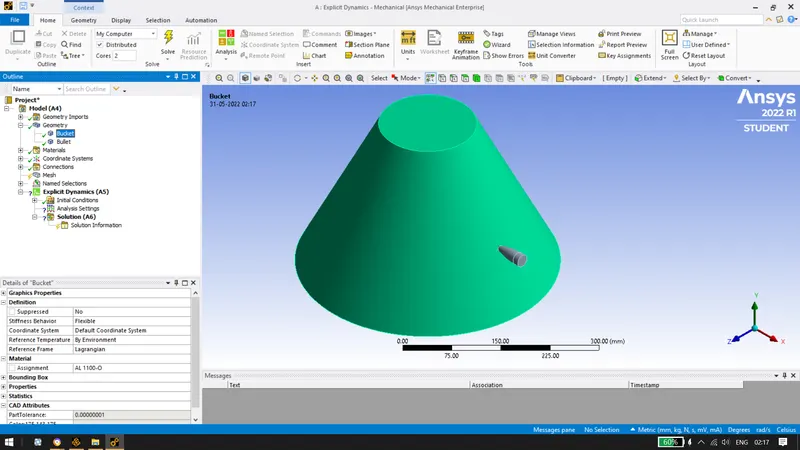
- Now, delete the default contacts created by ansys because no contacts are required for the simulation.
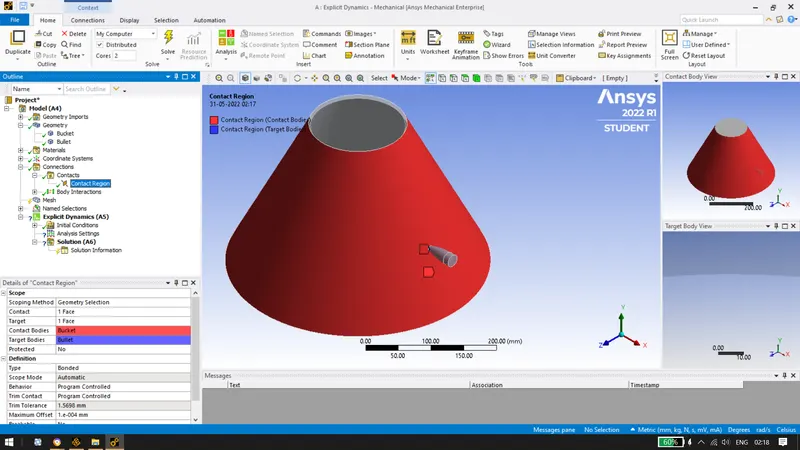
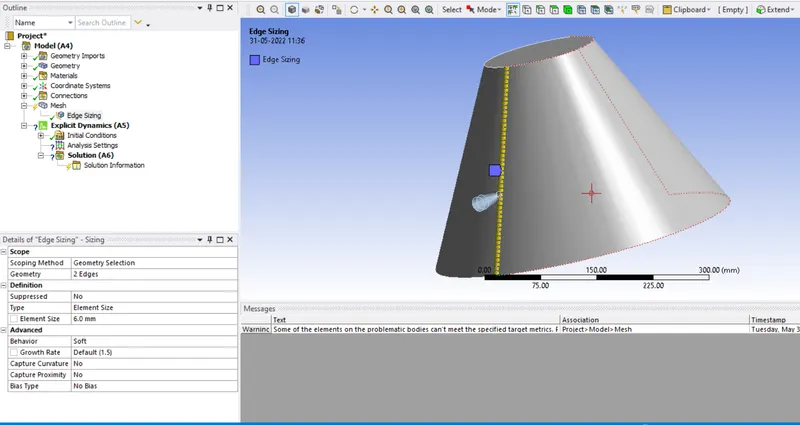
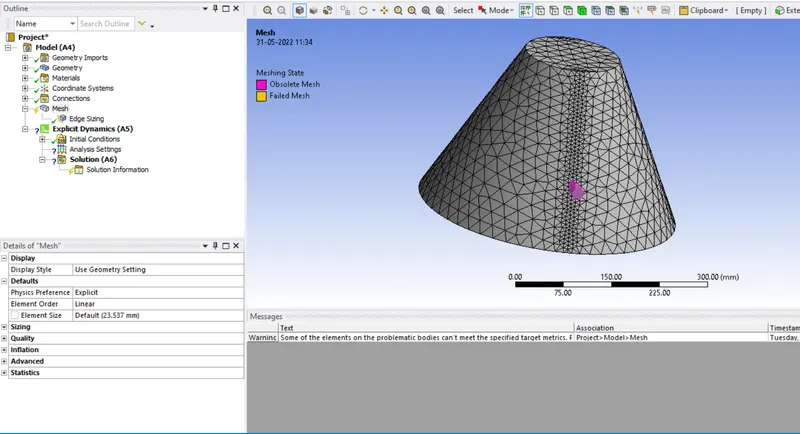
- Mesh the components with element size as 30, insert mesh size of 6mm where the bullet will be striking. Also set the smoothing to low to reduce the computational time.
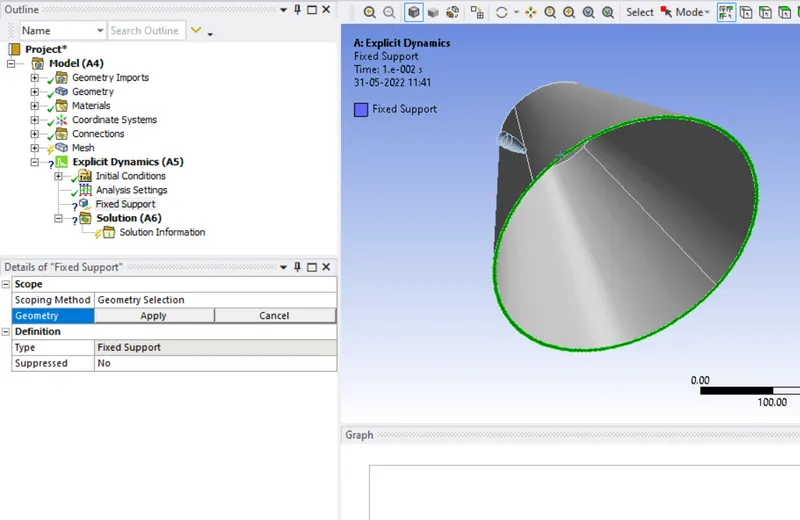
- Adding fixed support to the base of the bucket so that it does not move.
- Add a velocity of 140000mm/s to the bullet.
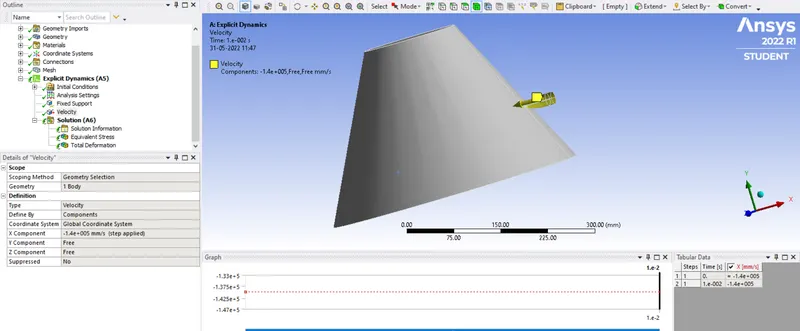
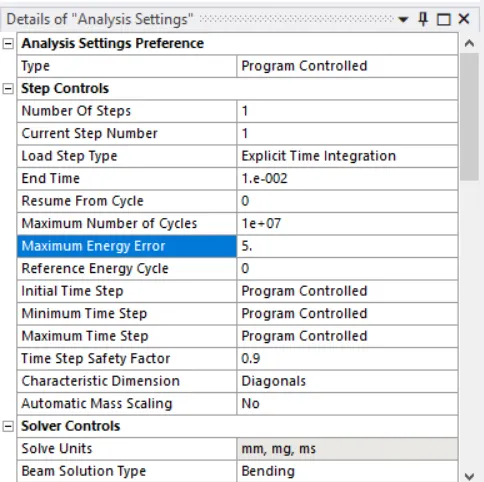
- Following analysis settings have been used for the simulation.
- Insert directional deformation and equivalent stress.
- Finally following solutions have been obtained after running the simulation for the crash of a car.
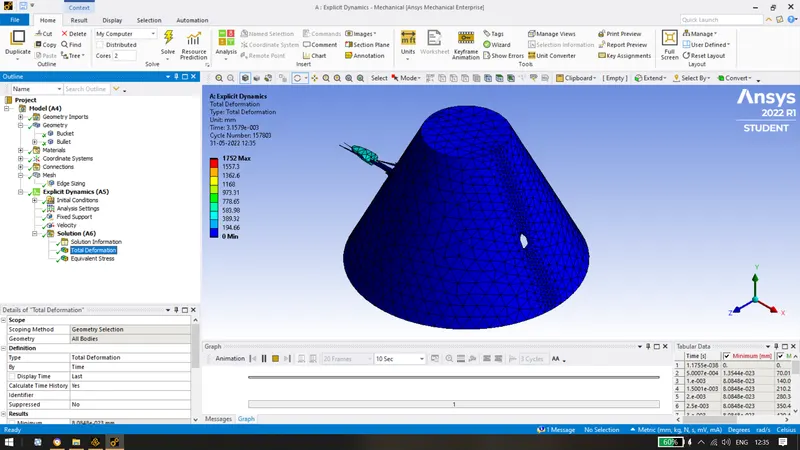
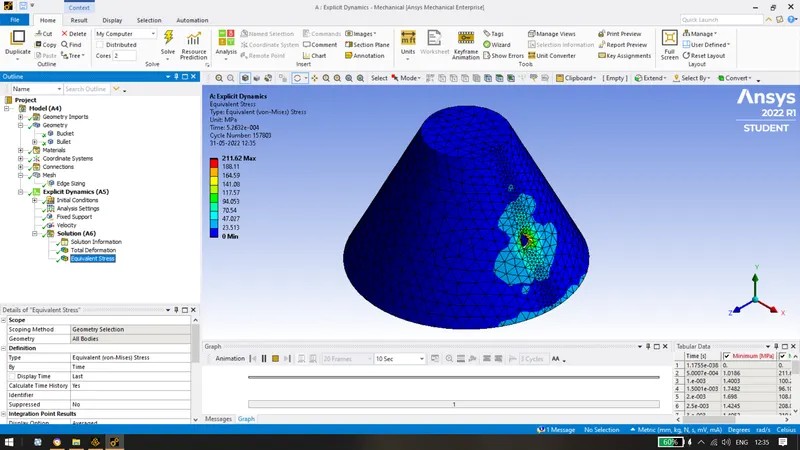
Case 1: Results for Al 1100 - O
Total deformation of 1752 mm and max equivalent stress of 211.62 MPa was observed.
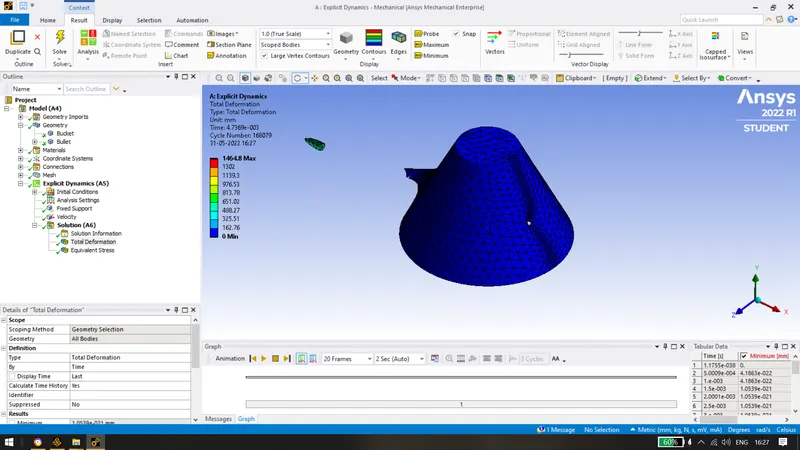
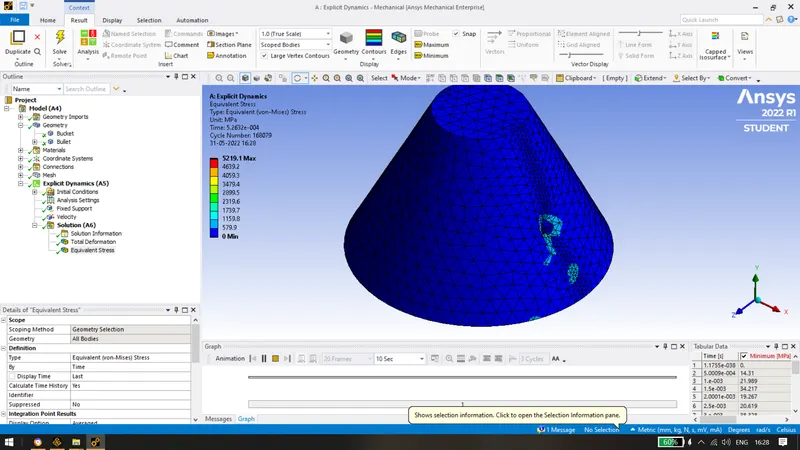
Case 2: Results for Titanium Alloy NL
Total deformation of 1464.8 mm and max equivalent stress of 5219.1 MPa was observed.
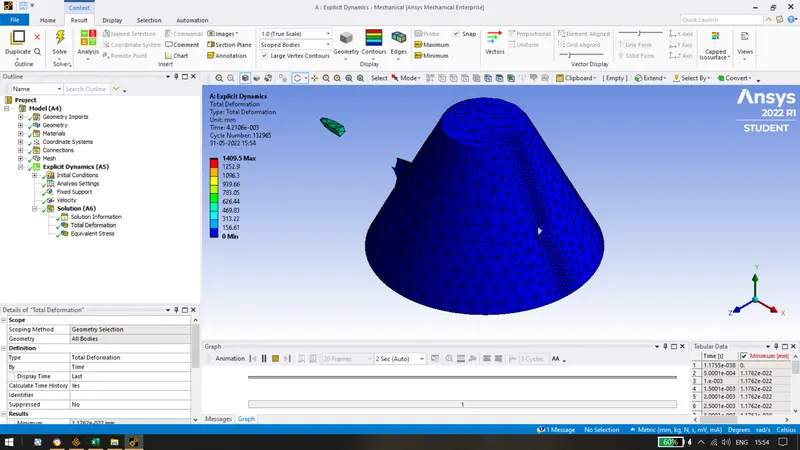
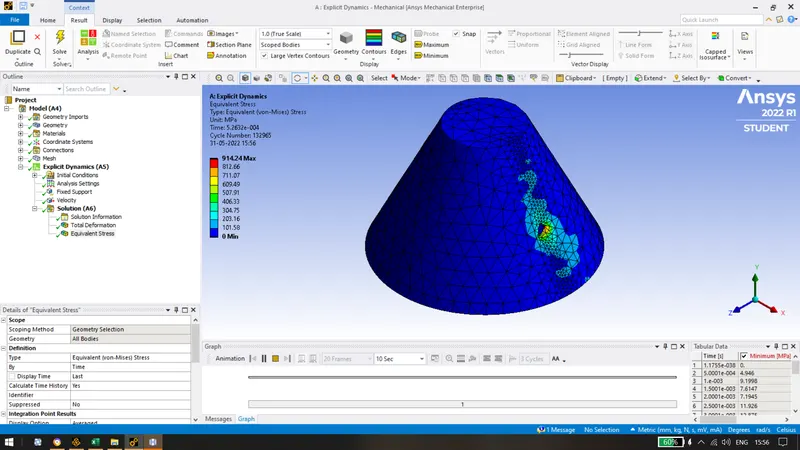
Case 3: Results for Aluminium Alloy NL
Total deformation of 1409.5 mm and max equivalent stress of 914.24 MPa was observed.
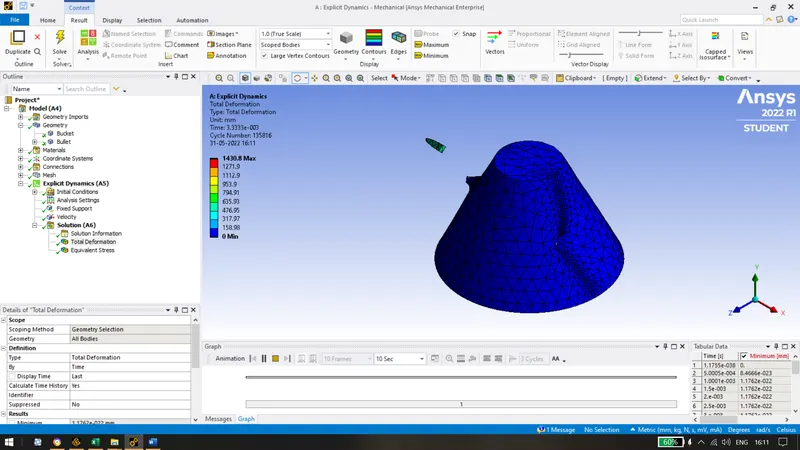
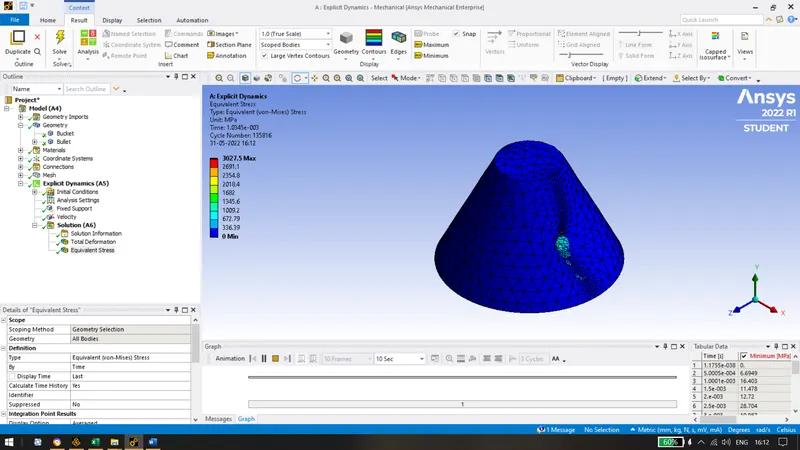
Case 4: Results for Stainless Steel NL
Total deformation of 1430.8 mm and max equivalent stress of 3027.5 Mpa was observed.
Conclusion:

From the above table, we can see that the maximum stress of 5219.1 MPa is developed in the bucket which is a titanium alloy NL material having a deformation of 1464.8mm.
Since we want to compare the results between the three non linear materials, we must select the aluminium alloy NL material which generates the least amount of stress with least deformation when shot by a bullet i.e. 853.5 MPa and 1409.5 mm respectively.
Also, Stainless Steel NL has highest youngs modulus and highest density. It's more stiff and resistant as compared to others. The Young's Modulus of a material represents its elasticity. Higher the value of Young's modulus, more stress the material sustains without permanent deformation. It's more elastic than the rest because it has higher value of Young's Modulus.
But it all depends on our requirements, and here we are comparing on the basis of stresses induced.