Week 1 Understanding Different Battery Chemistry
1) Prepare a table which includes materials & chemical reactions occurring at the anode and cathode of LCO, LMO, NCA, NMC, LFP and LTO type of lithium ion cells.Give your detailed explanation on it.
ANSWER
The table showing the materials and chemical reactions in different types of Li-Ion batteries are shown below,
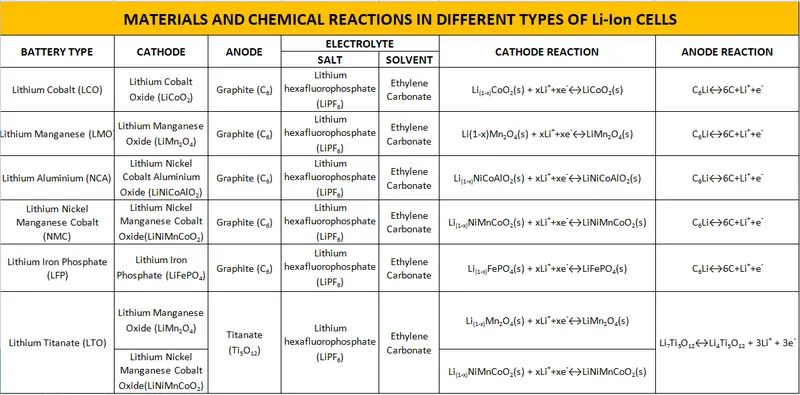
The explanations for these different types of Lithium-Ion batteries becomes easy once we understand the basic working principle of Li-ion batteries.
A Li-ion battery is a type of rechargeable battery which are commonly used in Electric vehicle applications. The first commercial Li-ion battery was developed by Sony in the year 1991.
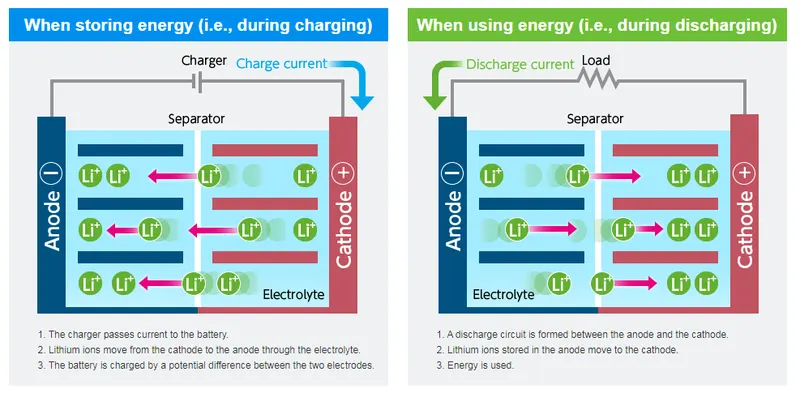
The simple working principle of a Li-ion battery is that , during discharge cycle lithium ions moves from the negative electrode through an electrolyte to the positive electrode and reverse in case of charging cycle. These electrolytes allows only ions to pass through it and blocks electrons.
Now let us take an example and explain this working principle in detail. For this let us take the first type of Li-ion battery shown in the above table which is Lithium Cobalt (LCO). First let us charge this battery by connecting it to an external electric source. Positive of the power source will attract the electrons from the Lithium atoms in the lithium cobalt oxide. These electrons will then go to the graphite anode and will stay there. This causes the positively charged lithium ions to get attracted to the negative electrode. And so the lithium ions moves through the electrolyte and reaches the graphite layer and stays there forming lithium graphite. Once all the lithium ions reach the graphite layer the battery is said to be fully charged.
Now during discharge , i.e when a load is connected to the battery , the lithium in the lithium graphite anode gets oxidized from Li to Li+ (0 to +1 oxidation state). This will release electrons. Now the so formed lithium ions has the tendency to achieve stable state and to do that it will move through the electrolyte to the cobalt oxide part . This lithium ions will reduce the cobalt(in this case) from a +4 to a +3 oxidation state hence causing reduction. And the electrons will move through the load and reaches the other part of the battery. Once all the lithium ions gets moved from the graphite layer and reaches the metal oxide , we can say that the battery is fully discharged.
This working principle is shown in the below diagram,
Now this same working principle applies to all other battery types mentioned in the table. The basic reaction taking place is reduction-oxidation or redox reaction.
2)Compare the differences between each type of Li-ion batteries based on their characteristics.
ANSWER
- Let us first look at the characteristics of Lithium Cobalt Oxide(LCO) type battery.
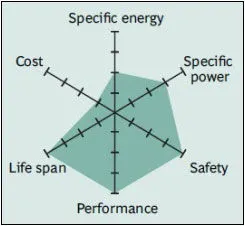
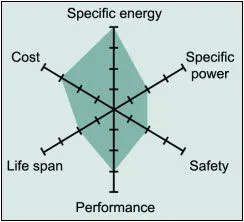
These batteries have high specific energy and has a layered structure. They have short life span , low thermal stability and limited load capabilities. The cobalt is more expensive raw material compared to others and hence high cost for this type of batteries. Their characteristics is shown in the figure below,
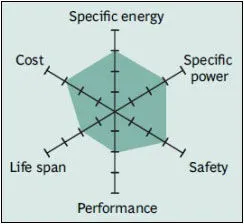
- Lithium Manganese Oxide(LMO) type of battery has manganese spinels. These spinels causes this type of batteries to have high power density but poor electronic conductivity and structural stability. They have higher thermal stability and enhanced safety but their cycle life is limited. When compared to Cobalt type batteries these have moderate specific energy. The characteristics of this battery is overall moderate. Their characteristics is shown in the figure below,
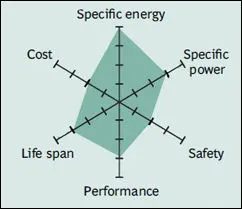
- Lithium Nickel Cobalt Aluminium Oxide(NCA) , this type of battery has high specific energy like that of LCO type batteries. Along with that it also has good specific power and long life span which are not present in LCO type batteries. Their safety is less and has high cost.Their characteristics is shown in the figure below,
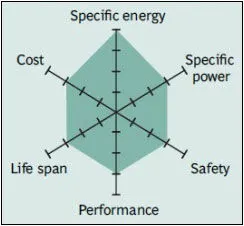
- Lithium Nickel Manganese Cobalt Oxide (NMC) , this type of batteries has good overall performance when compared to other types of batteries. Also they have high specific energy and has the lowest self heating rate. These are economical and achieves good performance. Their characteristics is shown in the figure below,
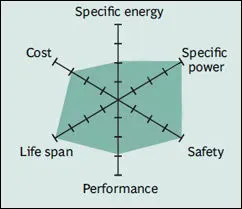
- Lithium Iron phosphate (LFP) ,this type of battery has good electrochemical performance with low resistance. They have high current rating , long cycle life , good thermal stability , enhanced safety and tolerance. But their specific energy is very low compared to other batteries like LCO type. They have higher self discharge rate compared to other Li-ion batteries.Their characteristics is shown in the figure below,
- Lithium Titanate (LTO) , this type of battery has high thermal stability and are very safe compared to other types. They also doesn’t form Solid Electrolyte Interface (SEI) and no lithium plating when fast charging and charging at low temperatures are done. The major drawback of this type battery is that they are very expensive and has very low specific energy. Their characteristics is shown in the figure below,