Week 1 Understanding Different Battery Chemistry
Q1: Materials & Chemical Reactions of Lithium-Ion Cells
Internal Structure of Battery:
A battery comprises interconnected individual cells, each consisting of five essential components: a positive electrode (cathode), a negative electrode (anode), a liquid electrolyte, a separator, and a current collector.
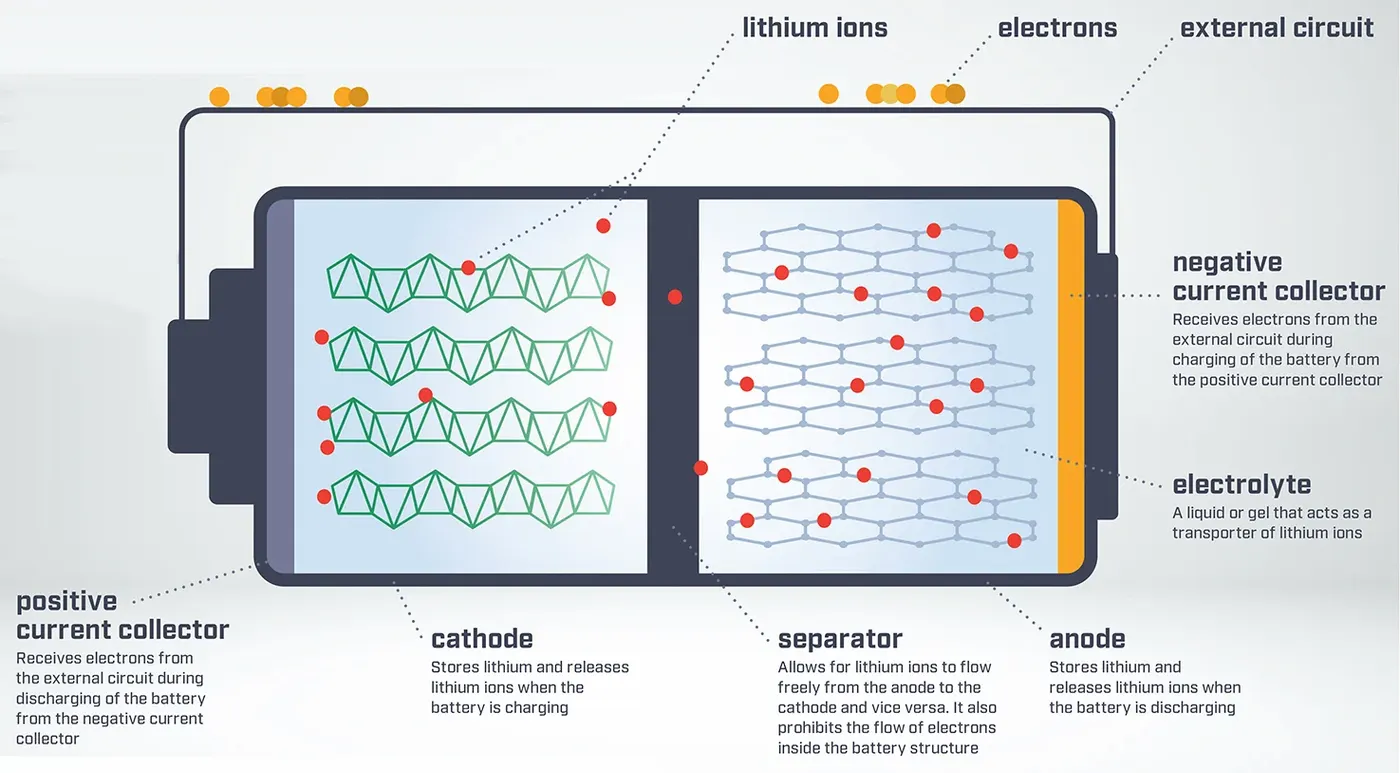
Components of Battery:
l Cathode (+ve): The cathode serves as the oxidizing electrode, accepting electrons from the external circuit during electrochemical reactions. Cathode materials typically derive from metal oxides like cobalt, nickel, manganese, iron, or aluminum.
l Anode (-ve): Operating as the reducing electrode, the anode releases electrons to the external circuit and oxidizes during electrochemical reactions. Common anode materials include carbon-based substances like graphite.
l Electrolyte: This medium facilitates ion transport between the cathode and anode within the cell, typically comprising lithium salt dissolved in an organic solvent.
l Separator: Positioned between the anode and cathode, the separator acts as a barrier, allowing ions to pass through while preventing electron flow.
l Current Collector: Utilized to conduct electrons from within the electrochemical reaction to the external circuit without participating in the reaction itself. Aluminum foil serves as the positive current collector, while copper foil is used for the negative current collector.
Working Principle:
l During Charging: Lithium ions migrate from the cathode to the anode via the electrolyte, while electrons flow through the external circuit to the graphite structure.
l During Discharging: Lithium ions return to the cathode and combine with the metal oxide structure, while electrons flow from the graphite layer through the load back to the metal oxide.
l This cyclical movement of lithium ions and electrons sustains a continuous flow of electrons, providing the energy necessary to power devices. Rechargeability stems from the ability to repeat this cycle multiple times.
l However, over time, the capacity of lithium-ion batteries diminishes due to the formation of a Solid Electrolyte Interface (SEI).
Types of Lithium-Ion Batteries:
1. Lithium Cobalt Oxide (LCO)
2. Lithium Manganese Oxide (LMO)
3. Lithium Nickel Cobalt Aluminum Oxide (NCA)
4. Lithium Nickel Manganese Cobalt Oxide (NMC)
5. Lithium Iron Phosphate (LFP)
6. Lithium Titanate (LTO)
Lithium Cobalt Oxide (LCO):
l Within lithium-ion batteries, oxidation-reduction (redox) reactions occur.
l Reduction takes place at the cathode. There, cobalt oxide combines with lithium ions to form lithium-cobalt oxide (LiCoO2). The half reaction is:
CoO2 + Li+ + e- → LiCoO2
l Oxidation takes place at the anode. There, the graphite intercalation compound LiC6 forms graphite (C6) and lithium ions. The half-reaction is:
LiC6 → C6 + Li+ + e-
Here is the full reaction (left to right = discharging, right to left = charging):
LiC6 + CoO2 ⇄ C6 + LiCoO2
l The full redox reaction is reversible, allowing for both discharging and charging processes.
Table of chemical reactions:
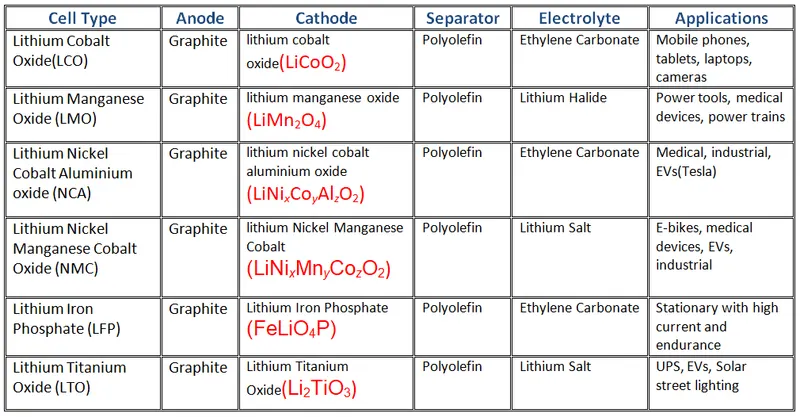
Q2: Characteristics of Li-Ion Batteries
Key Terminology:
l Energy Density: Measured in watt-hours per kilogram (Wh/kg), energy density indicates the amount of energy a battery can store relative to its mass, influencing driving range per charge.
l Power Density: Measured in watts per kilogram (W/kg), power density denotes the amount of power a battery can generate relative to its mass, impacting acceleration rates in electric vehicles (EVs).
l State of Charge (SOC): SOC estimates the ratio of the present charge to the full charge capacity, assisting drivers in assessing vehicle range.
l State of Health (SOH): SOH reflects the battery's health concerning performance and lifecycle, indicating any loss in charging capacity compared to the original design.
l C-Rate: Charge and discharge rates, typically expressed as multiples of the battery's nominal capacity, impacting discharge time and charge times.
l Closed Circuit Voltage (CCV): The potential or voltage of a battery during charging or discharging.
l Cycle Life: Total number of charge/discharge cycles a cell can sustain before its capacity significantly diminishes.
l Open Circuit Voltage (OCV): Potential difference between the terminals of a cell with no current flowing.
l Shelf Life: Duration of storage under specified conditions, retaining the battery's ability to deliver specified performance.
l Thermal Runaway: A critical condition during constant voltage charging, where current and temperature escalate, potentially leading to battery destruction.
Battery Characteristics:
Lithium Cobalt Oxide (LCO):
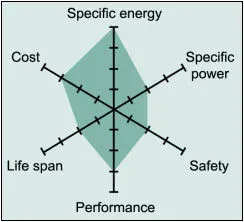
Cathode: Cobalt oxide; Anode: Graphite carbon.
Short lifespan, low thermal stability, limited load capabilities.
Drawbacks include changing solid electrolyte interface (SEI), anode thickening, and lithium plating during fast charging and low-temperature charging.
Lithium Manganese Oxide (LMO):
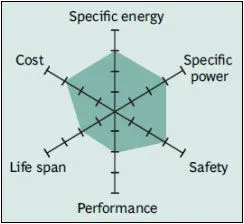
Cathode: Lithium manganese oxide.
Improved ion flow, low internal resistance, enhanced safety.
Limited cycle and calendar life.
Lithium Nickel Cobalt Aluminum Oxide (NCA):
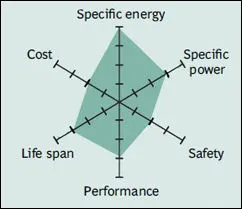
High specific energy, good specific power, long lifespan.
Safety and cost concerns.
Lithium Nickel Manganese Cobalt Oxide (NMC):
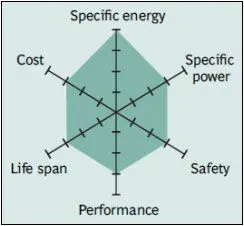
Combination of nickel, manganese, and cobalt.
High specific energy, good stability, low internal resistance.
Battery of choice for various applications including power tools and electric powertrains.
Lithium Iron Phosphate (LFP):
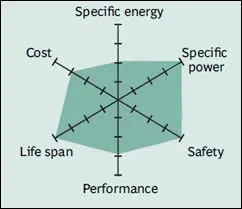
Good electrochemical performance, low resistance.
High current rating, long cycle life, enhanced safety.
Higher self-discharge compared to other Li-ion batteries.
Lithium Titanate (LTO):
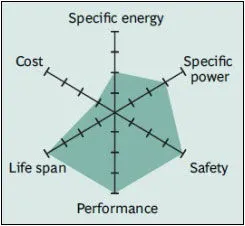
Anode replaces graphite with lithium titanate.
No SEI film formation or lithium plating during fast charging.
Better thermal stability, but higher cost.
The following differences between each type of Li+ion batteries based on their characteristics are given below:
|
Types of Li-ion Batteries |
Specific Power |
Specific Energy |
Safety |
Lifespan |
Cost |
Perfomance |
|
|
Lithium Cobalt Oxide |
Low |
High |
Low |
Low |
Low |
Medium |
|
|
Lithium Manganese Oxide |
Medium |
Medium |
Medium |
Low |
Low |
Low |
|
|
Lithium Nickel Manganese Cobalt Oxide |
Medium |
High |
Medium |
Medium |
Low |
Medium |
|
|
Lithium Iron Phosphate |
High |
Low |
High |
High |
Low |
Medium |
|
|
Lithium Nickel Cobalt Aluminium Oxide |
Medium |
High |
Low |
Medium |
Medium |
Medium |
|
|
Lithium Titanate |
Medium |
Low |
High |
High |
High |
High |