Week 1 Understanding Different Battery Chemistry
AIM:- To understand different Battery chemistry.
OBJECTIVES:-
1)Prepare a table that includes materials & chemical reactions occurring at the anode and cathode of different types of lithium-ion cells.
2)Comparing the differences between each type of Li+ion battery based on their characteristics.
Q.1.Prepare a table that includes materials & chemical reactions occurring at the anode and cathode of LCO, LMO, NCA, NMC, LFP, and LTO type of lithium-ion cells.Give your detailed explanation on it
Ans:-
1. Introduction
Lithium-ion cells , in their most common form, consist of a graphite anode, a lithium metal oxide cathode, and an electrolyte of a lithium salt and an organic solvent. Lithium is a good choice for an electrochemical cell due to its large standard electrode potential (–3.04 V) resulting in a high operating voltage (which helps both power and energy) and the fact that it is the metal with the lowest density (which reduces weight).
Li-ion Batteries
A lithium-ion battery or Li-ion battery is a type of rechargeable battery. Lithium-ion batteries are commonly used for portable electronics and electric vehicles and are growing in popularity for military and aerospace applications.
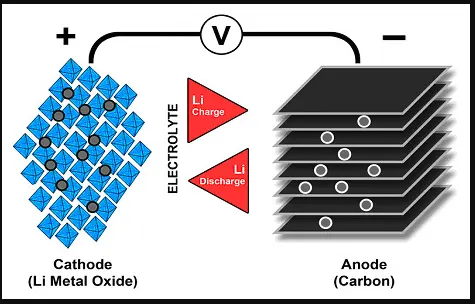
Similar to the lead- and nickel-based architecture, lithium-ion uses a cathode (positive electrode), an anode (negative electrode) and electrolyte as conductor. The cathode is a metal oxide and the anode consists of porous carbon. During discharge, the ions flow from the anode to the cathode through the electrolyte and separator; charge reverses the direction and the ions flow from the cathode to the anode. Figure 1 illustrates the process.
Types of Li-ion Cells
Lithium Cobalt Oxide(LiCoO2) — LCO
Its high specific energy makes Li-cobalt the popular choice for mobile phones, laptops and digital cameras. The battery consists of a cobalt oxide cathode and a graphite carbon anode. The cathode has a layered structure and during discharge, lithium ions move from the anode to the cathode. The flow reverses on charge. The drawback of Li-cobalt is a relatively short life span, low thermal stability and limited load capabilities (specific power).
Lithium Manganese Oxide (LiMn2O4) — LMO
Li-ion with manganese spinel was first published in the Materials Research Bulletin in 1983. In 1996, Moli Energy commercialized a Li-ion cell with lithium manganese oxide as cathode material. The architecture forms a three-dimensional spinel structure that improves ion flow on the electrode, which results in lower internal resistance and improved current handling. A further advantage of spinel is high thermal stability and enhanced safety, but the cycle and calendar life are limited.
Lithium Nickel Cobalt Aluminum Oxide (LiNiCoAlO2) — NCA
Lithium nickel cobalt aluminum oxide battery, or NCA, has been around since 1999 for special applications. It shares similarities with NMC by offering high specific energy, reasonably good specific power and a long life span. Less flattering are safety and cost. NCA is a further development of lithium nickel oxide; adding aluminum gives the chemistry greater stability.
Lithium Nickel Manganese Cobalt Oxide (LiNiMnCoO2) — NMC
One of the most successful Li-ion systems is a cathode combination of nickel-manganese-cobalt (NMC). Similar to Li-manganese, these systems can be tailored to serve as Energy Cells or Power Cells. For example, NMC in an 18650 cell for moderate load condition has a capacity of about 2,800mAh and can deliver 4A to 5A; NMC in the same cell optimized for specific power has a capacity of only about 2,000mAh but delivers a continuous discharge current of 20A.
Lithium Iron Phosphate(LiFePO4) — LFP
Li-phosphate offers good electrochemical performance with low resistance. This is made possible with nano-scale phosphate cathode material. The key benefits are high current rating and long cycle life, besides good thermal stability, enhanced safety and tolerance if abused.Li-phosphate is more tolerant to full charge conditions and is less stressed than other lithium-ion systems if kept at high voltage for a prolonged time. As a trade-off, its lower nominal voltage of 3.2V/cell reduces the specific energy below that of cobalt-blended lithium-ion.
Lithium Titanate (Li2TiO3) — LTO
Batteries with lithium titanate anodes have been known since the 1980s. Li-titanate replaces the graphite in the anode of a typical lithium-ion battery and the material forms into a spinel structure. The cathode can be lithium manganese oxide or NMC. Li-titanate has a nominal cell voltage of 2.40V, can be fast charged and delivers a high discharge current of 10C, or 10 times the rated capacity. The cycle count is said to be higher than that of a regular Li-ion. Li-titanate is safe, has excellent low-temperature discharge characteristics and obtains a capacity of 80 percent at –30°C.
The materials & chemical reactions occurring at the anode, cathode and overall reactions of all the types of Li-ion cells are given in the table below
Types of lithium-ion cells
| Types | Chemical name | Cathode material | Chemical Reaction at the cathode(discharge) | Anode material | Chemical Reaction at the anode(discharge) | Overall reaction |
| Lithium Cobalt Oxide (LCO) | LiCoO2 | Lithium Cobalt Oxide |  |
Graphite carbon |  |
 |
| Lithium-ion manganese oxide battery (LMO) | LiMn2O4 | Lithium manganese oxide |  |
Graphite carbon | 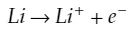 |
 |
| Lithium nickel cobalt aluminium oxides (NCA) | LiNiCoAlO2 | Lithium Nickel Cobalt Aluminum Oxide |  |
Graphite carbon |  |
 |
| Lithium Nickel Manganese Cobalt Oxide (NMC) | LiNiMnCoO2 | Lithium Nickel Manganese Cobalt Oxide |  |
Graphite carbon |  |
 |
|
Lithium iron phosphate battery(LFP) |
LiFePO4 | Lithium iron phosphate |  |
Graphite carbon |  |
 |
| Lithium-titanate-oxide (LTO) battery | Li2TiO3 | Manganese oxide |  |
Lithium titanium oxide |  |
 |
2.Compare the differences between each type of Li+ion batteries based on their characteristics?
Ans:-
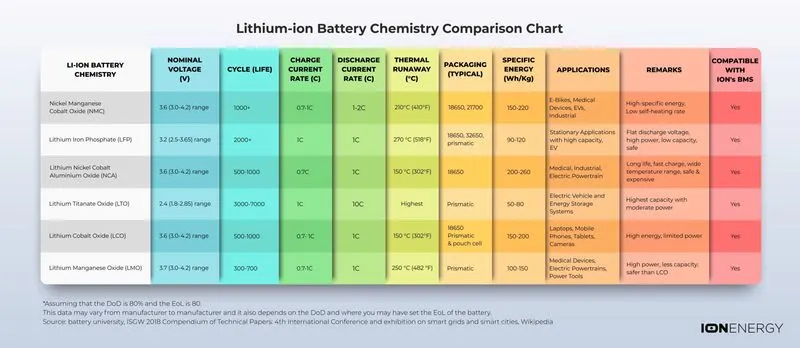
Key Differences Between Lithium Ion and Lithium Iron Batterie based on their characteristics

A lithium-ion battery and a lithium-iron battery have very similar names, but they do have some very different characteristics. This article is going to tell you what the similarities and differences are between a lithium-ion battery and a lithium-iron battery.
Similarities Between Lithium-Ion and Lithium-Iron Batteries based on their characteristics
First of all, both battery types operate based on a similar principle. The lithium ion in the batteries moves between the positive and negative electrode to discharge and charge.

Secondly, both battery types are rechargeable. Thirdly, both of them use graphitic carbon electrodes with a metallic backing as the anode.
Both types of batteries are the application of a pretty new technology in the battery industry. In the past, nickel-based batteries occupied pretty much the entire battery market. With this being said, the lithium-based batteries still have room to improve until the technology gets mature. Thus, their price is pretty expensive at this point and not affordable for a portion of manufacturers.

Differences Between Lithium-Ion and Lithium-Iron Batteries based on their characteristics
Despite the characteristics they share in common, a lithium-ion and a lithium-iron battery are quite different in terms of their stability, life span, and application.
1. Different Chemical Makeups
First and foremost, obviously, you can easily tell by reading their names that these two types of batteries are made up of different materials. A lithium-ion battery usually uses lithium cobalt dioxide (LiCoO2) or lithium manganese oxide (LiMn2O4) as the cathode. Whereas, a lithium-iron battery, or a lithium-iron-phosphate battery, is typically made with lithium iron phosphate (LiFePO4) as the cathode. One thing worth noting about their raw materials is that LiFePO4 is a nontoxic material, whereas LiCoO2 is hazardous in nature. As a result, disposal of lithium-ion batteries has been a big concern for manufacturers and users.
2. Newer Technology
Secondly, lithium-iron batteries are a newer technology than lithium-ion batteries. The phosphate-based technology has far better thermal and chemical stability. This means that even if you handle a lithium-iron battery incorrectly, it is far less likely to be combustible, compared to a lithium-ion battery.
3. Different Lifecycles
Thirdly, phosphate chemistry offers a longer life cycle. Since both types of batteries are rechargeable, they already have a relatively long life span. Lithium-iron batteries are even more long-lasting because they are more stable under the conditions of overcharges or short circuits. On one hand, lithium-ion batteries are at 80% discharge efficiency, and they have a lifespan of 13 to 18 years. Its cycle durability is between 400 and 1200. On other other hand, the cycle durability is around 2000 for lithium-iron batteries.
Applications: Which Should You Choose?
Do these mean that lithium-iron batteries are just better than lithium-ion batteries? The short answer is no, and this leads to the fourth difference. Lithium-ion batteries have the highest energy density among all rechargeable battery types in the market. This means that charging a lithium-ion is relevantly easier and takes a shorter time. A lithium-iron battery also has a good density, but, generally speaking, it is less powerful than a lithium-ion battery. Not all batteries are good for each use though, so for some applications, lithium-iron may be better than lithium-ion, and vice-versa.
Last but not least, a popular application of lithium-ion batteries is cellphones and laptops. For example, the products manufactured by Apple Inc. use lithium-ion batteries. It can also be used in power tools, like saws, electric vehicles, and other portable devices, like cameras, tablets or even handheld game consoles. Due to the heat-tolerant nature and the longer lifespan of lithium-iron batteries, they are usually used in transportation, solar-powered lights, electronic cigarettes. More and more EV manufacturers are starting to use lithium-iron batteries as well.

In the field of renewable energy, both lithium-ion and lithium-iron are popular types of commercial batteries used in energy projects. EnergyLink does provide battery storage service for customers and what’s more, we have a battery expert who knows basically everything about batteries. Click the green bar below to start a FREE conversation with him today!


