Week 1 Understanding Different Battery Chemistry
AIM:-
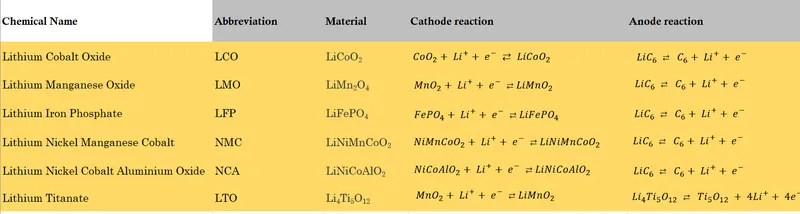
To prepare a table which includes materials & chemical reactions occurring at the anode and cathode of LCO, LMO, NCA, NMC, LFP and LTO type of lithium ion cells.
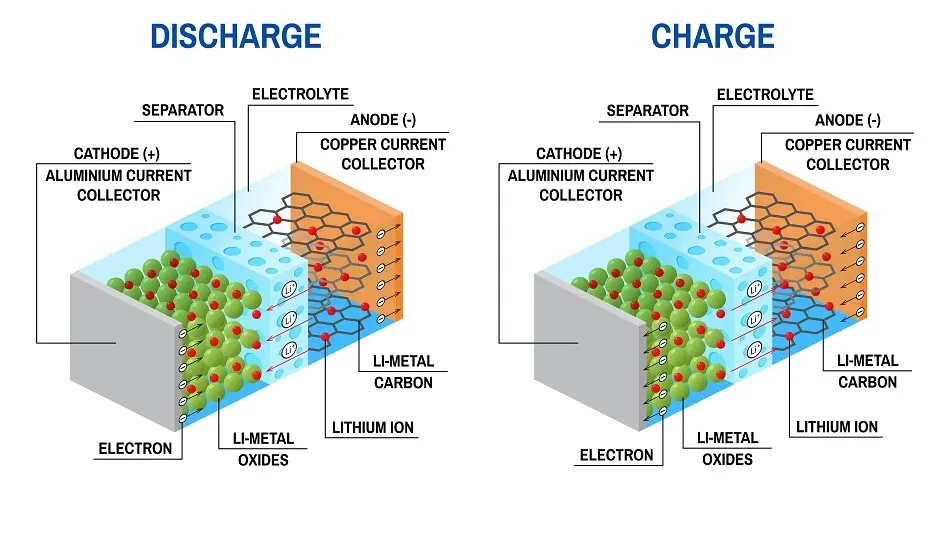
Similar to the lead- and nickel-based architecture, lithium-ion uses a cathode (positive electrode), an anode (negative electrode) and electrolyte as conductor. The cathode is a metal oxide and the anode consists of porous carbon. During discharge, the ions flow from the anode to the cathode through the electrolyte and separator; charge reverses the direction and the ions flow from the cathode to the anode. Figure 1 illustrates the process.
Lithium-ion batteries are used in most aspects of our everyday lives. Most devices like smartphones and laptops cannot operate without these batteries. Lithium-ion batteries have also become very important in the field of electromobility as it is now the battery of choice in most electric vehicles. Its high specific energy gives it an advantage over other batteries.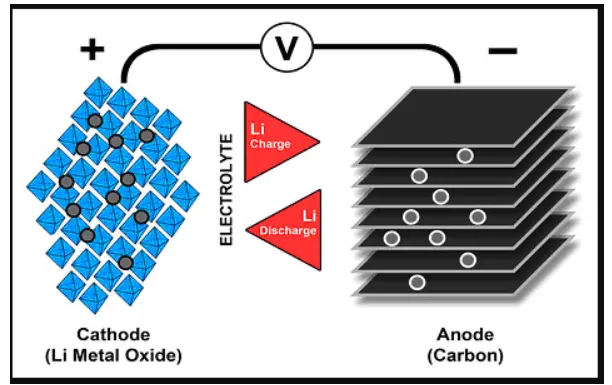
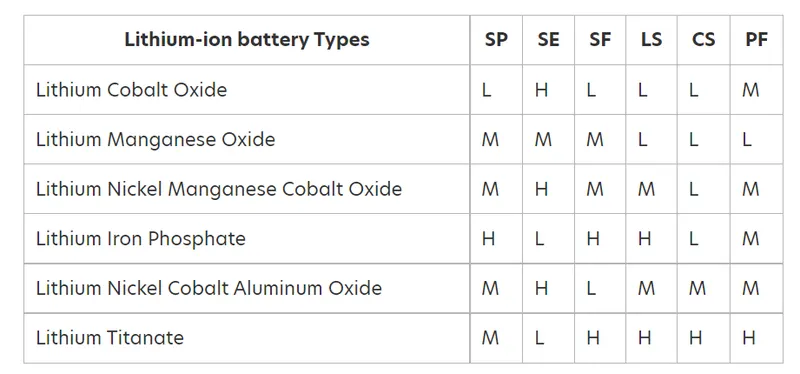
- SP stands for specific power
- SE stands for specific energy
- SF stands for safety
- LS stands for lifespan
- CS stands for cost
- PF stands for performance
- L stands for low
- M stands for moderate
- H stands for high
Summary of the Table
Lithium Cobalt Oxide(LiCoO2) — LCO:- has high specific energy compared to the other batteries, making it the preferred choice for laptops and mobile phones. It also has a low cost and a moderate performance. However, it is highly unfavorable in all the other aspects when compared to the other lithium-ion batteries. It has low specific power, low safety, and a low lifespan.
Lithium Manganese Oxide(LiMn2O4) — LMO:- has moderate specific power, moderate specific energy, and a moderate level of safety when compared to the other types of lithium-ion batteries. It has the added advantage of a low cost. The downsides are its low performance and low lifespan. It is usually used in medical devices and power tools.
Lithium Titanate(Li2TiO3) — LTO:- offers high safety, high performance, and a high lifespan which are very important features every battery should have. Its specific energy is low compared to the five other lithium-ion batteries, but it compensates for this with moderate specific power. The only major disadvantage of lithium titanate as compared to the other lithium-ion batteries is its extremely high cost. Another important feature of this battery worthy of mention is its remarkably fast recharge time. It can be used for storing solar energy and creating smart grids.
CONCLUSION:-
Thus a table is prepared which includes materials & chemical reactions occurring at the anode and cathode of LCO, LMO, NCA, NMC, LFP and LTO type of lithium ion cells.
REFERENCES: