Week 1 Understanding Different Battery Chemistry
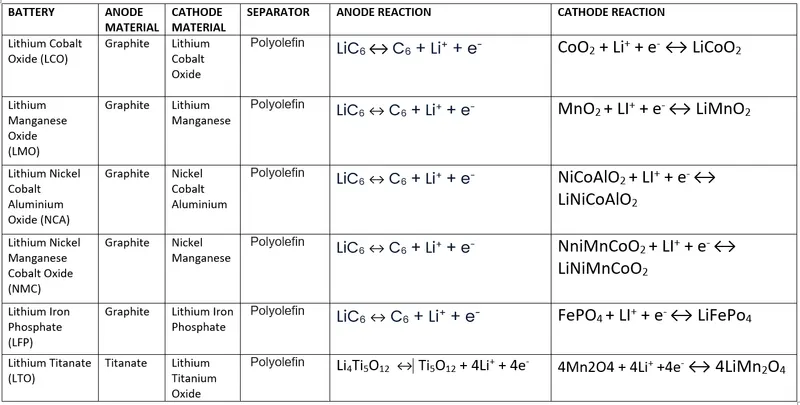
The battery is made up of an anode, cathode, separator, electrolyte, and two current collectors (positive and negative), the anode and cathode store the lithium.
The electrolyte carries positively charged lithium ions from the anode to the cathode and vice versa through the separator.
The movement of the lithium ions creates free electrons in the anode which creates a charge at the positive current collector.
The electrical current then flows from the current collector through a device being powered (cell phone, computer, Electric motor etc.) to the negative current collector. The separator blocks the flow of electrons inside the battery.
While the battery is discharging and providing an electric current, the anode releases lithium ions to the cathode, generating a flow of electrons from one side to the other.
When charging, the opposite happens, where Lithium ions are released by the cathode and received by the anode.
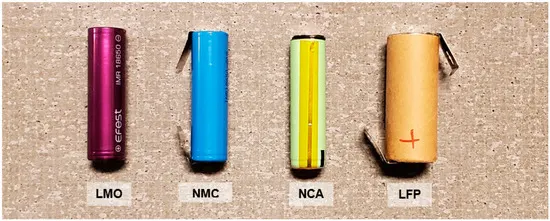
LCO Batteries:
LCO stands for Lithium cobalt battery. Lithium cobalt oxide is one of the most common Lithium-ions, it has a chemical symbol which is LiCoO2 and is abbreviated as LCO.
LCO (Lithium cobalt oxide) was invented in the year 1991. Its anode material is LiaC6, the cathode material is LibCoO2 and the carrier is Li+.It is used in various applications ranging from electronic devices to all laptops and phone batteries.The majority of lithium-ion batteries for the portable devices are cobalt based. The system contains a cobalt oxide cathode (positive electrode) and graphite carbon anode (negative electrode.
The main advantages of the LCO batteries are:
- High energy density.
- Long runtime making it optimum for new technologies
The main disadvantages of the LCO batteries are:
- It has a relatively low discharge current so high load can lead to pack overheat
- The safety circuit of the LCO battery is typically limited to a 1C for charging and discharging.
- The internal resistance increases with cycling and aging. This high internal resistance can cause the battery to become unserviceable due to a large voltage drop under the load after a couple of years of use.
LMO Batteries:
LMO (Lithium magnesium oxide) was invented in the year 1996. Its anode material is LiaC6, the cathode material is LibMn2O4 and the carrier is Li+. It is used in different applications like power tools and electric cars.LMO batteries have the ability to deliver a lot of energy in a short period of time, which makes them extremely useful for use in power tools like drills.In 1996, lithium manganese oxide was first used as a cathode material. A three dimensional spinel structure was formed by this structure, this improves the flow of ions between the electrodes. The high flow decreases the internal resistance and increases loading capability.LMO batteries are usually used in medical devices and equipment, power tools, electric bikes and more. Because of their thermal resistance and higher safety. LMO batteries can also be used for laptops and electrical cars.
The main advantages of the LMO batteries are:
- High temperature stability and safety relative to other Li-ion types as it has integrally high thermal stability thus needs less safety circuitry than cobalt system.
- High rate capability due to low internal cell resistance which benefits fast charging and high current discharging.
The main disadvantage of the LMO batteries is:
- Lower capacity relative to cobalt-based system,yet it still has an energy density which is nearly 50% higher than the nickel based system.
NCA batteries:
NCA (Lithium nickel cobalt aluminum oxide) battery was invented in the year 1999. Its anode material is LiaC6, the cathode material is LibNi0.8Co0.15Al0.05O2 and the carrier is Li+. It is used in different applications like power grid applications, medical devices and electric cars. Most notably Tesla deploys NCA batteries in their electric vehicles system. NCA batteries can store the same amount of energy as NMC.NCA batteries are not widely common in the consumer industry, but are quite promising in the electric car industry.
Advantages and disadvantages of NCA batteries
The main advantages of the NCA batteries are:
- High specific energy
- Reasonably good specific power
- Long life span
- NCA cathodes contain the most energy amount by weight and volume (as NMC).
The main disadvantages of the NCA batteries are:
- Less safety than other Li-ion battery types (they require extra safety features and circuits for use in electric cars for example)
- Higher cost in comparison to other Li-ion battery types.
LFP batteries:
LFP (Lithium iron phosphate) was invented in the year 1996. Its anode material is LiaC6, the cathode material is LibFePO4 and the carrier is Li+. They use LFP batteries in different applications like electric cars, electric buses and electric trucks. The LFP is ideal for use in electric trucks or buses – as volume or weight isn’t really a restriction as is in cars- because the battery is less energy dense yet cheaper to manufacture than other Li-ion batteries types. In addition, they use LFP batteries in other applications like electric motorcycles which need a longer life cycle and increased safety. LFP provides good electrochemical performance with lower resistance. This is enabled by the nano scale phosphate cathode material. The main benefits are long cycle life, higher current rating and thermal stability which means extra safety.
Advantages and disadvantages of LFP batteries
The main advantages of the LFP batteries are:
- Durability
- Long lifecycle
- Low cost
- Excellent safety
The main disadvantages of the LFP batteries are:
- More tolerant to conditions of full charge and is less stressed at higher voltage for a long time.
- lower nominal voltage which reduces the specific energy
- Higher self discharge than other types Li-ion batteries, which causes balancing issues with aging.
LTO batteries:
LTO (Lithium tintate) was invented in the year 2008. Its anode material is Li4+aTi5O12, the cathode material is LibFePO4 and the carrier is Li+. They use it in different applications like UPS, electrical power trains, solar powered street lights, fast charge stations and forklifts. Other applications for LTO batteries include aerospace and military uses, and more importantly wind and solar energy storage and smart grids creation.Li-titanate is used instead of the graphite in the anode of a common lithium-ion battery and the material is formed into a spinel structure. The cathode material is either LMO or NMC.As mentioned, they use li-titanate batteries in electric vehicles, yet LTO batteries have lower energy density than other Li-ion battery types, which can be a disadvantage in efficiently powering vehicles. Still, the density of LTO batteries is higher than other non-Li-ion batteries.
Advantages and disadvantages of LTO batteries
The main advantages of the LTO batteries are:
- Excellent low temperature discharge characteristics
- Zero strain property, no formation of SEI film nor lithium plating when charging at low temperature or fast charging
- Long life time
- Fast charge capability and wide temperature range
- Among the safest types of Li-ion batteries
The main disadvantages of the LTO batteries are:
- High cost
- Lower inherent voltage or lower energy density
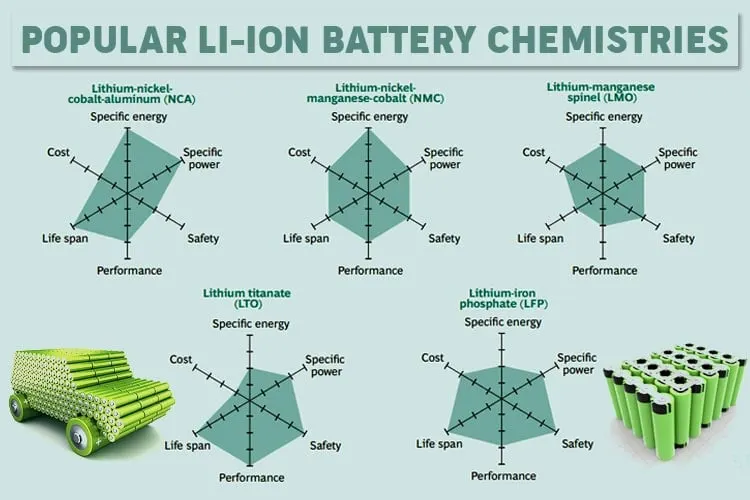
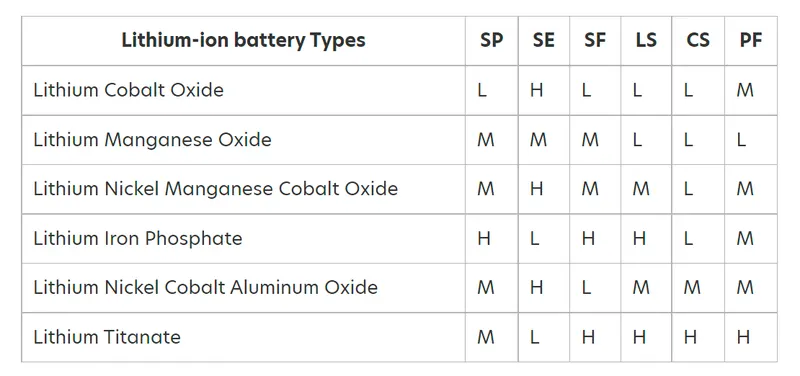
- SP stands for specific power
- SE stands for specific energy
- SF stands for safety
- LS stands for lifespan
- CS stands for cost
- PF stands for performance
- L stands for low
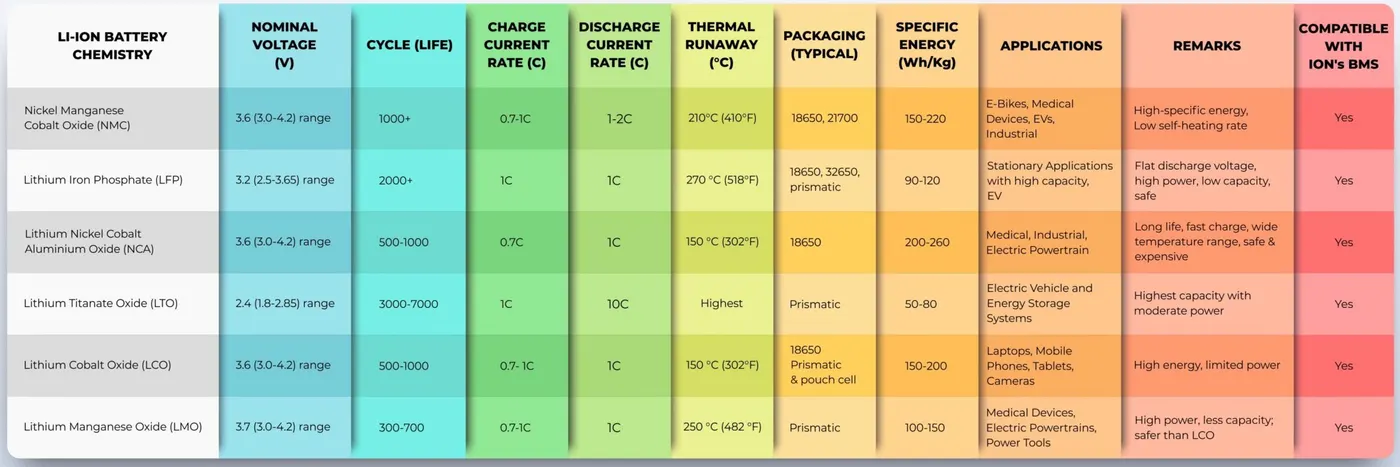
Summary of the Table
Lithium Cobalt Oxide has high specific energy compared to the other batteries, making it the preferred choice for laptops and mobile phones. It also has a low cost and a moderate performance. However, it is highly unfavorable in all the other aspects when compared to the other lithium-ion batteries. It has low specific power, low safety, and a low lifespan.
Lithium Manganese Oxide has moderate specific power, moderate specific energy, and a moderate level of safety when compared to the other types of lithium-ion batteries. It has the added advantage of a low cost. The downsides are its low performance and low lifespan. It is usually used in medical devices and power tools.
Lithium Nickel Manganese Cobalt Oxide has two major advantages as compared to the other batteries. The first one is its high specific energy, which makes it desirable in electric powertrains, electric vehicles, and electric bikes. The other is its low cost. It is moderate in terms of specific power, safety, lifespan, and performance when compared to the other lithium-ion batteries. It can be optimized to either have high specific power or high specific energy.
Lithium Iron Phosphate only has one major disadvantage when compared to other types of lithium-ion batteries, and that is its low specific energy. Other than that, it has moderate to high ratings in all the other characteristics. It has high specific power, offers a high level of safety, has a high lifespan, and comes at a low cost. The performance of this battery is also moderate. It is often employed in electric motorcycles and other applications that require a long lifespan and a high level of safety.