Week 1 Understanding Different Battery Chemistry
AIM
1.Prepare a table which includes materials & chemical reactions occurring at the anode and cathode of LCO, LMO, NCA, NMC, LFP and LTO type of lithium ion cells.Give your detailed explanation on it
2.Compare the differences between each type of Li+ion batteries based on their characteristics
Lithium-Ion Battery – Introduction
- In the batteries, lithium ions move from the negative electrode through an electrolyte to the positive electrode during discharge, and back when charging. Lithium-ion batteries use an intercalated lithium compound as the material at the positive electrode and typically graphite at the negative electrode. The batteries have a high energy density, no memory effect (other than LFP cells) and low self-discharge.
- Pioneer work with the lithium battery began in 1912 under G.N. Lewis but it was not until the early 1970s when the first non-rechargeable lithium batteries became commercially available. lithium is the lightest of all metals, has the greatest electrochemical
Types of Batteries
1) Primary Batteries:
As the name indicates these batteries are meant for single usage. Once these batteries are used they cannot be recharged as the devices are not easily reversible and active materials may not return to their original forms. Battery manufacturers recommend against recharge of primary cells.
2) Secondary Batteries:
Secondary batteries are also called as rechargeable batteries. These batteries can be used and recharges simultaneously. They are usually assembled with active materials with active in the discharged state. Rechargeable batteries are recharged by applying electric current, which reverses the chemical reactions that occur during discharge. Chargers are devices which supply the required current.
potential and provides the largest energy density for weight.
Lithium Cobalt Oxide(LiCoO2) — LCO
Its high specific energy makes Li-cobalt the popular choice for mobile phones, laptops and digital cameras. The battery consists of a cobalt oxide cathode and a graphite carbon anode. The cathode has a layered structure and during discharge, lithium ions move from the anode to the cathode. The flow reverses on charge. The drawback of Li-cobalt is a relatively short life span, low thermal stability and limited load capabilities (specific power). Figure 1 illustrates the structure.
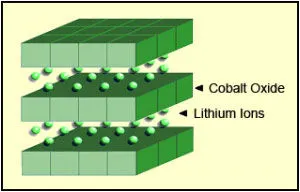
The cathode has a layered structure. During discharge the lithium ions move from the anode to the cathode; on charge the flow is from cathode to anode. Source: Cadex
The drawback of Li-cobalt is a relatively short life span, low thermal stability and limited load capabilities (specific power). Like other cobalt-blended Li-ion, Li-cobalt has a graphite anode that limits the cycle life by a changing solid electrolyte interface (SEI), thickening on the anode and lithium plating while fast charging and charging at low temperature. Newer systems include nickel, manganese and/or aluminum to improve longevity, loading capabilities and cost.
Li-cobalt should not be charged and discharged at a current higher than its C-rating. This means that an 18650 cell with 2,400mAh can only be charged and discharged at 2,400mA. Forcing a fast charge or applying a load higher than 2,400mA causes overheating and undue stress. For optimal fast charge, the manufacturer recommends a C-rate of 0.8C or about 2,000mA. (See BU-402: What is C-rate). The mandatory battery protection circuit limits the charge and discharge rate to a safe level of about 1C for the Energy Cell.
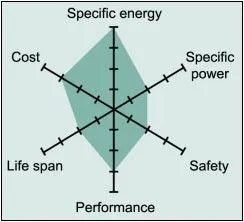
The hexagonal spider graphic (Figure 2) summarizes the performance of Li-cobalt in terms of specific energy or capacity that relates to runtime; specific power or the ability to deliver high current; safety; performance at hot and cold temperatures; life span reflecting cycle life and longevity; and cost. Other characteristics of interest not shown in the spider webs are toxicity, fast-charge capabilities, self-discharge and shelf life. (See BU-104c: The Octagon Battery – What makes a Battery a Battery).
The Li-cobalt is losing favor to Li-manganese, but especially NMC and NCA because of the high cost of cobalt and improved performance by blending with other active cathode materials. (See description of the NMC and NCA below.)
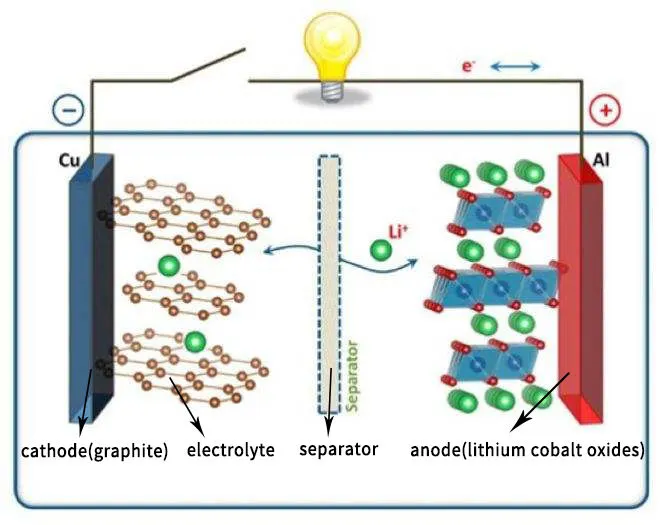
.Lithium Cobalt Oxide Battery Reactions
What happens when you charge it,
Anode: LiCoO2 = Li1-xCoO2+xLi++xe-
Cathode: 6C+xLi++xe- = LixC6
What happens when you discharge
Anode: Li1-xCoO2+xLi++xe-=LiCoO2
Cathode: LixC6=6C+xLi++xe-
Lithium Cobalt Oxide Battery Electrolyte
Composition of Lithium Cobalt Oxide Battery Electrolyte
Solvent: cyclic carbonate (PC, EC); Chain carbonates (DEC, DMC, EMC); Carboxylic esters (MF, MA, EA, MA, MP, etc.); (for dissolving lithium salts);
Lithium salts: LiPF6, LiClO4, LiBF4, LiAsF6, etc.
Additives: film forming additives, conductive additives, flame retardant additives, overcharge protection additives, additives to control H2O and HF in electrolyte, additives to improve low temperature performance, multi-functional additives.
Requirements of Lithium Cobalt Oxide Battery Electrolyte
High ionic conductivity is generally 1x10⁻³~2x10⁻² S/cm;
High thermal and chemical stability: no separation in a wide voltage range;
A wide electrochemical window keeps the electrochemical properties stable in a wide voltage range.
Good compatibility with other parts of the battery, such as electrode material, electrode collector and separator;
It is safe, non-toxic and pollution-free.
Lithium Manganate Oxide Batteries
Lithium manganate oxide battery refers to the battery that uses lithium manganate oxide as an anode material. Its nominal voltage is 3.7V. It is the mainstream power battery at present. This kind of battery has ordinary energy density and cycling life. It has environmental protection and no patent limitation. But lithium manganate oxide is not very stable, easy to decompose gas, may lead to swell, and its high-temperature performance is poor.
Lithium manganate oxide, whose chemical formula is LiMn2O4 (LCM), is one of the promising lithium ion anode materials. Compared with traditional anode materials such as lithium cobalt oxides, lithium manganate oxide has rich resources, low cost, no pollution, good safety and nice rate capability. It is an ideal anode material for power battery.
Lithium manganate oxide tends to be spinel type. LiMn2O4 spinel manganese acid lithium is the first anode material with 3D Li ion channel that made by Hunter in 1981. So far, it has been attracted attention from many scholars and researchers both at home and abroad. As an electrode material, it has low price and high potential, environment friendly and good safety performance, and is the most promising anode materials of new generation of lithium ion battery to replace LiCoO2.
LMO Battery Cathode
The main components of lithium manganate oxide are spinel lithium manganate oxide and layered structure lithium manganate oxide. The model of spinel structure lithium manganate oxide belongs to cubic system, which is a kind of Fd3m space group. At present, the high-capacity lithium manganate oxide anode material has a reasonable structure. Lithium ions can be easily and reversibly detached from the spinel lattice, because the structure is relatively secure, there is no risk of structural collapse, and the safety of the product is guaranteed.
1. Layered structure LiMnO2 has theoretical capacity of 285mA·h/g and voltage platform of 4V. The layered structure is difficult to synthesize and is unstable. It is easy to generate spinel structure Li2Mn2O4, which leads to the decline of voltage platform, poor stability and irreversible capacity decay.
2. High-pressure spinel LiMn2O4 has theoretical capacity of 148mA·h/g and voltage platform of 4.15. Its high-temperature performance is poor, and the capacity will have serious attenuation above 55℃. It is easy to produce spinel structure Li2Mn2O4, which leads to voltage platform decline, poor stability, irreversible capacity attenuation, etc. This is the lithium manganate oxide currently used in industry.
Structure Diagram of Spinel Lithium manganate oxide
3.Spinel Li2Mn2O4 has electric depression of 3V, low capacity and poor circulation. People are studying how to avoid these issues.
LMO Battery Composition
Lithium manganate oxide battery is a lithium ion battery that uses lithium manganate oxide as anode, graphite as cathode, and electrolyte with LiPF6 organic solution. Its nominal voltage is 3.7V. The structure of lithium manganate oxide battery packed in aluminum shell is shown in the following figure:
-
Anode structure: LiMn2O4(lithium manganate oxide)+ conductive agent (acetylene black)+ adhesive (PVDF)+ collector (aluminum foil) anode
-
Cathode structure: graphite + conductive agent (acetylene black)+ adhesive (PVDF)+ collector (copper foil) cathode
-
Separator: a special composite membrane
-
Case: divided into steel case and aluminum case
-
Organic electrolyte
-
Top cover and bottom cover
How Lithium Manganate Oxide Batteries Work
When a lithium manganate oxide battery is charged, lithium ions in the anode detach from the lattice, pass through the electrolyte to the cathode surface and embed into the graphite layer. When you discharge, the process is reversed. In charging and discharging process, lithium ions go between the anode and cathode, which is also known as the "rocking chair" battery.
Schematic Diagram of the Working Principle of LiMn2O4
Lithium nickel cobalt aluminum oxide (LiNiCoAlO2)
Lithium-ion is named for its active materials; the words are either written
in full or shortened by their chemical symbols. A series of letters and
numbers strung together can be hard to remember and even harder to
pronounce, and battery chemistries are also identified in abbreviated letters.
For example, lithium cobalt oxide, one of the most common Li-ions, has
the chemical symbols LiCoO₂ and the abbreviation LCO. For reasons of
simplicity, the short form Li-cobalt can also be used for this battery.
Cobalt is the main active material that gives this battery character.
Other Li-ion chemistries are given similar short-form nam
NCA is a further development of lithium nickel oxide; adding
aluminum gives the chemistry greater stability.
NCA is a further development of lithium nickel oxide; adding
aluminum gives the chemistry greater stability.
|
Voltages |
3.60V nominal; typical operating range 3.0–4.2V/cell |
|
Specific energy (capacity) |
200-260Wh/kg; 300Wh/kg predictable |
|
Charge (C-rate) |
0.7C, charges to 4.20V (most cells), 3h charge typical, fast charge possible with some cells |
|
Discharge (C-rate) |
1C typical; 3.00V cut-off; high discharge rate shortens battery life |
|
Cycle life |
500 (related to depth of discharge, temperature) |
|
Thermal runaway |
150°C (302°F) typical, High charge promotes thermal runaway |
|
Cost |
~$350 per kWh (Source: RWTH, Aachen) |
|
Applications |
Medical devices, industrial, electric powertrain (Tesla) |
|
Comments Latest update: |
Shares similarities with Li-cobalt. Serves as Energy Cell. Mainly used by Panasonic and Tesla; growth potential. |
Lithium Nickel Manganese Cobalt Oxide battery(LiNiMnCoO2)
Lithium Nickel Manganese Cobalt Oxides are a family of mixed metal oxides of lithium, nickel, manganese and cobalt. Nickel is known for its high specific energy, but poor stability. Manganese has low specific energy but offers the ability to form spinel structures that allow low internal resistance.
- Ni-rich NMC has a high discharge capacity
- Mn-rich compositions maintain better cycle life and thermal safety
- Co-rich compositions provide excellent rate capability.
These are lithium ion cell chemistries known by the abbreviation NMC or NCM.
- NMC and NCM are the same thing.
- Lithium-Nickel-Manganese-Cobalt-Oxide (LiNiMnCoO2)
- Voltage range 2.7V to 4.2V with graphite anode.
- OCV at 50% SoC is in the range 3.6 to 3.7V
- NMC333 = 33% nickel, 33% manganese and 33% cobalt
- NMC622 = 60% nickel, 20% manganese and 20% cobalt
- NMC955 = 90% nickel, 5% manganese and 5% cobalt
- Capacity ~ 154 to 203mAh/g (practical)
- Trend is to reduce Cobalt based on cost and increased capacity
- Higher Nickel content => higher capacity, more heat and faster capacity fade
- Energy density at cell level ~280Wh/kg (2021)
- Maximum energy density at cell level with graphite anode ~350Wh/kg
The general formula is LiNixMnyCozO2
- LiNi 0.333Mn0.333Co 0.333O2 is abbreviated to NMC111 or NMC33
- LiNi0.8Mn0.1Co0.1O2 is abbreviated to NMC811
Note that these ratios are not hard and fast. eg NMC811 can be 83% Nickel.
As we move from NMC333 to NMC811 the nickel content increases. As the Nickel content increases the Manganese and Cobalt decrease.
- The thermal stability of the charged NMC decreases with increasing nickel content.
- Manganese is the most thermally stable element, which can improve thermal stability.
- Mn-rich cathodes have a reduced capacity because of an ample supply of inactive Mn4+ species.
- Cobalt also plays an important role in maintaining good thermal stability.
This all means that there is a wide design space available for NMC chemistries and that is expanded further once we look at the anode combinations.
References
- Seong-Min Bak et al, “Structural Changes and Thermal Stability of Charged LiNixMnyCozO2 Cathode Materials Studied by Combined In Situ Time-Resolved XRD and Mass Spectroscopy“, Applied Materials and Interfaces, ACSJCA
Lithium iron phosphate(LiFePO4)
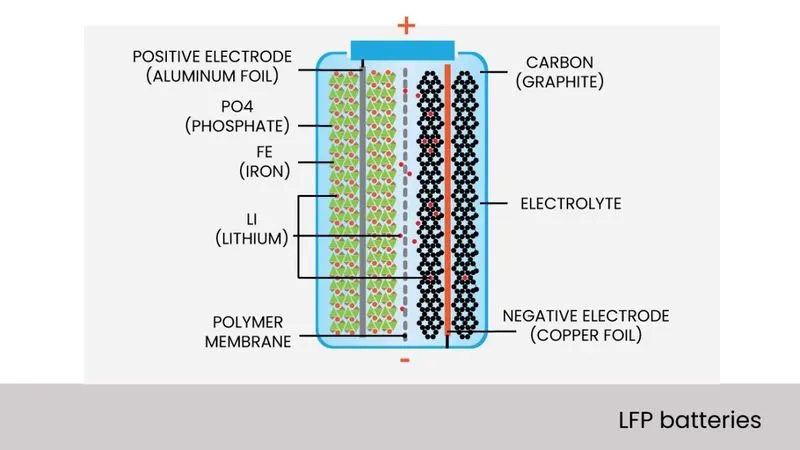
LFP batteries stand for Lithium iron phosphate(LiFePO4) batteries, which are known as li-phosphate batteries as well. They use phosphate as cathode material. In addition, they benefit from the low resistance properties that enhance their thermal stability and safety.
LFP batteries technology and applications
LFP (Lithium iron phosphate) was invented in the year 1996. Its anode material is LiaC6, the cathode material is LibFePO4 and the carrier is Li+. They use LFP batteries in different applications like electric cars, electric buses, and electric trucks. The LFP is ideal for use in electric trucks or buses – as volume or weight isn’t really a restriction as is in cars- because the battery is less energy-dense yet cheaper to manufacture than other Li-ion batteries types. In addition, they use LFP batteries in other applications like electric motorcycles which need a longer life cycle and increased safety. LFP provides good electrochemical performance with lower resistance. This is enabled by the nano-scale phosphate cathode material. The main benefits are long cycle life, higher current rating, and thermal stability which means extra safety.
6. LTO: LTO batteries are lithium titanate (Li2TiO3) or li-titanate batteries, which is a class of batteries that is used in a growing number of applications. They are high-power batteries, so they are perfect for use in fast-charging stations.
LTO batteries technology and applications
LTO (Lithium tintate) was invented in the year 2008. Its anode material is Li4+aTi5O12, the cathode material is LibFePO4 and the carrier is Li+. They use it in different applications like UPS, electrical power trains, solar-powered street lights, fast-charge stations, and forklifts. Other applications for LTO batteries include aerospace and military uses, and more importantly wind and solar energy storage and smart grids creation. Li-titanate is used instead of the graphite in the anode of a common lithium-ion battery and the material is formed into a spinel structure. The cathode material is either LMO or NMC. As mentioned, they use li-titanate batteries in electric vehicles, yet LTO batteries have lower energy density than other Li-ion battery types, which can be a disadvantage in efficiently powering vehicles. Still, the density of LTO batteries is higher than other non-Li-ion batteries
Compare the differences between each type of Li+ion batteries based on their characteristics
The table showing the materials and chemical reactions in different types of Li-Ion batteries are shown below,
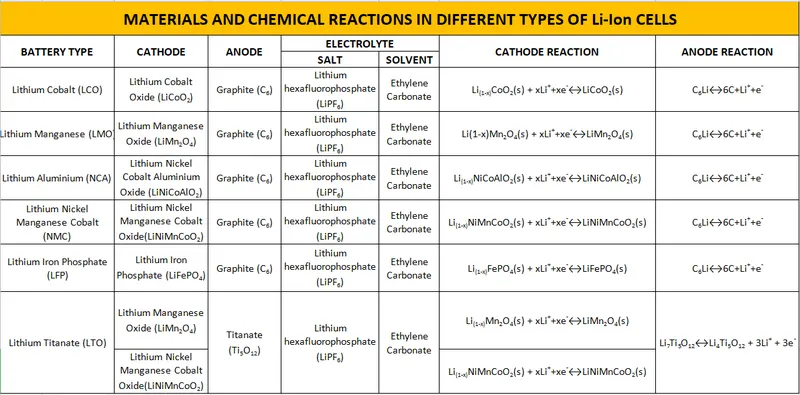
The explanations for these different types of Lithium-Ion batteries becomes easy once we understand the basic working principle of Li-ion batteries.
A Li-ion battery is a type of rechargeable battery which are commonly used in Electric vehicle applications. The first commercial Li-ion battery was developed by Sony in the year 1991.
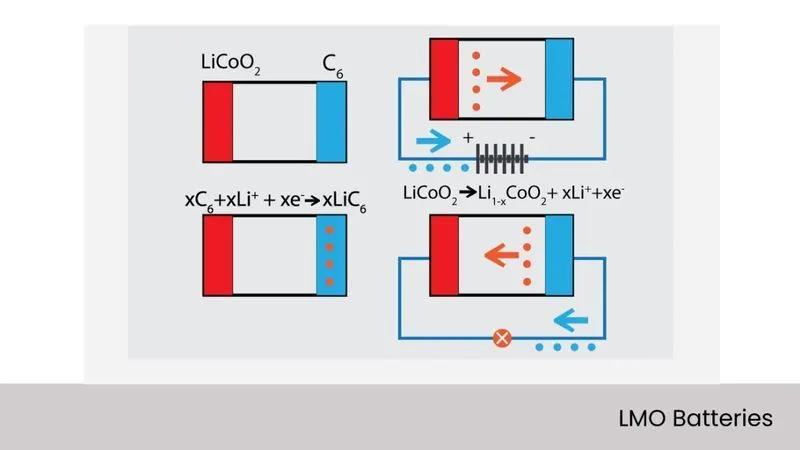
The simple working principle of a Li-ion battery is that , during discharge cycle lithium ions moves from the negative electrode through an electrolyte to the positive electrode and reverse in case of charging cycle. These electrolytes allows only ions to pass through it and blocks electrons.
Now let us take an example and explain this working principle in detail. For this let us take the first type of Li-ion battery shown in the above table which is Lithium Cobalt (LCO). First let us charge this battery by connecting it to an external electric source. Positive of the power source will attract the electrons from the Lithium atoms in the lithium cobalt oxide. These electrons will then go to the graphite anode and will stay there. This causes the positively charged lithium ions to get attracted to the negative electrode. And so the lithium ions moves through the electrolyte and reaches the graphite layer and stays there forming lithium graphite. Once all the lithium ions reach the graphite layer the battery is said to be fully charged.
Now during discharge , i.e when a load is connected to the battery , the lithium in the lithium graphite anode gets oxidized from Li to Li+ (0 to +1 oxidation state). This will release electrons. Now the so formed lithium ions has the tendency to achieve stable state and to do that it will move through the electrolyte to the cobalt oxide part . This lithium ions will reduce the cobalt(in this case) from a +4 to a +3 oxidation state hence causing reduction. And the electrons will move through the load and reaches the other part of the battery. Once all the lithium ions gets moved from the graphite layer and reaches the metal oxide , we can say that the battery is fully discharged.
This working principle is shown in the below diagram,
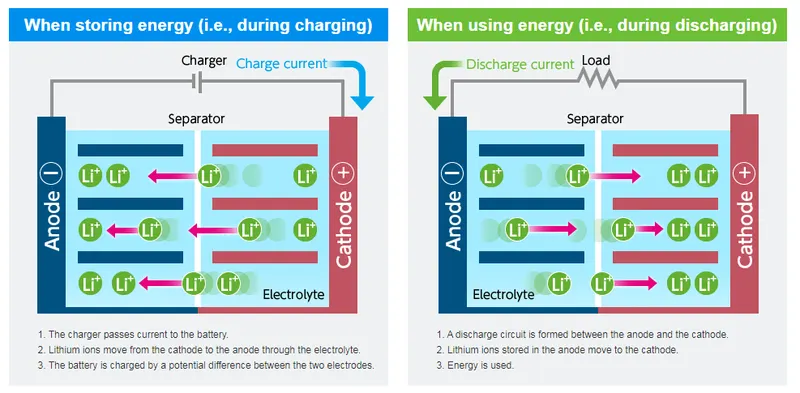
Now this same working principle applies to all other battery types mentioned in the table. The basic reaction taking place is reduction-oxidation or redox reaction.
Reference: