Week 1 Understanding Different Battery Chemistry
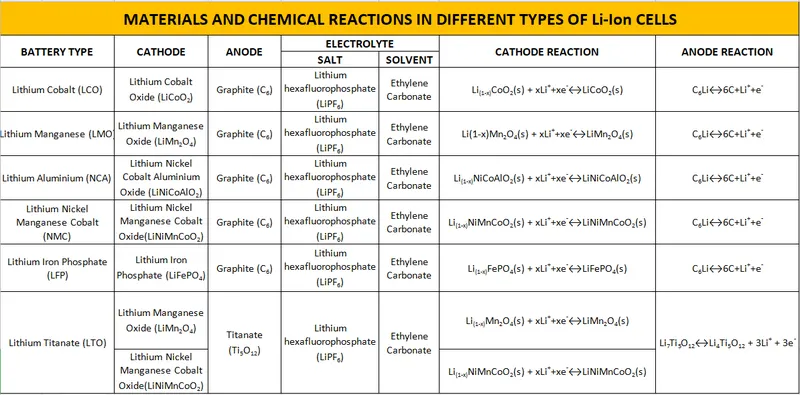
1.Prepare a table which includes materials & chemical reactions occurring at the anode and cathode of LCO, LMO, NCA, NMC, LFP and LTO type of lithium ion cells.Give your detailed explanation on it.
Solution:
Lithium Ion Battery
A lithium-ion battery is a type of rechargeable battery that is charged and discharged by lithium ions moving between the negative (anode) and positive (cathode) electrodes.
Because lithium-ion batteries are suitable for storing high-capacity power, they are used in a wide range of applications, including consumer electronics such as smartphones and PCs, industrial robots, production equipment and automobiles.
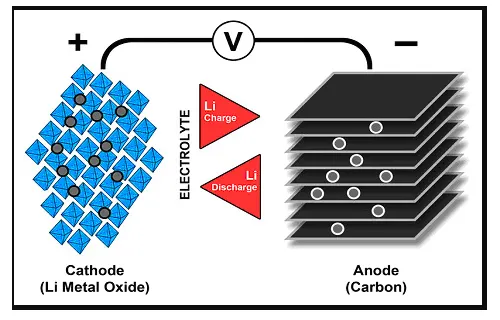
Similar to the lead- and nickel-based architecture, lithium-ion uses a cathode (positive electrode), an anode (negative electrode) and electrolyte as conductor. The cathode is a metal oxide and the anode consists of porous carbon. During discharge, the ions flow from the anode to the cathode through the electrolyte and separator; charge reverses the direction and the ions flow from the cathode to the anode as shown in below figure.
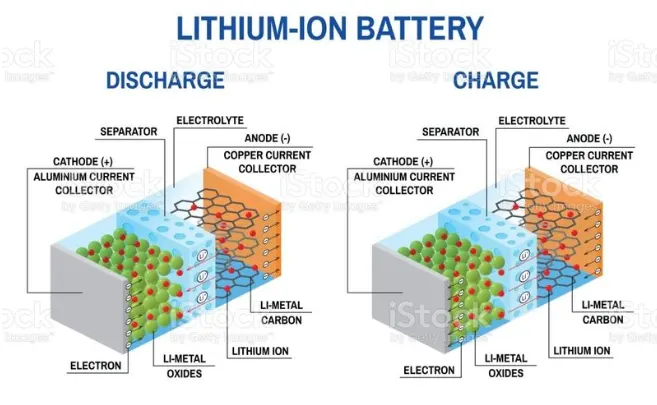
The materials & chemical reactions occurring at the anode, cathode and overall reactions of all the types of Li-ion cells are given in the table below
2.Compare the differences between each type of Li+ion batteries based on their characteristics.
Solution:
Types of Li-ion Cells:
1. Lithium Cobalt Oxide Battery (LiCoO2) — LCO
2. Lithium Manganese Oxide Battery (LiMn2O4) — LMO
3. Lithium Nickel Cobalt Aluminum Oxide-Based Battery (LiNiCoAlO2) — NCA
4. Lithium Nickel Manganese Cobalt Oxide Battery (LiNiMnCoO2) — NMC
5. Lithium Iron Phosphate Battery (LiFePO4) — LFP
6. Lithium Titanate battery (Li2TiO3) — LTO
The characteristics of different types of Li Ion batteries are as follows:
1. Specific Energy
2. Specific Power
3. Safety
4. Performance
5. Life Span
6. Cost
So what we will do is we will rate the above characteristics based on our consideration, as
1 for Bad
2 for Improvement
3 for Good
4 for Excellent
1. Lithium Cobalt Oxide Battery (LiCoO2) — LCO
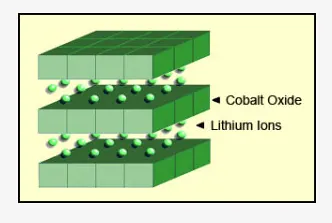
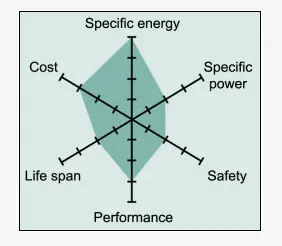
Its high specific energy makes Li-cobalt the popular choice for mobile phones, laptops and digital cameras. The battery consists of a cobalt oxide cathode and a graphite carbon anode. The cathode has a layered structure and during discharge, lithium ions move from the anode to the cathode. The flow reverses on charge. The drawback of Li-cobalt is a relatively short life span, low thermal stability and limited load capabilities (specific power) as shown in below figure.
Characteristics are as follow for Lithium Cobalt Oxide Battery (LiCoO2) — LCO
1. Specific Energy - Excellent
2. Specific Power - Improvement
3. Safety - Improvement
4. Performance - Improvement
5. Life Span - Improvement
6. Cost - Good
2. Lithium Manganese Oxide Battery (LiMn2O4) — LMO
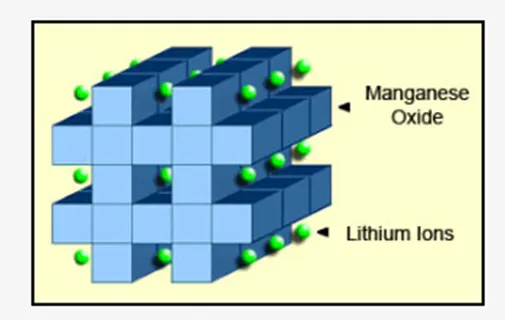
Li-ion with manganese spinel was first published in the Materials Research Bulletin in 1983. In 1996, Moli Energy commercialized a Li-ion cell with lithium manganese oxide as cathode material. The architecture forms a three-dimensional spinel structure that improves ion flow on the electrode, which results in lower internal resistance and improved current handling. A further advantage of spinel is high thermal stability and enhanced safety, but the cycle and calendar life are limited.
Characteristics are as follow for Lithium Manganese Oxide Battery (LiMn2O4) — LMO
1. Specific Energy - Good
2. Specific Power - Good
3. Safety - Good
4. Performance - Improvement
5. Life Span - Improvement
6. Cost - Good
3. Lithium Nickel Cobalt Aluminum Oxide-Based Battery (LiNiCoAlO2) — NCA
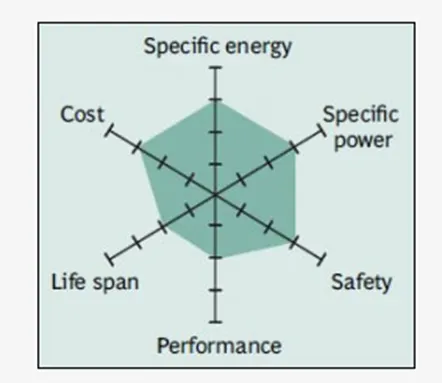
Lithium nickel cobalt aluminum oxide battery, or NCA, has been around since 1999 for special applications. It shares similarities with NMC by offering high specific energy, reasonably good specific power and a long life span. Less flattering are safety and cost. Figure 11 summarizes the six key characteristics. NCA is a further development of lithium nickel oxide; adding aluminum gives the chemistry greater stability.
Characteristics are as follow for Lithium Nickel Cobalt Aluminum Oxide-Based Battery (LiNiCoAlO2) — NCA
1. Specific Energy - Excellent
2. Specific Power - Good
3. Safety - Improvement
4. Performance - Good
5. Life Span - Good
6. Cost - Improvement
4. Lithium Nickel Manganese Cobalt Oxide Battery (LiNiMnCoO2) — NMC
One of the most successful Li-ion system is a cathode combination of nickel-manganese cobalt (NMC). The secret of NMC lies in combining nickel and manganese. An analogy of this is table salt in which the main ingredients, sodium and chloride, are toxic on their own but mixing them serves as seasoning salt and food preserver. Nickel is known for its high specific energy but poor stability; manganese has the benefit of forming a spinel structure to achieve low internal resistance but offers a low specific energy. Combining the metals enhances each other strengths.
Characteristics are as follow for Lithium Nickel Manganese Cobalt Oxide Battery (LiNiMnCoO2) — NMC
1. Specific Energy - Excellent
2. Specific Power - Good
3. Safety - Good
4. Performance - Good
5. Life Span - Good
6. Cost - Good
5. Lithium Iron Phosphate Battery (LiFePO4) — LFP
With four Li-phosphate cells in series, each cell tops at 3.60V, which is the correct full-charge voltage. At this point, the charge should be disconnected but the topping charge continues while driving. Li-phosphate is tolerant to some overcharge; however, keeping the voltage at 14.40V for a prolonged time, as most vehicles do on a long road trip, could stress Li-phosphate. Time will tell how durable Li-Phosphate will be as a lead acid replacement with a regular vehicle charging system.
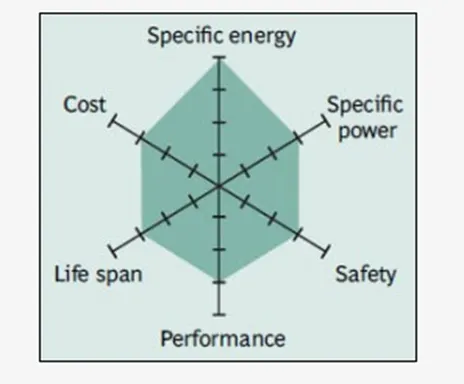
Characteristics are as follow for Lithium Iron Phosphate Battery (LiFePO4) — LFP
1. Specific Energy - Improvement
2. Specific Power - Excellent
3. Safety - Excellent
4. Performance - Good
5. Life Span - Excellent
6. Cost - Good
6. Lithium Titanate battery (Li2TiO3) — LTO
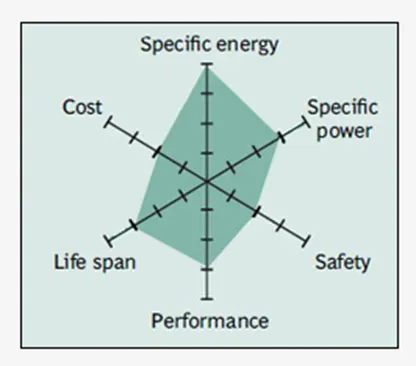
Li-titanate replaces the graphite in the anode of a typical Li-ion battery. The cathode can be lithium manganese oxide or NMC. Li-titanate has a nominal cell voltage of 2.40V, can be fast charged and delivers a high discharge current of 10C, or 10 times the rated capacity. The cycle count is said to be higher than that of a regular Li-ion. Li-titanate is safe, has excellent low-temperature discharge characteristics and obtains a capacity of 80 percent at –30°C (–22°F).
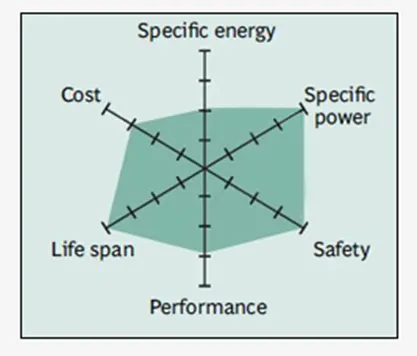
Characteristics are as follow for Lithium Titanate battery (Li2TiO3) — LTO
1. Specific Energy - Excellent
2. Specific Power - Good
3. Safety - Improvement
4. Performance - Good
5. Life Span - Good
6. Cost - Improvement
Please find attached below files for your reference.