Understanding Different Battery Chemistry
Aim:- Study of Different Types of Lithium ion Cells
Theory:- A Battery is a device consisting of one or more electrochemical cells with external connections for powering electrical devices such as Flashlights, mobile phones and electric cars. When a battery is supplying electric power, its positive terminal is the cathode and its negative terminal is the anode. The terminal marked negative is the source of electrons that will flow through an external electric circuit to the positive terminal. When a battery is connected to an external electric load, a redox reaction converts high-energy reactants to lower-energy products & the free energy difference is delivered to the external circuit as electrical energy.
There are two types of batteries,
1. Primary cell - These batteries are one time use batteries and they cannot be recharged for further usage.
2. Secondary cell - These batteries can be recharged and can be used for multiple times.
Lithium Ion Cell:
The Lithium ion batteries are secondary type of batteries which can be recharged for further usage.
The Lithium ion cells have four main Components in it and they are,
(i) Cathode:
They are the positive elctrodes of the cell. The cathode elctrode is usually made up of,
1. Layered Transition metal oxides - Has high Capacity but high in cost and poor in safety.
2. Spinels - High power Density but poor in conductivity and stability.
3. Olivines - Lees capacity but has long life and are high in safety.
(ii) Anode:
They are the negative elctrodes of the cell. The anode elctrode is usually made up of Graphite & Hard Carbon and these anodes are less in cost and high in stability and specific capacity.
(iii) Electrolyte:
An electrolyte is a substance that produces an electrically conducting solution when dissolved in a polar solvent. The dissolved electrolyte separates into cations and anions, which disperse uniformly through the solvent. Generally Lithium ion cells have electrolyes of Organic solvents such as, Ethylene carbonate, dimethyl carbonate, propylene carbonate and lithium salt as solute.
(iv) Seperator:
Battery separators provide a barrier between the anode (negative) and the cathode (positive) while enabling the exchange of lithium ions from one side to the other. They are materials that conducts ions but they do not conduct the electrons through them. Li-ion cells use polyolefin as a separator. This material has excellent mechanical properties, good chemical stability and is low-cost as well.
Working of Lithium Ion Cell:-
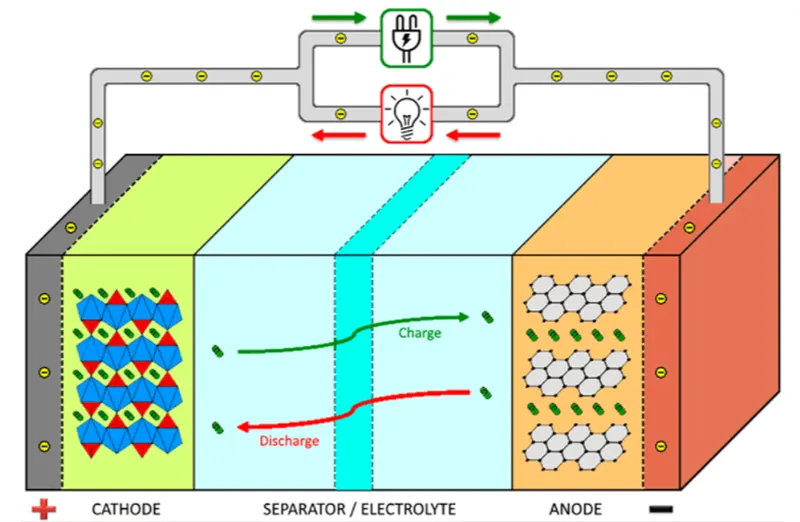
The battery is made up of an anode, cathode, separator, electrolyte, and two current collectors (positive and negative), the anode and cathode store the lithium.
The electrolyte carries positively charged lithium ions from the anode to the cathode and vice versa through the separator.
The movement of the lithium ions creates free electrons in the anode which creates a charge at the positive current collector.
The electrical current then flows from the current collector through a device being powered (cell phone, computer, Electric motor etc.) to the negative current collector. The separator blocks the flow of electrons inside the battery.
While the battery is discharging and providing an electric current, the anode releases lithium ions to the cathode, generating a flow of electrons from one side to the other.
When charging, the opposite happens, where Lithium ions are released by the cathode and received by the anode.
Parts of Lithium Ion Battery:-
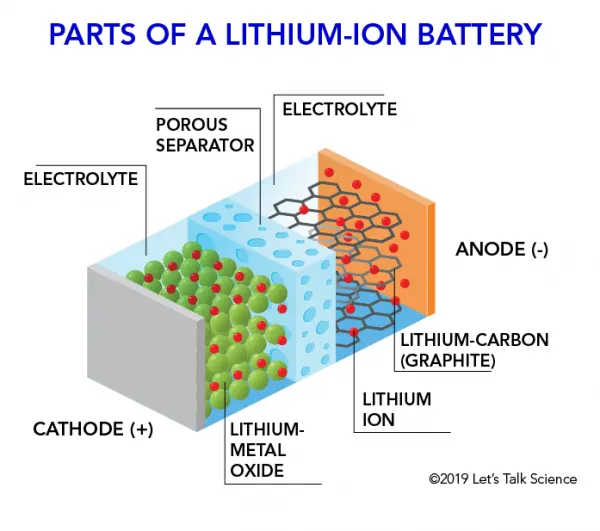
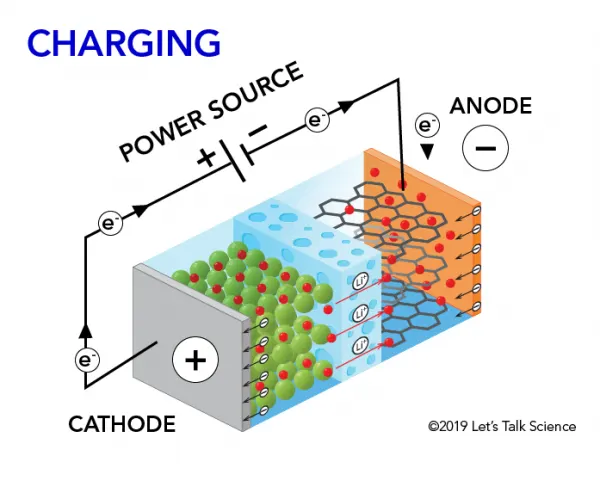
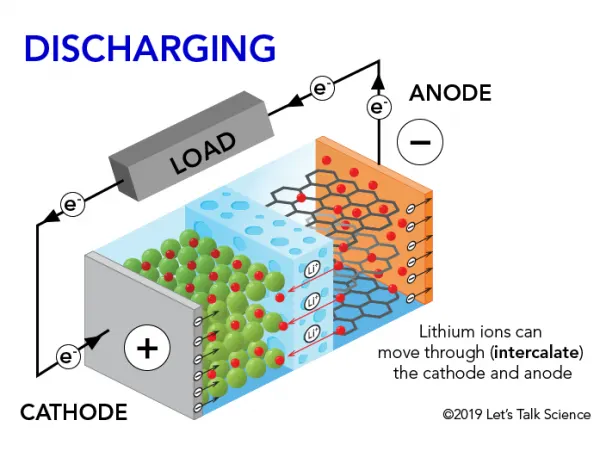
The 6 commonly used lithium ion batteries are listed below:-
1. Lithium cobalt oxide - LiCoO2 (LCO):-
Lithium cobalt oxide (LCO) battery was invented in the year 1991. Its anode material is LiaC6, the cathode material is LibCoO2 and the carrier is Li+. It is used in various applications ranging from electronic devices to all laptops and phone batteries. The majority of lithium ion batteries for portable devices are cobalt based. The system contains a cobalt oxide cathode (positive electrode) and graphite carbon anode (negative electrode).

2. Lithium Manganese Oxide - LiMn2O4 (LMO):-
Lithium ion manganese oxide battety (LMO) is a lithium ion cell that uses manganese dioxide MnO2 as a cathode material. They function through the same intercalation/ de-intercalation mechanism as other commercilized secondary battery technologies such as LiCoO2. Cathodes based on manganese oxide components are earth - abundant, inexpensive, non - toxic and provide better thermal stability.
MnO2 + Li + +e--->LiMnO4
3. Lithium Nickel Cobalt Aluminium Oxide - LiNiCoAlO2 (NCA):-Lithium Nickel cobalt aluminium oxides (NCA) battery has been around since 1999 for special applications. It shares similarities with NMC by offering high specific energy, reasonably good specific power and a long life span.

4. Lithium Nickel Manganese Cobalt Oxide - LiMnCoO2 (NMC):-
Lithium Nickel Manganese Cobalt Oxide (NMC) battery offer a combination a nickel, Manganese and cobalt. They are sometimes known as Lithium Manganese Cobalt oxide batteries. NMC batteries have a high specific energy or power.

5. Lithium Iron Phosphate - LiFePo4 (LFP):-
Lithium iron phosphate battery (LiFeO4) batteries which is known as Li - phosphate batteries as well. They use phosphate as cathode material. In addition they benefit from the low resistance properties that enchance their thermal stability and safety.

6. Lithium Titanium Oxide - LiTiO2 (LTO):-
Lithium Titanate oxide (LTO) batteries is a type of rechargable battery which has the advantage of being faster to charge than other lithium ion batteries but its disadvantage of having a much lower energy density.


Comparision Table:
| Li - ion cell Type | Cathode | Anode | Electrolyte | Seperator | Overall Reaction at Cathode & Anode | Application |
| LCO | Graphite | Lithium Cobalt Oxide | Ethylene Carbonate + Li salt |
Polyolefin | Li1-xCoO2(s) + x Li+ + x e- → LiCoO2(s) |
Mobile phones, laptops and digital cameras |
| LMO | lithium manganese oxide | Graphite carbon | Methyl carbonate + Li salt | Polyolefin |
Mn2+ + 2 LiC6 → Mn + 2 Li++ graphite |
Power tools, medical devices, electric powertrains |
| NCA | Comprised of Nickel cobalt & Aluminium | Graphite carbon | Propylene carbonate + Li salt | Polyolefin |
Li(1−x)NiO2 → (2 − x)Li(1−x)/(2−x)Ni1/(2−x)O + x/2O2 |
Medical devices, industrial, electric powertrain (Tesla) |
| NMC | Comprised of Nickel cobalt & Manganese | Lithium metal Graphite | Methyl carbonate + Li salt | Polyolefin | Li(x)MO2(s) → Li+(org) + Li(x-1)MO2(s) + e-. |
E-bikes, medical devices, EVs, industrial |
| LFP | Comprised of Lithium, Iron & Phosphate | Graphite Carbon | Propylene carbonate + Li salt | Polyolefin |  |
Portable and stationary needing high load currents and endurance |
| LTO | Comprised of Nickel cobalt & Manganese |
Lithium–titanium oxide |
Propylene carbonate + Li salt | Polyolefin | Li4Ti5O12 + 3Li+ + 3e → 4 Li7Ti5O12 | UPS, electric powertrain (Mitsubishi i-MiEV, Honda Fit EV), solar-powered street lighting |