Week 1 Understanding Different Battery Chemistry
Types of lithium-ion cells and its comparison :
| Types | Chemical name | Anode material | Chemical Reaction at the anode(discharge) | Cathode material | Chemical Reaction at the cathode(discharge) | Overall reaction |
| Lithium Cobalt Oxide (LCO) | LiCoO2 | Graphite carbon |  |
Lithium Cobalt Oxide |  |
 |
| Lithium-ion manganese oxide battery (LMO) | LiMn2O4 | Graphite carbon | 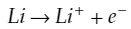 |
Lithium manganese oxide |  |
 |
| Lithium iron phosphate battery(LFP) | LiFePO4 | Graphite carbon |  |
Lithium iron phosphate |  |
 |
| Lithium nickel cobalt aluminium oxides (NCA) | LiNiCoAlO2 | Graphite carbon |  |
Lithium Nickel Cobalt Aluminum Oxide |  |
 |
| Lithium Nickel Manganese Cobalt Oxide (NMC) | LiNiMnCoO2 | Graphite carbon |  |
Lithium Nickel Manganese Cobalt Oxide |  |
 |
| Lithium-titanate-oxide (LTO) battery | Li2TiO3 | Lithium titanium oxide |  |
Manganese oxide |  |
 |
1)Lithium cobalt oxide(LCO) battery
LCO battery anode material is LiaC6, the cathode material is LibCoO2 and the carrier is Li+. It is used in various applications such as electronic devices to all phone and laptops batteries. The majority of lithium-ion batteries for portable devices are cobalt-based. The system contains a cobalt oxide cathode (positive electrode) and graphite carbon anode (negative electrode). It was invented in the year 1991.
2)Lithium-ion manganese oxide (LMO)battery
LMO is a lithium ion cell that uses manganese dioxide, MnO2, as the cathode material. Cathodes based on manganese-oxide components are earth-abundant, inexpensive, non-toxic, and provide better thermal stability.They function through the same intercalation/de-intercalation mechanism as other commercialized secondary battery technologies, such as LiCoO2.
LFP batteries is also known as li-phosphate batteries as well. They use phosphate as cathode material. In addition, they benefit from the low resistance properties that enhance their thermal stability and safety.
4)Lithium nickel cobalt aluminium oxides (NCA) battery
5)Lithium Nickel Manganese Cobalt Oxide (NMC) battery
Differences between each type of Li+ion batteries based on their characteristics
| Characteristics | LCO | LMO | NMC | LFP | LTO |
| Voltage (per cell)/operating range | 3.6 / (3-4.2V) | 3.7 / (3-4.4V) | 3.6 / (3-4.2V) | 3.2 / (2.5-3.65V) | 2.4 / (1.8-2.85V) |
| Charge Rate | 0.7-1C(>1C shortern life) | 0.7-1C (3C Max) | 0.7-1C(>1C shortern life) | 1C | 1C(5C Max) |
| Charge Voltage | 4.2V per cell | 4.2V per cell | 4.2V per cell | 3.5-3.65V per cell | 2.85V per cell |
| Discharge Rate |
1C(>1C shortern life) 2.5V cutt-off |
1C(>1C shortern life) 2.5V cutt-off |
1C(2C on same cell) 2.5V cutt-off |
1C(30C power cell) 2.0V cutt-off |
10C (30C 5sec) 1.8V cutt-off |
| Specific Energy | 150-200 Wh/kg | 100-150 Wh/kg | 150-220 Wh/kg | 90-120 Wh/kg | 50-80 Wh/kg |
| Energy density | 560Wh/l | 420Wh/l | 580Wh/l | 333Wh/l | 177Wh/l |
| Cycle life | 500-1000 | 300-700 | 1000-2000 | 2000-4000 | 3000-7000 |
| Thermal runaway (in celsius) | 150 Celsius | 250 Celsius | 210 Celsius | 270 celsius | NA |
| Cost | medium | Medium | Comparitively low | Comparitively low | Comparitively high |
| Application | Mobile Phone, laptop,tablet,camera | Electric powertrains,power tool, medical devices | Industrial,power tool, medical devices, E-Bikes | Applicable were high currents and endurance needed | electric powertrain, solar street lighting |