Project 1 Mechanical design of battery pack
Objectives:
- In this project, we'll figure out all the calculations needed to construct an EV battery pack.
- For our battery pack, we're going to use Cell: ANR26650M1-B.
- All electrical factors, including temperature, Depth of Discharge, Operation Current, Energy Density, Work Cycles, Battery Capacity, State of Charge (SOC), State of Health (SOH), and Ampere-Hour (Ah) Capacity, will be taken into account when determining parameters.
- Additionally, we will compute all geometrical factor, including size, weight, volume, area, etc.
- Finally, we will Consider perfect enclosure for dimensions that we calculated for the Battery Pack.
Technical Specifications of ANR26650M1-B :
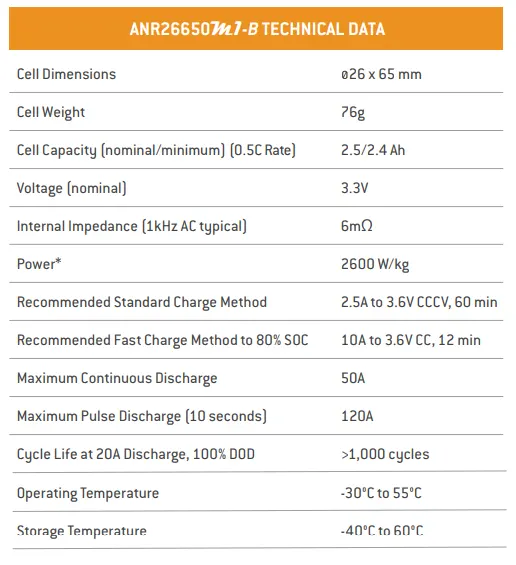
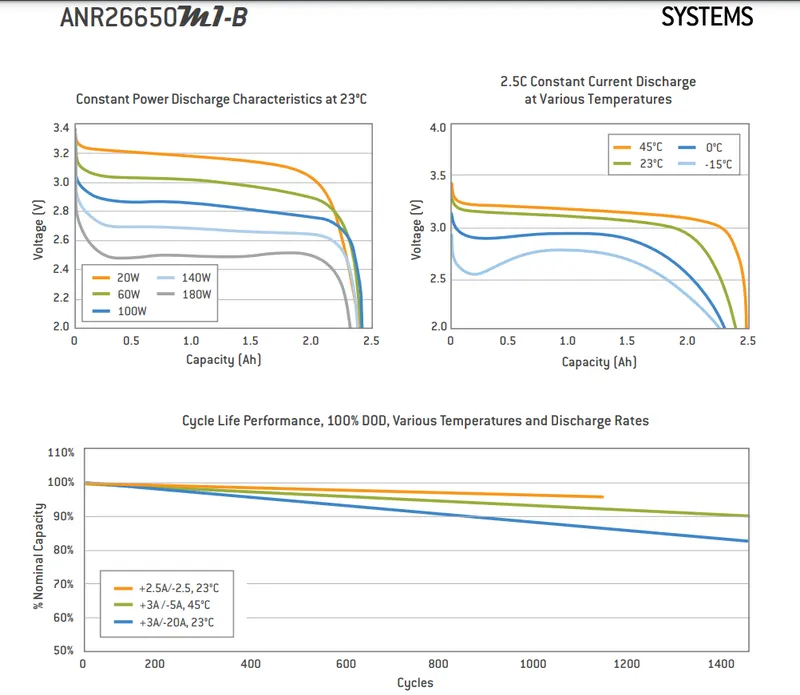
Reference: https://www.batteryspace.com/prod-specs/6610.pdf
ANR26650M1-B Specifications:
Nominal Ratings
Voltage: 3.3 Volts
Capacity: 2.5 Ah
Energy: 8.25 Wh
Specific Power: 2600 W/kg
Impedance (1KHz AC Typical) 6 mΩ
Cycle Life at 1C/1C, 100% DOD: > 4000 cycles
Cell Type: 26650 Lithium Ion Power Cylindrical Cell
Discharging
Max Continuous Discharage: 50 A
Max Pulse Discharge Current >50% SOC (10s): 120 A
Minimum Voltage: 2 Volts
Temperature: -30ºC to 55ºC
Charging
Recommended Standard Charge: 2.5 Amps
Max Charge Rate: 10 Amps
Max Pulse Charge Current <50% SOC (10s): 25 A
Float Voltage: 3.45 Volts
Recommended charge V & Cut-off Current: 3.6 Volts, taper to 125mA
Temperature
(reduce charging current to 250mA when under 0ºC): 0ºC to 55ºC
Mechanical
Diameter: Ø25.96 +/- 0.5 mm (1.0")
Length: 65.15 +/- 0.5 mm (2.6")
Mass: 76 g
Cylindrical Cell Primary Applications:
- Portable high power devices
- Stationary battery backup systems
- Grid stabilization energy storage systems
- Commercial truck and bus hybrid electric vehicles (HEVs)
Lithium Ion Cell Benefits:
- Power: Over 2,600 W/kg and 5,800 W/L
- Safety: Excellent abuse tolerance and environmentally friendly
- Life: Excellent calendar life, 10X cycle life vs. conventional lithium ion
Calculations:
- Calculations are for designing an 18kWh battery pack.
- Basically 18kWh is energy require to achieve the vehicle to its proper range. It's depends upon the parameters, voltage (V) and capacity (Ah) .
Assumptions:
- Nominal voltage = 72V
- We design HV battery pack for an EV to achieve up to 250km range.
1. Single Cell Energy (Wh) = Cell Capacity (Ah) x Cell Voltage (V)
= 2.5 x 3.3
= 8.25 Wh
Single cell energy is used to calculate the total energy of the battery pack.
2. Volume of the cell (m^3): Volume of cylinder = π*r^2*h, r= radius and h= height
From Datasheet of battery, we have 'r' and 'h' values i.e. d= 25.96 mm, r=0.013m and h=0.065m
Volume of cylinder = 3.14*0.013^2*0.065
=0.0000345 m^3
3. Single Cell Energy Density
Volumetric energy (Wh/m^3) = Single Cell Energy / Volume of each cell
= 8.25 Wh / 0.0000345m3
= 239.13 kWh/m3
Gravimetric energy (Wh/kg) = Single Cell Energy / Single Cell Mass
= 8.25 Wh / 0.076 kg
= 108.55 Wh/kg
We will calculate per km average energy = 18 kWh / 250km
= 72 Wh/km
As we assumed Nominal voltage for series connection = 72 V, Basically, this depends upon the motor power, We can decide the value according to the motor.
4. Number of cells connected in series = Nominal voltage of series connection / Nominal voltage of a single cell
=72 V / 3.3 V
= 21.88 = 22
So Number of cells connected in series = 22
22 Cells will be connected in a series connection to provide a proper voltage.
5. Battery pack capacity (Ah) = Total energy of battery pack / Nominal voltage
= 18000/72
= 250 Ah
6. Number of cells connected in parallel = Battery pack capacity / Nominal cell capacity
= 250 / 2.5
= 100
So 100 number of cells connected in parallel to provide a proper capacity power.
7. Total number of cells for battery pack = No. of cells connected in parallel x No. of cells connected in series
=100x22
= 2200
8. Battery pack total energy (wh) = No. of cells connected in parallel x Energy for battery pack (wh)
= 100 x 181.5
= 18.150kWh
9. Battery pack capacity = No. of cells connected in parallel x Single cell capacity (Ah)
= 100 x 2.5 Ah
= 250 Ah
Battery pack capacity of 250Ah is used for the total power required by the vehicle and 2200 cells will required to make complete battery pack.
10. Total volume of the battery pack = Total no. of cells for batter pack x Volume of single cell
= 2200 x 0.0345
= 75.9 m^3
11. Total Weight in kg of battery pack = Total no. of cells for batter pack x Mass of single cell
= 2200 x 0.076 kg
= 167.2 kg
12. Cell peak current (A) = C rate (Max Pulse Charge Current) x Single cell capacity
= 2.5 x 2.5
= 6.25 A
13. Battery pack peak current (A) = Cell peak current x No. of cells connected in parallel
= 6.25X100
= 625 A
Battery pack peak current will required to calculate Battery pack peak power.
14. Battery pack peak power (W) = Battery pack peak current x Voltage of series connection
= 625 x 72
= 45kW
15. Cell continuous current (A) = C rate (Max Continuous Charge Current) x Single cell capacity
= (2.5/10) x 2.5
= 0.625 A
16. Battery pack continuous current (A) = Cell continuous current x No. of cells connected in parallel
= 0.625 x 100
= 62.5 A
This is the power which is supply continue to the whole battery pack system.
17. Battery pack continuous power (W) = Battery pack continuous current x Voltage of series connection
= 62.5A x 72V
= 4.5 kW
Detailed battery pack design including its enclosure:
A. Dimensions of cell:
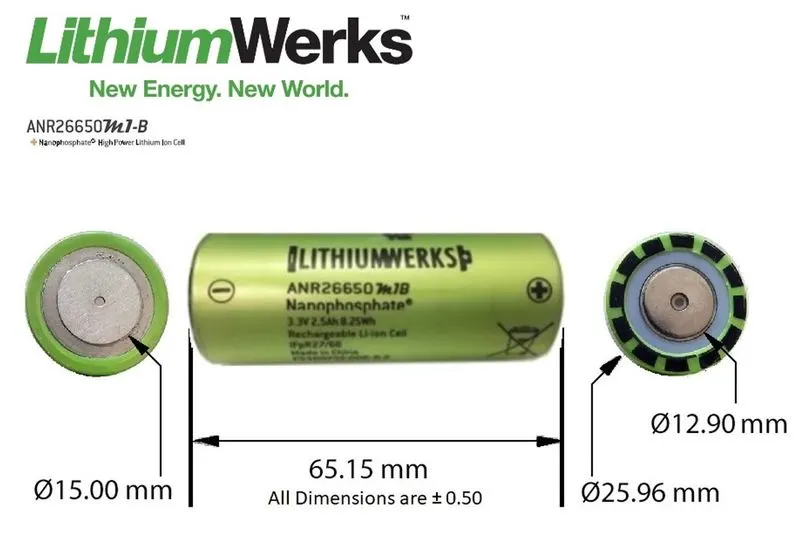
Reference: https://www.greyb.com/ev-battery-startups/
B. Battery's inside structure:
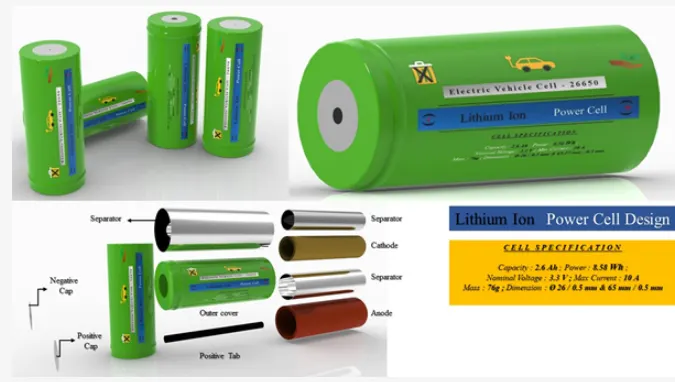
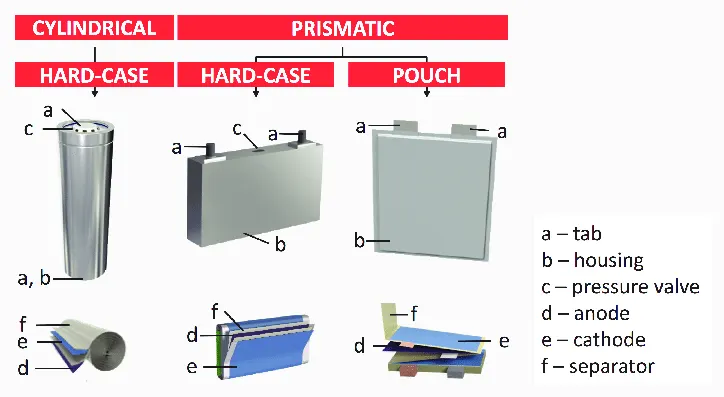
Fig. Different shapes of Lithium-ion battery cells
Reference link: EV design- battery calculations
C. Battery holder and spacer:
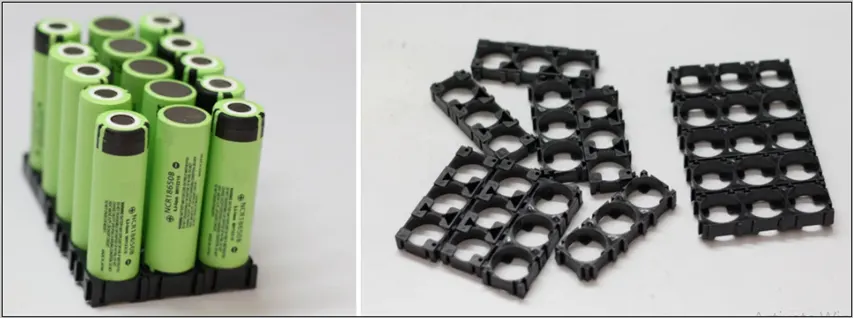
- The function of a battery holder is to keep the cells fixed in place safely and securely.
- It also ensures that the cells arranged properly to reduce mechanical vibration and improve the thermal runway between the cell gaps.
- Polypropylene or nylon bodies suitable for 80-100 °C comprise the majority of the cell holder's body.
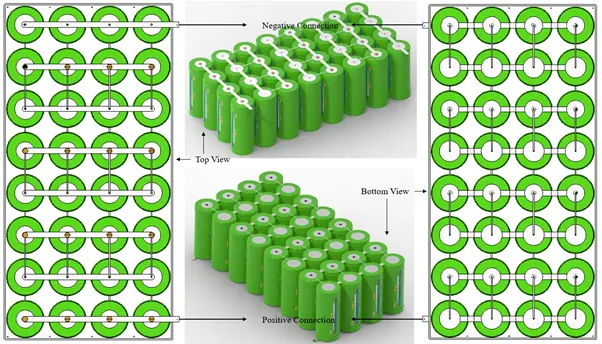
Nickel strip is mostly used in battery building. Because of its efficiency of usage in spot welding and soldering.It has good properties and excellent resistance to many corrosive environments. It has high corrosion resistance over time. The pure nickel will never get rust after it applied to battery packs. Also It won’t affect the current transfer between batteries.
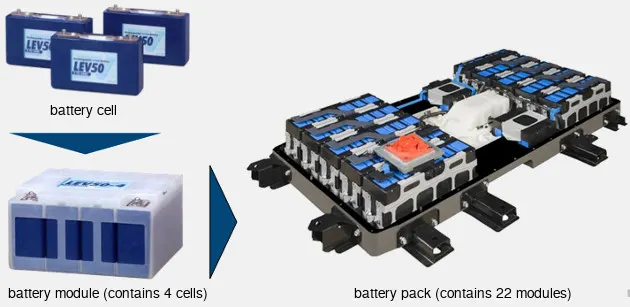
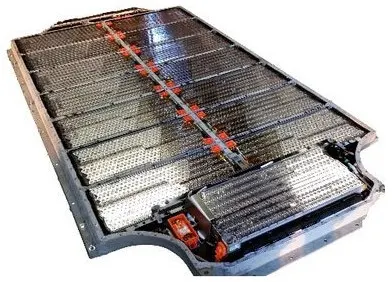
fig. Battery pack, module and cell Fig. Tesla Model Battery pack
D. Battery Enclosure:
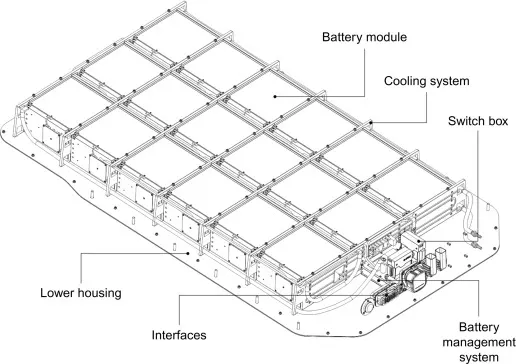
Fig. Novelis 2nd generation Aluminum Intensive Battery Enclusure for EV
(https://www.novelis.com/automotive/gen2battery-enclosure-solution/)
Conclusion: To Design Battery pack capacity of 18 kWh, by using Cell: ANR26650M1-B, follwing Battery pack parameter required.
| Calculated Parameters | Value Get |
|
Cell Volume |
0.0000345m^2 |
| Cell Energy | 8.25Wh |
| Single Cell Energy Density | 239.13 kWh/m3 |
| Pack assumptions | 22s 100p |
| Total no of cells | 2200 |
| Nominal Voltage (Assumption) | 72V |
| Capacity | 250 Ah |
| Energy | 18150WAh |
| Total volume | 75.9 m^3 |
| Weight | 167.2 kg |