Week 1 Understanding Different Battery Chemistry
1.
AIM:
to prepare a table which include a materials of anode, cathode and their chemical reaction.
table:
Types of lithium ion battery::
|
s.no |
type |
Chemical name |
cathode |
anode |
Overall reaction: |
|
1 |
Lithium Cobalt Oxide (LCO) |
Lithium Cobalt Oxide |
Lithium Cobalt Oxide Reaction:: Li1-xCoO2+xLi++xe-→LiCoO2 |
Graphite carbon Reaction:: LixC6→xLi++xe-+C6 |
C6+LiCoO2↔LiC6+CoO2 |
|
2 |
Lithium-ion Manganese Oxide battery (LMO) |
Lithium-ion Manganese Oxide |
Lithium-ion Manganese Oxide Reaction:: Li1xMn2O4+xLi++xe-→LiMn2O4 |
Graphite carbon Reaction:: LixC6→xLi++xe-+C6 |
C6+LiMn2O4↔LiC6+Mn2O4 |
|
3 |
Lithium Nickel Cobalt Aluminium oxides (NCA) |
Lithium Nickel Cobalt Aluminium oxides |
Lithium Nickel Cobalt Aluminium oxides Reaction:: Li1xNiCoAlO2+xLi++xe-→LiNiCoAlO2 |
Graphite carbon Reaction:: LixC6→xLi++xe-+C6 |
C6+LiNiCoAlO2↔LiC6+NiCoAlO2 |
|
4 |
Lithium Nickel Manganese Cobalt Oxide (NMC) |
Lithium Nickel Manganese Cobalt Oxide |
Lithium Nickel Manganese Cobalt Oxide Reaction:: Li1xNi0.8Mn0.1Co0.1O2+xLi++xe-→LiNi0.8Mn0.1Co0.1O2 |
Graphite carbon Reaction:: LixC6→xLi++xe-+C6 |
C6+LiNi0.8Mn0.1Co0.1O2↔LiC6+Ni0.8Mn0.1Co0.1O |
|
5 |
Lithium Iron Phosphate battery (LFP) |
Lithium Iron Phosphate |
Lithium Iron Phosphate Reaction:: Li1-xFePO4+xLi++xe-→LiFePO4 |
Graphite carbon Reaction:: LixC6→xLi++xe-+C6 |
C6+LiFePO4↔LiC6+FePO4 |
|
6 |
Lithium-Titanate-Oxide battery (LTO) |
Lithium-Titanate-Oxide |
manganese-Oxide Reaction:: 4Li1-xMn2O4+4Li++4e-→4LiMn2O4 |
Lithium Titanium Oxide Reaction:: Li4Ti5O12→Ti5O12+4Li++4e- |
Li4Ti5O12+4Mn2O4↔4LiMn2O4+Ti5O12 |
this table in attached in the below.
Explanation::
1.lithium cobalt oxide(LCO) battery:
LCO (Lithium cobalt oxide) was invented in the year 1991. Its anode material is LiaC6, the cathode material is LibCoO2 and the carrier is Li+.It is used in various applications ranging from electronic devices to all laptops and phone batteries. The majority of lithium-ion batteries for the portable devices are cobalt based. The system contains a cobalt oxide cathode (positive electrode) and graphite carbon anode (negative electrode). LCOstands for Lithium cobalt battery. Lithium cobalt oxide is one of the most common Lithium-ions, it has a chemical symbol which is LiCoO2 and is abbreviated as LCO. For simplification, Li-cobalt –which is the short term- can also be used for this type battery. Cobalt is the core active material which defines the character of the battery.
2.Lithium ion manganese Oxide(LMO) Battery::
A lithium ion manganese oxide battery (LMO) is a lithium ion cell. that uses manganese dioxide,MnO2 , as the cathode material. They function through the same interation/de-intercalation mechanism as other commercialized secondary battery technologies, such as LiCoO2 . Cathodes based on manganese-oxide components are earth-abundant, inexpensive, non-toxic, and provide better thermal stability.
3.Lithium Nickel Cobalt Aluminium Oxide(NCA)::
The lithium nickel cobalt aluminium oxides (NCAs) are a group of mixed metal oxides . Some of them are important due to their application in lithium ion batteries. NCAs are used as active material on the positive pole (which is the cathode when the battery is discharged). NCAs are composed of the cations of the chemical element lithium. The most important representatives as of this date have the general formula LiNixCoyAlzO2 with x + y + z = 1. In case of the NCA comprising batteries currently available on the market, which are also used in electric cars and electric appliance. x ≈ 0,8, and the voltage of those batteries is between 3.6 V and 4.0 V, at a nominal voltage of 3.6 V or 3.7 V. A version of the oxides currently in use in 2019 is LiNi0,84Co0,12Al0,04O2.
4.Lithium nickel manganese cobalt oxide (NMC) ::
One of the most successful li-ion cathode formulas developed to date is obtained by combining nickel, manganese, and cobalt. Lithium-Nickel-Manganese-Cobalt-Oxide (LiNiMnCoO2), abbreviated as NMC, has become the go-to cathode powder to develop batteries for power tools, e-bikes and other electric powertrains. It delivers strong overall performance, excellent specific energy, and the lowest self-heating rate of all mainstream cathode powders, which makes it the preferred option for automotive batteries.While NMC powder can refer to a variety of blends, the formula typically consists of 33% nickel, 33% manganese and 33% cobalt. This blend, sometimes referred to as 1-1-1, is a popular option for mass-produced cells in applications requiring frequent cycling (automotive) due to the reduced material cost resulting from lower cobalt content.
5.Lithium Iron Phosphate (LFP)::
The lithium iron phosphate battery or LFP battery is a type of lithium-ion battery using lithium iron phosphate as the cathode material, and a graphitic carbon electrode with a metallic backing as the anode.Reversible extraction of lithium from LiFePO
4 and insertion of lithium into FePO
4 was demonstrated. Because of its low cost, non-toxicity, the natural abundance of iron , its excellent thermal stability, safety characteristics, electrochemical performance, and specific capacity (170 mA-h/g, or 610 c/g ) it has gained considerable market acceptance
6.lithium titanate oxide (LTO)::
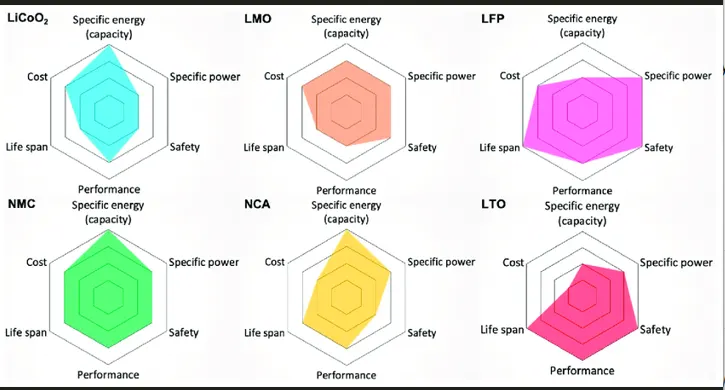
Specific energy: This defines the battery capacity in weight (Wh/kg). The capacity relates to the runtime. Products requiring long runtimes at moderate load are optimized for high specific energy.
Specific power: It's the ability to deliver a high current and indicates loading capability. Batteries for power tools are made for high specific power and come with a reduced specific energy.
Performance: This measures how well the battery works over a wide range of temperatures. Most batteries are sensitive to heat and cold and require climate control. Heat reduces life, and cold lowers performance temporarily.
Lifespan: This reflects cycle life and longevity and is related to factors such as temperature, depth of discharge, and load. Hot climates accelerate capacity loss. Cobalt blended lithium-ion batteries also usually have a graphite anode that limits the cycle life.
Safety: This relates to factors such as the thermal stability of the materials used in the batteries. The materials should have the ability to sustain high temperatures before becoming unstable. Instability can lead to thermal runaway in which flaming gases are vented. Fully charging the battery and keeping it beyond the designated age reduces safety.
Cost: Demand for electric vehicles has generally been lower than anticipated, mainly due to the cost of lithium-ion batteries. Hence cost is a huge factor when selecting the type of lithium-ion battery.
CHARACTERISTICS:
Comparison of lithium ion battery: |
Where,
- SP stands for specific power
- SE stands for specific energy
- SF stands for safety
- LS stands for lifespan
- CS stands for cost
- PF stands for performance
- L stands for low
- M stands for moderate
- H stands for high
SUMMARY OF THE TABLE::
Lithium Cobalt Oxide has high specific energy compared to the other batteries, making it the preferred choice for laptops and mobile phones. It also has a low cost and a moderate performance. However, it is highly unfavorable in all the other aspects when compared to the other lithium-ion batteries. It has low specific power, low safety, and a low lifespan.
Lithium Manganese Oxide has moderate specific power, moderate specific energy, and a moderate level of safety when compared to the other types of lithium-ion batteries. It has the added advantage of a low cost. The downsides are its low performance and low lifespan. It is usually used in medical devices and power tools.
Lithium Nickel Manganese Cobalt Oxide has two major advantages as compared to the other batteries. The first one is its high specific energy, which makes it desirable in electric powertrains, electric vehicles, and electric bikes. The other is its low cost. It is moderate in terms of specific power, safety, lifespan, and performance when compared to the other lithium-ion batteries. It can be optimized to either have high specific power or high specific energy.
Lithium Iron Phosphate only has one major disadvantage when compared to other types of lithium-ion batteries, and that is its low specific energy. Other than that, it has moderate to high ratings in all the other characteristics. It has high specific power, offers a high level of safety, has a high lifespan, and comes at a low cost. The performance of this battery is also moderate. It is often employed in electric motorcycles and other applications that require a long lifespan and a high level of safety.
Lithium Nickel Cobalt Aluminum Oxide offers one strong advantage compared to the five other batteries: high specific energy. It is pretty moderate in the rest of the characteristics like performance, cost, specific power, and lifespan. The only downside to this battery type is its low level of safety. Its high specific energy and moderate lifespan make it a good candidate for electric powertrains.
Lithium Titanate offers high safety, high performance, and a high lifespan which are very important features every battery should have. Its specific energy is low compared to the five other lithium-ion batteries, but it compensates for this with moderate specific power. The only major disadvantage of lithium titanate as compared to the other lithium-ion batteries is its extremely high cost. Another important feature of this battery worthy of mention is its remarkably fast recharge time. It can be used for storing solar energy and creating smart grids.
5-SCALE CHARACTERISTICS OF TYPE OF LITHIUM ION BATTERY::