Understanding Different Battery Chemistry
Aim & Objectives
To prepare a table which includes materials and chemical reactions occurring at anode and cathode of LCO, LMO, NCA, NMC, LFP and LTO type of lithium ion cells.
Explanation
Figure below shows a schematic of a lithium-ion cell, but the basic idea applies generally.
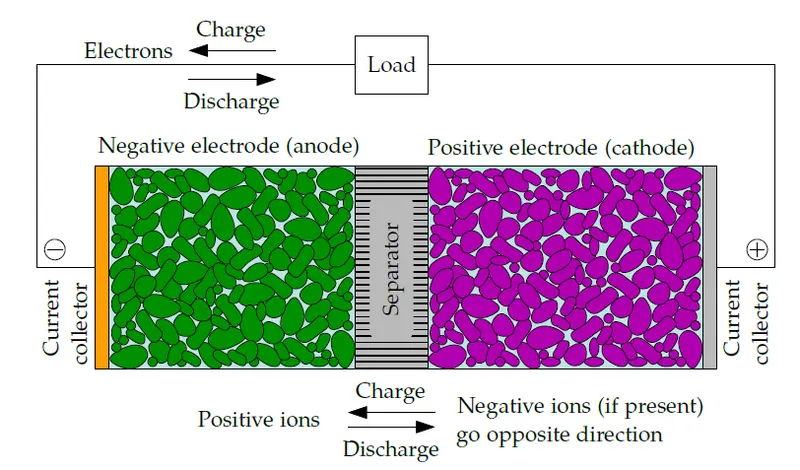
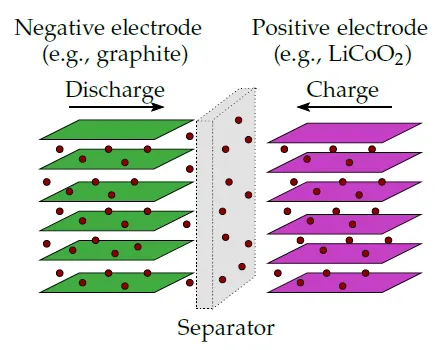
Lithium ion cells have several advantages over other chemistries. They operate at higher voltages than other rechargeable cells, typically about 3.7V for lithium-ion versus 1.2V for NiMH or NiCd. Because of this, they tend to have higher energy density also. The higher voltage means that a single cell can often be used in a particular application rather than multiple NiMH or NiCd cells in series. While NiCd and NiMH do not require battery management circuitry for safe operation, all battery packs can potentially benefit from battery management: the battery management circuitry for lithium ion can be simplified by this reduced cell count. Lithium ion cells also have a lower self-discharge rate than other types of rechargeable cells. NiMH and NiCd cells can lose anywhere from 1–5% of their charge per day, even if they are not installed in a device. Lithium-ion cells, on the other hand, will retain most of their charge even after months of storage. The table below shows the materials and chemical reactions occurring at anode and cathode of lithium ion cells.
|
Battery Name |
Anode Material |
Cathode Material |
Electrolyte |
Separator |
Reaction at Anode |
Reaction at Cathode |
Overall Reaction |
|
LCO (Lithium Cobalt Oxide) |
Graphite Carbon |
Cobalt Oxide |
Ethylene Carbonate |
Polyolefin |
LiC6 → xLi+ + xe− + C6 |
Li1−xCoO2 + xLi+ + xe− → LiCoO2 |
C6 + LiCoO2 ⟷ LixC6 + Li1−xCoO2 |
|
LMO (Lithium Manganese Oxide) |
Graphite |
Lithium Manganese spinal |
Lithium Halide |
Polyolefin |
LiC6 → xLi+ + xe− + C6 |
Li1-xMn2O4 + xLi+ + xe- → LiMn2O4 |
C6 + LiMn2O4 ⟷ LixC6 + Li1−xMn2O4 |
|
NCA (Lithium Nickel Cobalt Aluminium Oxide) |
Graphite |
Lithium Nickel Cobalt Aluminium spinal |
Ethylene Carbonate |
Polyolefin |
LiC6 → xLi+ + xe− + C6 |
Li1−xNiCoAlO2 + xLi+ + xe− → LiNiCoAlO2 |
C6 + LiNiCoAlO2 ⟷ LixC6 + Li1−xNiCoAlO2 |
|
NMC (Lithium Nickel Manganese Cobalt Oxide) |
Graphite |
Nickel Manganese Cobalt |
Lithium Salt |
Polyolefin |
LiC6 → xLi+ + xe− + C6 |
Li1−xNiMnCoO2 + xLi+ + xe− → LiNiMnCoO2 |
C6 + LiNiMnCoO2 ⟷ LixC6 + Li1−xNiMnCoO2 |
|
LFP (Lithium Iron Phosphate) |
Graphite |
Phosphate |
Ethylene Carbonate |
Polyolefin |
LiC6 → xLi+ + xe− + C6 |
LiFe(III)PO4 + xLi+ + xe− → LiFe(II)PO4 FePO4 + Li+ + e− → LiFePO4 |
C6 + LiFePo4 ⟷ LixC6 + Li1−xFePo4 |
|
LTO (Lithium Titanate) |
lithium titanate |
lithium manganese oxide or NMC |
Lithium Salt |
Polyolefin |
LiTiO2 → xLi+ + xe− + TiO2 |
Li1-xMn2O4 + xLi+ + xe- → LiMn2O4 |
TiO2 + LiMn2O4 ⟷ LixTiO2 + Li1−xMn2O4 |
Conclusion
A table which includes materials and chemical reactions occurring at anode and cathode of LCO, LMO, NCA, NMC, LFP and LTO type of lithium ion cells were created.
Reference
[1] https://batteryuniversity.com/learn/article/types_of_lithium_ion
[2] https://www.science.org.au/curious/technology-future/lithium-ion-batteries