Week 1 Understanding Different Battery Chemistry
QUESTION NO:1
LITHIUM ION CELL:A lithium-ion (Li-ion) cell is an advanced battery technology that uses lithium ions as a key component of its electrochemistry.
During a discharge cycle, lithium atoms in the anode are ionized and separated from their electrons.
WORKING PRINCIPLE:The movement of the lithium ions creates free electrons in the anode which creates a charge at the positive current collector. The electrical current then flows from the current collector through a device being powered (cell phone, computer, etc.) to the negative current collector
TYPES:
| Sl NO | Lithium Ion Cell Type | ANODE USED | CATHODE USED | Electrolyte | Rex. at Anode | Rex. at Cathode | Redox Rex. |
| 1 | LCO-Lithium Cobalt Oxide |
Lithiated Graphite-LiC6 |
Lithium Cobalt Oxide-LiCoO2 | Lithium Hexafluro Phosphate in Ethylene Carbonate-
LiPF6+C3H4O3
|
LixC6→xLi++xe-+C6 |
Li1-xCoO2+xLi++xe-→LiCoO2 |
C6+LiCoO2↔LiC6+CoO2 |
| 2 | LMO-Lithium Manganese Oxide | Lithiated Graphite-LiC6 | Lithium Manganese Oxide-LiMn2O4 | Lithium Hexafluro Phosphate in Ethylene Carbonate-
LiPF6+C3H4O3
|
LixC6→xLi++xe-+C6 | Li1-xMn2O4+xLi++xe-→LiMn2O4 | C6+LiMn2O4↔LiC6+Mn2O4 |
| 3 | NCA-Lithium Nickel Cobalt Aluminium Oxide | Lithiated Graphite-LiC6 | Lithium Nickel Cobalt Aluminium Oxide-LiNiCoAlO2 | Lithium Hexafluro Phosphate in Ethylene Carbonate-
LiPF6+C3H4O3
|
LixC6→xLi++xe-+C6 | Li1-xNiCoAlO2+xLi++xe-→LiNiCoAlO2 | C6+LiNiCoAlO2↔LiC6+NiCoAlO2 |
| 4 | NMC-Lithium Nickel Manganese Cobalt Oxide | Lithiated Graphite-LiC6 | Lithium Nickel Manganese Cobalt Oxide-LiNi0.8Mn0.1Co0.1O2 | Lithium Hexafluro Phosphate in Ethylene Carbonate-
LiPF6+C3H4O3
|
LixC6→xLi++xe-+C6 | Li1-xNi0.8Mn0.1Co0.1O2+xLi++xe-→LiNi0.8Mn0.1Co0.1O2 | Li1-xNi0.8Mn0.1Co0.1O2+xLi++xe-→LiNi0.8Mn0.1Co0.1O2 |
| 5 | LFP-Lithium Iron/Ferrous Phosphate | Lithiated Graphite-LiC6 | Lithium Ferrous Phosphate-LiFePO4 | Lithium Hexafluro Phosphate in Ethylene Carbonate-
LiPF6+C3H4O3
|
LixC6→ xLi++xe-+C6 | Li1-xFePO4+xLi++xe-→LiFePO4 | C6+LiFePO4↔LiC6+FePO4 |
| 6 | LTO-Lithium Titanium Oxide | Lithium Titanium Oxide-Li4Ti5O12 | Lithium Titanium Oxide-LiMn2O4 | Lithium Hexafluro Phosphate in Ethylene Carbonate-
LiPF6+C3H4O3
|
Li4Ti5O12→Ti5O12+4Li++4e- | 4Li1-xMn2O4+4Li++4e-→4LiMn2O4 | Li4Ti5O12+4Mn2O4↔4LiMn2O4+Ti5O12 |
QUESTION NO:2
| Sl NO | Lithium Ion Cell Type | VOLTAGE | SPECIFIC ENERGY |
C-RATE WHILE CHARGING |
C-RATE WHILE DISCHARGING |
THERMAL RUNAWAY POINT | CYCLE LIFE | APPLICATIONS | CHART |
| 1 | LCO-Lithium Cobalt Oxide |
3.6V (nominal) 3.0-4.2V (typical) |
150-200Wh/kg | 0.7-1C | 1C | 150°C | 500–1000 | Cameras,Mobiles,Laptop | 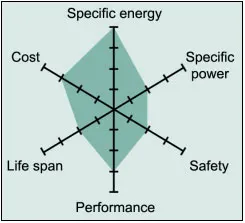 |
| 2 | LMO-Lithium Manganese Oxide |
3.7-3.8V (nominal) 3.0-4.2V (typical) |
100–150Wh/kg | 0.7–1C typical, 3C maximum | 1C; 10C possible with some cell | 250°C | 300-700 | e-powertrains,power tools etc. | 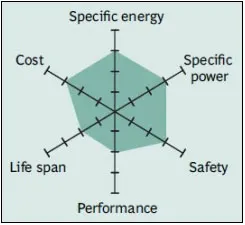 |
| 3 | NCA-Lithium Nickel Cobalt Aluminium Oxide |
3.6V (nominal) 3.0-4.2V (typical) |
200-260Wh/kg | 0.7C | 1C | 150°C | 500 | Medical devices, industrial, electric powertrain | 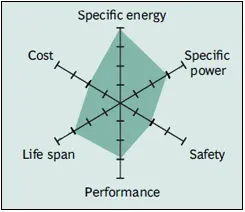 |
| 4 | NMC-Lithium Nickel Manganese Cobalt Oxide |
3.6-3.7V (nominal) 3.0-4.2V (typical) |
150–220Wh/kg | 0.7–1C | 1C; 2C possible on some cell | 210°C | 1000-2000 | EVs,BIkes,Industrial | 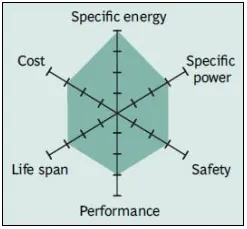 |
| 5 | LFP-Lithium Iron/Ferrous Phosphate |
3.2-3.3V (nominal) 2.5-3.65V (typical) |
90–120Wh/kg | 1C | 1C, 25C on some cell | 270°C | >2000 | High load and high current uses | 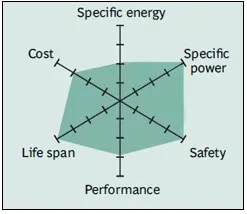 |
| 6 | LTO-Lithium Titanium Oxide |
2.4V (nominal) 1.8-2.85V (typical) |
50–80Wh/kg | 1C typical; 5C maximum | 10C possible, 30C 5s pulse |
300-350°C (safest) |
3000-7500 | Inverter,UPS,Vehicles,Solar Street Lights | 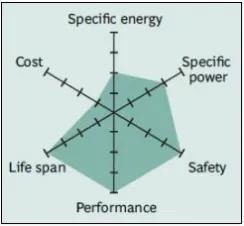 |