Week 1 Understanding Different Battery Chemistry
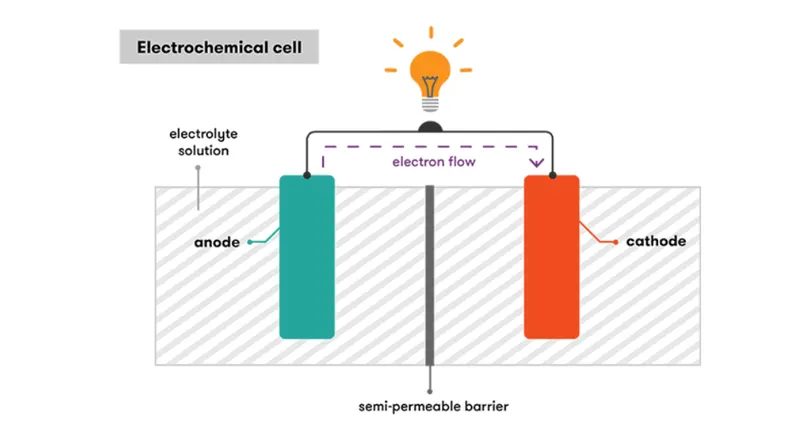
- A battery is a device that stores chemical energy and converts it to electrical energy. The chemical reactions in a battery involve the flow of electrons from one material (electrode) to another, through an external circuit or load. The flow of electrons provides an electric current that can be used to do work. To balance the flow of electrons, charged ions also flow through an electrolyte solution that is in contact with both electrodes. Different electrodes and electrolytes produce different chemical reactions that affect how the battery works, how much energy it can store, and its voltage.
- Batteries are of two types: a) Primary batteries which have a single discharge where chemical energy stored is converted to electrical energy b) Secondary batteries where by using a reverse current a battery can be charged again
- A typical battery consists of the following:
- 1) Anode (negative electrode): electrode through which conventional current enters into a polarized electrical device. It is made up of metal oxide or sulfide
- 2) Cathode (positive electrode): electrode through which conventional current leaves an electrical device. It is made up of a metal/metal alloy.
- 3) Electrolyte: electrolyte is an ionic conductor that provides a medium for ionic charge transfer between electrodes. Electrolytes can be acidic, basic, or salt
- 4) Separator-Insulating layer between electrodes that opposes the flow of electrons and prevents internal reactions
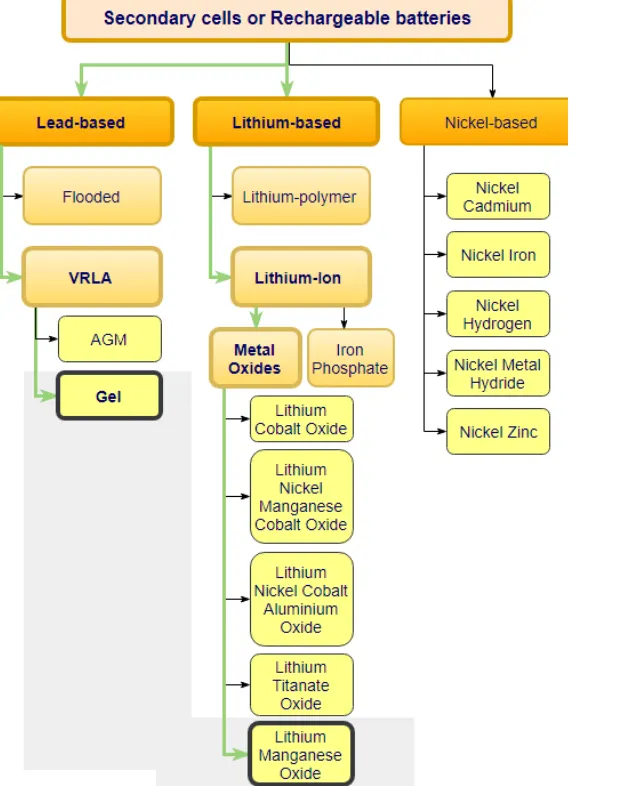
- In ev mostly secondary batteries are used. The below is classification of secondary battery:
- Working of Li ion battery:
- The positive electrode is typically made from a chemical compound which is an oxide or phosphide of lithium.
- Cathode materials of lithium ion battery is classified into three groups namely:
- a) Layered transition metal oxides
- b)Spinels
- c) Olivenes
- Spinal and olivenes are classifications based on the shape of materials
- The negative electrode is generally made from carbon (graphite or hard carbon). The electrolyte varies from one type of battery to another. They are generally organic solvents containing dissolved lithium salt where solvents are ethylene carbonate, dimethyl carbonate, and propylene carbonate
-
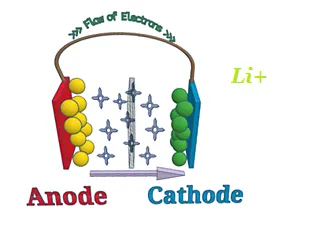
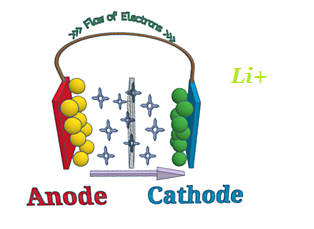
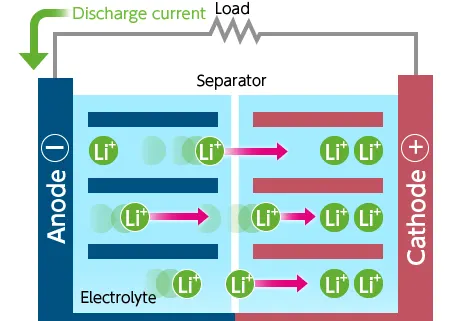
- The electrolyte carries positively charged lithium ions from the anode to the cathode.The movement of the lithium ions creates free electrons in the anode which creates a charge at the positive current collector. The electrical current then flows from the current collector through a load to the negative current collector. The separator blocks the flow of electrons inside the battery.
-
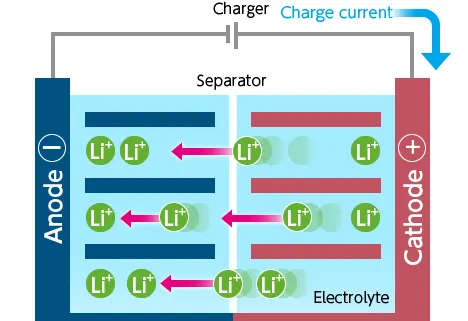
- While the battery is discharging and providing an electric current, the anode releases lithium ions to the cathode, generating a flow of electrons from one side to the other. When plugging in the device, the opposite reaction happens, the cathode releases lithium ions and anode receives them. This is how the Lithium-ion battery works.
-
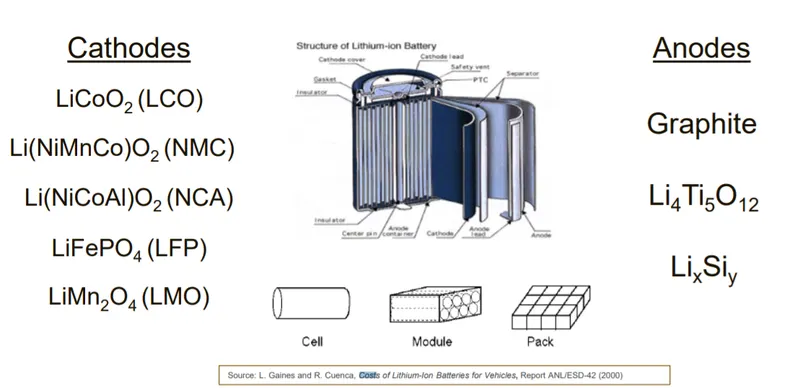
- Lithium ion batteries have predominantly 5 chemistries. They are:
-
Type of Lithium ion battery Cathode Anode Anodic reaction Cathodic reactions Electrolyte Lithium cobalt oxide (LCO) LiCoO2 LiC6 LixC6-->xLi(+) + xe- + C6 Li(1-x)CoO2 + xLi(+) +xe-->LiCoO2 LiPF6 in ethylene carbonate Lithium Manganese oxide (LMO) LiMn2O4 LiC6 LixC6-->xLi(+) + xe- + C6 Li(1-x)Mn2O4+xLi(+)+xe- -->LiMn2O4 LiPF6 in ethylene carbonate Lithium nickel aluminum cobalt oxide
(NCA)
LiNiCoAlO2 LiC6 LixC6-->xLi(+) + xe- + C6 Li(1-x)NiCoAlO2+xLi(+)+xe- -->LiNiCoAlO2 LiPF6 in ethylene carbonate Lithium Nickel Manganese Cobalt Oxide
(NMC)
LiNi(0.8)Mn(0.1)Co(0.1)02 LiC6 LixC6-->xLi(+) + xe- + C6 Li(1-x)Ni(0.8)Mn(0.1)Co(0.1)02 + xLi(+)+xe- -->LiNi(0.8)Mn(0.1)Co(0.1)02 LiPF6 in ethylene carbonate Lithium iron phosphate (LFP) LiFeP04 LiC6 LixC6-->xLi(+) + xe- + C6 Li(1-x)FeP04+xLi(+)+xe- --> LiFeP04 LiPF6 in ethylene carbonate Lithium Titanium oxide LiMn204 Li4Ti5012 Li4T5O12-->Ti5O12+4Li(+)+4e- 4Li(1-x)Mn204+4Li(+)+4e- -->4LiMn204 LiPF6 in ethylene carbonate