Week 1 Understanding Different Battery Chemistry
AIM:
To make a table which includes materials & chemical reactions occurring at the anode and cathode of LCO, LMO, NCA, NMC, LFP and LTO type of lithium ion cells.
CONSTRUCTION OF LITHIUM ION CELL:
- A lithium ion battery is made up of several Li-ion cells in series and parallel connections.
- A battery is made up of an anode, cathode, separator, electrolyte, and two current collectors (positive and negative). The anode and cathode store the lithium.
- The electrolyte carries positively charged lithium ions from the anode to the cathode and vice versa through the separator. The movement of the lithium ions creates free electrons in the anode which creates a charge at the positive current collector
WORKING:
- The electrolyte carries the positively charged Li-ions from anode to cathode through the separators. The movement of lithium ions makes free electrons in anode which creates the charge at positive current collectors makes them discharging and vise versa during charging.
- The electrons can move only through external circuits,they cann't move through the electrolyte and seperators. Electrolyte and seperators only allows the ions transfer from anode to cathode and vise versa.
-
While the battery is discharging and providing the electric current,the anode releases lithium ions to the chathode generating flow of electrons from anode to cathode which means current direction is from cathode to anode.
-
When plugging in the device,the Li-ions are released by cathode and received by anode.That is the electrons flows into the anode makes current direction from anode to cathode.
-
The above charging and discharging operations are held at every cells of the battery combaining the output voltage and current to connected load/charging ports.
VARIOUS TYPES OF LITHIUM ION CELL COMPOSITIONS:
The Li-ion battery chemical compositions varies according to different materials used in it their cathode and anode
parts.
Various chemical compositions used in cathode are,
- LCO-Lithium Cobalt Oxide(LiCoO2)
• LFP-Lithium Iron Phosphate(LiFePO4)
- LMO-Lithium Manganese Oxide (LiMn204)
• NMC-Litthium Nickel Manganese Cobalt oxide(LiNiMnCoO2)
• NCA-Lithium Nickel Cobalt Aluminium Oxide(LiNiCOAlO2)
• LTO-Lithium Titanium Oxide(LiTiO3)
The anode materials are usually,
- Graphite.
- Hard carbon.
- Lithium Titanate.
- Tin/cobalt alloy.
- Silicon/carbon.
CHEMICAL REACTIONS TAKE PLACE IN ANODE AND CATHODE:
In equations charging denotes from Right to Left ,and discharging denotes Left to Right.
(1)LCO (Lithium Cobalt oxide):
At anode:
LiC6 →C6 +Li+ + e-
At cathode:
CoO₂+ Li+ + e- → LicoO₂
Overall relation:
LicoO₂+ C6→LiC6 +CoO₂
(2)LMO (Lithium Manganese Oxide):
At anode:
LiC6 →C6+ Li+ + e-
At cathode:
MnO2+ Li+ + e- → LiMnO2
Overall relation:
LiMnO2+C6 →LiC6+ MnO2
(3)NCA (Lithium Nickel Cobalt Aluminium Oxide):
At anode:
LiC6 →C6+ Li+ + e-
At cathode:
NiCoAlO2 + Li+ + e- →LiNiCoAlO2
Overall relation:
CaLi +NiCoAlO2→LiCoAlO₂+C6
(4) NMC (Lithium Nickel Manganese Cobalt oxide):
At anode:
LiC6→C6+ Li+ + e-
At cathode:
NiMnCoO2 + Li+ + e- → LiNiMnCoO2
Overall relation:
LiC6 + NiMnCoO2→ LiNiMnCoO2+ C6
(5)LFP(Lithium Iron Phosphte):
At anode:
LiC6→ C6+ Li+ + e-
At cathode:
FePO4 + Li+ + e- → LiFePO4
Overall relation:
LiC6 + FePo4 → LiFePO4 + C6
(6) LTO-Lithium Titanium Oxide(LiTiO3)
At anode:
Li₂TiO3→ TiO2 +Li+ + e-
At cathode:
Mn2O4+ Li+ + e- → LiMn2O4
Overall relation:
Li₂TiO3 + 2 Mn2O4 → 2LiMn2O4+ TiO3
TABLE OF CONTENTS:
| Reaction Type | LCO | LMO | NCA | NMC | LFP | LTO |
| Anode | Graphite | Graphite | Graphite | Graphite | Graphite | Lithium Titinium Oxide |
| Cathode | Lithium Cobalt oxide | Lithium Manganese Oxide | Lithium Nickel Cobalt Aluminium Oxide | Lithium Nickel Manganese Cobalt oxide | Lithium Iron Phosphte | Lithium Iron Phosphte |
| Electrolyte | Ethylene Carbonate + Li Salt | Methyle Carbonate + Li Salt | Propylene Carbonate + Li Salt | Methyle Carbonate + Li Salt | Propylene Carbonate + Li Salt | Propylene Carbonate + Li Salt |
| Seperators | Polyolefin | Polyolefin | Polyolefin | Polyolefin | Polyolefin | Polyolefin |
| Nominal voltage | 3.6V | 3.7V |
3.6V |
3.6V-3.7V | 3.2V-3.3V | 2.4V |
| Applications | Mobiles,laptop,camera | power tools,medical devices | electrical power trains,industries | e-bikes,EV vechicle | High load current needed equipments | UPS,Solar powe street lights |
2) CHARACTERISTICS OF LITHIUM ION BATTERIES.
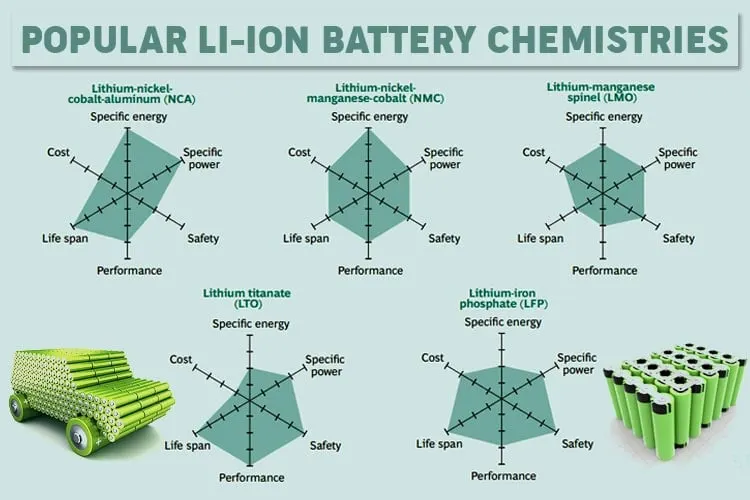
LCO (Lithium Cobalt oxide):
- LCO Li battries are having high specific energy makes more popular for mobile phones, laptops,cameras etc..
- The battery consist of Cobalt oxide cathode and carbon anode.The cathode having layered structure and during discharge the lithium ions move from anode to cathode.
- The flow get reversed while charging.
- The drawback of LCO Li-ion batteries are its low life span,low thermal stability, limited low capability.
- This shorter life span is due to the usage of graphite as anode with makes SEI(Solid Electrolyte Interface) thickening on anode and lithium plating whilw fast charging and charging in low twmperature.
Nominal voltage:3.6V
Typical operating range: 3.0-4.2 V/cell.
Specific energy (Capacity):150-200Wh/kg. Its seems to be high from above figure.
Specific Power: It is the ability to provide high current,which is operating in moderate level in these types of
baatteries.
Charge (C-rate):0.7C-IC rate charge in 3 hrs (typical case). Charge upto 4.2V Charge current above IC shorten
battery life.
Discharge(C-rate): IC.Cutoff voltage at 2.5V and Discharge current above IC shorten battery life.
Cycles life:500-1000 cycles. This related to depth of discharge,load and temperature.
Thermal runaway :Full charge promotes thermal runaway codition and its maximum value is 150 deg C.
Cost: Costwise Cobalt is expensive so these batteries are somewhat coastlier.
It has high specific energy capacity but having less specific power, lesser life span makes them less popular over higher load operations.
2)LMO (Lithium Manganese Oxide):
Nominal Voltage:3.7V.
Typical operating range:3.0-4.2V/cell.
Specific energy (Capacity):100-150wn/kg.
Charge (C-rate):0.7-IC typical,maximum upto 3C. Charge upto 4.2V (Typical level).
Discharge (C-rate): IC.Cutoff Voltage at 2.5V.Discharge possible upto 10C with some cells.
Cycle life:300-700 times related to depth of discharge and temperature.
Thermal runaway :250 deg C at typical condition.High charge promotes thermal runaway.
Higher power but lesser capacity.These battery types are safer than Li-Cobalt batteries. They are commonly mixed with NMC for better performance.
(3)NCA (Lithium Nickel Cobalt Aluminium Oxide):
Nominal Voltage:3.6-3.7 V.
Typical voltage range:3.0-4.2V/cell and higher too.
Specific energy:150-220Wh/kg.
Charge(C-rate):0.7-IC.Maximum charge upto 4.2V and also to 4.3V.Charge current above IC shorten the battery
life.
Discharge (C-rate) IC-2C.Cutoff voltage as 2.50V.
Cycle life: 1000-2000 times(Related to DOD and temperature).
Thermal runaway:210 deg C.High charge promotes thermal runaway.
Cost: Approx.$420/kWh.
These types of batteries provide high capacity and high power.They erves as hybrid cells.Most of the EV manufactures prefers this battery chemistry.
(4) NMC (Lithium Nickel Manganese Cobalt oxide):
Nominal Voltage: 3.20-3.30V.
Typical operating range:25-3.65V/cell.
Specific energy:90-120Wh/kg.
Charge(C-rate): IC typical Charge upto 3.65V.Charging duration as 3Hr.
Discharge (C-rate): IC-25C on some cells.Cutoff voltage as 250V.Less than 2V causses damage.
Cycle life :2000 and higher (Related to depth of discharge and temperature).
Thermal runaway:270 deg C(Fully safe even at full charge)
Cost:Approx. $580/Kwh.
These types of batteries are very flat voltage discharge curve but lower capacity.One of the safest Li-ions Used for special markets and elevated self discharge.
5)LFP(Lithium Iron Phosphte):
Nominal Voltage:3.6V
Typical operating range:3.0-4.2V/cell
Specific energy capacity:200-260Wh/kg.Upto 300Wh/kg.
Charge(C-rate):0.7C,Charge upto 4.2V(most cells),Charge duration as 3Hr(typical case).Fast charge are possible.
Discharge (C-rate): IC typical,Cutoff voltage to 3.0V.High discharge rate shorten the battery life.
Cycle life:500(Related to DOD and temperature)
Thermal runaway :150 deg C(Typical),High charge promotes thermal runaway.
Cost:Approx.$350/kWh.
These types of batteries also used of EV power trains.Tesla makes use of this battery chemistry.
(6) LTO-Lithium Titanium Oxide(LiTiO3)
Nominal Voltage:2.4V.
Typical operating range:1.8-2.85 V/cell.
Specific energy 50-80Wh/kg.
Charge(C-rate): IC-5C maximum.Charge upto 2.85V.
Discharge(C-rate) 10C. Cutoff voltage as 180V on LCO/LTO.
Cycle life:3000-7000 times.
Thermal runaway One of the safest among all Li-ion batteries.
Cost:Approx $1,005/kWh.
These typee of batteries are long life,fast charge,high temperature range but they are low specific energy and expensive.They are one of the safest among all Li-ion batteries.
SUBMITED BY,
VISHNU KIRAN.R
EV Live session Batch (20)