Week 1 Understanding Different Battery Chemistry
EV - 21 WEEK -1
A battery can be defined as an electrochemical device (consisting of one or more electrochemical cells) which can be charged with an electric current and discharged whenever required. Batteries are usually devices that are made up of multiple electrochemical cells that are connected to external inputs and outputs. Batteries are widely employed in order to power small electric devices such as mobile phones, remotes, and flashlights. Historically, the ‘term’ battery has always been used in order to refer to the combination of two or more electrochemical cells. However, the modern definition of the term ‘battery’ is believed to accommodate devices that only feature a single cell.
Batteries are broadly classified into two categories, namely primary batteries and secondary batteries. Primary batteries can only be charged once. When these batteries are completely discharged, they become useless and must be discarded. The most common reason why primary batteries cannot be recharged is that the electrochemical reaction that takes place inside of them is irreversible in nature. It is important to note that primary batteries are also referred to as use-and-throw batteries.
On the other hand, secondary batteries are the batteries than can be charged and reused for many charging-discharging cycles. The electrochemical reactions that take place inside these batteries are usually reversible in nature. Therefore, secondary batteries are also known as rechargeable batteries. When discharging, the reactants combine to form products, resulting in the flow of electricity. When charging, the flow of electrons into the battery facilitates the reverse reaction, in which the products react to form the reactants.
batteries generally can be classified into different categories and types ranging from chemical composition, size, form factor and use cases, but under all of these are two major battery types; 1. Primary batteries 2. Secondary batteries Let's take a deeper look to understand the major differences between a Primacy cell and Secondary Cell
1. primary cells - Non chargable
2. secondary cells - rechargable
primary cells are non chargeable cells which are used in appliences such as wrist watch,calculator and radio e.g: drycell , Li-battery
secondary cells are rechargable cells which can undergo reversible chemical reaction
e.g: Lead cell,Ni-cd cell , metal air , Ni-metal hydride ,Li-ion battery cells
battery cells are made up of three main components
1. the anode
2.the cathode
3.the electrolyte
During discharge the anode is negative electrode that produces electrons to the external circuit to which battery is connected when battery connected an electron build up is initiated at the anode which causes a potential difference between two elecrodes the electrons naturally try to redistribute themselves this is prevented by the electrolyte so when an electrical circuit connected it provides a clear path for the electrons to move from the anode to cathode thereby powering the circuit to which it is connected
During charging the Li ions move back from cathode to anode
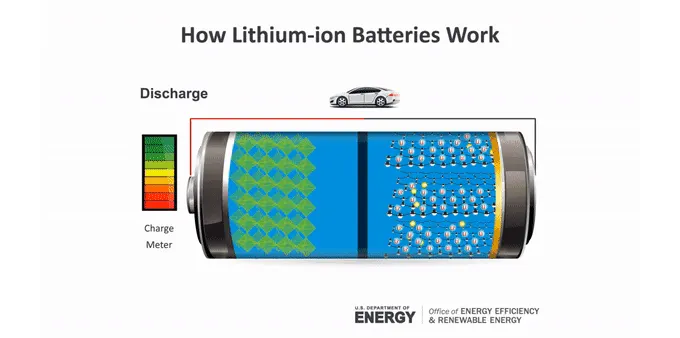
A lithium-ion battery is a rechagable battery that depends upon lithium ions flowing between negative and positive electrodes. There are two mechanisms that are involved in the working of the lithium-ion battery.
The first is charging and the other is the discharging process. During the charging phase, lithium ions flow from the positive electrode of the battery to the negative electrode. While in the case of discharging the flow of ions is reversed.
The movement of these ions creates a potential difference (voltage). Hence, when the device is connected to the battery the electrons pass to it and power your device.
Lithium-ion batteries come in a variety of features, shapes, and sizes. Below are the 6 types of lithium-ion batteries, explained along with their features and applications
Lithium Cobalt Oxide (LiCoO2) — LCO
Lithium Cobalt Oxide battery is manufactured using cobalt and lithium carbonate. In these batteries, cobalt oxide acts as a cathode while graphite carbon acts as an anode The cathode consists of a layered structure and during charge, lithium ions flow from cathode to anode. However, the flow reverses in case of discharge.
Lithium cobalt oxide batteries are ideal for laptops, digital cameras, mobile phones, and some other small portable electronics.
ADVANTAGES :
The key feature of lithium cobalt oxide batteries is that they possess high specific energy. This makes them offer power for a long period even under low-load applications
DIS-ADVANTAGES :
In addition to the benefits of LCO, they also have some drawbacks which are listed below:
These batteries have a short lifespan as compared to other types of lithium-ion batteries.
They have low thermal stability which makes them unsafe for use.
Due to high specific energy, they cannot perform well under high load applications.
LCO batteries are not cost-effective according to their performance.
Lithium Cobalt Oxide batteries are not as effective as compared to other types of lithium-ion batteries
Lithium Manganese Oxide (LiMn2O4) — LMO
In Lithium Manganese Oxide batteries, lithium manganese oxide acts as the cathode material. This compound provides a three-dimensional structure that is responsible for better ion flow. Also, this structure aids in lowering the internal resistance, thus the ability of current handling increases.
LMO batteries are majorly used in medical instruments and many cordless portable power tools. Additionally, some hybrid and electric vehicles also use these batteries
ADVANTAGES :
The lithium manganese battery is much better in performance than the lithium cobalt oxide battery. Following are the plus points of an LMO battery:
These batteries provide relatively high specific power and charge quickly.
They have better thermal stability which means that they can safely operate at higher temperatures.
LMO batteries are pretty flexible as they can handle high load applications.
They are low in cost
DIS - ADVANTAGES :
The major drawback of lithium manganese batteries is their shorter life span. Generally, the last 300 to 700 charge cycles which are lesser than many types of lithium-ion batteries.
We may conclude that lithium manganese batteries offer moderate performance as compared to other lithium-ion batteries.
Lithium Iron Phosphate (LiFePO4) — LFP
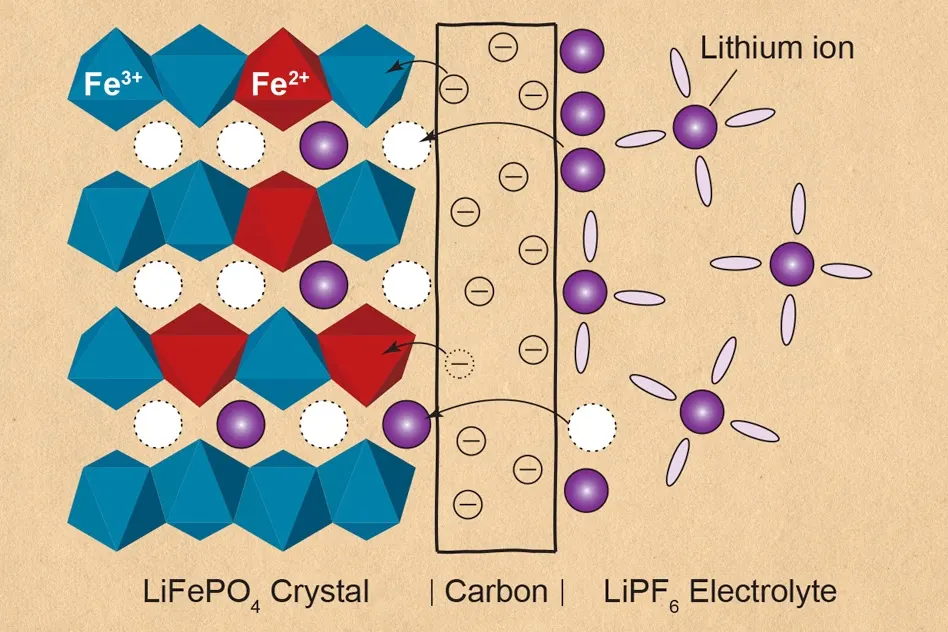
Lithium iron phosphate batteries use graphitic carbon electrodes as the anode and phosphate electrodes act as cathode. The crystal structure of lithium iron phosphate batteries ensures safety
Moreover, LFP batteries are applicable to portable applications that need high load currents and endurance.
ADVANTAGES :
LFP batteries have the following benefits:
They have a longer lifespan as they last 2000 or more charge cycles.
The materials used in these batteries provide low resistance. So they are pretty stable and safe.
LFP batteries offer 80 to 100% discharging without causing any damage
DIS - ADVANTAGES:
Besides the benefits, LFP batteries also have some downsides which are as follows:
These batteries have a relatively low specific energy.
They don’t perform well at lower temperatures.
Therefore, LiFePO4 batteries are not that suitable for high cranking applications
Lithium Nickel Manganese Cobalt Oxide (LiNiMnCoO2) — NMC
Lithium nickel manganese cobalt oxide battery is made up of a combination of three elements, nickel, manganese, and cobalt. These three combined elements act as the cathode of NMC batteries. Nickel is present in high proportion, i.e, 60% while, manganese and cobalt constitute 20%.
Nickel has high specific energy yet is not that stable. On the other hand, manganese is stable enough but possesses low specific energy. Ultimately, the collective effect of these elements results in high specific energy.
While talking about the applications of NMC batteries, they are much similar to LMO batteries. These batteries are perfect for power tools, some electric vehicles, scooters, and e-bikes
ADVANTAGES : -
NMC batteries offer a longer lifespan at a lower cost as compared to cobalt-based batteries.
They are also safer due to higher thermal stability
DIS - ADVANTAGES : -
The main demerit of the NMC battery is that it has a comparatively lower voltage than cobalt-based batteries.
Lithium Titanate (Li2TiO3) — LTO
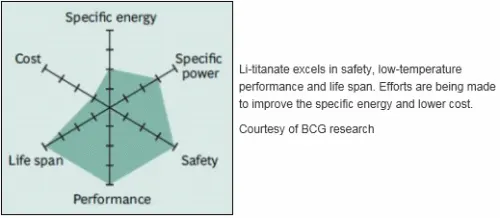
At last, lithium titanate is the type of lithium-ion battery that uses lithium manganate as a positive electrode. These batteries have zero strain, and no lithium plating during fast and low-temperature charging. This results in remarkable charge-discharge performance.
Lithium titanate batteries are often used in military and aerospace applications. Moreover, these are also used in solar energy, for storing wind and creating smart grids
ADVANTAGES :
The major advantage of lithium titanate batteries is that they feature super-fast recharge time.
The cycle times are higher and are pretty safe to use
DIS - ADVANTAGES :
They have low inherent voltage
Lithium Nickel Cobalt Aluminum Oxide (LiNiCoAlO2) — NCA
The positive electrode of NCA-based lithium-ion batteries comprises nickel, cobalt, and aluminium. The addition of aluminium in these types of lithium-ion batteries offers excellent chemical stability. Moreover, these batteries feature remarkable high energy density.
Lithium nickel cobalt aluminium oxide batteries are ideal for electric vehicles, and industrial devices. Mainly, Tesla prefers NCA batteries for their EV powertrains
ADVANTAGES : -
The high-power density of NCA batteries makes them pretty durable
DIS - ADVANTAGES : -
The only drawbacks of these batteries are as follows;
NCA batteries are quite expensive.
They are not very safe.
Generally, NCA batteries are considered favorable for the automobile industry rather than consumer electronics.
| Li - ion battery type | Cathode | Anode | Advantages | chemical reaction | Structure | |
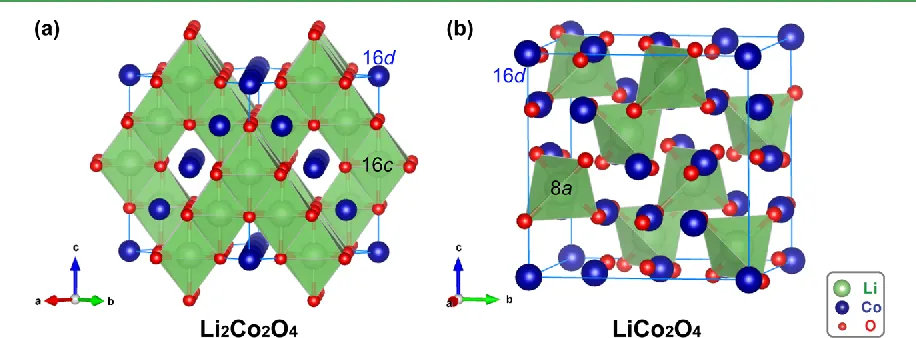
| (LiCoO2)- LCO | Lithium cobalt oxide | Graphite carbon | high specific energy |
charging: Anode: LiCoO2 = Li1-xCoO2+xLi++xe- Cathode: 6C+xLi++xe- = LixC6 discharge : Anode: Li1-xCoO2+xLi++xe-=LiCoO2 Cathode: LixC6=6C+xLi++xe- |
 |
|
| (LiMn2O4) - LMO | Lithium manganese oxide | Graphite carbon | lower internal resistance and improved current handling high thermal stability and enhanced safety |
During charging: The reaction on the anode: LiMn2O4==Li1-xMn2O4+Xli++Xe(electron)The reaction on the cathode: 6C+XLi+Xe==LixC6 Dis - charging : The reaction on the anode Li1-xMn2O4+xli++xe(electron)==LiMn2O4 The reaction on the cathode LixC6==6C+xLi+xe |
||
| (LiNiMnCoO2) - NMC | Lithium nickle manganese oxide | Graphite carbon | good overall performance and excels on specific energy lowest self heating rate |
Discharge: LiNixMnyCozO2→Li1-tNixMnyCozO2+tLi++te Charge: Li1-tNixMnyCozO2+tLi++te→LiNixMnyCozO2 |
||
| (LiFeO4) - LFP | Lithium iron phosphate | Graphite carbon | high current rating and long life cycle besides good thermal stability and enhanced safety |
LiFePO4?Li1 - xFePO4 + xLi++ xe -; Total reactive: LiFePO4 xc + 6?Li1 - xFePO4 + LixC6. |
 |
|
| (LiNiCoAIO2)- NCA | Lithium Nickle cobalt aluminium oxide | Graphite carbon | high specific energy reasonbly good specific power long life span |
LiCoO2 =1/2LiCoO2+1/6Co3O4+1/6O2 LiC6==xLi+ + xe- + C6 Li1-xMO2 + xLi+ + xe==LiMO2 |
||
| (Li2TiO3) - LTO | Lithium manganese oxide | titante | fast charging safe,high discharge current of 10c |
LiC6==xLi+ + e- + C6 4Mn2O4 + 4Li+ + 4e-==4LiMn2O4 |
 |
LITHIUM COBALT OXIDE :-
Lithium cobaltate is the first generation of commercial anode materials. In decades of development, it can be considered as the most mature anode materials of lithium ion battery.
Lithium cobalt oxide is still the best choice for small lithium batteries. At present, as for 3C products, most of them still use lithium cobaltate instead of ternary materials with higher specific capacity, because the compaction density of lithium cobaltate is higher than that of ternary materials, that is, more lithium cobaltate can be contained in unit volume. Lithium cobalt oxide plays an important role in small size batteries that concentrate on volume density.
As the technology development and market changing, the requirement of lithium cobaltate battery is also rising slowly. It has been used in electronic equipment such as tablet and mobile phone, and also expand to different domain in recent years. Due to its good stability and consistency, high energy density and other advantages, lithium cobalt oxide battery has been gradually applied to medical equipment, instrumentation, emergency backup, special communication equipment, etc
LITHIUM MANGANESE OXIDE :-
Lithium manganate oxide is one of the promising lithium ion anode materials. Compared with lithium cobalt oxide and other traditional anode materials, lithium manganate oxide has advantages of rich resources, low cost, no pollution, good safety and nice rate capability. It is an ideal anode material for power battery. Therefore, lithium battery electrode materials, especially the new-generation lithium manganate oxide anode materials, have great potential in the electric vehicle power battery market. Due to the low price and rich resources of lithium manganate oxide, it is easier to be produced than lithium cobalt oxides and lithium nickelate, which will make lithium ion battery enter a new era of development.
Because lithium manganate oxide material has such distinct characteristics, people will make use of its advantages and avoid its disadvantages. Therefore, lithium manganate oxide battery is applied in different fields, which are usually called class A and class B applications.
Class A refers to the power battery, which focuses on safety and recycling performance. It is required to have a reversible capacity of 100~115mAh/g and maintain 80% capacity after 500 cycles.
Class B is mainly used for consumer electronics. It is characterized by high capacity. Generally, it is required to have a reversible capacity of 120 mAh/g and maintain 60% capacity after 300~500 cycles. The different performance of these two types of batteries is realized in the production process
APPLICATIONS :-
Lithium cobalt oxide : - mobile phones ,laptops and digital cameras
Lithium manganese oxide : - electrical vehicles likes nissan leaf , chevy volt and BMW i3 ,power tools and medical devices , electric powertrain
Lithium nickel manganese cobalt oxide :- E - bikes ,medical devices and EV industrial
Lithium iron phosphate : - portable and stationary needing , high load current and endurance
Lithium nickel cobalt aluminium oxide : -medical devices , industrial ,electric powertrain
Lithium titanate :- UPS , electric powertrain (Mitsubishi i-miev , honda fit ev) solar powered street lighting
ELECTROLYTE :-
ethylene carbonate
lithium halide
lithium salt
ethylene carbonate
ehylene carbonate
lithium salt
SPERATOR :-
polyolefin
polyolefin
polyolefin
polyolefin
polyolefin
polyolefin
NOMINAL VOLTAGE AND OPERATING RANGE :
3.60v nominal, typical operating range 3.0 - 4.2v/cell
3.70v nominal , typical operating range 3.0 to 4.2v/cell
3.6v nominal , typical operating range 3.0 to 4.2v/cell
3.20v nominal , typical operating range 2.5 to 3.65v/cell
3.6v nominal ,typical operating range 3.0 v to 4.2v/cell
2.40v nominal , typical operating range 1.8 to 2.85v /cell
ENERGY CAPACITY :
150-200wh/kg
100-150wh/kg
150-220wh/kg
90-120wh/kg
200-260wh/kg
50-80wh/kg
LIFE CYCLE (Related to depth of discharge ,load temperature )
500 - 1000
300 - 700
1000 - 2000
2000 and higher
500
3000 - 7000
THERMAL RUNAWAY (Full charge promotes thermal runaway)
150c (302 F)
250c (482 f)
210c (410 f)
270c (518 f)
150c (302 f)
one of the safest Li-ion batteries