Week 1 Understanding Different Battery Chemistry
AIM:
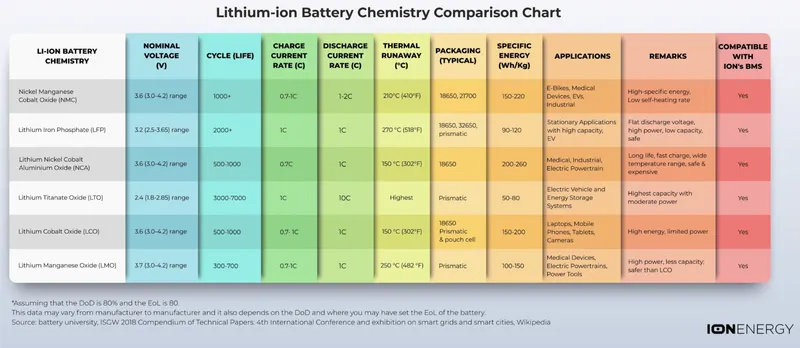
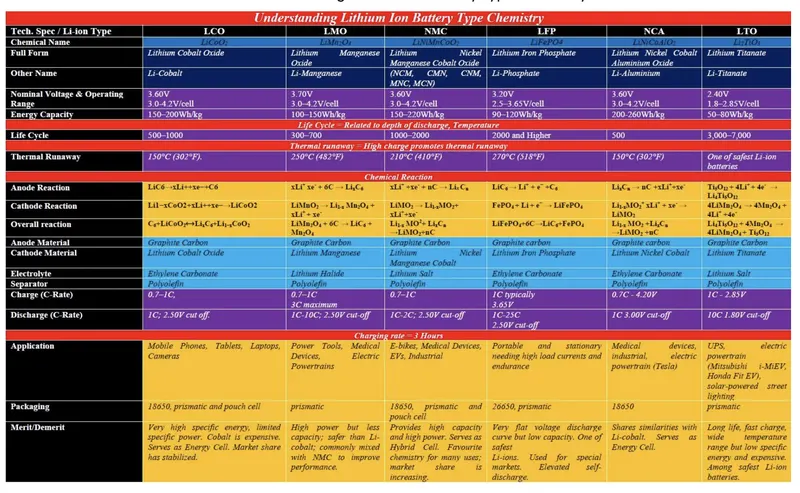
1.Prepare a table which includes materials & chemical reactions occurring at the anode and cathode of LCO, LMO, NCA, NMC, LFP and LTO type of lithium ion cells.Give your detailed explanation on it.
2.Compare the differences between each type of Li+ion batteries based on their characteristics .
QUESTION :
Prepare a table which includes materials & chemical reactions occurring at the anode and cathode of LCO, LMO, NCA, NMC, LFP and LTO type of lithium ion cells.Give your detailed explanation on it.
INTRODUCTION:
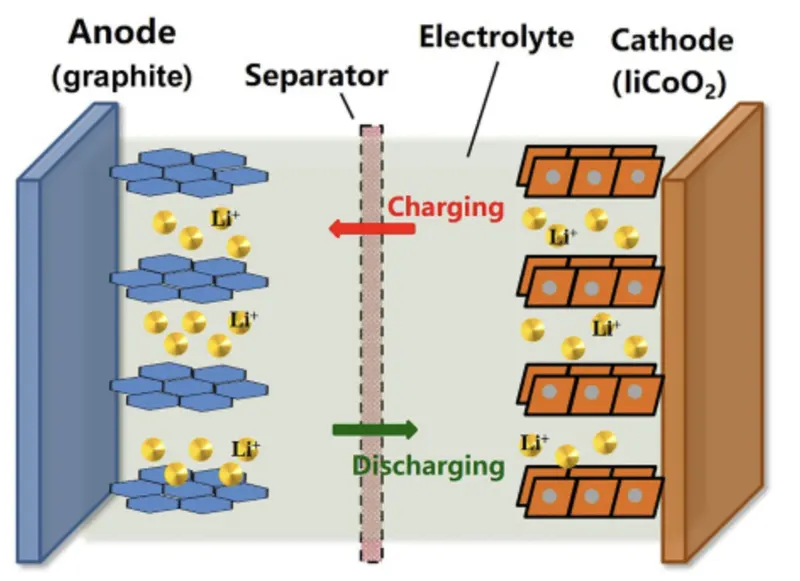
A lithium-ion battery or Li-ion battery is a type of rechargeable battery composed of cells in which lithium ions move from the negative electrode through an electrolyte to the positive electrode during discharge and back when charging. Li-ion cells use an intercalated lithium compound as the material at the positive electrode and typically graphite at the negative electrode. Li-ion batteries have a high energy density, no memory effect (other than LFP cells) and low self-discharge. Cells can be manufactured to prioritize either energy or power density.They can however be a safety hazard since they contain flammable electrolytes and if damaged or incorrectly charged can lead to explosions and fires.
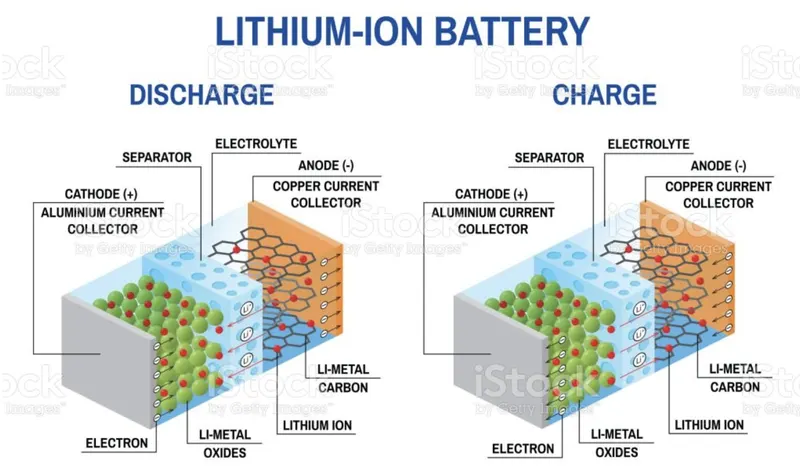
ELECTROLYTE:
An electrolyte is a medium containing ions that is electrically conducting through the movement of ions, but not conducting electrons.This includes most soluble salts, acids, and bases dissolved in a polar solvent, such as water. Upon dissolving, the substance separates into cations and anions, which disperse uniformly throughout the solvent. Solid-state electrolytes also exist. In medicine and sometimes in chemistry, the term electrolyte refers to the substance that is dissolved.
CATHODE AND ANODE:
A cathode is the electrode from which a conventional current leaves a polarized electrical device. This definition can be recalled by using the mnemonic CCD for Cathode Current Departs. A conventional current describes the direction in which positive charges move. Electrons have a negative electrical charge, so the movement of electrons is opposite to that of the conventional current flow. Consequently, the mnemonic cathode current departs also means that electrons flow into the device's cathode from the external circuit.
An anode is an electrode through which the conventional current enters into a polarized electrical device. This contrasts with a cathode, an electrode through which conventional current leaves an electrical device. A common mnemonic is ACID, for "anode current into device".The direction of conventional current (the flow of positive charges) in a circuit is opposite to the direction of electron flow, so (negatively charged) electrons flow out the anode of a galvanic cell, into an outside or external circuit connected to the cell. In both a galvanic cell and an electrolytic cell, the anode is the electrode at which the oxidation reaction occurs.
SEPERATOR:
A separator is a permeable membrane placed between a battery's anode and cathode. The main function of a separator is to keep the two electrodes apart to prevent electrical short circuits while also allowing the transport of ionic charge carriers that are needed to close the circuit during the passage of current in an electrochemical cell.
CURRENT COLLECTOR:
Electric current collectors are used by trolleybuses, trams, electric locomotives or EMUs to carry electrical power from overhead lines, electrical third rails, or ground-level power supplies to the electrical equipment of the vehicles. Those for overhead wires are roof-mounted devices, those for rails are mounted on the bogies. Current collectors are also electric bridging components that collect electrical current generated at the electrodes of electrochemical devices, such as lithium-class battery cells, and connect with external circuits.
Benefits or advantages of Lithium Ion Battery
➨As mentioned it has high energy density which is two times compare to Ni-Cd.
➨The Lithium-Ion battery is rechargeable.
➨There is no memory effect. Hence it is not needed to discharge them completely before recharging.
➨The battery can handle many charge/discharge cycles.
➨The battery can hold the charge and it can lose only 5% of its charge every month.
Drawbacks or disadvantages of Lithium Ion Battery
➨It lasts only two to three years after manufacturer.
➨It is sensitive to high temperatures.
➨If the battery is completely discharged, it can no longer be recharged again.
➨It is relatively expensive.
➨If the "separator" gets damaged, it can burst into flames.
QUESTION 2:
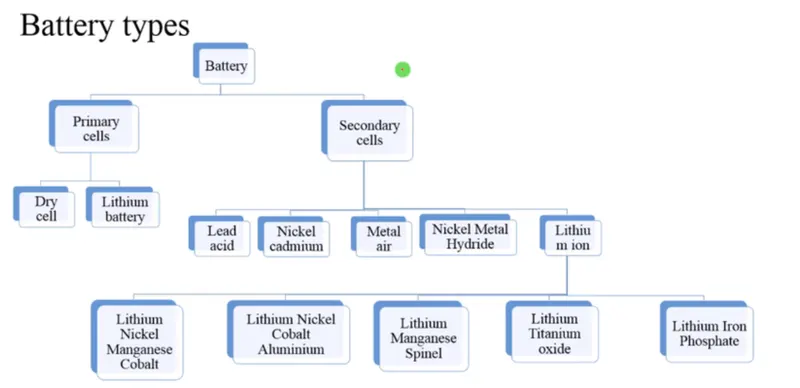
Compare the differences between each type of Li+ion batteries based on their characteristics:
DIFFERENCE TYPE OF BATTERY
Lithium cobalt battery:
Lithium-ion batteries and concept:
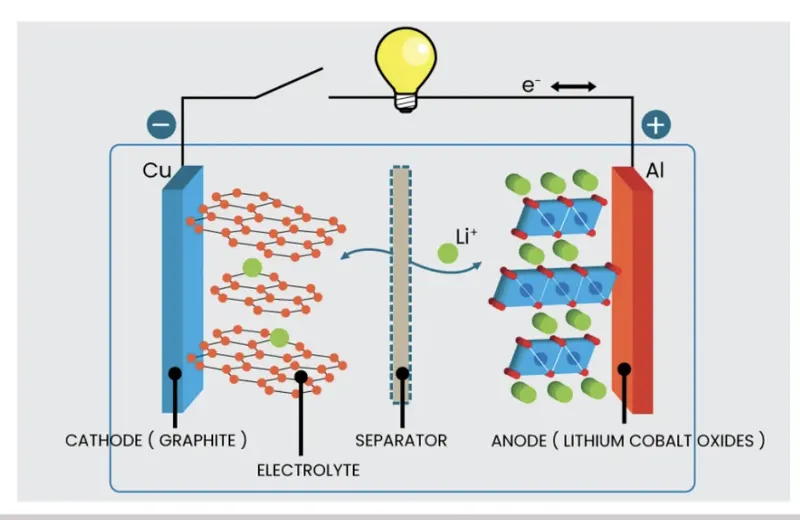
The most popular technology of the battery sector currently is the lithium ion battery. Relative to other types of batteries, lithium ion batteries have better energy, power density and higher cycling ability. These qualities are extremely important in the use in modern applications like electrical and hybrid vehicles and most importantly energy storage systems which are used in the renewable energy applications.The lithium ion batteries chemistry is the same across the different lithium-ion battery types; during discharge, Lithium-ions are moved to the positive cathode from the negative anode through the organic electrolyte. The anodes in all various technologies of lithium ion are all made from graphite. The differences are the cathode which contains changing cobalt, nickel or manganese concentrations. All various cathode types allow high lithium insertion and intercalation levels which result in large energy storage quantities.
LITHIUM MANGANESE OXIDE:
LMO Batteries: properties and usage
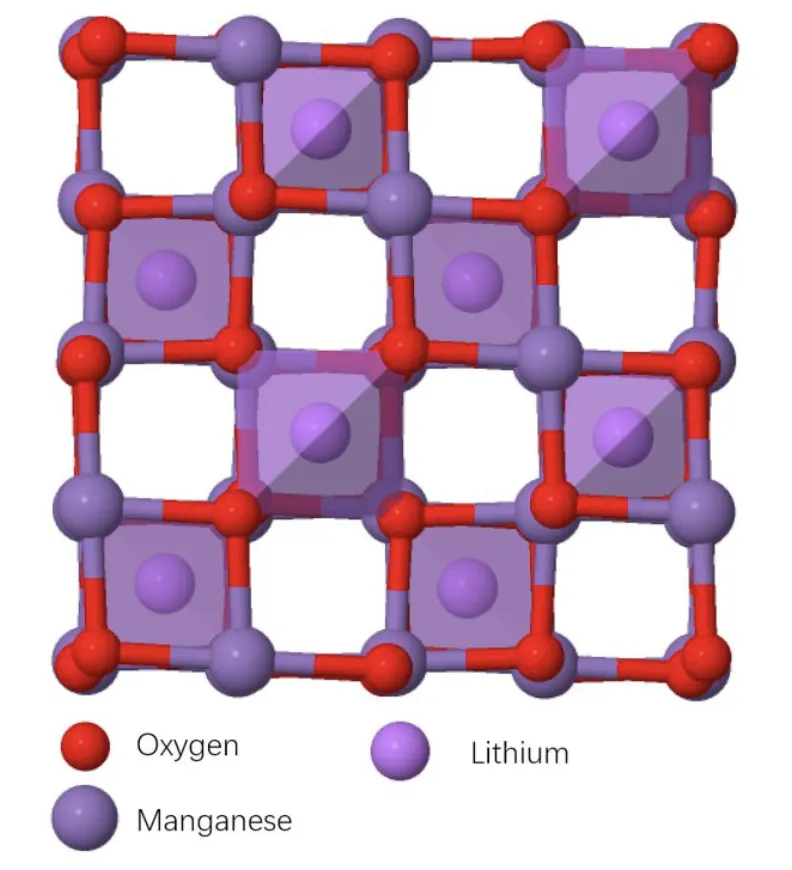
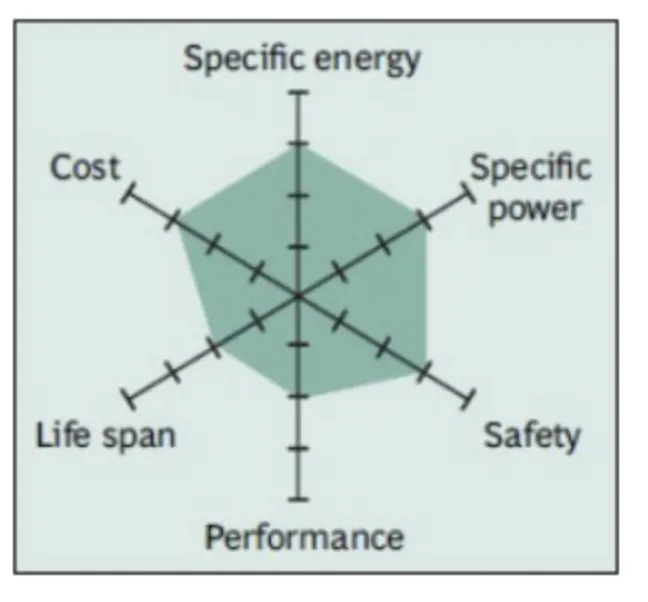
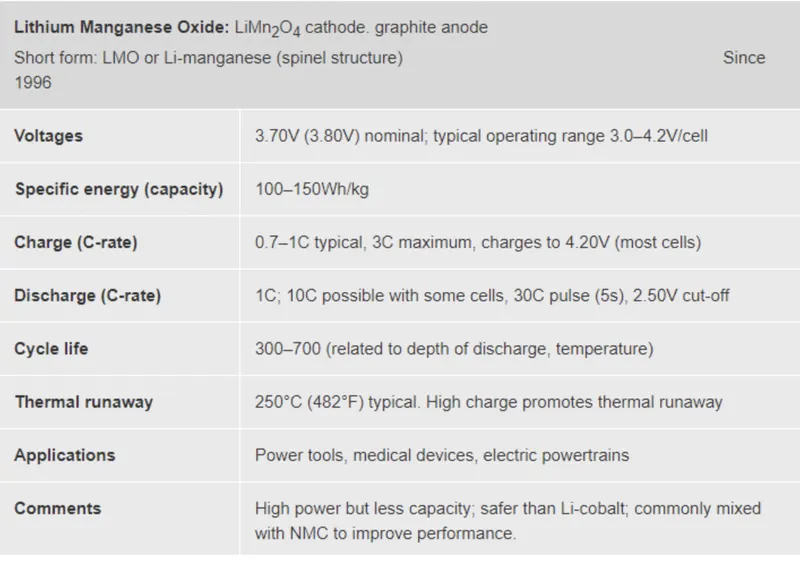
LMO stands for Lithium manganese oxide batteries, which are commonly referred to as lithium-ion manganese batteries or manganese spinel. This battery was discovered in the 1980s, yet the first commercial lithium-ion battery made with a cathode material made from lithium manganese was produced in 1996.
Lithium-ion batteries and concept
The most popular technology of the battery sector currently is the of the lithium ion battery. Relative to other types of batteries, lithium ion batteries have better energy, power density and higher cycling ability. These qualities are extremely important in the use in modern applications like electrical and hybrid vehicles and most importantly energy storage systems which are used in the renewable energy applications. The lithium ion batteries chemistry is the same across the different lithium-ion battery types; during discharge, Lithium-ions are moved to the positive cathode from the negative anode through the organic electrolyte. The anodes in all various technologies of lithium ion are all made from graphite. The differences are the cathode which contains changing cobalt, nickel or manganese concentrations. All various cathode types allow high lithium insertion and intercalation levels which result in large energy storage quantities.
Lithium iron phosphate battery
The lithium iron phosphate battery (LiFePO
4 battery) or LFP battery (lithium ferrophosphate) is a type of lithium-ion battery using lithium iron phosphate (LiFePO
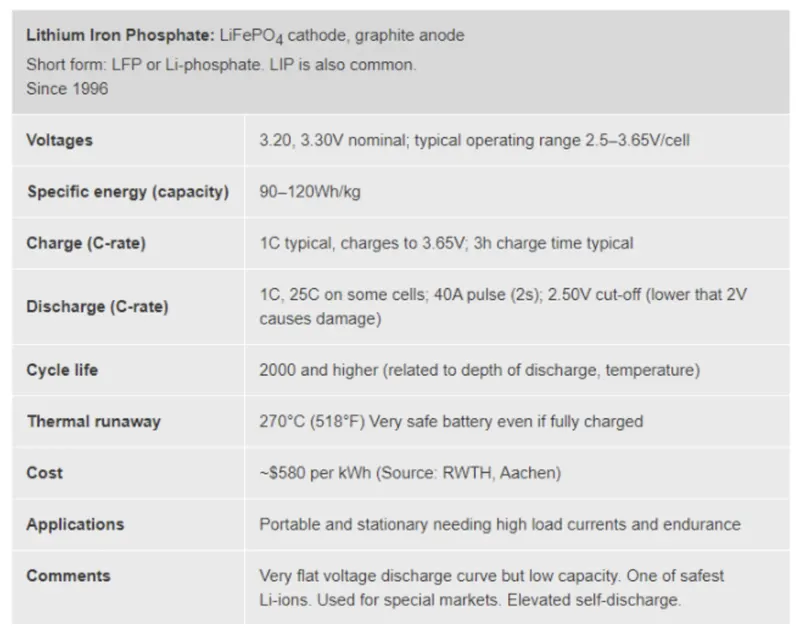
4) as the cathode material, and a graphitic carbon electrode with a metallic backing as the anode. The energy density of an LFP battery is lower than that of other common lithium ion battery types such as Nickel Manganese Cobalt (NMC) and Nickel Cobalt Aluminum (NCA), and also has a lower operating voltage; CATL's LFP batteries are currently at 125 watt hours (Wh) per kg, up to possibly 160 Wh/kg with improved packing technology, while BYD's LFP batteries are at 150 Wh/kg, compared to over 300 Wh/kg for the highest NMC batteries.
Because of its lower cost, high safety, low toxicity, long cycle life and other factors, LFP batteries are finding a number of roles in vehicle use, utility scale stationary applications, and backup power. LFP batteries are cobalt-free. As of Q1 2021, LFP type battery market share reached 24.1%,with Chinese manufacturers holding a near monopoly, and is expected to rise further to surpass NMC type batteries in 2028.
LiFePO
4 is a natural mineral of the olivine family (triphylite). Arumugam Manthiram and John B. Goodenough first identified the polyanion class of cathode materials for lithium ion batteries
LiFePO
4 was then identified as a cathode material belonging to the polyanion class for use in batteries in 1996 by Padhi et al. Reversible extraction of lithium from LiFePO
4 and insertion of lithium into FePO
4 was demonstrated. Because of its low cost, non-toxicity, the natural abundance of iron, its excellent thermal stability, safety characteristics, electrochemical performance, and specific capacity (170 mA·h/g, or 610 C/g) it has gained considerable market acceptance.[
The chief barrier to commercialization was its intrinsically low electrical conductivity. This problem was overcome by reducing the particle size, coating the LiFePO
4 particles with conductive materials such as carbon nanotubes,
LITHIUM NICKEL MAGANESE:
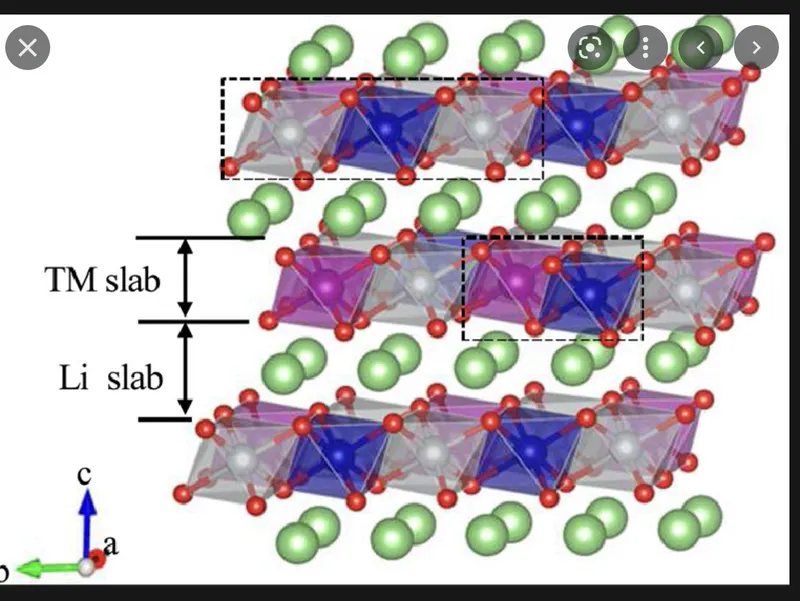
Lithium nickel manganese cobalt oxides (abbreviated Li-NMC, LNMC, NMC or NCM) are mixed metal oxides of lithium, nickel, manganese and cobalt. They have the general formula LiNixMnyCozO2. The most important representatives have a composition with x + y + z that is near 1, with a small amount of lithium on the transition metal site. In commercial NMC samples, the composition typically has < 5% excess lithium.[1][2] Structurally materials in this group are closely related to lithium cobalt(III) oxide (LiCoO2) and have a layered structure but possess an ideal charge distribution of Mn(IV), Co(III), and Ni(II) at the 1:1:1 stoichiometry. For more nickel-rich compositions, the nickel is in a more oxidized state for charge balance. NMCs are among the most important storage materials for lithium ions in lithium ion batteries. They are used on the positive side, which acts as the cathode during discharge.
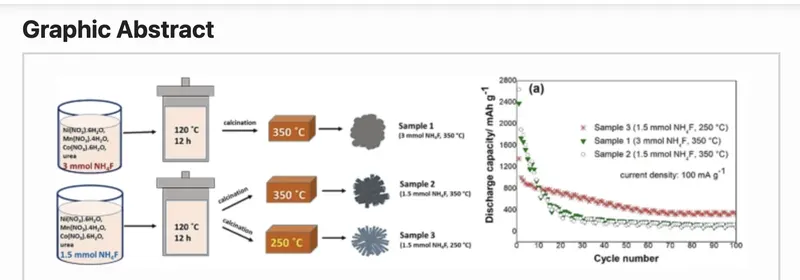
Beside that, there are some researchers who focus their studies on the morphological improvement of TMOs. Several approaches, such as producing nano- or micron- sized TMOs, including microcube, nanosheet, nanorods, nanotubes, nano/micro-spheres have been suggested to enhance the structural stability [. Li et al. have produced plum-like NiCo2O4 particles with wrinkled structure to increase the electrode–electrolyte contact area. The latter delivers better electrochemical performance compared to the spherical NiCo2O4 anode materials . Li et al. have produced a micron-sized hierarchical flower-like NiCo2O4, which has been constructed through a 2D template. Herein, polyvinylpyrolidone (PVP) and process duration have been used to control the morphology of the products from spherical particles to microflowers. The electrochemical tests substantiate that flower-like NiCo2O4 have showed better capacity and cycling stability . More recently, to ease volume expansion and enhance cycling performance as well as rate capability, researchers have been committed to fabricate combinations of TMO with more conductive materials. For example, Yao et al. have synthesized MnCo2O4/graphene composites and deposited them on nickel foam to enhance electronic conductivity, ion transportation and suppress the volume variation.
lithium nickel cobalt aluminium oxides:
The lithium nickel cobalt aluminium oxides (NCAs) are a group of mixed metal oxides. Some of them are important due to their application in lithium ion batteries. NCAs are used as active material on the positive pole (which is the cathode when the battery is discharged). NCAs are composed of the cations of the chemical elements lithium, nickel, cobalt and aluminium. The most important representatives as of this date[when?] have the general formula LiNixCoyAlzO2 with x + y + z = 1. In case of the NCA comprising batteries currently available on the market, which are also used in electric cars and electric appliances, x ≈ 0,8, and the voltage of those batteries is between 3.6 V and 4.0 V, at a nominal voltage of 3.6 V or 3.7 V. A version of the oxides currently in use in 2019 is LiNi0,84Co0,12Al0,04O2.
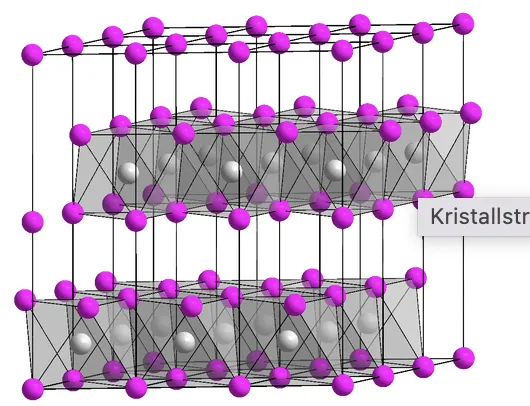
The usable charge storage capacity of NCA is about 180 to 200 mAh/g. This is well below the theoretical values; for LiNi0,8Co0,15Al0,05O2 this is 279 mAh/g.However, the capacity of NCA is significantly higher than that of alternative materials such as lithium cobalt oxide LiCoO2 with 148 mAh/g, lithium iron phosphate LiFePO4 with 165 mAh/g and NMC 333 LiNi0,33Mn0,33Co0,33O2 with 170 mAh/g.Like LiCoO2 and NMC, NCA belongs to the cathode materials with layer structure. Due to the high voltage, NCA enables batteries with high energy density. Another advantage of NCA is its excellent fast charging capability.Disadvantages are the high costs and the limited resources of cobalt and nickel.
The two materials NCA and NMC have related structures, quite similar electrochemical behaviour and show similar performance, in particular relatively high energy densities and relatively high performance. It is estimated that the NCA battery of Model 3 contains between 4.5 and 9.5 kg of cobalt and 11.6 kg of lithium.
Lithium-titanate battery:
The lithium-titanate or lithium-titanium-oxide (LTO) battery is a type of rechargeable battery which has the advantage of being faster to charge than other lithium-ion batteries but the disadvantage of having a much lower energy density.
Titanate batteries are used in certain Japanese-only versions of Mitsubishi's i-MiEV electric vehicle as well as Honda's EV-neo electric bike and Fit EV. They are also used in the Tosa concept electric bus. Because of the battery's high level of safety and recharge capabilities, LTO batteries are used in car audio applications as well as mobile medical devices.
An LTO battery is also used in the S-Pen that comes with the Samsung Galaxy Note 20 Ultra 5G.
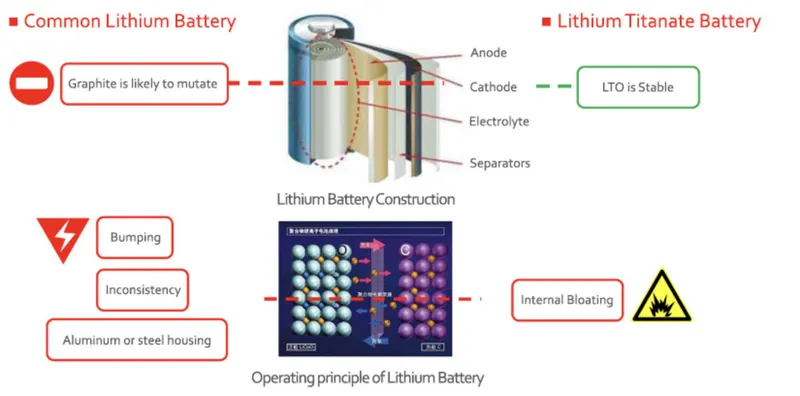
A lithium-titanate battery is a modified lithium-ion battery that uses lithium-titanate nanocrystals, instead of carbon, on the surface of its anode. This gives the anode a surface area of about 100 square meters per gram, compared with 3 square meters per gram for carbon, allowing electrons to enter and leave the anode quickly. Also, the redox potential of Li+ intercalation into titanium oxides is more positive than that of Li+ intercalation into graphite. This leads to fast charging (higher charging current) being much safer in the case of the titanate, than in the case of carbon, since lithium dendrites are less likely to form in the former case. Lithium-titanate cells last for 3000 to 7000 charge cycles; a life cycle of ~1000 cycles before reaching 80% capacity is possible when charged and discharged at 55 °C (131 °F), rather than the standard 25 °C (77 °F).
A disadvantage of lithium-titanate batteries is their lower inherent voltage (2.4 V), which leads to a lower specific energy (about 30–110 Wh/kg) than conventional lithium-ion battery technologies, which have an inherent voltage of 3.7 V. Some lithium-titanate batteries, however, have an energy density of up to 177 Wh/L.
conclution:
In this way , i am study different types of lithium ion batteries.
REFERENCE:
wikkipedia
google and others.