Understanding Different Battery Chemistry
Q. Prepare a table that includes materials & chemical reactions occurring at the anode and cathode of LCO, LMO, NCA, NMC, LFP, and LTO type of lithium-ion cells.
A lithium-ion battery is a type of rechargeable battery. Lithium-ion batteries are commonly used for portable electronics and electric vehicles and are growing in popularity for military and aerospace applications.
In the batteries, lithium ions move from the negative electrode through an electrolyte to the positive electrode during discharge, and back when charging. Li-ion batteries use an intercalated lithium compound as the material at the positive electrode and typically graphite at the negative electrode.
Electrochemistry
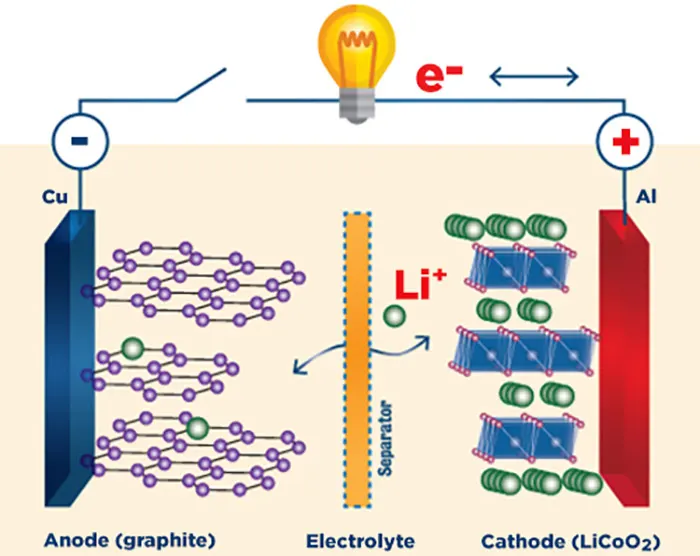
The working principle behind the working of a cell can be explained using electrochemistry. The reactants in the electrochemical reactions in a lithium-ion cell are materials of anode and cathode, both of which are compounds containing lithium atoms.
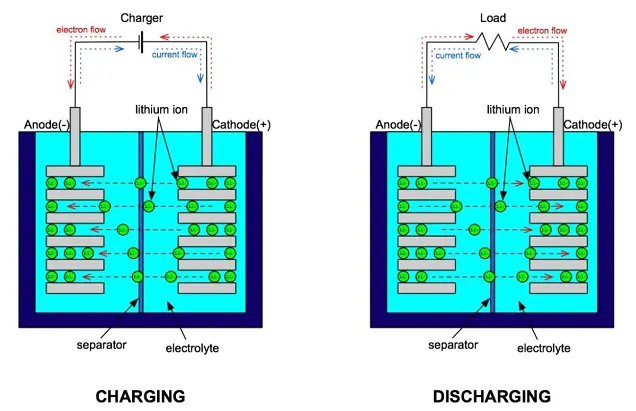
During discharge, an oxidation half-reaction at the anode produces positively charged lithium ions and negatively charged electrons. The oxidation half-reaction may also produce uncharged material that remains at the anode. Lithium ions move through the electrolyte, electrons move through the external circuit, and then they recombine at the cathode (together with the cathode material) in a reduction half-reaction. The electrolyte and external circuit provide conductive media for lithium ions and electrons, respectively, but do not partake in the electrochemical reaction. During discharge, electrons flow from the negative electrode (anode) towards the positive electrode (cathode) through the external circuit. The reactions during discharge lower the chemical potential of the cell, so discharging transfers energy from the cell to wherever the electric current dissipates its energy, mostly in the external circuit.
During charging these reactions and transports go in the opposite direction: electrons move from the positive electrode to the negative electrode through the external circuit. To charge the cell the external circuit has to provide electric energy. This energy is then stored as chemical energy in the cell (with some loss, e. g. due to coulombic efficiency lower than 1).
Both electrodes allow lithium ions to move in and out of their structures with a process called insertion (intercalation) or extraction (deintercalation), respectively.
Electrolyte
An electrolyte is a substance that produces an electrically conducting solution when dissolved in a polar solvent, such as water. The dissolved electrolyte separates into cations and anions, which disperse uniformly through the solvent. Electrically, such a solution is neutral.
Liquid electrolytes
Liquid electrolytes in lithium-ion batteries consist of lithium salts, such as LiPF_6, LiBF_4 or LiClO_4 in an organic solvent, such as ethylene carbonate, dimethyl carbonate, and diethyl carbonate. A liquid electrolyte acts as a conductive pathway for the movement of cations passing from the negative to the positive electrodes during discharge.
Conductivities of liquid electrolyte at room temperature (20 °C (68 °F)) are in the range of 10 mS/cm, increasing by approximately 30–40% at 40 °C (104 °F) and decreasing slightly at 0 °C (32 °F).
The combination of linear and cyclic carbonates (e.g., ethylene carbonate (EC) and dimethyl carbonate (DMC)) offers high conductivity and solid electrolyte interphase (SEI)-forming ability.
Solid electrolytes
The advanced battery technologies involve using a solid as the electrolyte material. The most promising of these are ceramics.
Solid ceramic electrolytes are mostly lithium metal oxides, which allow lithium-ion transport through the solid more readily due to the intrinsic lithium. The main benefit of solid electrolytes is that there is no risk of leaks, which is a serious safety issue for batteries with liquid electrolytes.
Solid ceramic electrolytes can be further broken down into two main categories, ceramic and glassy.
Ceramic solid electrolytes are highly ordered compounds with crystal structures that usually have ion transport channels.
Glassy solid electrolytes are amorphous atomic structures made up of similar elements to ceramic solid electrolytes but have higher conductivities overall due to higher conductivity at grain boundaries.
Both glassy and ceramic electrolytes can be made more ionically conductive by substituting sulfur for oxygen. The larger radius of sulfur and its higher ability to be polarized allow higher conductivity of lithium. This contributes to the conductivities of solid electrolytes that are nearing parity with their liquid counterparts, with most on the order of 0.1 mS/cm (ms/cm=millisiemens per centimeter) and the best at 10 mS/cm.
| Lithium-Ion Batteries | |||||
|
Sl. No.
|
Types of Lithium-Ion Batteries
|
Material |
Chemical Reaction
|
Application
|
|
| Anode | Cathode | ||||
| 1 | Lithium Cobalt Oxide(LiCoO2)-LCO | Graphite | Cobalt oxide |
The positive electrode (cathode) half-reaction `CoO_2+Li^++e^(-)harrLiCoO_2` The negative electrode (anode) half-reaction `LiC_6harrC_6+Li^++e^-` Full reaction (left`to`right:charging & right`to`left discharging) `LiC_6+CoO_2harrC_6+LiCoO_2` |
Mobile phones, tablets, laptops, cameras |
| 2 | Lithium Nickel Manganese Cobalt Oxide (LiNiMnCoO2)-NMC | Graphite | Nickel Manganese Cobalt Oxide |
The positive electrode (cathode) half-reaction `NiMnCoO_2+Li^++e^(-)harrLiNiMnCoO_2` The negative electrode (anode) half-reaction `LiC_6harrC_6+Li^++e^-` Full reaction (left`to`right:charging & right`to`left discharging) `LiC_6+NiMnCoO_2harrC_6+LiNiMnCoO_2` |
E-bikes, medical devices, EVs, industrial |
| 3 | Lithium Iron Phosphate(LiFePO4)-LFP | Graphite | Iron Phosphate |
The positive electrode (cathode) half-reaction `FePO_4+Li^++e^(-)harrLiFePO_4` The negative electrode (anode) half-reaction `LiC_6harrC_6+Li^++e^-` Full reaction (left`to`right:charging & right`to`left discharging) `LiC_6+FePO_4harrC_6+LiFePO_4` |
Portable and stationary needing high load currents and endurance |
| 4 | Lithium Nickel Cobalt Aluminum Oxide (LiNiCoAlO2)-NCA | Graphite | Nickel Cobalt Aluminum Oxide |
The positive electrode (cathode) half-reaction `NiCoAlO_2+Li^++e^(-)harrLiNiCoAlO_2` The negative electrode (anode) half-reaction `LiC_6harrC_6+Li^++e^-` Full reaction (left`to`right:charging & right`to`left discharging) `LiC_6+NiCoAlO_2harrC_6+LiNiCoAlO_2` |
Medical devices, industrial, electric powertrain (Tesla) |
| 5 | Lithium Manganese Oxide (LiMn2O4)-LMO | Graphite | Manganese Oxide |
The positive electrode (cathode) half-reaction `Mn_2O_4+Li^++e^(-)harrLiMn_2O_4` The negative electrode (anode) half-reaction `LiC_6harrC_6+Li^++e^-` Full reaction (left`to`right:charging & right`to`left discharging) `LiC_6+Mn_2O_4harrC_6+LiMn_2O_4` |
Power tools, medical devices, electric powertrains |
| 6 | Lithium Titanate (Li2TiO3)-LTO | Titanate (Li_2TiO_3) |
Manganese Oxide or NMC |
The positive electrode (cathode) half-reaction `Mn_2O_4+Li^++e^(-)harrLiMn_2O_4` The negative electrode (anode) half-reaction `Li_2TiO_3harrTiO_3+2Li^++2e^-` Full reaction (left`to`right:charging & right`to`left discharging) `Li_2TiO_3+2Mn_2O_4harrTiO_3+2LiMn_2O_4` |
UPS, electric powertrain (Mitsubishi i-MiEV, Honda Fit EV), solar-powered street lighting |
Lithium Cobalt Oxide(`LiCoO_2`)-LCO
| Lithium Cobalt Oxide: LiCoO2 cathode (~60% Co), graphite anode Short form: LCO or Li-cobalt. Since 1991 |
|
| Voltages | 3.60V nominal; typical operating range 3.0–4.2V/cell |
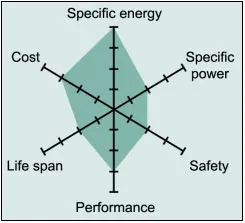
| Specific energy (capacity) | 150–200Wh/kg. Specialty cells provide up to 240Wh/kg. |
| Charge (C-rate) | 0.7–1C, charges to 4.20V (most cells); 3h charge typical. Charge current above 1C shortens battery life. |
| Discharge (C-rate) | 1C; 2.50V cut off. Discharge current above 1C shortens battery life. |
| Cycle life | 500–1000, related to depth of discharge, load, temperature |
| Thermal runaway | 150°C (302°F). Full charge promotes thermal runaway |
| Applications | Mobile phones, tablets, laptops, cameras |
| Comments 2019 update: |
Very high specific energy, limited specific power. Cobalt is expensive. Serves as Energy Cell. Market share has stabilized. Early version; no longer relevant. |
Lithium Manganese Oxide (`LiMn_2O_4`)-LMO
| Lithium Manganese Oxide: LiMn2O4 cathode. graphite anode Short form: LMO or Li-manganese (spinel structure) Since 1996 |
|
| Voltages | 3.70V (3.80V) nominal; typical operating range 3.0–4.2V/cell |
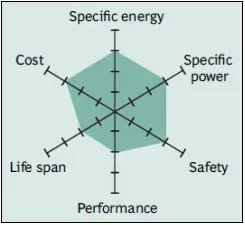
| Specific energy (capacity) | 100–150Wh/kg |
| Charge (C-rate) | 0.7–1C typical, 3C maximum, charges to 4.20V (most cells) |
| Discharge (C-rate) | 1C; 10C possible with some cells, 30C pulse (5s), 2.50V cut-off |
| Cycle life | 300–700 (related to the depth of discharge, temperature) |
| Thermal runaway | 250°C (482°F) typical. High charge promotes thermal runaway |
| Applications | Power tools, medical devices, electric powertrains |
| Comments 2019 update: |
High power but less capacity; safer than Li-cobalt; commonly mixed with NMC to improve performance. Less relevant now; limited growth potential. |
Lithium Nickel Manganese Cobalt Oxide (`LiNiMnCoO_2`) — NMC
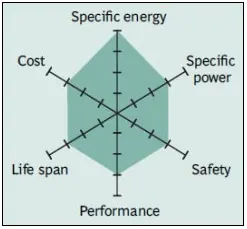
| Lithium Nickel Manganese Cobalt Oxide: LiNiMnCoO2. cathode, graphite anode Short form: NMC (NCM, CMN, CNM, MNC, MCN similar with different metal combinations) Since 2008 |
|
| Voltages | 3.60V, 3.70V nominal; typical operating range 3.0–4.2V/cell, or higher |
| Specific energy (capacity) | 150–220Wh/kg |
| Charge (C-rate) | 0.7–1C, charges to 4.20V, some go to 4.30V; 3h charge typical. Charge current above 1C shortens battery life. |
| Discharge (C-rate) | 1C; 2C possible on some cells; 2.50V cut-off |
| Cycle life | 1000–2000 (related to the depth of discharge, temperature) |
| Thermal runaway | 210°C (410°F) typical. High charge promotes thermal runaway |
| Cost | ~$420 per kWh (Source: RWTH, Aachen) |
| Applications | E-bikes, medical devices, EVs, industrial |
| Comments 2019 update: |
Provides high capacity and high power. Serves as Hybrid Cell. Favorite chemistry for many uses; market share is increasing. Leading system; dominant cathode chemistry. |
Lithium Iron Phosphate(`LiFePO_4`) — LFP
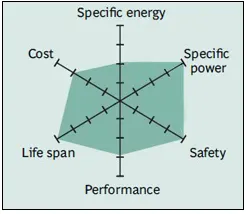
| Lithium Iron Phosphate: LiFePO4 cathode, graphite anode Short form: LFP or Li-phosphate Since 1996 |
|
| Voltages | 3.20, 3.30V nominal; typical operating range 2.5–3.65V/cell |
| Specific energy (capacity) | 90–120Wh/kg |
| Charge (C-rate) | 1C typical charges to 3.65V; 3h charge time typical |
| Discharge (C-rate) | 1C, 25C on some cells; 40A pulse (2s); 2.50V cut-off (lower than 2V causes damage) |
| Cycle life | 2000 and higher (related to the depth of discharge, temperature) |
| Thermal runaway | 270°C (518°F) Very safe battery even if fully charged |
| Cost | ~$580 per kWh (Source: RWTH, Aachen) |
| Applications | Portable and stationary needing high load currents and endurance |
| Comments 2019 update: |
Very flat voltage discharge curve but low capacity. One of the safest Li-ions. Used for special markets. Elevated self-discharge. Used primarily for energy storage, moderate growth. |
Lithium Nickel Cobalt Aluminum Oxide (`LiNiCoAlO_2`) — NCA
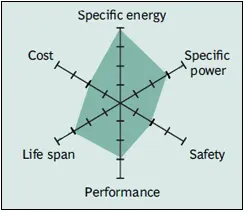
| Lithium Nickel Cobalt Aluminum Oxide: LiNiCoAlO2 cathode (~9% Co), graphite anode Short form: NCA or Li-aluminum. Since 1999 |
|
| Voltages | 3.60V nominal; typical operating range 3.0–4.2V/cell |
| Specific energy (capacity) | 200-260Wh/kg; 300Wh/kg predictable |
| Charge (C-rate) | 0.7C charges to 4.20V (most cells), 3h charge typical, fast charge possible with some cells |
| Discharge (C-rate) | 1C typical; 3.00V cut-off; high discharge rate shortens battery life |
| Cycle life | 500 (related to the depth of discharge, temperature) |
| Thermal runaway | 150°C (302°F) typical, High charge promotes thermal runaway |
| Cost | ~$350 per kWh (Source: RWTH, Aachen) |
| Applications | Medical devices, industrial, electric powertrain (Tesla) |
| Comments 2019 update: |
Shares similarities with Li-cobalt. Serves as Energy Cell. Mainly used by Panasonic and Tesla; growth potential. |
Lithium Titanate (`Li_2TiO_3`) — LTO
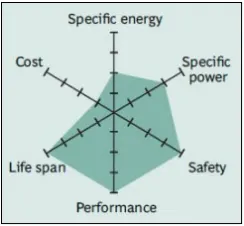
| Lithium Titanate: Cathode can be lithium manganese oxide or NMC; Li2TiO3 (titanate) anode Short form: LTO or Li-titanate Commercially available since about 2008. |
|
| Voltages | 2.40V nominal; typical operating range 1.8–2.85V/cell |
| Specific energy (capacity) | 50–80Wh/kg |
| Charge (C-rate) | 1C typical; 5C maximum, charges to 2.85V |
| Discharge (C-rate) | 10C possible, 30C 5s pulse; 1.80V cut-off on LCO/LTO |
| Cycle life | 3,000–7,000 |
| Thermal runaway | One of the safest Li-ion batteries |
| Cost | ~$1,005 per kWh (Source: RWTH, Aachen) |
| Applications | UPS, electric powertrain (Mitsubishi i-MiEV, Honda Fit EV), solar-powered street lighting |
| Comments 2019 update: |
Long life, fast charge, wide temperature range but low specific energy, and expensive. Among safest Li-ion batteries. Ability to ultra-fast charge; high-cost limits to a special application. |
References
1. https://en.wikipedia.org/wiki/Lithium-ion_battery
2. https://batteryuniversity.com/learn/article/types_of_lithium_ion
- Harry Brielmannwow a treasure trove of information for an electrochemist. Love that the focus is on the half reactions and overall chemical reaction. My interest is electric cars and the two major chemistry types: LiFePO4 and NCA. Based on what is happening in late 2021 the cost for LiFePO4 is now around $100 per kwh and interest has really skyrocketed. Thanks for a great resource