Week 1 Understanding Different Battery Chemistry
Q1.
Aim: To Understand the basics of a Battery and different types of Li-Ion Battery and their characteristics.
What is a Battery?
A battery is a device that stores chemical energy and converts it to electrical energy.
It consists of one or more electrochemical cells with external connections for powering electrical devices such as flashlights, mobile phones, and electric cars.
The chemical reactions in a battery involve the flow of electrons from one material (electrode) to another, through an external circuit. The flow of electrons provides an electric current that can be used to do work.
Types of Battery
Battery cells are mainly divided into 2 types:
1) Primary cells - Non chargeable cells
2) Secondary cells - chargeable cells -
Primary cells are Non chargeable cells which are used in appliances such as wrist watch, calculator & radio e.g. Dry cell, Li battery
Secondary cells are chargeable cells which can undergo Reversible chemical process i.e., Electrical energy to chemical energy.
E.g. Lead cell, Ni-cd cell, metal air, Ni metal Hydride, Li ion Battery cells
The reason for using Li ion Battery in many application is because of High energy density.
Energy Density: The energy density is the total amount of energy that can be stored per unit mass or volume. This determines how long your device stays on before it needs a recharge.
Battery cells are usually made up of three main components:
1. The Anode (Negative Electrode)
2. The Cathode (Positive Electrode)
3. The electrolytes
During Discharge, The anode is a negative electrode that produces electrons to the external circuit to which the battery is connected. When batteries are connected, an electron build up is initiated at the anode which causes a potential difference between the two electrodes. The electrons naturally then try to redistribute themselves, this is prevented by the electrolyte, so when an electrical circuit is connected, it provides a clear path for the electrons to move from the anode to the cathode thereby powering the circuit to which it is connected.
During charging, the Li ions move back from cathode to Anode.
In a lithium-ion battery, lithium atoms at the anode (-ve) split. This makes electrons and lithium ions (lithium atoms with a positive charge). The lithium ions move within the battery to the cathode (+ve) through an electrolyte. Electrons generally can't pass through this material. So the electrons take a different path to the cathode through an external circuit. That creates an electric current that can power a device. At the cathode, the electrons meet up with the lithium ions for another chemical reaction.
To charge a battery, this process runs in reverse. The ions and electrons journey back to the anode. In a lithium-ion battery, that anode usually is graphite. The lithium ions tuck between the atom-thin layers of the graphite. The cathode can be one of several lithium-containing materials.
Types of Li-ion Battery
1) Lithium Cobalt Oxide (LiCo02) - LCO
2) Lithium Manganese Oxide (LiMn204) - LMO
3) Lithium Nickel Manganese Cobalt Oxide (LiNiMnC002) - NMC
4) Lithium Iron Phosphate (LiFePO4) - LFP
5) Lithium Nickel Cobalt Aluminum Oxide (LINICOAIO2) - NCA
6) Lithium Titanate (Li2TiO3) - LTO
1) Lithium Cobalt Oxide (LiCo02) - LCO DURING DISCHARGE
Chemical reaction in different battries:
1) LCO:
At the anode, lithium is oxidised. Lithium ions are released from the carbon, along with electrons:
LiC -> xLi^+ + xe^- + C6
At the cathode, lithium-ions are absorbed by the lithium dioxide, and the electrode is reduced as it also receives the electrons from the circuit:
Li1-xCoO2 + xLi + xe -> LiCoO2
The overall reaction is:
C6 + LiCoO₂ <-> LixC6 + Li1 - xCoO₂
2) Lithium manganese oxide(LiMn2O4)-LMO
Reaction at anode:Li->Li++e-
Reaction at cathode:MnO2++e- -> MnOOLi
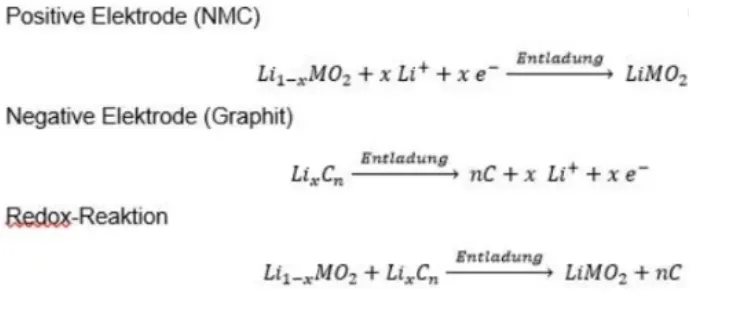
3) Lithium Nickel Manganese Cobalt Oxide(LiNiMnCoO2) - NMC
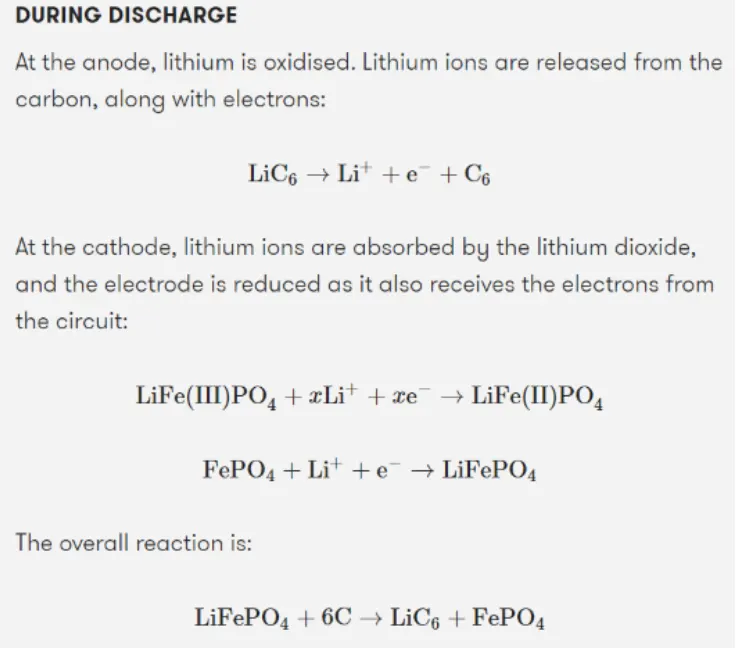
4) Lithium Iron Phosphate:
5) Lithium Nickel Cobalt Aluminium Oxide
