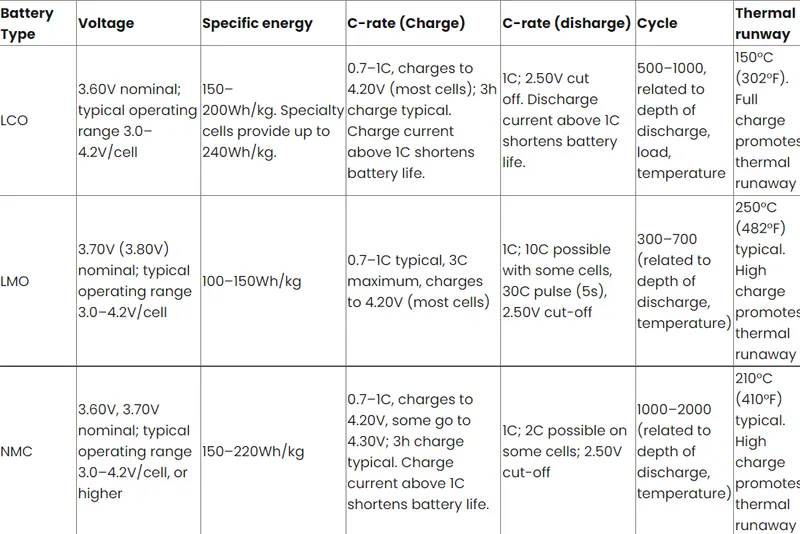
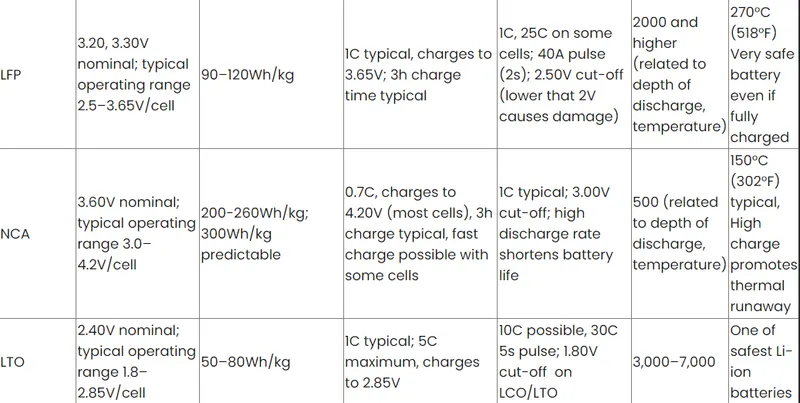
Week 1 Understanding Different Battery Chemistry
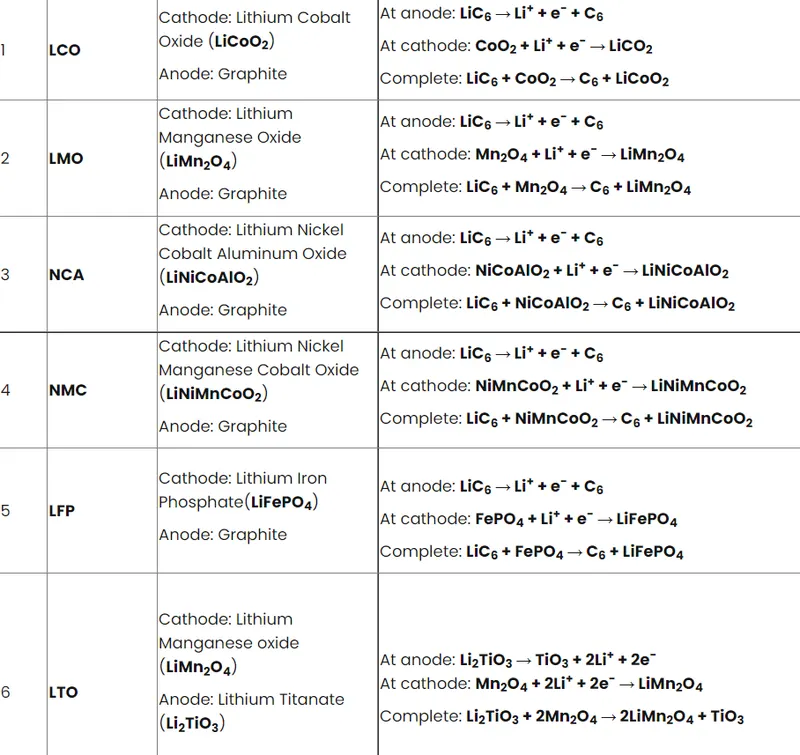
1.Prepare a table which includes materials & chemical reactions occurring at the anode and cathode of LCO, LMO, NCA, NMC, LFP and LTO type of lithium ion cells.Give your detailed explanation on it
Ans :
UNDERSTANDING DIFFERENT TYPES OF Li-ion BATTERY CHEMISTRY
A lithium-ion (Li-ion) battery is an advanced battery technology that uses lithium ions as a key component of its electrochemistry. During a discharge cycle, lithium atoms in the anode are ionized and separated from their electrons. The lithium ions move from the anode and pass through the electrolyte until they reach the cathode, where they recombine with their electrons and electrically neutralize. The lithium ions are small enough to be able to move through a micro-permeable separator between the anode and cathode. In part because of lithium's small size (third only to hydrogen and helium), Li-ion batteries are capable of having a very high voltage and charge storage per unit mass and unit volume.
Li-ion batteries can use a number of different materials as electrodes. The most common combination is that of lithium cobalt oxide (cathode) and graphite (anode), which is most commonly found in portable electronic devices such as cellphones and laptops. Other cathode materials include lithium manganese oxide (used in hybrid electric and electric automobiles) and lithium iron phosphate. Li-ion batteries typically use ether (a class of organic compounds) as an electrolyte.
Lithium-ion batteries are categorized mostly on the basis of what type of material is used in cathode electrode. Why cathode? Why not anode?. Almost all the li-ion batteries use graphite material at anode electrode hence it is categorized on the basis of cathode material. Except LTO; LTO uses NMC type material in anode uses Lithium titanent in anode. So for other type of li-ion batteries the common anode material is: LiC and also the common electrolyte is lithium salt such as LiPF6 in an organic solution.Table below shows the types of Li-ion batteries with there cathode material and chemical reactions.
Sr Battery Type Elctrode Material Chemical Reaction
No.
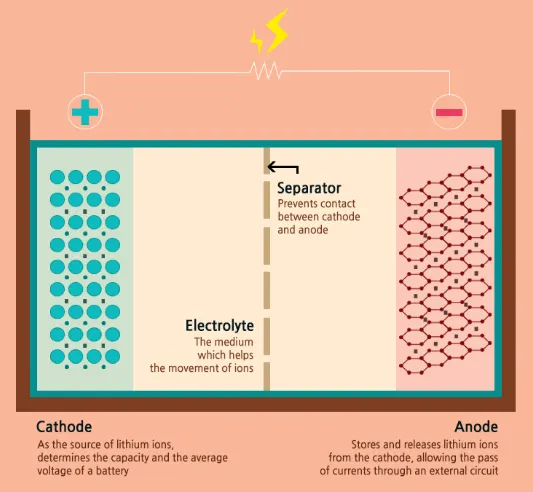
Li-ion batteries consist of largely four main components: cathode, anode, electrolyte, and separator. Every single component of a Li-ion battery is essential as it cannot function when one of the components is missing.
"Cathode" determines the capacity and voltage of a Li-ion battery
A Lithium-ion battery generates electricity through chemical reactions of lithium. This is why, of course, lithium is inserted into the battery and that space for lithium is called "cathode". However, since lithium is unstable in the element form, the combination of lithium and oxygen, lithium oxide is used for cathode. The material that intervenes the electrode reaction of the actual battery just like lithium oxide is called" active material". In other words, in the cathode of a Li-ion battery, lithium oxide is used as an active material.
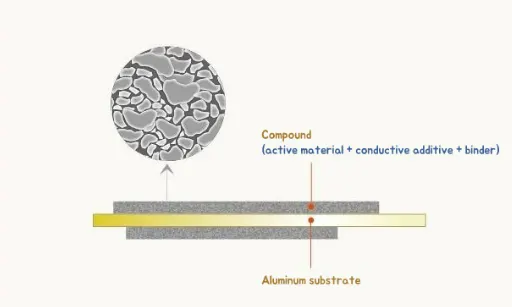
If you take a closer look at the cathode, you will find a thin aluminium foil used to hold the frame of the cathode coated with a compound made up of active material, conductive additive and binder. The active material contains lithium ions, the conductive additive is added to increase conductivity; and the binder acts as an adhesive which helps the active material and the conductive additive to settle well on the aluminium substrate. Cathode plays an important role in determining the characteristid of the battery as the battery's capacity and voltage are determined by active material type used for cathode. The higher amount of lithium, bigger the capacity; and the bigger potential difference between cathode and anode, higher the voltage. The potential difference is small for anode depending on their type but for cathode, the potential difference is relatively high in general.
As such, the cathode plays a significant role in determining the voltage of the battery.
"Anode" sends electrons through a wire
Just like the cathode, the anode substrate is also coated with active material. The anode's active material performs the role of enabling electric current to flow through the external circuit while allowing reversible absorption/emission of lithium ions released from the cathode. When the battery is being charged, lithium ions are stored in the anode and not the cathode. At this point, when the conducting wire connects the cathode to the anode (discharge state), lithium ions naturally flow back to the cathode through the electrolyte, and the electrons (e-) separated from lithium ions move along the wire generating electricity. For anode graphite which has a stable structure is used, and the anode substrate is coated with active material, conductive additive and a binder.
Thanks to graphite's optimal qualities such as structural stability, low electrochemical reactivity, conditions for storing much lithium ions and price, the material is considered suitable to be used for anode.
"Electrolyte" allows the movement of ions only
When explaining about cathode and anode, it was mentioned that lithium ions move through the electrolyte and electrons move through the wire. This is the key in enabling the use of electricity in a battery. If ions flow through the electrolyte, not only can't we use electricity but safety will be jeopardized. Electrolyte is the component which plays this important role. It serves as the medium that enables the movement of only lithium ions between the cathode and anode. For the electrolyte, materials with high ionic conductivity are mainly used so that lithium ions move back and forth easily. The electrolyte is composed of salts, solvents and additives. The salts are the passage for lithium ions to move, the solvents are organic liquids used to dissolve the salts, and the additives are added in small amounts for specific purposes. Electrolyte created in this way only allows ions to move to the electrodes and doesn't let electrons to pass. In addition, the movement speed of lithium ions depends on the electrolyte type. Thus, only the electrolytes that meet stringent conditions can be used.
"Separator", the absolute barrier between cathode and anode
While the cathode and anode determine the basic performance of a battery, electrolyte and separator determine the safety of a battery. The separator functions as a physical barrier keeping cathode and anode apart. It prevents the direct flow of electrons and carefully lets only the ions pass through the internal microscopic hole. Therefore, it must satisfy all the physical and electrochemical conditions.
Commercialized separators we have today are synthetic resin such as polyethylene (PE) and polypropylene (PP).
1.Prepare a table which includes materials & chemical reactions occurring at the anode and cathode of LCO, LMO, NCA, NMC, LFP and LTO type of lithium ion cells.Give your detailed explanation on it
Ans :