Week 1 Understanding Different Battery Chemistry
Challenge: Understanding Different Battery Chemistry
Study Cases:
1. Prepare a table that includes materials & chemical reactions occurring at the anode and cathode of LCO, LMO, NCA, NMC, LFP, and LTO types of lithium-ion cells. Give your detailed explanation of it
2. Compare the differences between each type of Li+ion battery based on their characteristics
Study Case 1:
1. Prepare a table that includes materials & chemical reactions occurring at the anode and cathode of LCO, LMO, NCA, NMC, LFP, and LTO types of lithium-ion cells. Give your detailed explanation of it.
Explanation:
Battery Reactions:
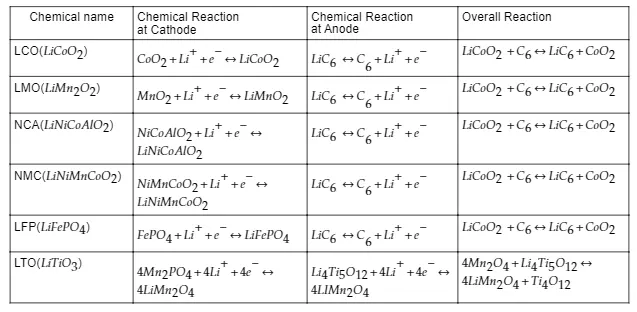
1. LCO: Lithium-cobalt oxide:
Lithium Cobalt Oxide
Lithium cobalt oxide batteries are manufactured from lithium carbonate and cobalt and are also known as lithium cobaltate or lithium-ion cobalt batteries. These batteries are used in cell phones, laptops, and electronic cameras because of their high specific energy. They have a cobalt oxide cathode and a graphite carbon anode, and lithium ions migrate from the anode to the cathode during discharge, with the flow reversing when the battery is charged.
The electrolyte is a lithium salt in liquid or gel form and allows the ions to flow from the cathode to the anode (and vice versa).
This battery has a few disadvantages, including short battery life and low specific power. We also want to let you know that these batteries are not as safe as other varieties. Despite this, they are a popular choice for cell phones and other portable electronic devices because of their properties.
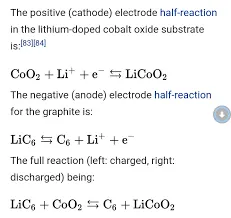
When it comes to powering EVs, lithium-cobalt batteries are unmatched. Specific properties of cobalt make them stand out from the rest:
- High energy density
- Thermal stability
- High specific power
- Low self-discharge rate
- Low weight
- Recyclability
Not only do lithium-cobalt batteries allow EVs to travel farther, but they also improve safety and sustainability.
Cobalt’s high energy density allows batteries to pack more energy in smaller spaces, making them lightweight and powerful at the same time. In addition, its ability to withstand high temperatures increases the safety and reliability of EVs.
Furthermore, cobalt increases the longevity of batteries and remains highly recyclable, promoting a more sustainable battery supply chain.
Despite its advantages, EV manufacturers are making efforts to reduce the cobalt content of their batteries for various reasons associated with their supply chain:
- Cobalt is a by-product of nickel and copper mining, which makes it harder to obtain.
- Cobalt is expensive, at US$33,000/tonne—more than twice the price of nickel.
- The general public associate's cobalt mining in the Congo with child labor, tough conditions, and corruption.
Although cobalt may be associated with unethical mining practices, it remains essential to EV manufacturers—as demonstrated by Tesla’s agreement to buy 6,000 tonnes of cobalt annually from mining giant Glencore.
LMO: Lithium Mahganese Oxide :
Lithium-manganese dioxide cells have a metallic lithium anode (the lightest of all the metals) and a solid manganese dioxide cathode, immersed in a non-corrosive, non-toxic organic electrolyte. They deliver a voltage of 3.0 V and are cylindrical, button, and polymer in shape.
Lithium manganese oxide batteries are sometimes known as lithium manganate or lithium-ion manganese batteries, or li-manganese or manganese spinel batteries. The technology for this sort of battery was initially discovered in the 1980s, with the first publication in the Materials Research Bulletin in 1983. Moli Energy manufactured the first commercial lithium-ion cells using lithium manganese oxide as the cathode material in 1996.
High-temperature stability distinguishes lithium manganese oxide batteries from others, which are also safer than other lithium-ion battery types. As a result, they’re frequently found in medical equipment and devices, but they can also be used in power tools, electric motorcycles, and other applications. Lithium manganese oxide batteries can also be used to power laptop computers and electric vehicles.
| Positive reaction : | MnO2+Li++e- → MnOOLi |
|---|---|
| Negative reaction : | Li → Li++e- |
| Total reaction : | MnO2+Li → MnOOLi |
Features:
- Low self-discharge (less than 1 % per year at RT)
- Superior shelf life and operational life
- High Capacity or High rate cell construction
- No Memory Effect
- No need for expensive safety electronics
- Operation over a wide temperature range (-20ºC up to 60ºC )
- 0% lead, 0% mercury and 0% cadmium
- Product support worldwide is available for the design engineer
- Battery designs in various assembles
- With wire connector
- In plastic housing with high-tech materials
- High Capacity for longer running time
- Low self-discharge for long life
- UL Recognition
- Safe & reliable
Main applications:
- Military radio-communication
- Sonobuoys
- Emergency location transmitters beacon (ELTs, EPIRBs)
- Professional electronics
- Measuring equipment
- Cardiac defibrillators
NCA: Nickel Cobalt Aluminum Oxide batteries:
NCA batteries, or lithium nickel cobalt aluminum oxide batteries, are making their way into electric vehicles and grid storage.
Although NCA batteries are not widely used in consumer electronics, they have great potential in the automobile industry. NCA batteries offer a high-energy choice with a long lifespan, but they are less safe than other lithium-ion battery types and are rather expensive. To ensure driver safety, NCA batteries must be accompanied by monitoring systems.
Given the widespread use of NCA batteries in electric vehicles, demand for these batteries may increase as the number of electric vehicles grows.
Less Safe
Moderate Life span
Moderate performance

Nickel Manganese Cobalt : NMC:
A cathode combination of nickel, manganese, and cobalt is one of the most successful Li-ion systems. These systems, like Li-manganese, can be modified to serve as Energy Cells or Power Cells.
NMC in a 18650 cell for moderate load conditions has a capacity of about 2,800mAh and can produce 4A to 5A; NMC in the same cell can be optimized for specific power. For example, it can have a capacity of just about 2,000mAh but can deliver a continuous discharge current of 20A.
The capacity of a silicon-based anode can be increased to 4,000mAh and beyond, but at the cost of reduced loading capability and shorter cycle life.
The anode grows and shrinks with charge and discharge, making the cell mechanically unstable. Silicon added to graphite has the disadvantage of growing and shrinking with charge and discharge, making the cell mechanically unstable.
The combination of nickel and manganese is the key to NMC’s success. Table salt is an example of this; the major constituents, sodium, and chloride, are both harmful on their own, but when combined, they act as seasoning salt and a food preservative. Manganese has the advantage of developing a spinel structure to create low internal resistance but has a low specific energy. Nickel has high specific energy but is unstable. When the metals are combined, their strengths are amplified.
For power tools, e-bikes, and other electric powertrains, NMC is the battery of choice. The cathode is commonly made up of one-third nickel, one-third manganese, and one-third cobalt, or 1-1-1. This creates a distinctive blend while also lowering the cost of raw materials due to the lower cobalt percentage. NCM, which consists of 5 parts nickel, 3 parts cobalt, and 2 parts manganese, is another excellent combination (5-3-2). It’s possible to make other combinations with different amounts of cathode materials.
To increase capacity, new electrolytes and additives are used that enable charging to 4.4V/cell and higher. There is a trend toward NMC-blended Li-ion since the system is cost-effective and provides good performance. Nickel, manganese, and cobalt are three active materials that may be easily combined to suit a wide range of automotive and energy storage systems (EES) applications that require frequent cycling. The NMC family is becoming more diverse
Reaction:
2LiCoO2,(s) + 8HCl(l) ⇌ 2LiCl(l) + 2CoCl2,(l) + 4H2O(l) + Cl2,(g)
LFP:
The lithium iron phosphate battery (LiFePO
4 battery) or LFP battery (lithium ferrophosphate) is a type of lithium-ion battery using lithium iron phosphate (LiFePO
4) as the cathode material, and a graphitic carbon electrode with a metallic backing as the anode. The energy density of an LFP battery is lower than that of other common lithium-ion battery types such as Nickel Manganese Cobalt (NMC) and Nickel Cobalt Aluminum (NCA), and also has a lower operating voltage;
Phosphate is used as a cathode in lithium iron phosphate batteries, often known as li-phosphate batteries. They have low resistance qualities, which improve their thermal stability and safety.
Durability and a long lifecycle are other advantages – fully charged batteries can be kept with no effect on the battery’s overall charge life. When the lengthy battery life of Li-phosphate batteries is considered, they are frequently the most cost-effective option. The lower voltage of the lithium-phosphate battery, on the other hand, means that it has less energy than other lithium batteries.
As a result, these batteries are frequently used in electric bikes and other applications requiring a long lifecycle and high levels of safety. These batteries are also commonly used in electric vehicles.
Reaction:
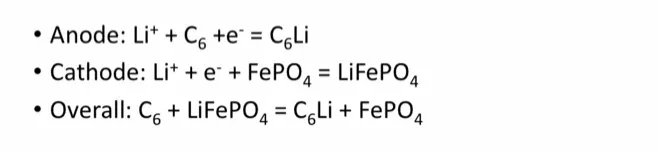
Uses:
Lithium iron phosphate batteries are widely used in passenger cars, buses, logistics vehicles, low-speed electric vehicles, etc. due to their safety and low-cost advantages.
LTO:lithium-titanium-oxide :
Finally, lithium titanate, often known as li-titanate, is a type of battery that has a growing number of uses. Because of its superior nanotechnology, the lithium-titanate battery has an extremely rapid recharge time.
Li-titanate batteries are being employed by makers of electric vehicles and bicycles, and this type of battery has the potential to be used in electric buses for public transit. However, these batteries have a lower intrinsic voltage or energy density than other lithium-ion battery types, which might cause problems when it comes to efficiently powering automobiles. Despite this, lithium titanate batteries have a higher density than non-lithium-ion batteries, which is a benefit.
These batteries could be used for military and aerospace applications, as well as storing wind and solar energy and constructing smart grids. Furthermore, according to Battery Space, these batteries could be employed in power system system-critical backups.
Cathode: The cathode can be lithium manganese oxide; Anode: lithium titanate

Study Case 2:
2. Compare the differences between each type of Li+ion battery based on their characteristics
| Properties | LCO | LMO | NCA | NMC | LFP | LTO |
| Voltage | 3.60 NV | 3.70 Nv | 3.60 Nv | 3.60Nv | 3.20 | 2.40Nv | |
| Specific Energy | 1500 - 200 Wh/kg | 100-150Wh/kg | 200-260 | 150-220 | 90-120 | 50-80 Wh/kg | |
| Charge Rate | 0.7 - 1C | 0.7-1C | 0.7C | 0.7-1C | 1C | 1C | |
| Discharge Rate | 1C | 1C, some have 10C | 1C | 1C-2C | 1C-25C | 10C -30C | |
| Cycle Life | 500-100 | 300-700 | 500 | 1000-2000 | 2000 | 3000-7000 | |
| Thermal Runaway | 150 Deg Cent | 250 Deg Cent | 150 Deg Cant | 210 Deg Cent | 270 Deg Cent | Safest Battery | |
| Cost | 350 dollars per Kwh | 420 Dollar per kWh | 580 Dollar per kWh | 1000 Dollar per kWh | |||
| Applications | Mobiles, Laptops, | power tools,Electric powertrains | Medical, Electric power train (Tesla) | E-bikes, EV, Insdustries |
|
UPS, electric powertrain (Mitsubishi i-MiEV, Honda Fit EV), solar-powered street lighting |
References:
1.https://batteryuniversity.com/article/bu-205-types-of-lithium-ion
2.https://inverted.in/blog/types-of-lithium-ion-batteries-available-in-the-market
3.https://www.visualcapitalist.com/lithium-cobalt-batteries-powering-the-electric-vehicle-revolution/
5.https://www.degruyter.com/document/doi/10.1515/ntrev-2012-0049/html