Week 1 Understanding Different Battery Chemistry
1.PREPARING A TABLE ON MATERIALS OF DIFFERENT TYPES OF LITHIUM ION CELLS:
| TYPES OF LITHIUM ION CELLS | AT CATHODE | AT ANODE | OVERALL REACTION |
| Lithium Cobalt Oxide (LiCoO2) — LCO | LiCoO2↔Li1−xCoO2+xLi++xe− | 6C+xe−+xLi+↔LixC6 | LiCoO2+6C↔LiC6+CoO2 |
| Lithium Manganese Oxide (LiMn2O4) — LMO | LiMnO2↔Li1−xMn2O4+xLi++xe− | LiMnO2↔Li1−xMn2O4+xLi++xe− | LiMnO2↔Li1−xMn2O4+xLi++xe− |
| Lithium Nickel Manganese Cobalt Oxide (LiNiMnCoO2) — NMC | LiMnO2↔Li1−xMO2+xLi++xe− | LiMnO2↔Li1−xMO2+xLi++xe− | LiMnO2↔Li1−xMO2+xLi++xe− |
| Lithium Iron Phosphate (LiFePO4) — LFP | LiFe3PO4↔Li1−xFe2PO4+xLi++xe− | xLi++xe−+6C↔LixC6 | LiFePO4+6C↔LiC6+FePO4 |
| Lithium Nickel Cobalt Aluminum Oxide (LiNiCoAlO2) — NCA | LiNiCoAlO2↔Li1−xNiCoAlO2+xLi++xe− | xLi++xe−+6C↔LixC6 | 6C+LiNiCoAlO2↔LiC6+NiCoAlO2 |
| Lithium Titanate (Li2TiO3) — LTO | 4LiMn2O4↔4Mn2O4+4Li++4e− | Ti5O12+4Li++4e−↔Li4Ti5O12 | Li4Ti5O12+4Mn2O4↔4LiMn2O4+Ti5O12 |
FOR ALL REACTIONS MENTIONED ABOVE FOR CATHODE AND ANODE AND OVERALL REACTIONS THE ORDER IS:
Order of the equation: Left to Right Charging & Right to Left Discharging
2.. Now, the main differences between their characteristics can be best found out when choosing a battery type that can be best suited for your requirements or which does the job for you more efficiently than the others. In that context, there are certain factors for which the 6 types can be differentiated from one another.
Nominal Voltage: It is the system voltage at which the device is designed to operate. The rated voltage is usually higher than the nominal voltage to ensure the safe operation of the device.
Cycle: The charge and discharge when took place each for a single time, makes a Cycle. The higher the cycles can take place, the higher is the lifespan.
The current rate (C): This is used to determine the fast charging capability and short-circuit discharge capability of a battery.
Thermal Runaway: In simplest terms, thermal runaway begins when the heat generated within a battery exceeds the amount of heat that is dissipated to its surroundings. If the cause of excessive heat creation is not remedied, the condition will worsen. Internal battery temperature will continue to rise, causing battery current to rise, creating a domino effect. The rise in temperature in a single battery will begin to affect other batteries nearby, and the pattern will continue, thus the term “runaway".
What is thermal runaway and how can it be addressed? - Elmelin Ltd
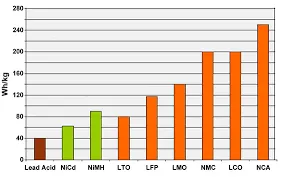
Specific Energy: It is the amount of energy stored per unit mass (Wh/Kg). This is a very important deciding factor that decides how much energy or power we are going to get from different batteries with the same amount of weight.
Typical specific energy of lead-, nickel-and lithium-based batteries
Typical specific energy of different types of lithium-based batteries
The main differences between the 6 types of Li+ ion batteries can be differentiated based on their characteristics and a screenshot of the same is given in a tabular format :
Nominal Voltage: Most of them are very close when it comes to this characteristic. LMO(3.7) has the highest range and LTO(2.4) has the lowest range in volts.
Cycle Life: They differ by a significant amount from each other mostly. LTO battery has the longest life cycle that's why it can last for a longer period of time and it is exactly the opposite for the LMO type batteries.
Charge Current Rate: Higher the charge current, the less time the battery will take to get fully charged. LFP and LTO are highest, NCA comes close to its contenders but finishes last in this case.
Discharge Current Rate: In severe cases, you can cause an internal short circuit and/or even an explosion. Most consumer applications require only 1C from their batteries. If you need higher discharge rates and faster charging times, you should definitely choose a high-rate battery instead. LTO has a discharge rate 10 times higher than others, that is why it is one of the safest batteries out there.
Thermal Runaway: It is discussed before, a Thermal runaway occurs in situations where an increase in temperature changes the conditions in a way that causes a further increase in temperature, often leading to a destructive result. It is a kind of uncontrolled positive feedback. We know that the higher the temperature at which the thermal runaway will occur, the safer the battery will be. LTO has the highest temperature rating in this and NCA & LCO has the lowest.
Specific Energy: The Specific energy density can be calculated by integrating from 0 to tcutoff (time to reach the cut-off potential) the expression V(t)*I*A dt and then dividing for (3600*Mw). In this way, you can obtain the specific energy density in Wh kg-1. Lithium-ion with cobalt cathodes(NCA-type batteries) offer the highest energy densities. Typical applications are cell phones, laptops, and digital cameras. Power Density (W/kg) indicates how much power a battery can deliver on-demand.
Specific Energy
Specific Power
Safety
Performance
Life Span
Cost
Comparisons of different types of Li-ion batteries used in EVs from the following perspectives: specific energy (capacity), specific power, safety, performance, life span, and cost (the outer hexagon is most desirable). Lithium Nickel Manganese Cobalt Oxide (NMC), Lithium Iron Phosphate (LiFePO4) and Lithium Manganese Oxide stand out as being superior among these six candidates [26].
CONCLUSION
Here we have completely studied all the lithium-ion cells, their performance, reactions, and all other parameters.