Week 1 Understanding Different Battery Chemistry
Q-1: Prepare a table which includes materials & chemical reactions occurring at the anode and cathode of LCO, LMO, NCA, NMC, LFP and LTO type of lithium ion cells.Give your detailed explanation on it.
ANS:
Lithuum-ion Battery:
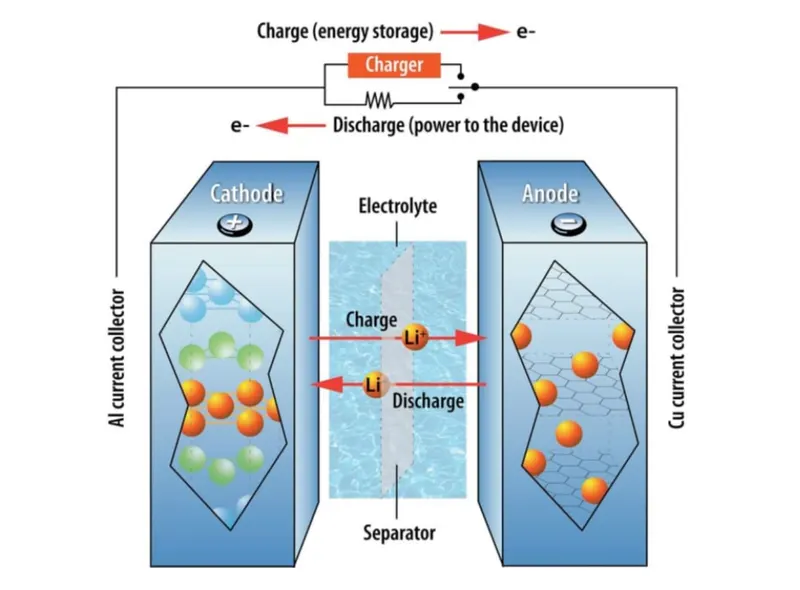
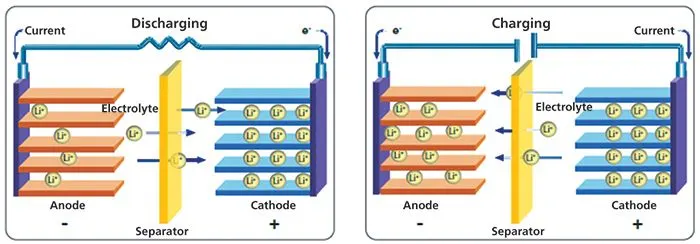
Lithium-ion batteries use lithium ions to create an electrical potential between the positive and negative sides of the battery. A thin layer of insulating material called a “separator” sits between the two sides of the battery and allows the lithium ions to pass through while blocking the electrons. While the battery charges, lithium ions move through the separator from the positive side to the negative. While the battery discharges, the ions move in the opposite direction. The movement of the lithium ions causes an electrical potential difference called “voltage”. When you hook your electronic devices up to the battery, electrons (not lithium-ions) flow through your device and power it. Multiple lithium-ion cells connect internally to make up a lithium-ion battery. Think of lithium-ion cells as the building blocks that make up a full battery.
The voltage of a lithium-ion cell varies depending on the particular chemistry type. The nominal output voltage of a single lithium iron phospate cell (the type used in Battery Born Batteries) ranges between 3.2 and 3.8 volts. However, the standard voltages for many lithium-ion batteries are 12, 24, and 48 volts.
When we connect cells in series, their voltages add together. For example, connecting four cells in series will yield a 12-volt battery. Wiring eight cells in series will produce a 24-volt battery, and so on.
Lithium-ion cells can also be connected in parallel. When you connect battery cells (and batteries) in parallel, their capacities add together. This means that two cells wired in parallel will last about twice as long as a single cell.
Inside the lithium-ion battery: The inside of a lithium-ion battery contains multiple lithium-ion cells (wired in series and parallel), the wires connecting the cells, and a battery management system also know as BMS. The battery management system monitors the health and temperature of the battery. At the top of each charge, The BMS also balances the energy across all of the cells and helps ensure to get the maximum life and performance out of for the lithium-ion battery.
Inside the lithium-ion cell: The inside of an individual lithium-ion cell is relatively simple. There are four main components: The anode, the cathode, an electrolyte, and a separator.
- The Electrodes (Anode and Cathode): The negative electrode in a cell is called the anode. The positive side is called the cathode. During charging, the lithium ions move from the cathode, through the separator, to the anode. During discharge, the flow reverses. The most popular material used for the anode is graphite. Common materials for the cathode are lithium cobalt oxide, lithium iron phosphate, and lithium manganese oxide. These different chemistries provide different benefits and voltages.
- The Electrolyte: The role of the electrolyte inside of a lithium-ion battery is to help transport the positive lithium-ions between the anode and cathode. The most common electrolyte inside of a lithium-ion battery is a lithium salt, such as LiPF6 in an organic solution.
- The Seperator: Between the anode and cathode is the separator. The separator is a thin sheet of material that allows the lithium ions to pass through but doesn’t conduct electricity. It prevents the anode and cathode from shorting together electrically and forces the electrons to flow through your electronic device, giving it power. The separator also plays an important safety role. If the seperator gets too hot, the pores close and prevents the lithium ions from passing through. Stopping the transport of the ions shuts down the battery cell, which can help prevent damage to the battery or a fire.
Energy density vs Power density:
The two most common concepts associated with batteries are energy density and power density. Energy density is measured in watt-hours per kilogram (Wh/kg) and is the amount of energy the battery can store with respect to its mass. Power density is measured in watts per kilogram (W/kg) and is the amount of power that can be generated by the battery with respect to its mass. To draw a clearer picture, think of draining a pool. Energy density is similar to the size of the pool, while power density is comparable to draining the pool as quickly as possible.
Lithium-ion battery classification, Chemical reactions along with their anode and cathode materials:
|
Type of Battery |
Anode and Cathode materials |
Chemical Reactions |
|
Lithium cobalt oxide - LCO (LiCoO2) |
Anode: Graphite carbon Cathode: Lithium cobalt oxide |
At anode: LiC6→xLi++xe−+C6LiC6→xLi++xe−+C6 At cathode: Li1−xCoO2+xLi++xe−→LiCoO2Li1−xCoO2+xLi++xe−→LiCoO2 Overall reaction: C6+LiCoO2⟷LixC6+Li1−xCoO2C6+LiCoO2⟷LixC6+Li1−xCoO2 |
|
Lithium manganese oxide - LMO (LiMn2O4) |
Anode: Graphite carbon Cathode: Lithium manganese cobalt |
At anode: LinC6 ⇌ nLi+ + ne− At cathode: Lim − nMn2O4 + nLi+ + ne− ⇌ LimMn2O4 Overall reaction: LinC6 + Lim − nMn2O4 ⇌ Li0C6 + LimMn2O4 |
|
Lithium nickle cobalt aluminium oxide - NCA (LiNiCoAlO2) |
Anode: Graphite carbon Cathode: Lithium cobalt aluminium oxide |
At anode: LinC6 ⇌ Li0C6 + nLi+ + ne− At cathode: Lim − n(NixCoyAlz)O2 + nLi+ + ne− ⇌ Lim(NixCoyAlz)O2 Overall reaction: LinC6 + Lim − n(NixCoyAlz)O2 ⇌ Li0C6 + Lim(NixCoyAlz)O2 |
|
Lithium nickle manganese cobalt oxide - NMC (LiNiMnCoO2) |
Anode: Graphite carbon Cathode: Lithium nickle manganese cobalt oxide |
At anode: LinC6 ⇌ Li0C6 + nLi+ + ne− At cathode: Lim − n(NixMnyCoz)O2 + nLi+ + ne− ⇌ Lim(NixMnyCoz)O2 Overall reaction: LinC6 + Lim − n(NixMnyCoz)O2 ⇌ Li0C6 + Lim(NixMnyCoz)O2 |
|
Lithuiu titanium oxide - LTO (Li2TiO3) |
Anode: Lithium titanium oxide Cathode: Lithium magnagese oxide |
At anode: Li4Ti5O12 + 3Li + + 3e ⇔ 2Li7Ti5O12 At cathode: 4LiMn2O4 ↔ 4Mn2O4 + 4Li + + 4e− Overall reaction: Li4Ti5O12 + 4Mn2O4 ↔ 4LiMn2O4 + Ti5O12 |
|
Lithium iron phaspate - LFP (LiFePO4) |
Anode: Graphite carbon Cathode: Lithium iron phaspate |
At anode: LinC6 ⇌ Li0C6 + nLi+ + ne− At cathode: Lim − nFePO4 + nLi+ + ne− ⇌ LimFePO4 Overall reaction: LinC6 + Lim − nFePO4 ⇌ Li0C6 + LimFePO4 |
-------------------------------------------------------------------------------------------------------------------------------------------------
Q-2: Compare the differences between each type of Li+ion batteries based on their characteristics.
ANS:
- Lithium Cobalt Oxide (LiCoO2) - LCO:
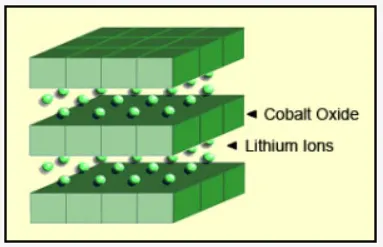
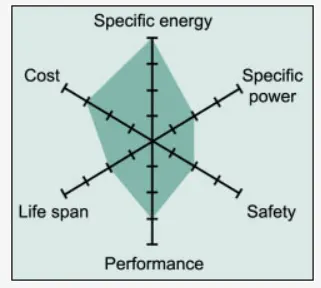
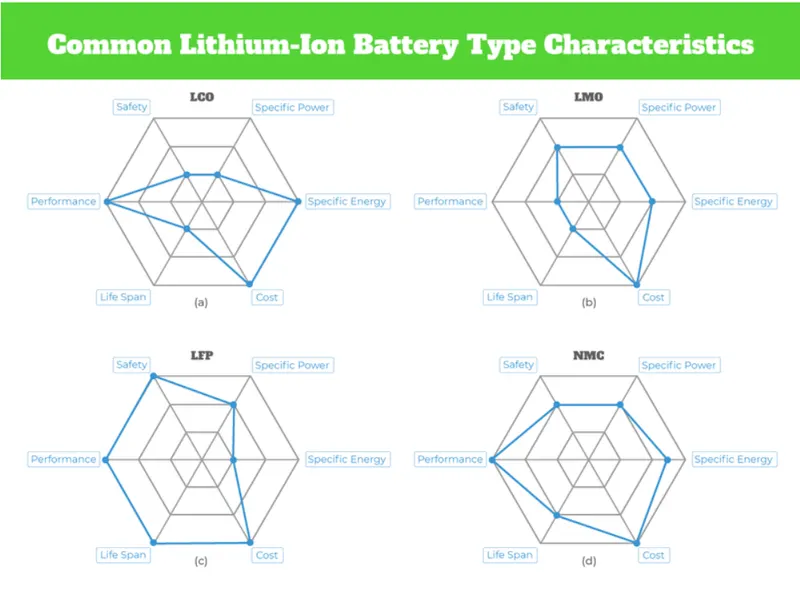
Its high specific energy makes Li-cobalt the popular choice for mobile phones, laptops and digital cameras. The battery consists of a cobalt oxide cathode and a graphite carbon anode. The cathode has a layered structure and during discharge, lithium ions move from the anode to the cathode. The flow reverses on charge. The drawback of Li-cobalt is a relatively short life span, low thermal stability and limited load capabilities (specific power).
Li-cobalt should not be charged and discharged at a current higher than its C-rating. This means that an 18650 cell with 2,400mAh can only be charged and discharged at 2,400mA. Forcing a fast charge or applying a load higher than 2,400mA causes overheating and undue stress. For optimal fast charge, the manufacturer recommends a C-rate of 0.8C or about 2,000mA. The mandatory battery protection circuit limits the charge and discharge rate to a safe level of about 1C for the Energy Cell.
| Lithium Cobalt Oxide: LiCoO2 cathode (~60% Co), graphite anode Short form: LCO or Li-cobalt. Since 1991 |
|
| Voltages | 3.60V nominal; typical operating range 3.0–4.2V/cell |
| Specific energy (capacity) | 150–200Wh/kg. Specialty cells provide up to 240Wh/kg. |
| Charge (C-rate) | 0.7–1C, charges to 4.20V (most cells); 3h charge typical. Charge current above 1C shortens battery life. |
| Discharge (C-rate) | 1C; 2.50V cut off. Discharge current above 1C shortens battery life. |
| Cycle life | 500–1000, related to depth of discharge, load, temperature |
| Thermal runaway | 150°C (302°F). Full charge promotes thermal runaway |
| Applications | Mobile phones, tablets, laptops, cameras |
- Lithium Manganese Oxide (LiMn2O4) - LMO:
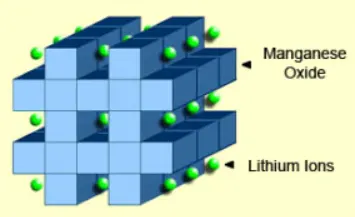
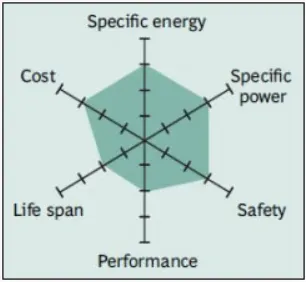
Li-ion with manganese spinel was first published in the Materials Research Bulletin in 1983. In 1996, Moli Energy commercialized a Li-ion cell with lithium manganese oxide as cathode material. The architecture forms a three-dimensional spinel structure that improves ion flow on the electrode, which results in lower internal resistance and improved current handling. A further advantage of spinel is high thermal stability and enhanced safety, but the cycle and calendar life are limited.
Low internal cell resistance enables fast charging and high-current discharging. In an 18650 package, Li-manganese can be discharged at currents of 20–30A with moderate heat buildup. It is also possible to apply one-second load pulses of up to 50A. A continuous high load at this current would cause heat buildup and the cell temperature cannot exceed 80°C (176°F). Li-manganese is used for power tools, medical instruments, as well as hybrid and electric vehicles. Li-manganese has a capacity that is roughly one-third lower than Li-cobalt. Design flexibility allows engineers to maximize the battery for either optimal longevity (life span), maximum load current (specific power) or high capacity (specific energy). For example, the long-life version in the 18650 cell has a moderate capacity of only 1,100mAh; the high-capacity version is 1,500mAh.
| Lithium Manganese Oxide: LiMn2O4 cathode. graphite anode Short form: LMO or Li-manganese (spinel structure) Since 1996 |
|
| Voltages | 3.70V (3.80V) nominal; typical operating range 3.0–4.2V/cell |
| Specific energy (capacity) | 100–150Wh/kg |
| Charge (C-rate) | 0.7–1C typical, 3C maximum, charges to 4.20V (most cells) |
| Discharge (C-rate) | 1C; 10C possible with some cells, 30C pulse (5s), 2.50V cut-off |
| Cycle life | 300–700 (related to depth of discharge, temperature) |
| Thermal runaway | 250°C (482°F) typical. High charge promotes thermal runaway |
| Applications | Power tools, medical devices, electric powertrains |
- Lithium Nickle Cobalt Aluminium Oxide (LiNiCoAlO2) - NCA:
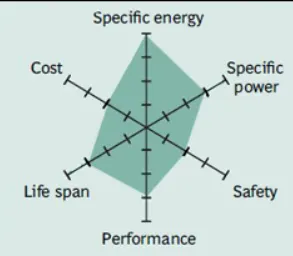
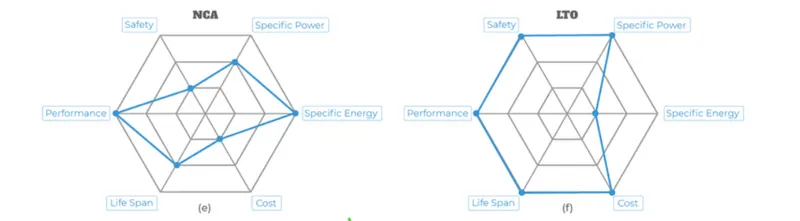
Lithium nickel cobalt aluminum oxide battery, or NCA, has been around since 1999 for special applications. It shares similarities with NMC by offering high specific energy, reasonably good specific power and a long life span. Less flattering are safety and cost. summarizes the six key characteristics. NCA is a further development of lithium nickel oxide; adding aluminum gives the chemistry greater stability.
| Lithium Nickel Cobalt Aluminum Oxide: LiNiCoAlO2 cathode (~9% Co), graphite anode Short form: NCA or Li-aluminum. Since 1999 |
|
| Voltages | 3.60V nominal; typical operating range 3.0–4.2V/cell |
| Specific energy (capacity) | 200-260Wh/kg; 300Wh/kg predictable |
| Charge (C-rate) | 0.7C, charges to 4.20V (most cells), 3h charge typical, fast charge possible with some cells |
| Discharge (C-rate) | 1C typical; 3.00V cut-off; high discharge rate shortens battery life |
| Cycle life | 500 (related to depth of discharge, temperature) |
| Thermal runaway | 150°C (302°F) typical, High charge promotes thermal runaway |
| Cost | ~$350 per kWh[1] |
| Applications | Medical devices, industrial, electric powertrain (Tesla) |
- Lithium Nickle Manganese Cobalt Oxide (LiNiMnCoO2) - NMC:
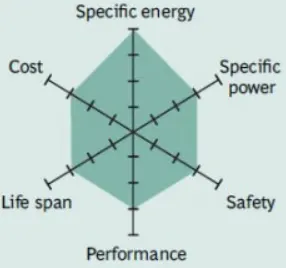
One of the most successful Li-ion systems is a cathode combination of nickel-manganese-cobalt (NMC). Similar to Li-manganese, these systems can be tailored to serve as Energy Cells or Power Cells. For example, NMC in an 18650 cell for moderate load condition has a capacity of about 2,800mAh and can deliver 4A to 5A; NMC in the same cell optimized for specific power has a capacity of only about 2,000mAh but delivers a continuous discharge current of 20A. A silicon-based anode will go to 4,000mAh and higher but at reduced loading capability and shorter cycle life. Silicon added to graphite has the drawback that the anode grows and shrinks with charge and discharge, making the cell mechanically unstable.
| Lithium Nickel Manganese Cobalt Oxide: LiNiMnCoO2. cathode, graphite anode Short form: NMC (NCM, CMN, CNM, MNC, MCN similar with different metal combinations) Since 2008 |
|
| Voltages | 3.60V, 3.70V nominal; typical operating range 3.0–4.2V/cell, or higher |
| Specific energy (capacity) | 150–220Wh/kg |
| Charge (C-rate) | 0.7–1C, charges to 4.20V, some go to 4.30V; 3h charge typical. Charge current above 1C shortens battery life. |
| Discharge (C-rate) | 1C; 2C possible on some cells; 2.50V cut-off |
| Cycle life | 1000–2000 (related to depth of discharge, temperature) |
| Thermal runaway | 210°C (410°F) typical. High charge promotes thermal runaway |
| Cost | ~$420 per kWh[1] |
| Applications | E-bikes, medical devices, EVs, industrial |
- Lithium Iron Phaspate (LiFePO4) - LFP:
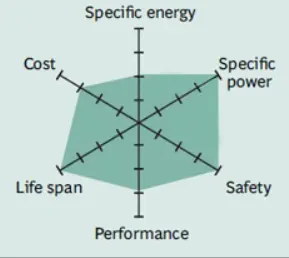
In 1996, the University of Texas (and other contributors) discovered phosphate as cathode material for rechargeable lithium batteries. Li-phosphate offers good electrochemical performance with low resistance. This is made possible with nano-scale phosphate cathode material. The key benefits are high current rating and long cycle life, besides good thermal stability, enhanced safety and tolerance if abused. Li-phosphate is often used to replace the lead acid starter battery. Four cells in series produce 12.80V, a similar voltage to six 2V lead acid cells in series. Vehicles charge lead acid to 14.40V (2.40V/cell) and maintain a topping charge. Topping charge is applied to maintain full charge level and prevent sulfation on lead acid batteries.
| Lithium Iron Phosphate: LiFePO4 cathode, graphite anode Short form: LFP or Li-phosphate Since 1996 |
|
| Voltages | 3.20, 3.30V nominal; typical operating range 2.5–3.65V/cell |
| Specific energy (capacity) | 90–120Wh/kg |
| Charge (C-rate) | 1C typical, charges to 3.65V; 3h charge time typical |
| Discharge (C-rate) | 1C, 25C on some cells; 40A pulse (2s); 2.50V cut-off (lower that 2V causes damage) |
| Cycle life | 2000 and higher (related to depth of discharge, temperature) |
| Thermal runaway | 270°C (518°F) Very safe battery even if fully charged |
| Cost | ~$580 per kWh[1] |
| Applications | Portable and stationary needing high load currents and endurance |
- Lithium Titanate Oxide (Li2TiO3) - LTO:
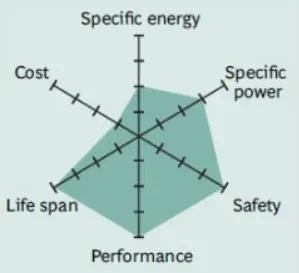
Batteries with lithium titanate anodes have been known since the 1980s. Li-titanate replaces the graphite in the anode of a typical lithium-ion battery and the material forms into a spinel structure. The cathode can be lithium manganese oxide or NMC. Li-titanate has a nominal cell voltage of 2.40V, can be fast charged and delivers a high discharge current of 10C, or 10 times the rated capacity. The cycle count is said to be higher than that of a regular Li-ion. Li-titanate is safe, has excellent low-temperature discharge characteristics and obtains a capacity of 80 percent at –30°C (–22°F).
| Lithium Titanate: Cathode can be lithium manganese oxide or NMC; Li2TiO3 (titanate) anode Short form: LTO or Li-titanate Commercially available since about 2008. |
|
| Voltages | 2.40V nominal; typical operating range 1.8–2.85V/cell |
| Specific energy (capacity) | 50–80Wh/kg |
| Charge (C-rate) | 1C typical; 5C maximum, charges to 2.85V |
| Discharge (C-rate) | 10C possible, 30C 5s pulse; 1.80V cut-off on LCO/LTO |
| Cycle life | 3,000–7,000 |
| Thermal runaway | One of safest Li-ion batteries |
| Cost | ~$1,005 per kWh[1] |
| Applications | UPS, electric powertrain (Mitsubishi i-MiEV, Honda Fit EV), solar-powered street lighting |
References:
- https://dragonflyenergy.com/types-of-lithium-batteries-guide/#:~:text=LFP%20battery%20cells%20have%20a,%2Dacid%20deep%2Dcycle%20batteries.
- https://batteryuniversity.com/article/bu-205-types-of-lithium-ion
- https://www.mdpi.com/2313-0105/7/3/51/htm
- https://www.science.org.au/curious/technology-future/lithium-ion-batteries#:~:text=In%20the%20case%20of%20a,(intercalated)%20in%20the%20cathode.