Week 1 Understanding Different Battery Chemistry
1.Prepare a table which includes materials & chemical reactions occurring at the anode and cathode of LCO, LMO, NCA, NMC, LFP and LTO type of lithium ion cells.Give your detailed explanation on it
2.Compare the differences between each type of Li+ion batteries based on their characteristics
Solution :
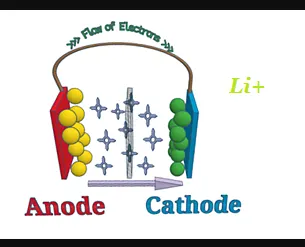
The rechargeable lithium-ion battery is made of one or more power-generating compartments called cells. Each cell has essentially three components.- positive electrode, negative electrode and electrolyte.
A positive electrode connects to the battery's positive or + terminal. A negative electrode connects to the negative or − terminal. And a chemical called an electrolyte in between them.
 .
.
The electrolyte carries positively charged lithium ions from the anode to the cathode.The movement of the lithium ions creates free electrons in the anode which creates a charge at the positive current collector. The electrical current then flows from the current collector through a device being powered (cell phone, computer, etc.) to the negative current collector. The separator blocks the flow of electrons inside the battery.
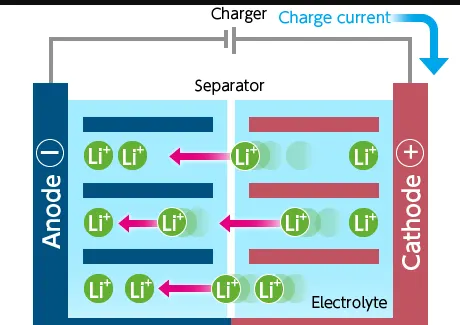
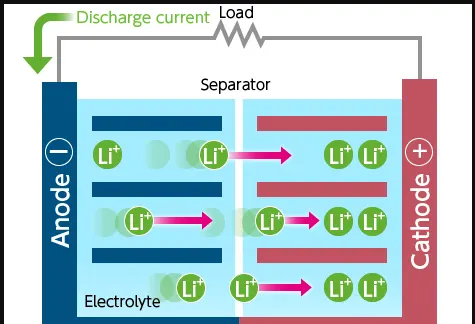
While the battery is discharging and providing an electric current, the anode releases lithium ions to the cathode, generating a flow of electrons from one side to the other. When plugging in the device, the opposite reaction happens, the cathode releases lithium ions and anode receives them. This is how the Lithium-ion battery works.
For Explaining Chemical Reaction take LCO Battery :
1.How lithium cobalt oxide battery works
What happens when you charge it,
While charging, at the external electric field, lithium elements in the LiCoO2 molecules of the anode material become lithium ion with positive charge, which moves from the anode to cathode. After chemical reaction with the carbon atoms of the cathode, LiC6 is formed, which is stably embedded into the layered graphite cathode.
Anode: LiCoO2 = Li1 + CoO2+ Li+e-
Cathode: 6C+ Li + e- = LiC6
What happens when you discharge
When discharging, on the contrary, in the internal electric field turns, Li+ breaks away from the cathode, goes along the direction of the electric field, returns to the anode, and then becomes LiCoO2. The more lithium ions involved in back-and-forth embedding and disembedding activities, the more energy the battery can store.
Anode: Li + CoO2+ e-=LiCoO2
Cathode: LiC6=6C+Li+e-
| Item | LCO | LMO | NMC | NCA | LFP | LTO |
| Cathode | LiCoO2 | LiMn2O4 | LiNiMnCoO2 | LiNiCoAlO2 | LiFePO4 | LiMn2O4 |
| Anode | Graphite | Graphite | Graphite | Graphite | Graphite | Li2TiO3 |
| Chemical Reaction | Cathode: CoO2 + Li + e- --> LiCoO2 Anode: LiC6 ---> C6 + Li+ + e- Complete : LiC6 + CoO2 <--> C6 +LiCoO2 |
Mn2O4 + Li + e- --> LiMn2O4 LiC6 ---> C6 + Li+ + e- LiC6 +Mn2O4<-->C6+LiMn2O4 |
NiMnCoO2 + Li + e- -->LiNiMnCoO2 LiC6 ---> C6 + Li+ + e- LiC6 +NiMnCoO2 <--> C6 +LiNiMnCoO2 |
NiCoAlO2 + Li + e- -->LiNiCoAlO2 LiC6 ---> C6 + Li+ + e- LiC6 +NiCoAlO2 <--> C6 +LiNiCoAlO2 |
FePO4 + Li + e- -->LiFePO4 LiC6 ---> C6 + Li+ + e- LiC6 +FePO4 <-->C6 + LiFePO4 |
Mn2O4+ Li + e- -->LiMn2O4 Li2TiO3 -->TiO3+ 2Li+ + 2e- Li2TiO3 +2Mn2O4<-->2LiMn2O4+TiO3 |
| Voltage | 3.6V Nominal; Typical Operating Range: 3.0-4.2V/cell |
3.7V Nominal; Typical Operating Range: 3.0-4.2V/cell |
3.6V,3.7V Nominal; Typical Operating Range: 3.0-4.2V/Cell |
3.6V Nominal; Typical Operating Range: 3.0-4.2V/cell |
3.2V,3.3V Nominal; Typical Operating Range: 2.5-3.65V/cell |
2.4V Nominal; Typical Operating Range: 1.8-2.85V/cell |
| Specific Energy | 150-200Wh/Kg | 100-150Wh/Kg | 150-220Wh/Kg | 200-260Wh/Kg | 90-120Wh/Kg | 90-80Wh/Kg |
| C-Rate(Charge) | 0.7-1C charges to 4.2V; Above 1C Shorten Battery Life |
0.7-1C charges to 4.2V. 3C Maximum |
0.7-1C charges to 4.2V; Above 1C Shorten Battery Life |
0.7 charges to 4.2V; Fast Charge Possible |
1C typical,charges to 3.65V 3h charge time typical |
1C typical,5C Maximum, charges to 2.85V |
| C-Rate(Discharge) | 1C,2.5V Cut Off Above 1C Shorten battery Life |
1C,10C possible with some cells 30C pulse(5s)2.5 cut off |
1C,2C possible on some cells, 2.5V cut off |
1C typical,3.0V cut off; | 1C,25C on some cells; 40A pulse(2s);cut off 2.5V |
10C Possible, 30C 5s pulse 1.80Vcut off |
| Tap density (g/cm3) | 2.8 | 2.2 | 2.6 | 2.6 | 1 | 1.68 |
| Compaction density (g/cm3) | 4.2 | 3 | 3.6 | 3.6 | 2.2 | 2.43 |
| Cycling life | better | worse | ordinary | ordinary | best | better |
| Transition metal | scarce | most abundant | more abundant | more abundant | most abundant | shortage |
| material costs | more expensive | cheap | expensive | expensive | cheap | expensive |
| Environmental protection | contain cobalt | non-toxic | contain nickel and cobalt | contain nickel and cobalt | non-toxic | non-toxic |
| safety performance | bad | good | better | better | best | better |