Week 1 Understanding Different Battery Chemistry
AIM:
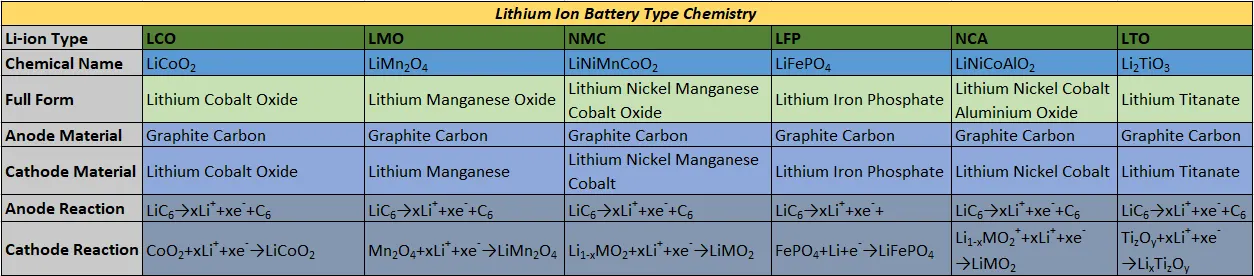
Prepare a table which includes materials & chemical reactions occurring at the anode and cathode of LCO, LMO, NCA, NMC, LFP and LTO type of lithium ion cells.
THEORY:
Batteries are storage medium made up of two electrodes in an electrolyte. This electrolyte provides a medium for the exchange of ions which produces the electricity. Each type of batteries has their own unique advantages and disadvantages, though recent innovations in Li-ion batteries have propelled them to become the market leader for use in most handheld and portable electronics as well as EVs. This is primarily due to their specific energy (Wh/kg), cycle life and high efficiency. They do have downsides which include their high cost and the need for complex safety and monitoring systems.
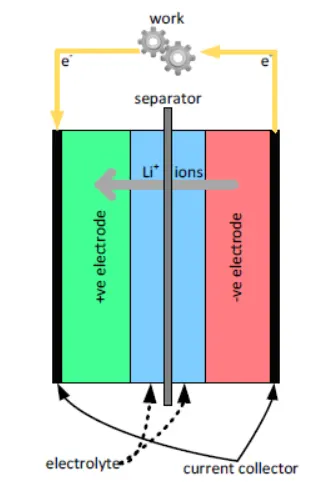
Fig: Schematic Diagram of Li-ion Battery
- Electrolyte: It is a substance that produces an electrically conducting solution when dissolved in a polar solvent, such as water.
- Separator: It is permeable membrane placed between electrodes.
- Anode reaction: The anode is the electrode where oxidation occurs and electrons are lost.
- Cathode reaction: The cathode is where reduction take place and electron are gained.
Types of Li-ions Battery:
LCO: Lithium cobalt oxide (LiCoO22) batteries are made from lithium carbonate and cobalt and feature very stable capacities along with high-specific energy, making them a popular choice for use with mobile devices such as smartphones, laptops, and digital cameras. Internally, they are composed of a cobalt oxide cathode and a carbon graphite anode. During discharge, lithium ions travel from anode to cathode, and the process reverses during the recharging cycle. These batteries do have some drawbacks, including a relatively short life cycle, low thermal stability, and smaller load capabilities—meaning they need frequent recharging.
LMO: Lithium manganese oxide (MnO2) batteries offer fast charging and high-current discharging with increased thermal stability over cobalt oxide batteries and provide enhanced safety as a result, making them ideal for medical devices, electric vehicles, and power tools.
NMC: Lithium nickel manganese cobalt oxide (LiNiMnCoO2) batteries are made using several different elements commonly found in other Li-ion batteries and use a combination of nickel, manganese, and cobalt for the cathode. Ratio varies according to the manufacturers. The inclusion of nickel provides the cell with the high-specific energy, although it also has reduced stability. Manganese, on the other hand, provides low internal resistance but has the drawback of low specific energy. Combining the two, however, enhances each other’s strengths, making them suitable for EV powertrains and cordless power tools.
LFP: Lithium iron phosphate (LiFePO4) batteries use the iron phosphate for the cathode along with a graphite electrode combined with metallic current collector grid for the anode. These batteries are more tolerant at full-charge conditions and are less prone to stress than other Li-ion batteries when subjected to prolonged high voltages. As a result, these types benefit from low-resistant properties, thereby increasing their safety and thermal abilities, making them ideal for electric motorcycles and vehicles. The only drawback is their low-voltage capacities and offers less energy than other types of Li-ion batteries.
NCA: Lithium nickel cobalt aluminium oxide (LiNiCoAlO2) batteries are not conventional in the consumer industry but have promise for EV manufacturers, as they provide high-specific energy options, reasonably good specific power, and a decent lifespan. These types are not as safe as the others listed here
LTO: Lithium titanate batteries are faster-charging batteries in the Li-ion category. They do have their disadvantages, however, as they have lower inherent voltage and lower specific-energy ratings over conventional lithium technologies. That being said, they are one of the safer platforms regarding thermal tolerances, making them incredibly safe for use in EVs and e-bikes with possibilities in the military and aerospace industries.
Table for understanding battery chemistry: