Week 1 Understanding Different Battery Chemistry
Q1 : Prepare a table that includes materials & chemical reactions occuring at the anode cathode of LCO, LMO, NCA, NMC, LFP and LTO type of LI-ion cells. Give your detailed explanation on it.
A).
| Types | Chemical Name | Cathode Material | Chemical Reaction at the Cathode(discharge) | Anode Material | Chemical Reaction at the Anode(discharge) | Overall Reaction |
| Lithium Cobalt Oxide(LCO) | LiCoO2 | Lithium Cobalt Oxide | CoO2+Li+ +e-↔LiCoO2 | Graphite Carbon | LiC6↔C6+Li+ +e- | LiCoO2+C6↔LiC6+CoO2 |
| Lithium Manganese Oxide (LMO) | LiMn2O2 | Lithium Manganese Oxide | MnO2+Li+ +e-↔LiMnO2 | Graphite Carbon | LiC6↔C6+Li+ +e- | LiCoO2+C6↔LiC6+CoO2 |
| Lithium Nickel Cobalt Aluminum Oxide (NCA) | LiNiCoAlO2 | Lithium Nickel Cobalt Aluminum Oxide | NiCoAlO2+Li+ +e-↔LiNiCoAlO2 | Graphite Carbon | LiC6↔C6+Li+ +e- | LiCoO2+C6↔LiC6+CoO2 |
| Lithium Nickel Manganese Cobalt Oxide (NMC) | LiNiMnCoO2 | Lithium Nickel Manganese Cobalt Oxide | NiMnCoO2+Li+ +e-↔LiNiMnCoO2 | Graphite Carbon | LiC6↔C6+Li+ +e- | LiCoO2+C6↔LiC6+CoO2 |
| Lithium Iron Phosphate (LFP) | LiFePO4 | Lithium Iron Phosphate | FePO4+Li+ +e-↔LiFePO4 | Graphite Carbon | LiC6↔C6+Li+ +e- | LiCoO2+C6↔LiC6+CoO2 |
| Lithium Titanium Oxide(LTO) | Li2TiO3 | Maganese Oxide | 4Mn2PO4+PO4+4Li+ +e-↔4LiMn2O4 | Lithium Titanium Oxide | Li4Ti5O12+4Li+ +4e-↔4LIMn2O4 | 4Mn2O4+Li4Ti5O12↔4LiiMn2O4+Ti4O12 |
LCO:
- LCO stands for Lithium cobalt battery.
- Lithium cobalt oxide is one of the most common Lithium-ions, it has a chemical symbol which is LiCo02 and is abbreviated as LCO.
- For simplification, Li-cobalt-which is the short term- can also be used for this type battery. Cobalt is the core active material which defines the character of the battery.
Lithium-ion batteries and concept :
- The most popular technology of the battery sector currently is the lithium ion battery.
- Relative to other types of batteries, lithium ion batteries have better energy, power density and higher cycling ability. These qualities are extremely important in the use in modern applications like electrical and hybrid vehicles and most importantly energy storage systems which are used in the renewable energy applications.
- The lithium ion batteries chemistry is the same across the different lithium-ion battery types; during dischare, Lithium-ions are moved to the positive cathode from the negative anode through the organic electrolyte.
- The anodes in all various technologies of lithium ion are all made from graphite. The differences are the cathode which contains changing cobalt, nickel or manganese concentrations.
- All various cathode types allow high lithium insertion and intercalation levels which result in large energy storage quantities.
LCO batteries technology and applications :
- LCO (Lithium cobalt oxide) was invented in the year 1991.
- Its anode material is LiaC6, the cathode material is LibCoO2 and the carrier is Li+.
- It is used in various applications ranging from electronic devices to all laptops and phone batteries.
- The majority of lithium-ion batteries for the portable devices are cobalt based.
- The systerm contains a cobalt oxide cathode (positive electrode and graphite carbon anode (negative electrode).
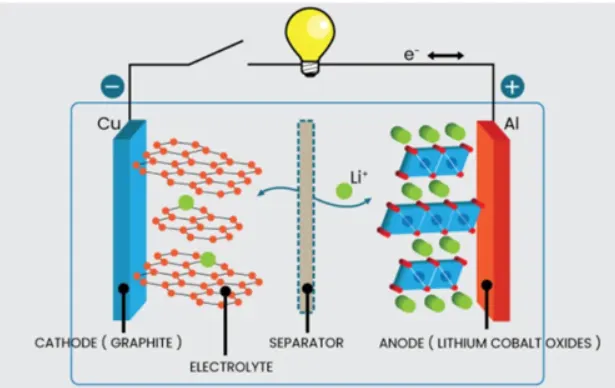
Advantages and disadvantages of LCO batteries :
The main advantages of the LCO batteries are:
- High energy density.
- Long runtime making it optimum for new technologies.
The main disadvantages of the LCO batteries are:
- It has a relatively low discharge current so high load can lead to pack overheat.
- The safety circuit of the LGO battery is typically limited to a 1C for charging and discharging.
- The internal resistance increases with cycling and aging. This high internal resistance can cause the battery to become unserviceable due to a large voltage drop under the load after a couple of years of use.
LMO :
- LMO stands for Lithium manganese oxide batteries, which are commonly referred to as lithium-ion manganese batteries or manganese spinel.
- This battery was discovered in the 1980s, yet the first commercial lithium-ion battery made with a cathode material made from lithium manganese was produced in 1996.
LMO batteries technology and applications :
- LMO (Lithium magnesium oxide) was invented in the year 1996.
- lts anode material is LiaC6, the cathode material is LibMn 204 and the carrier is Li+.
- It is used in different applications like power tools and electric cars.
- LMO batteries have the ability to deliver a lot of energy in a short period of time, which makes them extremely useful for use in power tools like drills. In 1996, lithium manganese oxide was first used as a cathode material.
- A three dimensional spinel structure was formed by this structure, this improves the flow of ions between the electrodes.
- The high flow decreases the internal resistance and increases loading capability.
- LMO batteries are usually used in medical devices and equipment, power tools, electric bikes and more. Because of their thermal resistance and higher safety. LMO batteries can also be used for laptops and electrical cars.
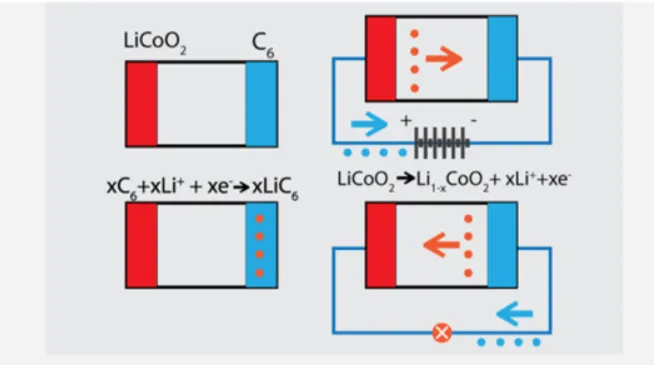
Advantages and disadvantages of LMO batteries :
The main advantages of the LMO batteries are :
- High temperature stability and safety relative to other Li-ion types as it has integrally high thermal stablity thus needs less safety circuitry than cobalt system.
- High rate capability due to low internal cell resistance which benefits fast charging and high current discharging.
The main disadvantage of the LMO batteries is :
- Lower capacity relative to cobalt-based system, yet it still has an energy density which is nearly 50% higher than the nickel-based system.
NCA:
- NCA battery stands for Lithium nickel cobalt aluminum oxide based battery (LiNiCoAlO2).
- Also, NCA batteries are becoming more and more important in in-grid storage and electrical power terrain applications.
NCA battery technology and applications :
- NCA (Lithium nickel cobalt aluminum oxide) battery was invented in the year 1999.
- Its anode material is LiaC6, the cathode material is LibNiO.8Co0.15AlO.0502 and the carrier is Li+.
- It is used in different applications like power grid applications, medical devices and electric cars.
- Most notably Tesla deploys NCA batteries in their electric vehicles system.
- NCA batteries can store the same amount of energy as NMC.
- NCA batteries are not widely common in the consumer industry, but are quite promising in the electric car industry.
Advantages and disadvantages of NCA batteries
The main advantages of the NCA batteries are:
- High specific energy.
- Reasonably good specific power.
- Long life span
- NCA cathodes contain the most energy amount by weight and volume (as NMC).
The main disadvantages of the NCA batteries are:
- Less safety than other Li-ion battery types (they require extra safety features and circuits for use in electric cars for example).
- Higher cost in comparison to other Li-ion battery types.
NMC :
- One of the most successful li-ion cathode formulas developed to date is obtained by combining nickel, manganese, and cobalt.
- Lithium-Nicdkel-Manganese-Cobalt-Oxide (liNiMnCo02), abbreviated as NMC, has become the go-to cathode powder to develop batteries for power tools, e-bikes and other electric powertrains.
- it delivers strong overall performance, excellent specific energy, and the lowest self-heating rate of all mainstream cathode powders, which makes it the preferred option for automotive batteries.
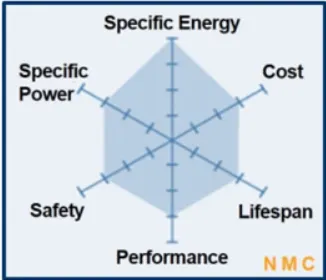
- While NMC powder can refer to a variety of blends, the formula typically consists of 33% nickel, 33% manganese and 33% cobalt. This blend, sometimes referred to as 1-1-1, is a popular option for mass-produced cells in applications requiring frequent cycling (automotive, energy storage) due to the reduced material cost resulting from lower cobalt content.
LFP :
- Lithium Iron phosphate (LFP) is a popular, cost-effective cathode material for lithium-ion cells that is known to deliver excellent safety and long life span, which makes it particulartly well-suited for specialty battery applications requiring high load currents and endurance.
- Discovered by University of Texas researchers in the mid-90s, LFP cathode offers several key advantages including a high current rating, long cycle life, and superior thermal stability, which makes it one of the safest and most abuse-tolerant cathode material options available to manufacturers.
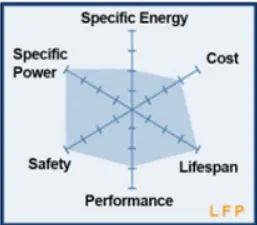
- On the other hand, LFP delivers a lower nominal voltage, which results in lower specific energy when compared to other cathode
materials on the market. Consequently, LFP batteries tend to have a higher self-discharge than other Li-ion battery types.
LTO :
- The lithiunm-titanate battery (Li4Ti5O12.referred to as LTO in the battery industry) is a type of rechargeable battery based on advanced nano-technology, which has the following advantages than other lithiurm batteries.
Advantagees :
- Li-Titanate batteries have a wider operating temperature range (-30-55°C) and a recharge efficiency exceeding 98%, compared to other carbon based batteries.
- Li-Titanate batteries as long cyecle life: > 3000-7000 cycles.
- Li-Titanate batteries are high security, high stability.
- Li-litanate batteries are faster to charge than other lithium-ion batteries. Data shows that these batteries can be safely charged at rates higher than 10C.
- Li-Titanate batteries are green & eco-friendly.
Disadvantage:
The disadvantage is that lithium-titanate batteries have a lower inherent voltage (2.4V/cell), which leads to a lower energy density than conventional lithium-ion battery technologies. But the enerey density of LTO - based batteries is still higher than lead acid and NiCad batteries.
Applications: Ideal for High Rate and High Cycle Life Applications :
- Because of the benefits of lithium titanate in terms of high security, high stability, long life and green features, lithium titanate batteries can be widely used in military, aerospace, electric vehicles and charging stations, tourist coaches, yachts, wind and solar energy storage power, traffic signals, solar hybrid street lighting. UPS power supply, home storage, coal, disaster relief emergency weather radar, electricity, smart grid, communication base stations, hospitals, finance, telecommunications as well as system critical backup power systems.
Q2 : Compare the difference between each type of Li-ion batteries based on their characteristics.
A). Characteristics.of lithium.cobalt oxide( LCO)
Lithium Cobalt Oxide: LiCo0 cathode (-60% Co), graphite anode
Short form: LCO or Li-cobalt.
Voltages : 3.60V nominal; typical operating range 3.0-4.2V/cell
Specific energy (capacity) : 150-200VWh/kg. Speciality cells provide up to 240Wh/kg
Charge (C-rate) : O.7-1C, charges to 4.20V (most cells); 3h charge typical Charge current above 1C shortens battery life.
Discharge (C-rate) : IC; 2.50V cut off. Discharge current above 1C shortens battery life.
Cycle life : 500-100, related to the depth of discharge, load, temperature.
Thermal runaway : 150°C (302'F). Full charge promotes thermal runaway.
Applications : Mobile phones, tablets, laptops, cameras.
Comments : Very high specific energy, limited specific power. Cobalt is expensive. Serves as Energy CellL Market share has stabilized.
Characteristics of Lithium Manganese Oxide( LMO) :
Lithium Manganese Oxide: LiMn204 cathode. graphite anode
Short form : LMO or Li-manganese (spinel structure)
Voltages : 3.70V (3.8OV) nominal; typical operating range 3.0-4.2V/cell
Specific energy (capacity) : 100-150Wh/kg
Charge (C-rate) : 0.7-1C typical, 3C maximum, charges to 4.20V (most cells)
Discharge (C-rate) : IC; 10C possible with some cells, 30C pulse (5s), 2.50V cut-off
Cycle life : 300-700 (related to the depth of discharge, temperature)
Thermal runaway : 250'C (482F) typical. High charge promotes thermal runaway
Applications : Power tools, medical devices, electric powertrains
Comments : High power but less capacity; safer than Li-cobalt; commonly mixed with NMC to improve performance.
Characteristies of Lithium Nickel Cobalt Aluminum Oxide(NCA)
Lithium Nickel Cobalt Aluminum Oxide: LiNÍCOAlO, cathode (-9% Co), graphite anode
Short form : NCA or Li-aluminum.
Voltages : 3.60V nominal; typical operating range 3.0-4.2V/cell
Specific energy (capacity) : 200-260Wh/kg: 300Wh/kg predictable
Charge (C-rate) : 0.7C charges to 4.20V (most cells), 3h charge typical, fast charge possible with some cells
Discharge (C-rate) : 1C typical; 3.00V cut-off; high discharge rate shortens battery life
Cycle life : 500 (related to the depth of discharge, temperature)
Thermal runaway : 150°C (302'F) typical, High charge promotes thermal runaway
Applications : Medical devices, industrial, electric powertrain (Tesla) Shares similarities with Li-cobalt. Serves as Energy Cell.
Comments : Mainly used by Panasonic and Tesla; growth potential.
Characteristics of lithium nickel manganese.cobalt oxide (NMC)
Lithium Nickel Manganese Cobalt Oxide: LiNiMnCoO2. cathode, graphite anode
Short form : NMC
Voltages : 3.60V, 3.70V nominal; typical operating range 3.0-4.2V/cell, or higher
Specific energy (capacity) : 150-220Wh/kg
Charge (C-rate) : 0.7-1C, charges to 4,20V, some go to 4.30V; 3h charge typical. Charge current above 1C shortens battery life.
Discharge (C-rate) : 1C; 2C possible on some cells; 2.50V cut-off
Cycle life : 1000-2000 (related to the depth of discharge, temperature)
Thermal runaway : 210°C (410°F) typical. High charge promotes thermal runaway
Applications : E-bikes, medical devices, EVs, industrial
Comments : Provides high capacity and high power. Serves as Hybrid CellL. Favourite chemistry for many uses; market share is increasing.
Characteristics of lithium iron phosphate(LFP)
Lithium Iron Phosphate: LiFePO4 Cathode, graphite anode
Short form: LFP or Li-phosphate. LIP is also common.
Voltages : 3.20, 3.30V nominal; typical operating range 2.5-3.65V/cell
Specific energy (capacity) : 90-120Wh/kg
Charge (C-rate) : 1C typical charges to 3.65V; 3h charge time typical
Discharge (C-rate) : 1C, 25C on some cells; 40A pulse (25): 2.50V cut-off (lower than 2V causes damage)
Cycle life : 2000 and higher (related to the depth of discharge, temperature)
Thermal runaway : 270°C (518°F) Very safe battery even if fully charged
Applications : Portable and stationary needing high load currents and endurance
Comments : Very flat voltage discharge curve but low capacity. One of safest Li-ions. Used for special markets. Elevated self-discharge.