Week 1 Understanding Different Battery Chemistry
OBJECTIVE 1 : Prepare a table which includes materials & chemical reactions occurring at the anode and cathode of LCO, LMO, NCA, NMC, LFP and LTO type of lithium ion cells.Give your detailed explanation on it
SOLUTION : Table of materials & chemical reactions occuring at anode and cathode of LCO, LMO, NCA, NMC, LFP, LTO is given below :-

1. Lithium Cobalt Oxide LiCoO2 (LCO) :-
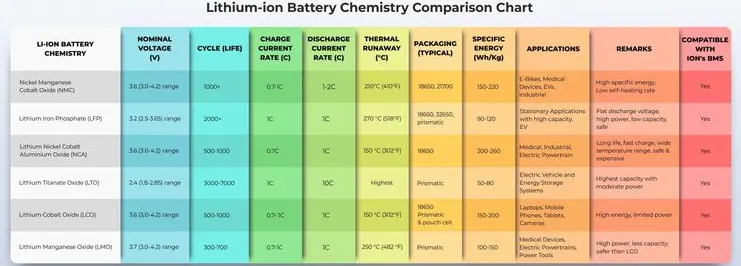
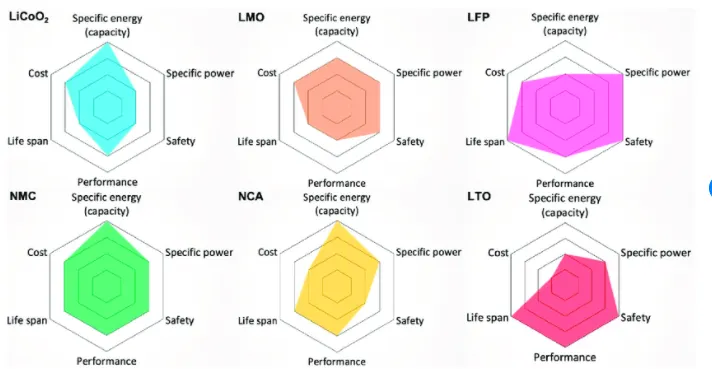
- Its high specific energy makes Li-cobalt the popular choice for mobile phones, laptops &digital camera. The battery consists of a cobalt oxide cathode and a graphite carbon anode. The cathode has a layered structure and during discharge lithium ions move from the anode to the cathode. The flow reverses on charge. The drawback of Li-cobalt is relatively short life span, low thermal stability and limited load capabilities (specific power).
2. Lithium Manganese Oxide LiMn2O4 (LMO) :-
- Li-ion with manganese spinel was first published in the materials research bulletin in 1983. It has lithium manganese oc=xide as cathode material. The architecture forms a three-dimensional spinel structure that improves ion flow on the electrode and results in lower internal resistance and improved current handling. A further advantage of spinel is high thermal stability and enhanced safety but with limited life cycle.
3. Lithium Nickle Cobalt Aluminium Oxide LiNiCoAlO2 (NCA) :-
- NCA shares similarities with NMC by offering high specific energy, reasonably good specific power and a long life span. Less flattering, safety and cost. NCA is a further development of lithium nickle oxide, adding aluminium gives greater chemical stability.
4. Lithium Nickle Manganese Cobalt Oxide LiNiMnCoO2 (NMC) :-
- One of the most successful Li-ion systems is a cathode combination of nickel-manganese-cobalt(NMC). Similar to Li-manganese, these systems can be tailored to serve as Energy calls or Power Cells. They have capacity of about 2800mAh and can deliver 4A - 5A. NMC in a same cell optimized for specific power has a capacity of only 2000mAh but delivers a continuous discharge current of 20A.
5. Lithium Ion Phosphate LiFePO4 (LFP) :-
- Li-phosphate offers good electrochemical performance with low resistance. This is made possible with nano-scale phosphate cathode material. The key benifits are high current rating and long cycle life, besides good thermal stability, enhanced safety and tolerance if exposed. Li-phosphate is more tolerant to full charge conditions and is less stressed than other lithium-ion systems if kept at high voltage for a prolonged time. As a trade-off its lower nominal voltage of 3.2V/cell reduces the specific energy below that of cobalt-blended lithium ion.
5. Lithium Titanate Li2TiO3 (LTO) :-
- Lithium titanate replaces the graphite in the anode of atypical lithium-ion battery and the material forms into a spinel structure. The cathode can be lithium manganese oxide or NMC. Li-titanate has a nominal cell voltage of 2.4V and can be fast charged and delivers a high discharge current of 10C or 10 times the rated capacity. The cycle count is said to be higher than the regular Li-ion. Li-titanate is safe, has excellent low temperature discharge characterstics and obtains a capacity of 80% at -30C.
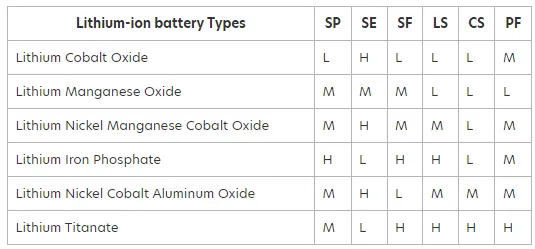
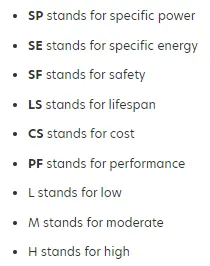
OBJECTIVE 2 : Compare the differences between each type of Li+ion batteries based on their characteristics
SOLUTION :-