Week 1 Understanding Different Battery Chemistry
1.Prepare a table which includes materials & chemical reactions occurring at the anode and cathode of LCO, LMO, NCA, NMC, LFP and LTO type of lithium ion cells.Give your detailed explanation on it
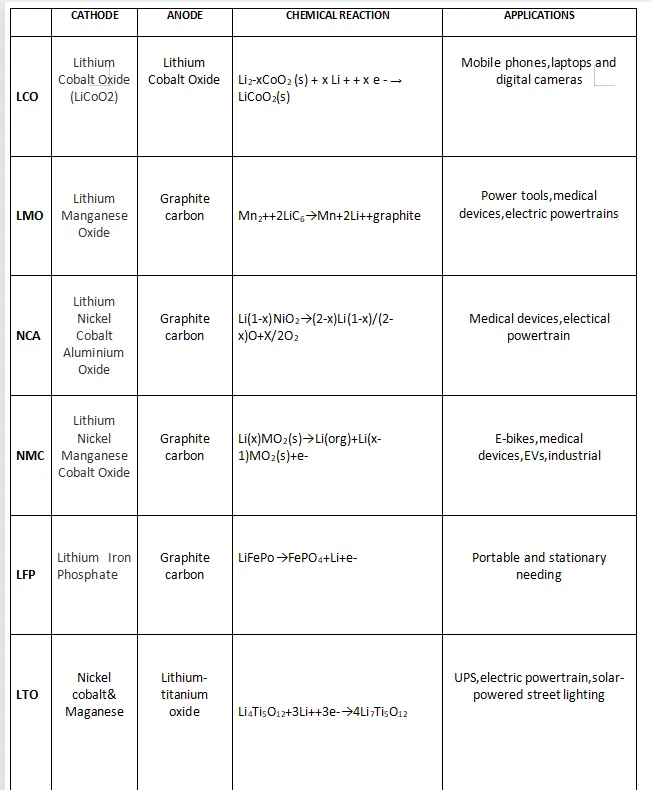
1.Lithium Cobalt oxide (LiCoO2) - LCO
It has high power but low power specified which means that charging and discharging with Current Rate (C) above average values shortens battery life. It contains cobalt oxide Cathode and graphite anode. The cathode is thickened.
During extraction, Li-ions move from the anode to the cathode. The flow returns during charging. Graphite anode limits its cycle life which is why it has a short lifespan. It has low thermal stability. Its main applications are cell phones, laptops, cameras, etc.
2.Lithium Manganese Oxide (LiMn2O4) - LMO
Manganese Oxide forms a 3D-spinel structure that enhances ion flow to the electrode. This results in lower internal resistance, allowing faster charging and higher current output. In addition to this, spinel formation also packs additional thermal stability. Making it safer compared to LCO. LMO has low cycle health.
Many Li-manganese batteries combine with lithium nickel manganese cobalt oxide (NMC) to improve direct power and extend battery life. These three active metals, as well as silicon enhancements, can increase strength (strength), strength (load capacity) or longevity.
Li-manganese has great strength and low energy. It is used for electrical tools, medical devices and the powertrain of an electric car.
3.Lithium Nickel Manganese Cobalt oxide (LiNiMnCoO2) - NMC
The cathodic compound of Nickel Manganese Cobalt is effective as it can be synthesized into Energy cells or Power Cells. NMC is efficient and advanced in certain strengths. This Lithium-ion battery can deliver continuous current output.
The beauty of Nickel is its high strength but it is not stable. While Manganese achieves low internal resistance by building a spinal structure. Unlike Nickel, Manganese offers some low energy.
Their combination improves each other's performance. New electrolytes can increase energy. It has a very low self-heating rate and improved cycle life. This is an optional battery for powertrains and industrial applications.
4.Lithium Iron Phosphate (LiFePO4) - LFP
In this form, Li-Phosphate is used as a cathode because it has good electrochemical performance with low resistance. This is due to the nano-scale phosphate cathode material.
The various benefits of this Lithium-ion battery chemistry include - long life cycle, good thermal stability, high current rating, improved safety and tolerance in the event of abuse.
Li-Phosphate is often used to supplement lead-acid batteries as it has some moderate strength and has a very low moisture tolerance, which greatly reduces its life cycle.
Other features include a very low power output curve but a low volume. LFP is one of the safest Li-ions on the market.
5.Lithium Nickel Cobalt Aluminum oxide (LiNiCoAlO2) - NCA
NCA batteries are gaining value in electrical powertrains and grid maintenance. They are rare in the consumer industry but are promising in the automotive sector. Tesla, a US-based EV manufacturer, is researching this technology and using this Lithium-ion battery chemical.
The NCA has a very high Special Strength, Well Clear Power, and a long lifespan. Higher costs and limit security are the worst things.
6.Lithium Titanate (Li2TiO3) - LTO
In this technology, Li-titanate replaces graphite in a standard Lithium-ion battery anode and the price forms become a spinel structure.
The cathode can be lithium manganese oxide or NMC. The titanate can be charged quickly and deliver a high current output ten times in the estimated volume. Cycle counts are higher than standard Li-ion batteries.
The titanate is a safety precaution and has excellent properties for extracting low temperatures and lifespan. Lithium ion battery chemistry applications include solar power, UPS and street lighting using solar energy.
2.Compare the differences between each type of Li+ion batteries based on their characteristics.