Week 1 Spur Gear Challenge
Objective :
To perform the analyses of the pair of spear gears by assigning to them different material properties and studying the differences in certain behaviours of the set.
Procedure :
Setting up the simulation :
To set up the simulation, first we need to import all the required material cards such as Cast Iron, Cast Steel and Cast Bronze.
The above materials can be found in the Granta materials library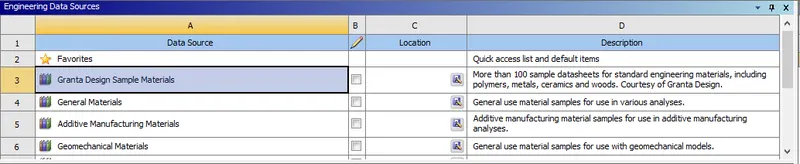
Cast Iron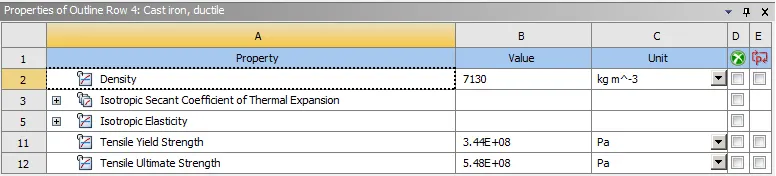
Cast Steel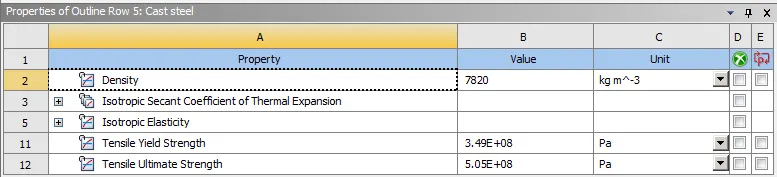
Cast Bronze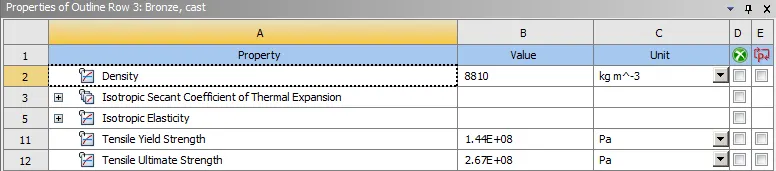
Importing geometry :
Next we import the geometry which the Creo CAD file of the 2 gears which has been provided.
Material defintion : 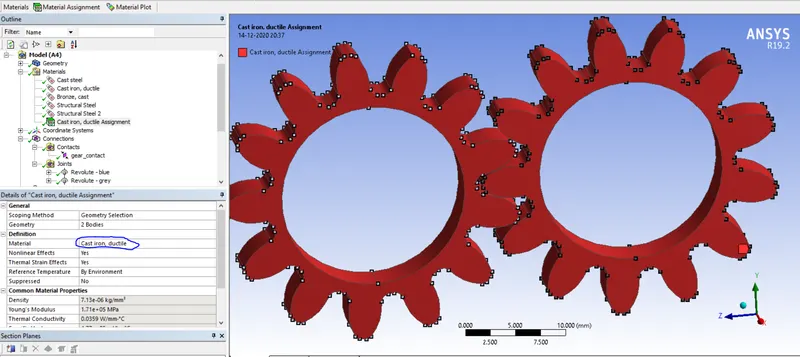
The material cast iron is assigned to the gears for the first case.
Then we will open Ansys mechanical to set up the rest of the simulation.
To set up the contact we go to connections-->contacts and open the contact card.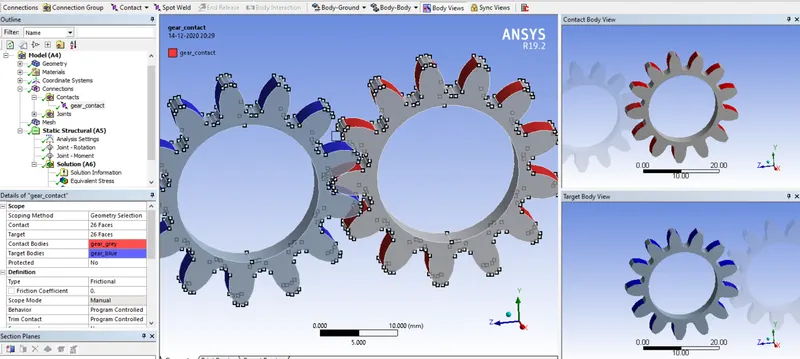
We will create the contact by selecting the faces on both the gears as shown below. Just the Addendum + Dedendum is selected which is one continuous surface on both sides of each gear tooth. So from both gears 26 faces are selected respectively.
Type = frictional
Formulation = Augmented Lagrange
Interface treatment = Adjust to touch
Next we define the joints for both gears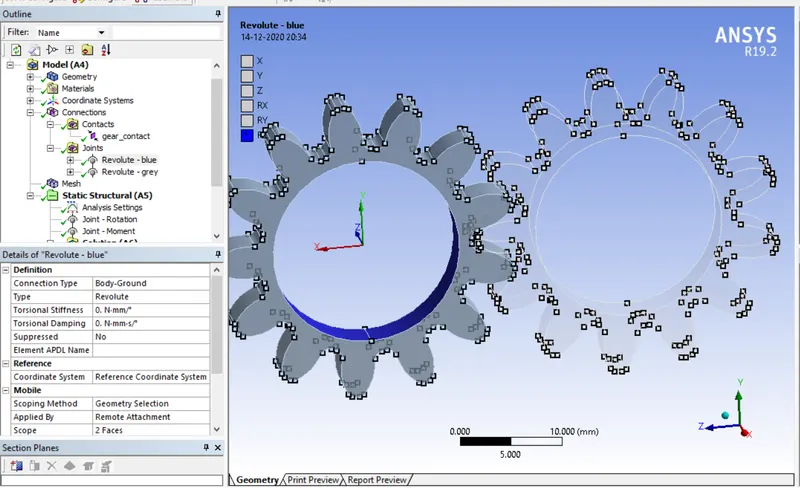
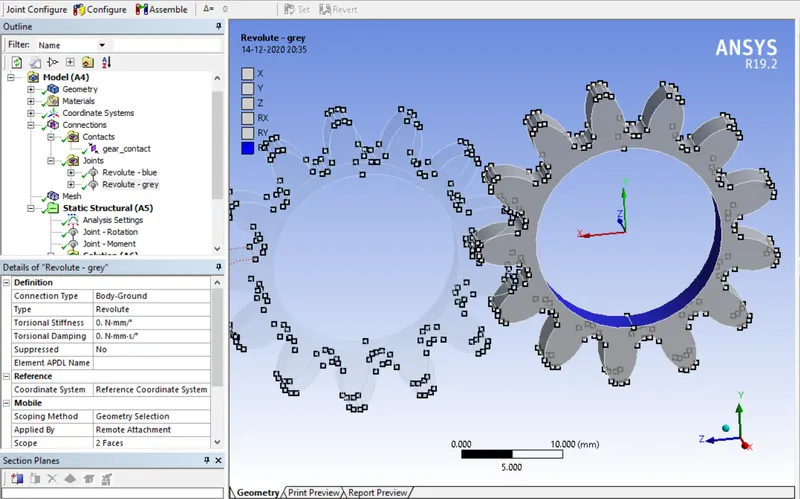
In this way both the joints are selected as body-ground & Revolute type.
Next a mesh is generated of 0.5mm as shown below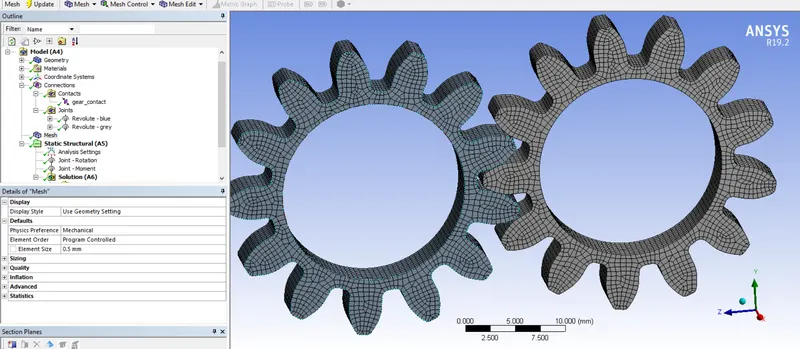
Creation of Joint-loads : Next we assign the motion to the individual gears. This can be done by giving rotation or a moment.
For the first gear we provide rotation by increments of 30 degrees as shown below by inputting data into the table. The motion is given in the form of 10 increments.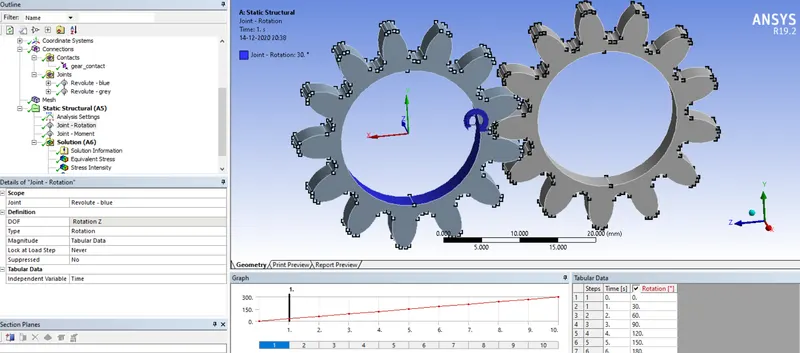
For the second gear, we input a moment in the opposite direction of rotation to the first gear as shown below. The torque provided is of the order of 10000 N-mm which is equal to 10 N-m which is constant from the beginning till the end.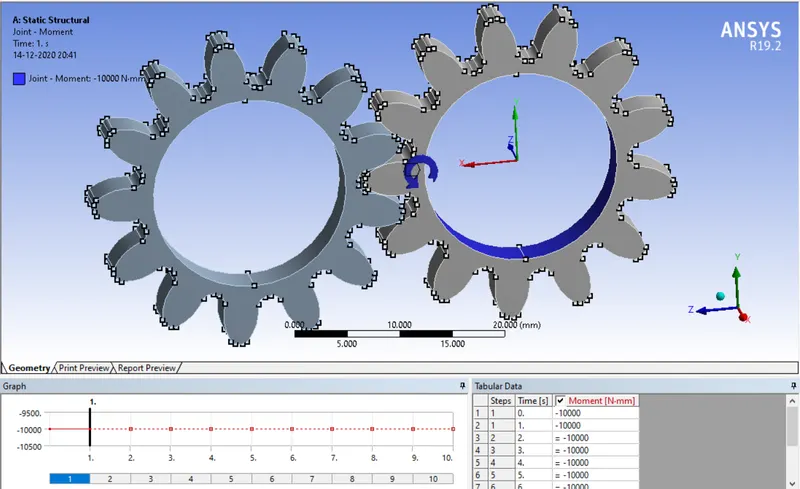
Setting up the analysis settings : Next the analysis settings are selected as shoen below, inputting the vvalues of number of steps, initial time-step, maximum/minimum timestep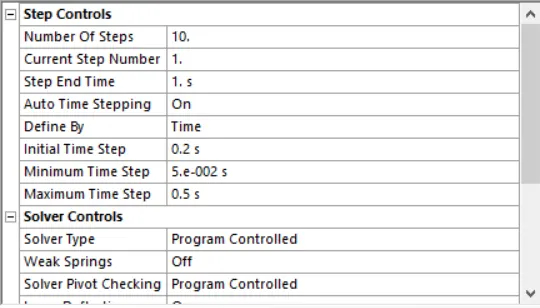
Output Parameters : The following parameters are selected for output from the simulation.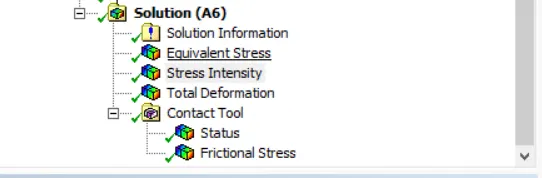
Running the simulation :
Next we run the simulation. The simulation takes a very long time to run as we can see from the runtime below.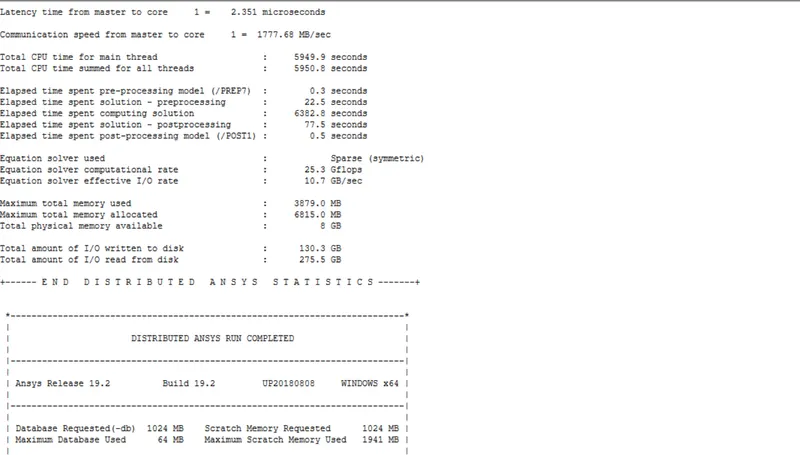
Post-processing : The simulation is run for all the 3 materials by changing material assignment and re-running it.
1) Cast Iron
2) Cast Steel
3) Cast Bronze
Equivalent Stress :
1)Cast Iron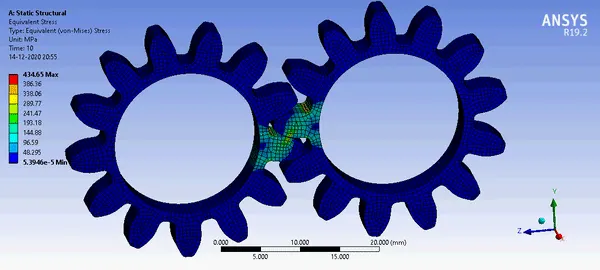
A peak stress of 580.58 Mpa is obtained is obtained at the middle of the height of the gear tooth as shown below.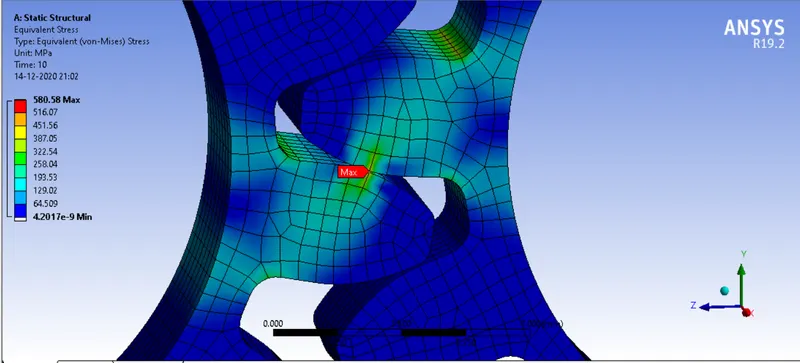
2)Cast Steel
A peak stress of 540.87 Mpa is obtained for Cast steel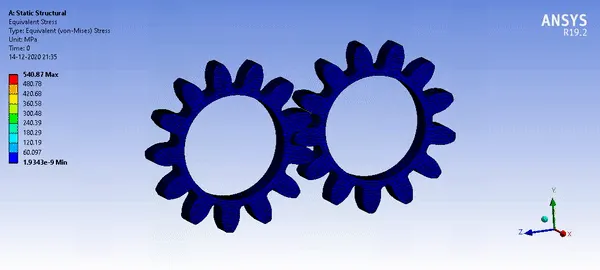
3)Cast Bronze
A peak Von-Mises stress value of 526.12 Mpa is obtained for cast bronze 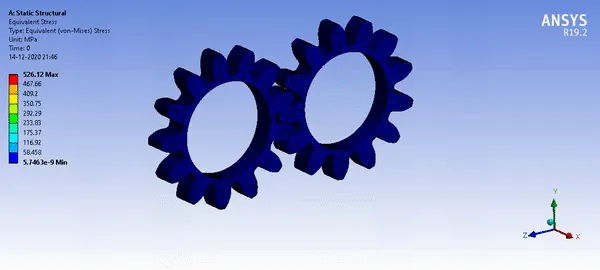
Stress Intensity :
1)Cast Iron
The stress intensity is equal to the resultant of compressive and tensile forces at a particular point.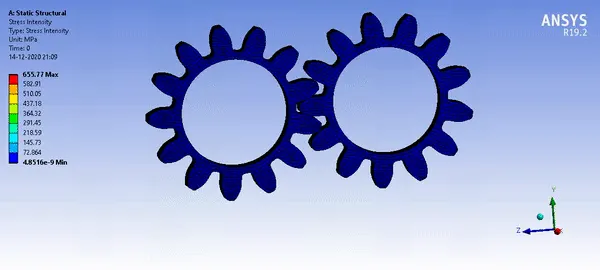
As we can see the peak stress intensity of 655.77 Mpa is obtained for cast iron gears.
2)Cast Steel :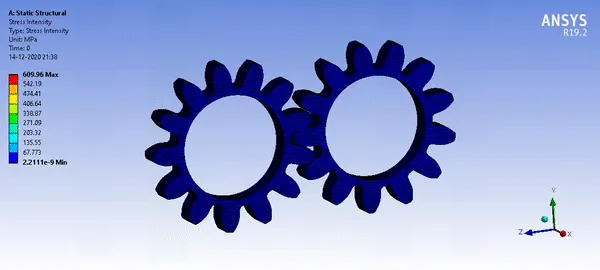
As we can see the peak stress intensity of 609.96 Mpa is obtained for cast steel gears.
3)Cast Bronze 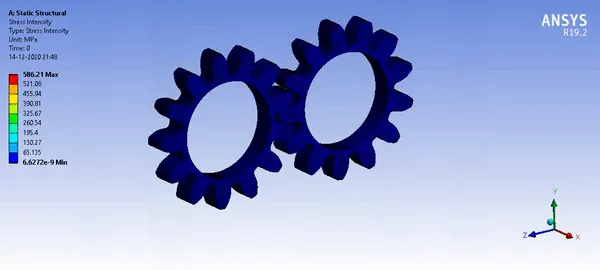
As we can see the peak stress intensity of 586.21 Mpa is obtained for cast bronze gears.
Total deformation :
The total deformation is calculated as follows. Although this may not be accurate as we are dealing with moving parts here and hence deformation reading will be subject to motion of parts.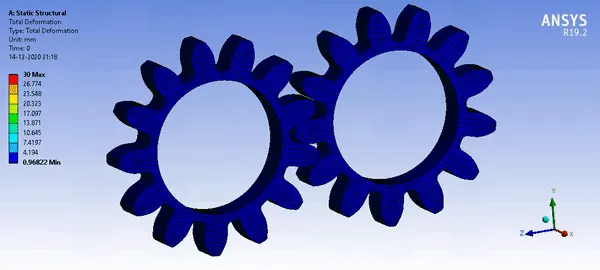
1) Cast Iron :
To get accurate deformation reading we can request for equivalent strain output as shown below. As we can see a maximum strain of 0.0058 is obtained which is equal to 0.58%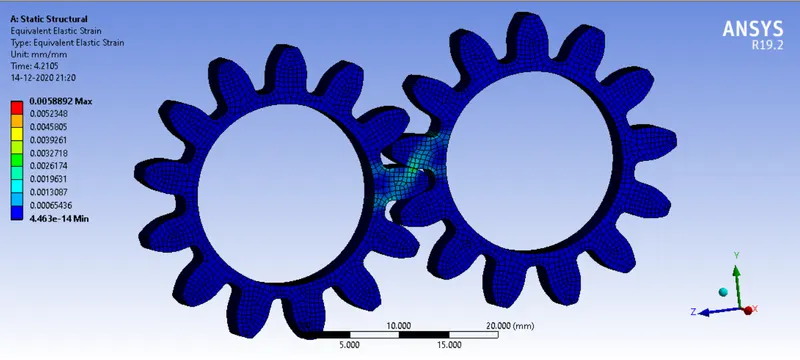
2)Cast Steel
A peak equivalent strain value of 0.00476 which is equivalent to 0.476% is obtained.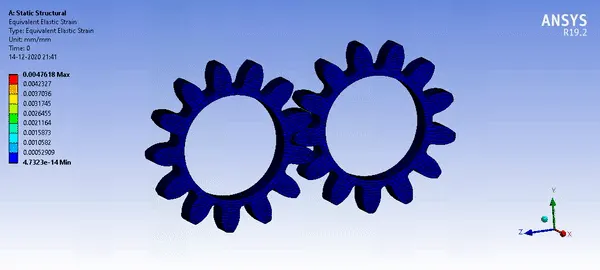
3)Cast Bronze
A peak equivalent elastic strain value of 0.01154 which is equal to 1.15% is obtained which is significantly higher than cast steel and cast iron options. 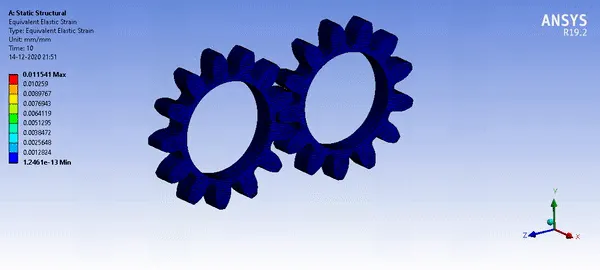
This is due to the lower yield strength of bronze as compared to iron and steel.
Conclusion : Based on the results ontained above we find out that cast steel offers the best compromise as it has shows the lowest strain rate and comparably low stress as well when compared to cast iron. Hence the proper material to be chosen based on the above simulation is Cast Steel.
Result :
Cast Iron
Cast Steel
Cast Bronze