Week 1:- Introduction to BiW and Fixtures Challenge
1. What is BIW & its parts?
Body in White commonly refered as BIW refers to the welded sheet metal components which form the structure of the vehicle to which the other components like engine, chassis, exterior & interior trims, etc will be married or assembled. Its structure supports the overall subsystems of the vehicle.
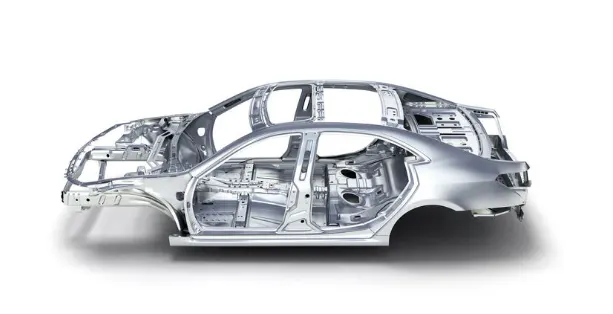
The structure is made from Steel or Aluminium panels (0.7 - 2.0 mm thickness). The design needs to be stiff to support the mass & securely keep them all integrated. Further, it needs to resist & absorb energy during the event of a vehicle crash.
Parts of BIW:
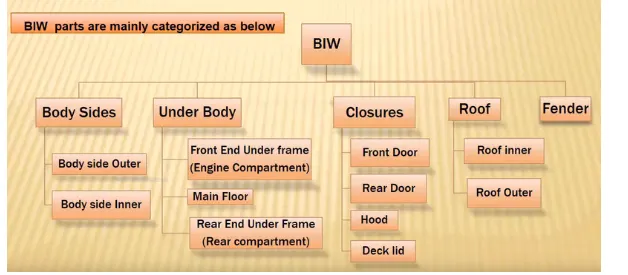
Below image represents some of the parts of BIW:
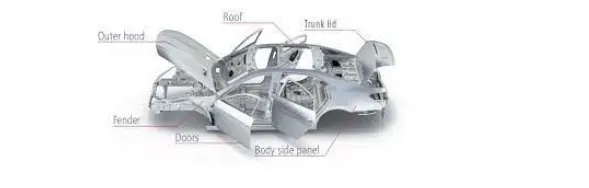
1. Body sides
The side ward parts of the BIW structure falls into this category.
- Body side outer refers to the sideward outer parts of the body/frame.
- Body side inner refers to the sideward inner parts of the body/frame.
2. Under body
The bottom/downward parts of the BIW structure falls into this category.
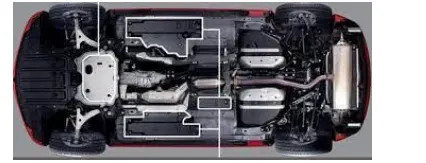
- Front end under frame refers to the frame under the front end i.e. under the engine bonnet.
- Main floor refers to the frame under the middle i.e. under the seats.
- Rear end under frame refers to the frame under the rear end i.e. under the boot cabin.
3. Clousers
The closing parts of the BIW structures such as doors/lids parts fall into this category
- Front door refers to the parts of front door panels of the automobile.
- Rear door refers to the parts of rear door panels of the automobile.
- Hood refers to the closure door the hood of the automobile.
- Deck lid refers to the closure lid of the deck of the automobile.
4. Roof
The top covering parts of the BIW structure falls into this category
- Roof inner refers to the inner side of the roof surface
- Roof outer refers to the outer side of the roof surface
5. Fender
The front and rear fender parts of the BIW structures falls into this category.
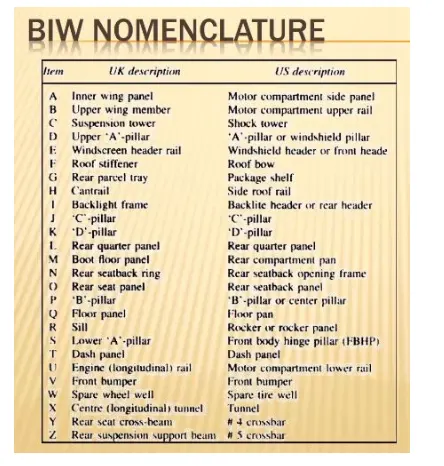
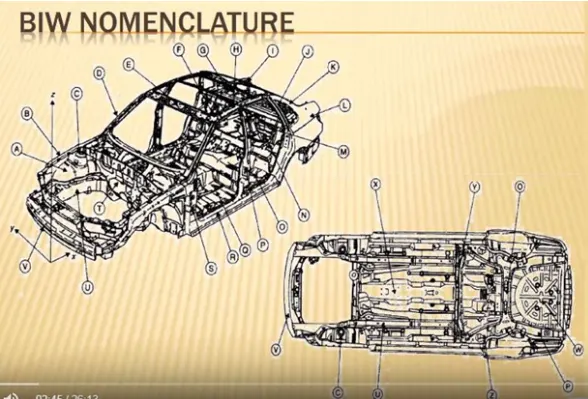
2.What do you understand by BIW nomenclature?
There are several parts involved in BIW structure. These parts are identified or referred using BIW nomenclature.The terms used in nomenclature for referring parts are given as,
3.What is fixture & its types?
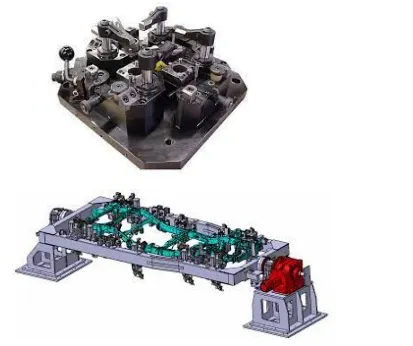
Fixture is a holding device which holds the workpiece to be processed. In general fixtures are designed using 3-2-1 principle. Further, fixture should firmly hold the work piece without causing vibrations, distortions, stresses in the workpiece and also fixture should not disturb or interfere the processing of the workpiece.
Types of fixture:
- Production fixture
These fixtures are used for mass production. Since these fixtures are used for mass production, they should be simple, rigid and hard. These fixtures should be periodically maintained in regular intervals to avoid errors and repairs. The design of the fixture should be in such a way that it should be easy to load and unload the workpiece within seconds to increase the productivity of the processing/assembly.
- Pre production operation fixture
These fixtures are basically newly designed fixtures for the new products or parts. These may be complex, manual and heavy based on the application. These can be referred as the protype fixtures. Once the preproduction operation fixture functions properly, then modifications are made to improve and to make it simple and reliable. These fixtures are used in special cases or during initial or trail stages of processing/production
- Checking fixture
These fixtures are used for checking and inspection purpose. No processing is done in these fixtures. These fixtures consist of gauges for checking the dimensions and tolerances and its accuracies. In some checking fixtures, fixtures are fixed and CMM devices check the geometrical accuracies.
5.What is the basic principle of fixture design?
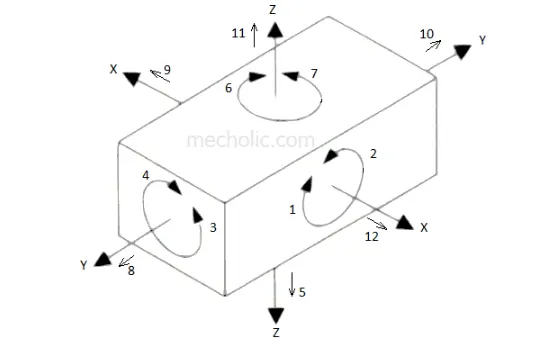
The aim of the fixture is to hold the workpiece in the desired angle and location. For a free body we have 12 degrees of freedom they are six rotational and six translational. Six rotational degrees of freedom refers to clockwise and anticlockwise along X, Y, Z axes and six translational degrees of freedom refers to translation in X, Y, Z axes. So the basic principle of fixture design is to arrest or restrict all the 12 degrees of freedom in the desired or required location and orientation.
5.Elaborate types of BIW Stations?
Tool station: This contains various tools used for machining the workpiece.
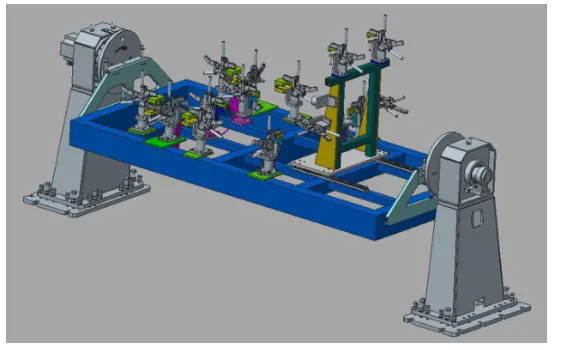
- Geo-tools: This tools are used for accurately defining the geometry of a car panel.
- Re-spot tools: In this fixture weld spots are welded, which were not welded in Geo-tool.
- Marriage tools: This tools are use for marriage of parts of the car together.
Gripper: This is used for grabbing the workpiece. This is usually attached to the end of the robot arm.
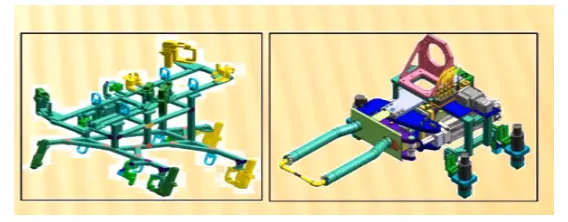
- Material Handling Gripper: This gripper is use for handling the material.
- Process gripper: The workpiece undergoes a process while being gripped.
- Dual Gripper: This gripper grabs the workpiece from both side.
Stand: This is were the tools/grippers/robots/fixyures are mounted.
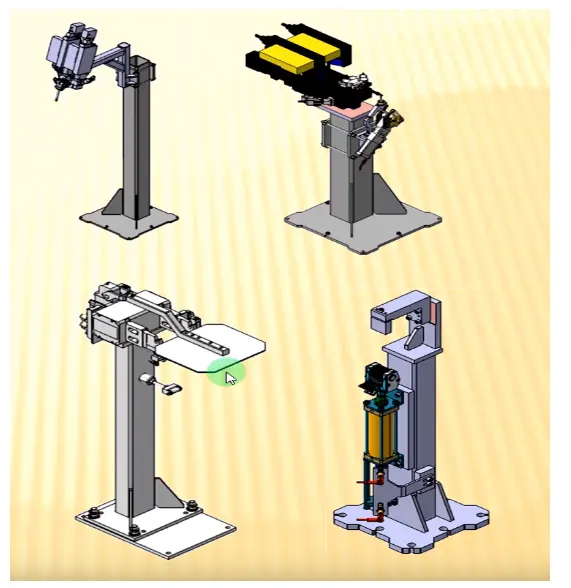
- Gluing and sealer stand: This where the gluing of the workpiece is done. The gluing gun is fixed on a stand on the floor.
- Date stamp stand: For engraving the date on the product.
- Pedestal gun stand: A weld gun mounted on a stand.
Miscellaneous stations:
- Curing
After gluing it needs some time to cool down, so we put the assembly on some belts & it will take the panel to another station & meanwhile gluing will cool down.
- Buffer Stand
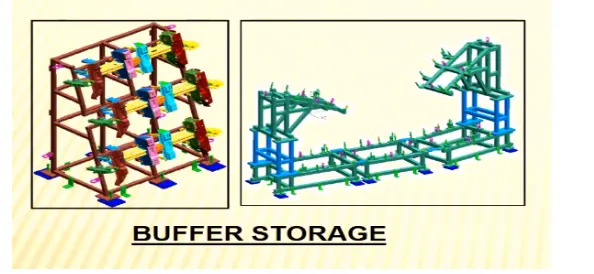
After some operation, we can put the no. of assemblies in this stand which is buffer stock & it can be transported to another station in easy They are also used to store the inventory while the machine is undergoing some maintenance.
- Take out trolleys
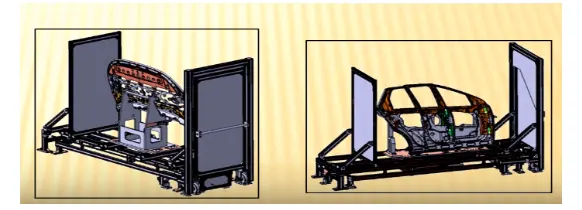
It used to take out some panels for inspection to rectify the process is going in the right or not between the cycle.
- Conveyor
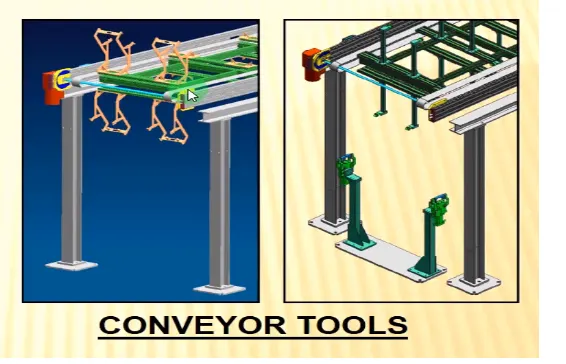
The conveyor is the rotating path that transports the parts to the next station which are kept over it.
6.What are the basic terminologies used in the BIW fixture ?
- Car panel- Referes to the car skin such as hood, door, etc.
- spot welding- Resistant welding.
- Takt time- Avg. time needed to meet the customer demand.
- cycle time- Time required to excute a task.
- 2 metal spot- spot welding to join 2 sheets.
- 3 metal spot- spot welding to join 3 sheets.
- Car lines- The designer needs to know the lines.
- Rest Block- Block for resting the work piece.
- Clamp block- Block for holding the component.
- Location Round Pin- Pin used to location BIW sheet metal parts.