Week 1:- Introduction to BiW and Fixtures Challenge
1.
BIW it means body in white.
BIW is a stage where sheet metal are welded and it forms a structure of the vechile. where the all components of the vechile are assembled to the biw structure like engine, doors, trims, etc. for the biw commponents differetnt shapes of sheet metal are welded together to form a structure by using different types of fixtures. actually there is a stage where the welded sheet metals called biw. thaa stage is in between welding and painting of biw components.in that stage the welded sheet metal dipped in solution. it named as primer. where this is called as biw components. and then it goes to the paintainng station. then it goes to the main assembly line where all components are assembled to the main biw.
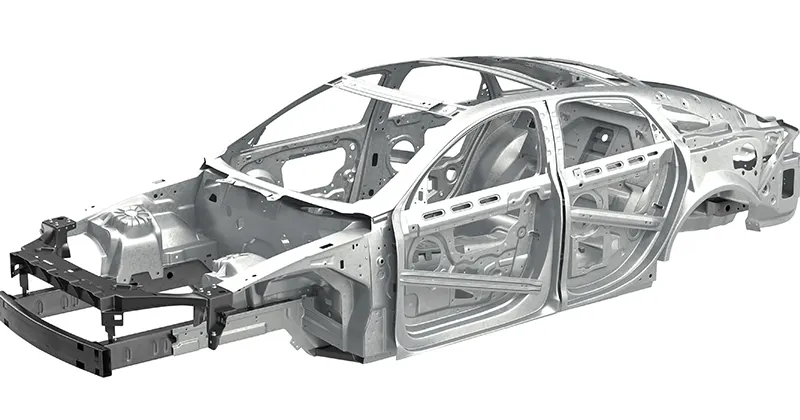
actually car body structure is very complex and we are not manfacture the whole structure in single shot. because of its complexity and time consuming, we are not able to manfacture the product without any defects. so thats why we catagaries the car biw structure into diffrent biw parts such as
- body side
- under body
- closures
- roof
- fender
body side: it is the main structure of the vechile and remaining biw parts are assembled to this body side. and it it catagarised into two parts
- body inner side:thes biw parts allows assembled the different internal parts of the vachile. and it forms the inner structure of the vechile.
- body outer side:thes biw parts allows assembled the different external parts of the vachile. and it forms the inner structure of the vechile.
after the design of these two parts then it goes to manfacturing in the stations. using different fixtures and welding and fastening and riveting twchinques to form the body structure. then these two parts are assembled in the main body zone.
under body:it forms the under body structure of the vechile. under body also catagarised in to three parts.
- frent end under body:these part is helps to assemble the engine to the main structure, so it is also called as engine compartment.
- mian floor: these main floor part helps to form the under body structure. and it also helps to assmbled the diffrent components like seats, interior trms etc.
- rear end under body: these structure helps to hold the different components like trunk, lighting system, and helps to formation of structure of the car
after the manfacturing of these three parts then it is assmbled in the under body zone.then it is called as a under body. and the these parts of the under body manfacturing in different stations.each stationd manfacturing diffrent units of the parts. and then these are all assembled in the main zones.where it is to get the structure.
closures: closures are helps to close the main structure and also give the strength to the main structure. and it also help to assemble the diferent components like hood, trunk,doors etc. and each parts are helps to allow the diffrent functions.
roof:these parts are helps to complete main structure. and the main function of these part is help to strength the main structure and prevent from the main climate conditions.the roof are classified the two parts
- roof inner
- roof outer
fender:The fender on a car is located at the front and at the back side. The wheels are located immediately behind in the case of the front fenders, and immediately in front of the rear fenders. the main purpose of the fender is to create the frames of the wheel.
2.
BIW NOMENCLATURE
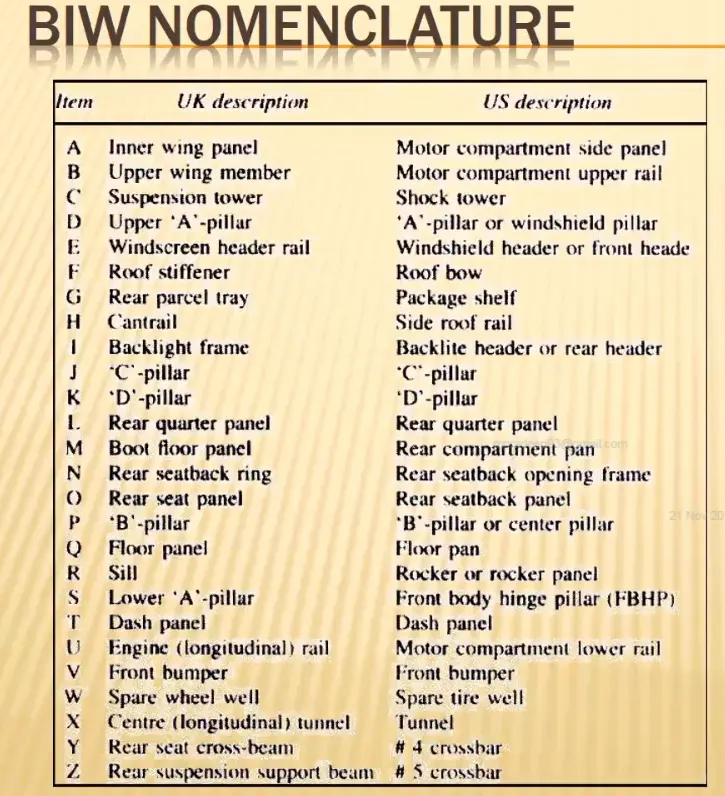
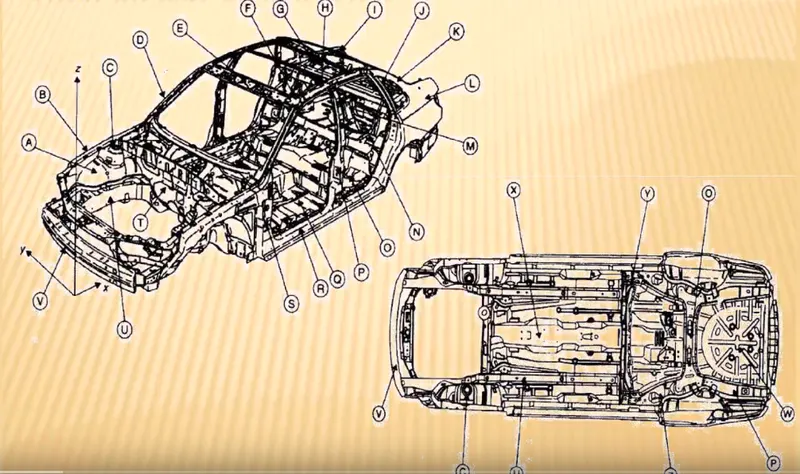
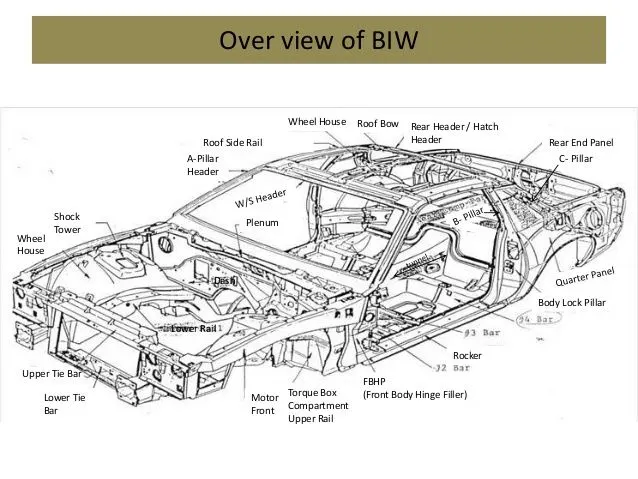
BIW nomenclature is the process of namming the different parts involved in BIW frame and therefore used for describing the parts and its properties.because whole part cant manfacturing the single shot. so we devided the main structure int diffrent components. so it reduces the complexity, manfacturing time, easy assembly process and it provides the excellent accurate properties.An overview of parts used in BIW at two different region shows the emphasis of tagging names for the parts which are useful for collaborating vehicle for different geographical locations.
3.
fixture:
Fixture is a holding device which holds the workpiece to be processed. In general fixtures are designed using 3-2-1 principle.
Securing parts is absolutely necessary to avoid distortion in the work piece and clamping has to firm with correct location of parts. This enables a stable working environment and helps to withstand various stresses caused by different operations.it means whenever do the operations on the sheet metals initially we clamp the metal parts using diffrent types of fixtures and then it being processed some operations like welding, riveting, fastening, glooving etc. so our fixture must be very rigid during this operaions. to reduce the distorsions after removing the fixtures.
Fixtures are also useful during mass production which helps to achieve repeatability and automatic transmission between different stations by reducing variations in the parts produced during different operations.
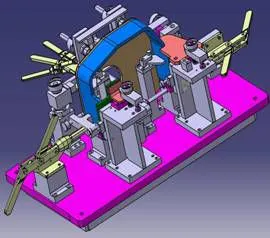
the fixtures are diffent and these are classified according to these functions
- Production Fixtures
- Pre-Production Operation Fixtures
- Checking Fixtures
PRODUCTION FIXTURES:
They are used for mass production and are usually implemented after testing for dimensions, tolerances to reduce variations and are present in the shop floor till the final stage of production processes.The Productions fixtures are designed for feasible access to operators with affordable working space and easy to maintain.Automation levels are high in these types of fixtures as functioning of production fixtures are always tested before implementation.
PREPRODUCTION OPERATION FIXTURES:
These are initial type of fixtures used for batch production to study and validate the process. these fixture are helps to validating the fixture and its accuracy and it is feausable r not.these are all parameters are decided by the these productions fixtures. and it helps to make the batch produtions and then qc department check the quality of the fixure and the make a trail component and these components are check by the QC department to meet the requirements and it is as per the given dimensions are not and also do the some stress analysis on that particular part. wheather it obeys the all tests then it goes for mass productions. if not we redisigened the fixture to make accurate parts.
Checking fixtures:
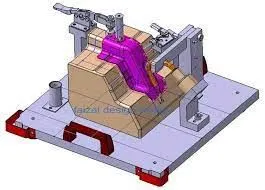
These fixtures are used for checking and inspection purpose. No processing is done in these fixtures. These fixtures consist of gauges for checking the dimensions and tolerances and its accuracies. In some checking fixtures, fixtures are fixed and CMM devices check the geometrical accuracies
4.
PRINCIPLE OF FIXTURE DESIGN:
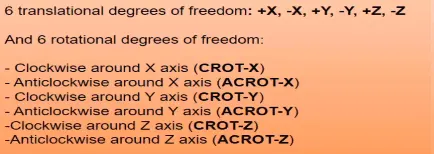
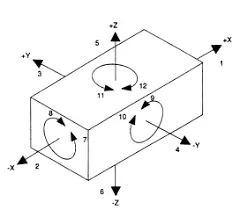
The aim of the fixture is to hold the workpiece in the desired angle and location. For a free body we have 12 degrees of freedom they are six rotational and six translational. Six rotational degrees of freedom refers to clockwise and anticlockwise along X, Y, Z axes and six translational degrees of freedom refers to translation in X, Y, Z axes. So the basic principle of fixture design is to arrest or restrict all the 12 degrees of freedom in the desired or required location and orientation
5.
BIW STATIONS:
In BIW assembly line we have zones and these zones are divided into stations. the biw parts are manfactured in these stations. and then goes to another stations to form structure. these are all comes under zone. each zone produce main biw structure. These BIW stations are diffferent types as follows:
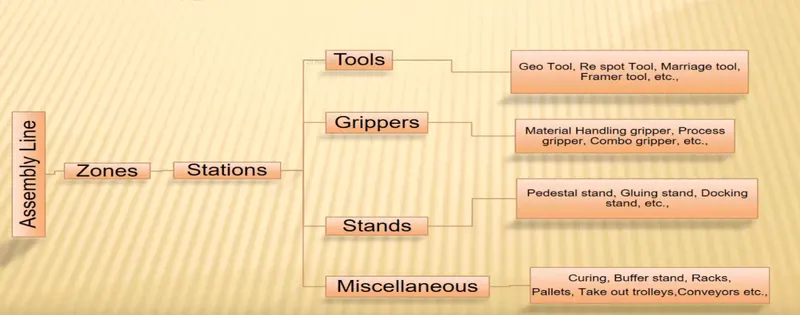
TOOL STATION:
Tool Station are used for manfacturing the diffrent biw parts. and some of the toolstations are
- GEO TOOL
- RESPOT TOOL
- MARRIAGE TOOL
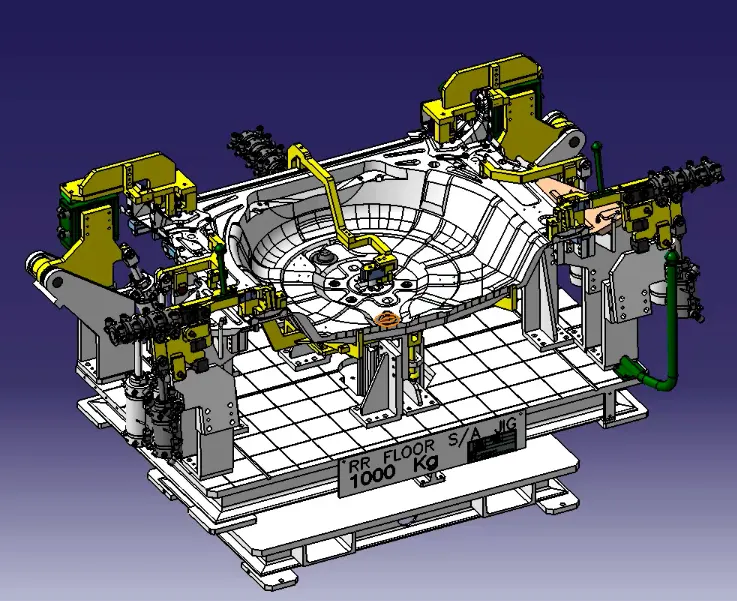
GEO TOOL:
In Geo tool fixtures the geometry of the panel to be operated or held together very precisely with closer tolerances.For instance, a hole with dimension of 20 mm will have a pin designed with tolerance less than 0.15 mm.Thus Geo Fixtures help in achieving the geometry of the panels hence tighter tolerance are required to hold the panels firmly. geo tool covers the entire part to be manfactured but in some times it is not easy to hold the all parts to the main body. so at that time we use respot tool.
RESPOT TOOL:
In order to tackle the lead time and reduce the waiting time between two different station staions , not all welding spots are acchieved in geo fixture. Hence remaining tacks of prewelded panel are completed in Respot Fixtures.The tolerance standard for Respot Fixture is 0.28mm in general. Since Respot Fixtures are used for already welded panels there is a slight relacation in tolerance compared to geo fixtures.
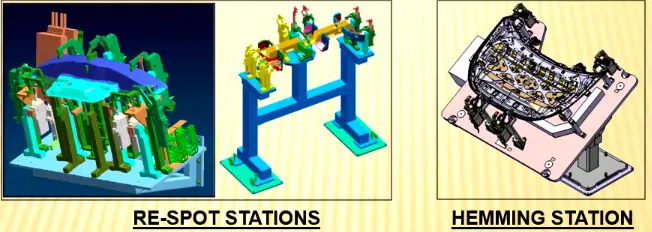
MARRIAGE TOOL
Marriage tool also called as hemming tool fixture is used to join inner and outer panels together. and also used for joining the main assembly parts like under body, closures, side body etc.
Hemming Fixtures are used to assemble specific components especially closure panels like Hood, Tail gate which has outer panel enveloped around the inner panel.
CHECKING STATION
- Checking station is used to gauge the processed automotive panels to ensure the coordinates, relative dimensions and position of parts as per tolerances
- The types of fixtures used in checking stations are gauge type, fixed type and automated checking fixtures.
GRIPPER STATION:
Gripper is type of fixture with lesser parts and weight compated Tool Fixtures and is used to hold the car panel.
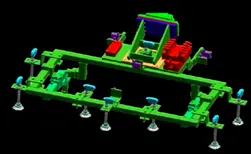
Type of grippers
MATERIAL HANDLING GRIPPER
Material handling gripper are used to transfer the part from one place to another place.
PROCESS GRIPPERS
- Process Gripper are also used to transfer parts between station but in addition some of welding, riveting , gluing and sealing are performed intermediately between two process station.
- Thus after picking up part from one station the process gripper prepares for additional process by orienting the BIW panel for gluing, sealant etc before unloading in the next processing station.
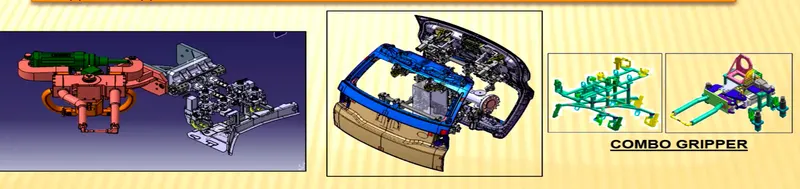
COMBO GRIPPER
Combo gripper are used to transfer parts with additional weld gun or other processing station so it can multitask while transferring parts. like it can handled the glooving gun or welding gun
DUAL GRIPPER
Dual Gripper have gripper on both sides which are used to transfer symmetric parts to be assembled between two stations.
STANDS
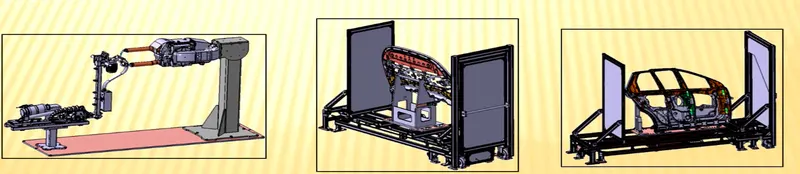
Stands are used to bolster the operation of the fixtures and grippers and are attached to the floor.
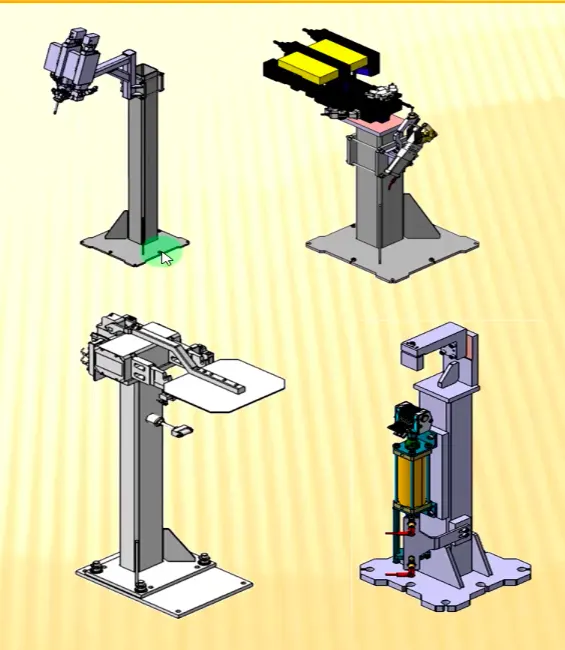
Gluing stand, Docking stand and Date stamp stand
They are used to resist vibrations while welding performed on the metal which might cause distortions. and also support the diffrent guns.
The types of stands are used are
Gluing and Sealer Stand
Gluing or welder gun is attached to the stand that are fixed permanently to the floor
Docking Stand
Docking Stand are used for placing welding gun or gripper while the fixtures are multitasking to avoid excessive payloads while material handling
Date Stamp Stand
The panel will get the date embossed on to it, with the date stamping device attached to the stand.
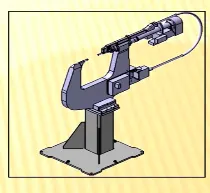
Pedestal Stand
Weld gun is mounted to the pedestal stand and pedestal stand are fixed to the ground. The processing grippers move the panels by passing below these pedestal stands.
MISCELLANEOUS STANDS
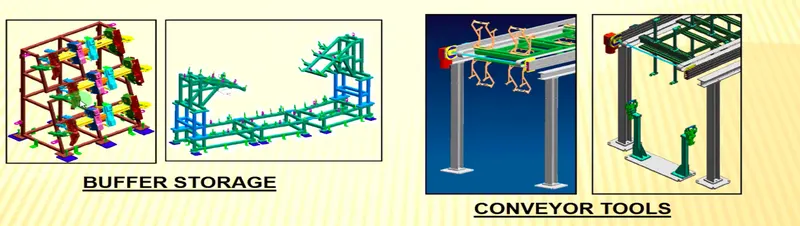
Buffer Stands: Buffer stands are used to hold the parts for while before loading in next station
Conveyer Stand: They are usually attached to conveyor belts and move from one station to the station
Take out trolley: Take out trolley is used to take the automotive panel out of the working station for inspection purposes.
Curing station: After welding and gluing the panels needed to cool for some time hence the assembly are allowed to cool with these type of stands
6.
The basic terminologies used in BIW are,
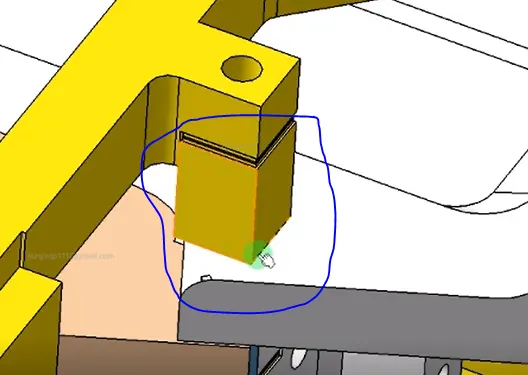
1. NC/Mylars/Fingers.
These are the components which holds the parts from both top and bottom directions. The top side mylars are called clamping mylars where as bottom side are called as resting mylars
2. PLP (Principle locating points).
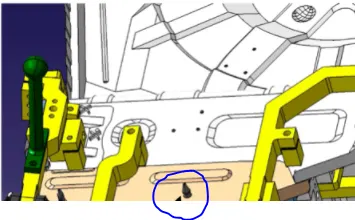
Principle location points (PLP) are used for accurate location of panel for maintaining the geometry of the assembly. The holes in panels are predefined in the design stages for accurate dimensioning so positioning of these holes relative to the dimensions are fealisble during fixture welding process.
3. Blade.
These provide support and height to the assembly base
4. Raiser.
Risers are adjustable standing brackets that are used to define the height of the clamps and fixtures. Additional parts such as cylinders, mounting plate are also attahced to the risers.
5. Shims
SHIMS are small thin tapered adjustments provided below the Mylars to negate the stack up analysis. In Worst Case Scenario the tolerance stack up and additional adjustments are provided through SHIMS to level the surface of the bed.
6. Rough Locators.
These is a kind of fool proofing which allows the operator to load the component only in the correct location and orientation
7. Hardwares.
These are bolts, nuts and self locking nuts etc.
8. CMM.
CMM is a Coordinate Measuring Machine. This device measures the geometry of the panel by gauging discrete points along the surface with a probe. This is used to inspection of the panels to validate with CAD file and generate reports for analysis.
9. Units
There are different type of units that forms a fixture. They are classified as base unit, hole unit, pin unit, clamp unit
10. Number plates.
It is a plate which have numbers embossed on it. Which helps in recognizing the part later
11. Name plate.
It is a plate which consists of all the details of the fixture embossed on it.
12. Clamp arm.
In a clamp assembly unit the arm that moves are called as clamp arm
13. Pivot.
It is the axis or bearing about which the clamp arm rotates
14. Class 'A' surface (or) Skin surface.
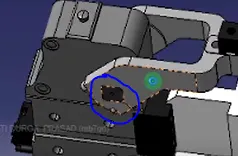
Class A surfaces are aesthetic Styling surfaces that are visible to the customers. It essential for Fixtures that are holding Class A surfaces are basked with soft material so that it will not leave any impression or dent on the CLASS A surface and it will not affect the surface texture.
15. Reed switches.
These are the electronic switches which are operated by the sensors or sometimes manually
16. Sensors.
These are the electronic devices which senses the components on the fixture and helps to operate or send input commands to the other mechanical or electronic components