Week 1:- Introduction to BiW and Fixtures Challenge
1) What is BIW & define its parts?
Answer- BIW- Body in white, BIW is a stage in automobile industry where the car body gets joined together before painting, before motar fitting, before Trims attached. And this process done by Welding ( pot,MIG), etc.
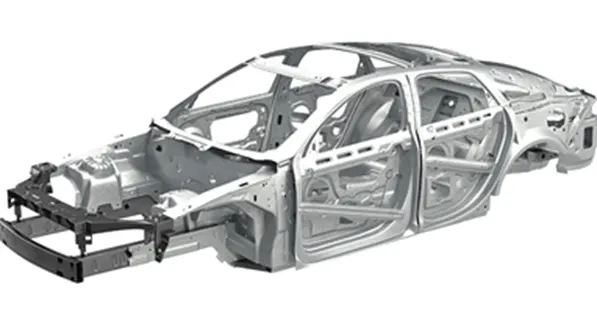
BIW parts are divided as follows :
- Underbody structure
- Front End structure
- Body side structure
- Closure
- Roof
Underbody structure :
An automobile underbody structure includes a floor panel having a pair of longitudinal side edges, each extending longitudinally of the automobile body structure and having a respective side sill rigidly secured from below to the associated side edge so as to extend in a direction generally parallel to the longitudinal dimension of the automobile body structure.
Body side structure
In a vehicle body side structure, a tailor welded blank is used for forming an outer panel assembly consisting of a frame structure, and a center pillar assembly is connected vertically between a roof side rail and a side sill outer of the outer panel assembly.
Closure :
As in the BIW, a side closures, and door is manufactured through process, such as blanking, rolling, stamping and assembly. The analyse the influence of tolerances and visualization on the side closures are classified into three major categories
- Hinge Adjustments.
- Striker Adjustments.
- Hemming Technology.
Roof :
A Roof Bow is a sheet metal part, usually spot welded to the BIW inner frame, forming the inner structure of the vehicle body. Its primary function is to supporting.
2) What do you understand by BIW nomenclature?
Answer-Nomenclature is basically naming the specific parts in a vehicle and This naming is varies region to region.
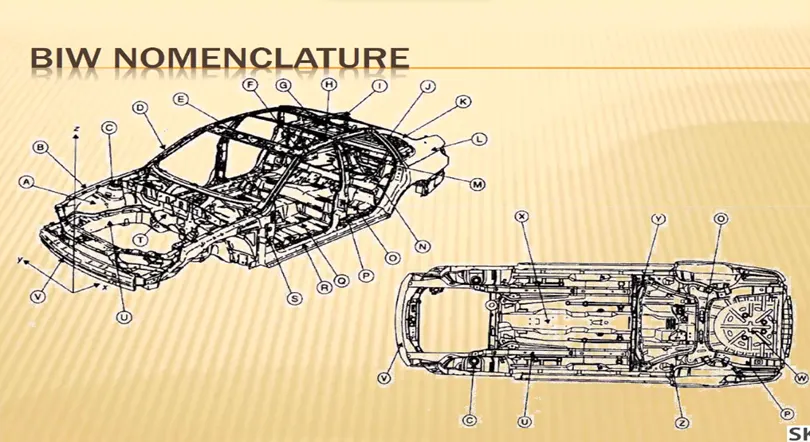
|
Items |
UK Description |
US Description |
|
A |
Inner Wing Panel |
Motor Compartment Side Panel |
|
B |
Upper Wing Member |
Motor Compartment Upper Rail |
|
C |
Suspension tower |
Shock tower |
|
D |
Upper ‘A’ Pillar |
‘A’ – Pillar or Windshield Pillar |
|
E |
Windscreen header rail |
Windshield header or front header |
|
F |
Roof Stiffener |
Roof bow |
|
G |
Rear Parcel tray |
Package shelf |
|
H |
Contrail |
Side roof rail |
|
I |
Backlight frame |
Backlite header or Rear header |
|
J |
‘C’ - Pillar |
‘C’ – Pillar |
|
K |
‘D’ - Pillar |
‘D’ - Pillar |
|
L |
Rear Quarter Panel |
Rear Quarter Panel |
|
M |
Boot Floor Panel |
Rear Compartment Pan |
|
N |
Rear Seatback Ring |
Rear Seatback Opening Frame |
|
O |
Rear Seat Panel |
Rear Seatback panel |
|
P |
‘B’- Pillar |
‘B’- Pillar or Centre Pillar |
|
Q |
Floor Panel |
Floor Pan |
|
R |
Sill |
Rocker or Rocker Panel |
|
S |
Lower ‘A’-Pillar |
Front body hinge pillar (FBHP) |
|
T |
Dash Panel |
Dash Panel |
|
U |
Engine (longitudinal) rail |
Motor Compartment Lower Rail |
|
V |
Front Bumper |
Front Bumper |
|
W |
Spare Wheel Well |
Spare Tire Well |
|
X |
Centre (Longitudinal) Tunnel |
Tunnel |
3) What is fixture & its types?
Answer-A fixture is a work-holding or support device used in the manufacturing industry.
Fixtures are used to securely locate and support the work, ensuring that all parts produced using the fixture will maintain conformity,
fixture arrests all 12 DOF so we can able to work on the workpiece without any movement of the workpiece.
- General types of Biw fixtures are
- production Fixture
- preproduction operation Fixtures(PPO)
- checking Fixtures.
- production fixtures are used for mass production of components these are mainly used in the assembly lines, these fixtures need to be highly accurate in shape so that work to be produced on this component will be having good geometr
- preproduction operation Fixtures (PPO) are for initial batch production to study the feasibility
- checking fixtures are used for inspection of the produced part.
4) What is the basic principle of fixture design?
Answer-
- 3-2-1 principal is used for the design of the fixtures
- Any object in space has 12 degrees of freedom those are translation along x, y, z-axis that takes 6 DOF Rotation( both positive side and negative side) and Rotation with Respect to x,y, z-axis ( clockwise and Anti Clockwise Rotation) its takes 6 DOF
- By using 3-2-1 principle we can arrest 9 DOF Remaining 3 DOF are left free for Loading and unloading of the workpiece
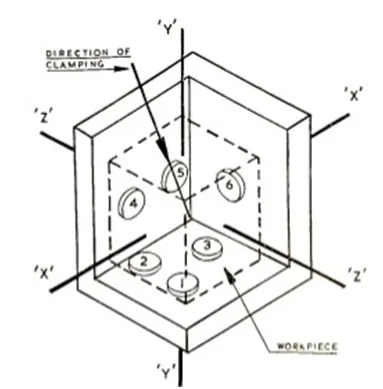
- In the above picture 1, 2, 3 pins Restrict the motion of x-axis Rotation both clockwise and anticlockwise, the motion of workpiece along the negative y-direction and Rotation of the workpiece along the z-axis
- 4,5 pins block the motion of negative z-direction and rotation along y-direction both clock and antilock wise rotation and 6 the pin stops translation long negative x side
- so by this 9 DOF are arrested the remaining three DOF is used for movement of the workpiece to loading and unloading
- if we want the Remaining 3 DOF can be blocked by additional clamping to the workpiece
5) Elaborate types of BIW Stations?
Answer- The different types of stations are
- Tool station
- Gripper station
- stand station
- miscellaneous stations
Tool station: Tool station Consists of a number of units together, there are different types of tools are present those are
- Geo tool: A geo tool is a Fixture in which the Geometry of panels which are welded together is defined accurately. the pin tolerance for a geo pin will be closer tolerance i.e -0.15 in general.
- Respot tool: A Re-spot tool is a Fixture in which the remaining weld spots that are not achieved in the geo tool are welded for the pre-welded panel from the geo tool.
- The pin tolerance of respot pin will be tolerance with -0.28 in general
- Marriage fixture: A marriage or hemming tool is a fixture in which inner panel assembly and outer panel assembly are joined together. these are done by welding or by hemming in case of closure panels.
- checking station: A checking station is a Fixture which is used to check the automotive parts or assemblies, ensuring all the coordinates, Relative dimensions, and positions as per the tolerance. A checking station can be a gauge type, fixed type, and automated checking fixtures
- A checking gauge is a tool where a workpiece is hold and various measuring gauges are introduced to ensure the dimensions & Repeatability
A Fixed type checking fixture is used where the workpiece is fixed with clamps and pins& a CMM machine is used which measures the coordinate of different points of panel or assembly. compare it with the nominal value
Gripper:
A Gripper is a device or a fixture that holds the car panel, and is fixed to the manipulating end of a robot or end effector. also known as EOAT ( End of arm tooling)
Types of Grippers:
- Material Handling gripper(MH): Material Handling gripper are designed for handling the car panel from one tool (station) to another tool (station)
- process Gripper: process gripper is designed for handling the car panel from one tool(station) to another tool (station), and in addition to that it undergoes process like pedestal welding, pedestal Riveting, gluing, sealing, etc.
- combo gripper: combo grippers are designed for handling the car panel from one tool(station) to another tool(station), also with the combination of weld gun at another side of the gripper for welding. (Gripper+weld gun)
- Dual gripper: Dual Gripper are designed for handling the car panel from one tool(station) to another tool(station), with two-sided grippers (Gripper+Gripper)
Stands:
- stands are used to hold the workpiece
- Gluing and sealer stand: Gluing gun or sealer gun is fixed to a welded or standard stand which is grouted to the floor permanently.
- docking stand: when Robots are selected for multitasking like welding & material handling, which cannot carry both due to some limitations (payload capacity of the robot or space constraint) the robot will drop and pick the gripper gun after completing the respective operation with the help of docking stands.
- Date stamp stand: the panel will get date embossed on to it, with date stamping device mounted on this date stamp stand.
- pedestal gun stand: weld gun is mounted to a fixed stand which grouted to the floor permanently, where process grippers carry the car panel to weld the spot with this fixed weld gun
Miscellaneous:
- Take out trolley: take out trolley used to take car panel out of the robotic working cell between the cycle for inspection
- conveyor: conveyor is used to transporting parts to next station
- curing: After gluing we will put workpiece on curing stand to settle down the glue
- buffer stand: buffer stand has used an inventory. we will keep sub-assemblies in buffer stand while other operations are going on and we will keep the workpieces in buffer stand while the machine is undergoing some maintenance
6) What are the basic terminologies used in the BIW fixture?
Answer-
1) MYLARS – These parts are used to hold the panel .they are globally called as MYLARS .
top side mylar is called as clamping mylar & bottom side mylar is called as resting mylar.
2) PLP-principle locating point which are used for the accurate location of part to maintain
he geometry of assembly ,means principle locating points are those where we use pin
for locating panel
3) Risers – risers can be of L-type , welded or square tube or frame type .
these are basically manufactured parts are use to give height to assembly .
4) Blades – blades are plates attached to riser . other part likes cylinder,
arm etc are mounted on the blade .
5) Shims – in fixture we providing tolerance to each parts mostly manufactured .
those tolerance tend to stack up & reflect together .
in order to avoid that we use shims so we can easily adjust after assembly
so whatever stack up there we will rectify it through shims . shims come in
thickness of 0.1, 0.2,0.5 etc .
6) Rough locators – rough locators are those used majorly for manual fixture .
there is chance that operator can place part in wrong orientation mistakenly.
The rough locator will work as a guide while placing the part in fixture &
part will be loaded in desired orientation.
7) Hardware – hardware are like the hex head bolts , Allen bolt , hex nuts ,
spring washers , self locking nuts , etc .,.
8) CMM – CMM stands for co ordinate measuring machine .
its is a device that measure the geometry of physical objects by sensing discrete
point on the surface of object with probe
9) Units – this fixture is assembly of different types of units to form a fixture.
There are different unit like pin unit , base unit , clamping unit , etc
10) Number plates – number plate is the aluminium embossed plate placed on
each unit to recognize the unit .
11) Co-ordinate plates – when we discuss about fixture on every fixture
we have tooling hole which is called master hole through all fixture checked
on CMM mastering the particular hole .
12) Name plate – the plate on which basic information described like company name ,
fixture name , fixture weight , panel name , are embossed and joined to fixture
13) Clamp arm – clamp arm is part of clamp unit which moves about axis ,
over clamp are mylars are mounted
14) Pivot – it is axis about which clamp arm will rotates
15) Read switches & sensors – these are the electric components used in automated .
fixtures is fully automated or semiautomatic that run through PLC , control panel etc
sensor are used to defect part present or not clamp is close or open where as reed
switches confirm position of piston i.e. it is at top or down .