Week 1:- Introduction to BiW and Fixtures Challenge
Q.no- 1. What is BIW & define its parts?
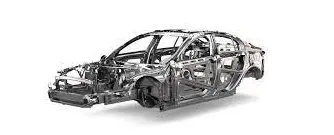
In the Automotive Industry BIW (Body in White) is the common terminology used to mention the car sheet metal welded structure (body shell).
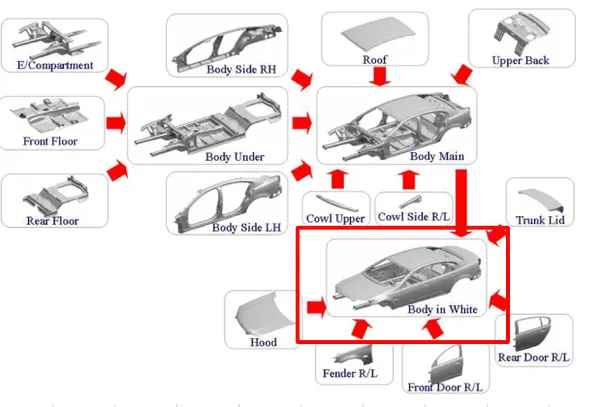
Sub-assemblies like Underbody, Bodyside Left Hand Side/ Right Hand Side, Front End, Roof, etc. gets welded together by various metal joining process e.g. resistance spot welding, Laser welding, MIG welding to make welded metal shell (Without Door, Trunk-lid / Tailgate), Fender, Bonnet Center) called Body in White.
BIW TYPES:-
1. Frame-mounted Body Structure
- It is called body on frame construction.
- This type is mounted on the chassis/frame.
- Powertrains and suspension are mounted on the chassis.
- used in utility vehicles, trucks, buses.
2. Monocoque Body Structure
- It is called a Chassis with a built-in body.
- The chassis / Frame is inbuilt with itself & and there is no separate chassis.
- powertrains and suspension are directly mounted to BIW.
BIW PARTS-----
* BODY SIDES
- Body side outer
- Body side inner
* UNDERBODY
- Front-end under frame (Engine compartment)
- Main Floor
- Rear-end under frame (Rear compartment)
* CLOSURES
- Front door
- Rear door
- Hood
- Decklid
* ROOF
- Roof inner
- Roof outer
* FENDER
Q.no- 2. What do you understand by BIW nomenclature?
Body in white or BIW refers to the stage in automotive design or automobile manufacturing in which car body sheet metal ( including door, hoods, and deck lids) has been assembled or designed but before the components ( chassis, motor) and trim ( windshields, seats, upholstery, electronics, etc.) have been added.it is important to define common terminology for components to support common understanding between engineers.
Q.no- 3. What is fixture & its types?
The fixture is a workpiece locating and holding device used with machine tools. it is also used in inspection welding and assembly. fixture does not guide the cutting tool but is always fixed to the machine or bench. by using fixtures, responsibility for accuracy shifts from the operator to the construction of machine tools.
when a few parts are to be machined, the workpiece clamp to the machine table without using a fixture in many machining operations. however, when the numbers of parts are large enough to justify its cost, a fixture is generally used for holding locating the work.
TYPES OF BIW FIXTURES
- PRODUCTION FIXTURE
- PRE-PRODUCTION FIXTURE
- CHECKING FIXTURE
PRODUCTION FIXTURE:-
These fixtures are used for mass production. it required high consistency through its operation to maintain the geometry of the parts so the materials used are well tested for hardness & aesthetics. this quality for maintaining the dimensions & tolerances is also checked. the production fixtures need to be easy for maintenance purposes. this fixture needs some maintenance after completing no. of operation. the times required for assembly & disassembly should be as low as possible which saves lots of time.
PRE-PRODUCTION FIXTURE:-
These fixtures are designed as prototype fixtures to check the feasibility of initial batch production & to check which things need to be improved before starting the production. this fixture can be taken as the base fixture which sets the benchmark & criteria and helps us to rectify the errors that we could get from preproduction operation fixtures. in this many manual operations are involved, many engineers & quality-related persons are required. it has a large cycle time as compared to production fixtures. it requires lots of time & cost also. we have to maintain the cost of the car as low as possible so we directly go to the production fixture by considering standards, a checklist to maintain error-free production.
CHECKING FIXTURE:-
These fixtures are used for checking purposes. no operation like welding gluing or hemming is carried out in the fixture. the gauges are used in this fixture to get the dimensions & the tolerance parts having & the data is compared with the designed dimension to check whether the part is ok or not. the geometry of the welded parts is also checked in these fixtures to ensure the parts maintain the required dimension& geometry.
Q.no- 4. What is the basic principle of fixture design?
The basic principle is fixing the parts and locking all the twelve degrees of freedom (6 movements & 6 Rotations), For a fixture designer, the major portion of design time is spent deciding how to locate the workpiece in the fixture.
Any free body has a total of 12 degrees of freedom they are
6 translational degrees of freedom: +X, -X, +Y, -Y, +Z, -Z and
6 Rotational degree of freedom: Clockwise around the x-axis (CROT-X)
Anticlockwise around X-axis (ACROT-X)
Clockwise around the y-axis (CROT-Y)
Anticlockwise around the y-axis (ACROT-Y)
Clockwise around the z-axis (CROT-Z)
Anticlockwise around the z-axis (ACROT-Z)
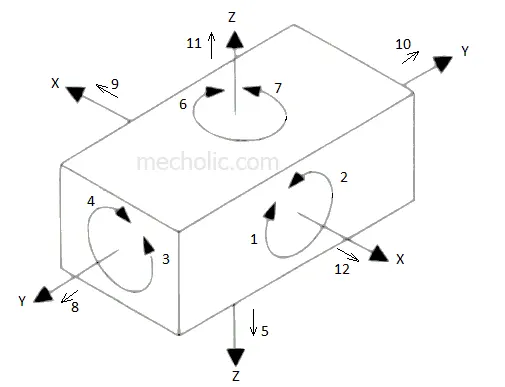
To make sure the proper fixing of the part we need to restrict all 12 degrees of the workpiece. the major portion of the time of BIW fixture designers is spent deciding to fix these all Degree of Freedom.
The jig & fixture are tools used for holding the workpiece in a carrot location for mass production. various types of fixtures (like drilling fixtures, milling fixtures & welding fixtures) are used in the industry. The 3-2-1 method is the fundamental principle for all types of fixture design.
Q.no- 5. Elaborate types of BIW Stations?
BIW station is the parts of BIW assembly line is divided into zones & these zones are again divided into the station.
- TOOL STATIONS
- GRIPPER STATIONS
- STAND STATIONS
- MISCELLANEOUS STATIONS
TOOL STATIONS
A). GEO FIXTURES:-
- In BIW fixture we consider Tack/Geo fixture tack welding done for all to be assembled in that fixture. the geo fixture defines the geometry of the part.
- All the parts must be located with two locating pins (pin can be common for two or more parts)
- these jigs have tight accuracy standards. in the case of geo fixtures, all the machines parts individually should be made with max tolerance of (±0.02mm±0.02��). whereas positional accuracy of the pin should be within ( -0.15mm.)
Geo fixture spots/ MIG welding is done in such sequence that the taking out from the fixture achieves the desired accuracy and does not get disturbed during transportation from the geo fixture. Goe fixture controls the sub-assy accuracy in all 3 axes.
B) RE-spot fixture:-
- In BIW we consider a Re-spot fixture. in re fixture, remaining takes are completed.
- suppose in an assembly we need 50 weld tacks .on the station we can't complete all these operations because it will take more & another station relative to the assembly will be in ideal condition.
- In this type of case, we carefully choose some weld tack points which will define the geometry of the part & also the assembly will not get deformed after opening the clamping or in transportation due to the welding stresses.
- The remaining weld tacks will be completed in the re-spot fixture as per needed. by performing this kind of operation no station will be ideal hence we re-spot fixtures.
- Re-spot fixtures also have very tight positional accuracy. re spot jig, pin tolerance will be -0.28mm.
C) Marriage fixture or Hamming tools:-
- As the name suggests the marriage of different assemblies is carried out in this fixture.
- In different zones of the assembly line, different assemblies are completed like underbody, side body, front body, rear body, etc.
- after this all the parts come to the station where all parts are gets assembled by using various joining techniques like welding, Gluing, Reverting, etc this station is called marriage tools.
D) FRAMER FIXTURE:-
- framer fixture is next station after the marriage fixture
- in a framer fixture, the roof is attached to the output of the marriage fixture & it forms like a frame hence it's called a framer tool.
E) CHECKING FIXTURE:-
- These are used to check the assembly of parts, Tolerance, Dimension & coordinates.
- It can be of gauge type, fixed type of automated checking fixture.
- A checking gauge is a tool where the workpiece is held & different measuring gauges are introduced to ensure dimensions & repeatability.
- A fixed type checking fixture is used where the workpiece with clamps & pin & CMM is used which measures the coordinates of the different points of the panel or assembly, then is compares with the CAD data & gives a report.
GRIPPER STATIONS:-
A gripper is a device that enables the holding of objects to be manipulated. the easier way to describe a gripper is to think human hand just like a hand. rippers enable the holding, tightening, handling, and releasing of an object. A gripper is just one component of an automated system.
A) Materials handling gripper:-
- As the name suggests these grippers are used for materials handling
- These grippers can pick assembly from one station & will drop the assembly to another station
B) Process grippers:-
- These grippers are used to carry out some specific processes like gluing, welding, reverting, etc in addition to materials handling.
- The grippers will go under gluing stand in case of gluing process & will goes under the pedestal weld stand in case of the welding process.
C) Combo Gripper:-
- Combo grippers are the ones that can carry out multiple tasks like it can do material handling & also it can carry out some specific processes like gluing, welding, etc as ell.
- weld gun+ gripper
D) Dual gripper:-
These grippers are two-sided grippers. in the case when we want one LH & one RH part, these grippers are used can handle the materials from one station to another station
STAND STATIONS
The stand is used to hold parts when not in use or also it is used to mount some parts or bodies on it. the different stands are used in BIW.
A) Pedestal stands
- weld gun is mounted on the fixed stand which is mounted to the floor permanently. the gripper can carry the panel under the stands to do the operation
B) Gluing & sealer stand:-
- Gluing gun or sealer gun is fixed to a welded or a standard stand which is grouted to the floor permanently.
C) Docking stand
- The robots have some limitations such as the payload capacity the robot & also due to lack of space.
- when we select the robot for, multitasking it cannot do both the task simultaneously due to limitations.
- In this kind of case, we add a docking stand to put some equipment that is not in use for the current operation but will be required for the next operation.
- hence the robot can drop a gripper or gun & pick the next operation equipment to complete the task from the docking stand.
D) Date stamp stand:-
- Every, manufactured product has some data to stamp or to be embossed on it like serial no, batch no, date, etc for some future reference or for data collection.
- The required data_ is stamped or embossed by using the stamping device mounted on the stand.
Miscellaneous stand:-
A) Curing
after gluing it needs some time to cool down, so we put the assembly on some belts & it will take the panel to another station & meanwhile gluing will cool down.
B) Butter stand:-
After some operation, we can put the no .of assemblies in this stand which is buffer stocks & it can be transported to another station in an easy way. they are also used to store the inventory while the machine is undergoing some maintenance.
C) take out trolleys:-
It used to takeout out some panels for inspection to rectify the process is going in right or nat between the cycle.
D) Conveyer:-
the conveyor is the rotating path that transports the parts to the station which are kept over it.
Q.no-6 What are the basic terminologies used in the BIW fixture?
- NC/ Mylars/ Fingers
- PLP (principle locating points)
- Blade
- Raiser
- Shims
- Rough locators
- hardware
- CMM
- UNITS
- Number plates
- Co-ordinate plates
- Clamps arm
- pivot
- Class A surface or Skin surface
- Read Switches
- Sensors
- Nameplate