Week - 1 - Consistency of Units
Consistency of Units- Conversion of measurements from one system of units to another.
1. Problem statement
Solvers like LS Dyna are unitless, which means, the user needs to take care of the values and only a single unit system should be followed to avoid errors in the inputs which may lead to totally unexpected results. In this exercise, the below-given quantities need to be converted to a number of other unit systems from their current SI system.
| S.N. | Measurement | Value (SI unit) |
| 1 | Mass | 1 kg |
| 2 | Length | 1m |
| 3 | Time | 1 s |
| 4 | Force | 1 N |
| 5 | Stress | 1 Pa |
| 6 | Energy | 1 N-m |
| 7 | Density | 1 kg/m3 |
| 8 | Young's Modulus | 210 GPa |
| 9 | Velocity | 56.33 km/Hr |
| 10 | Gravity | 9.8 m/s2 |
Table: The given quantities
Detailed conversion of quantities from SI system to the [gm-mm-ms] system of units
1. Mass
- kilogram [kg] is the SI unit of mass and 1 kg= 1000gm.
2. Length
- Meter is the SI unit of length and 1 m = 1000 mm
3. Time
- Time is expressed in seconds [s] in SI units and 1 s= 1000 milliseconds
4. Force
- Force = mass* Acceleration
=mass*(velocity difference/time difference)
=`mass* (Distance)/(time)^2`
- So the dimensional form becomes :
- F= [`MLT^(-2)`]
- In SI units: 1 N= [`kg*m*s^-2`]
After converting ;
- 1 kg= 1000 gm
- 1 m= 1000mm
- 1s = 1000ms
We get in gm-mm-ms
- `N= 1e3*1e3*1e-6 [gm*mm*(ms)^2]`
= 1[gm*mm*(ms)^2]
- Finally, a value of 1N becomes 1 [gm*mm*(ms)^2]
5. Sress
- Stress is defined as internal resisting Force per unit area and its SI unit is Pascal
- 1 Pa= 1 N/m2
- And in dimensional form it becomes;
- [`ML^-1T^-2`] = [`kg*m^-1*s^-2`]
and in [gm-mm-ms] system we get;
- 1 Pa= [`1e3*1e-3*1e-6`] [gm*mm^-1*(ms)^2`]
= 1e-6 [gm*mm^-1*(ms)^2`]
- Hence a value of 1 MPa in SI unit will be entered as 1 in gm-mm-ms system
6. Energy
- In dimensional form energy is same as the work done which is force* distance.
- i.e. Energy = Force* dist
- 1 J = 1 N-m
In dimensional form
- Energy = `[ML^2T^-2]`
= [kg*m^2*s^-2]
=[1e3*1e6*1e-6] [gm*mm^2*ms^-2]
= 1e3 [gm*mm^2*ms^-2]
- Hence a value of 1mJ in SI unit becomes 1 in gm-mm-ms system
7. Density
- Density= mass/volume
- In SI units density is expressed as `[(kg)/(m)^3]`
On converting it to gm-mm-ms we get
- 1 `[(kg)/(m)^3]`= [1e3*1e-9] `[(gm)/(mm)^3]`
= 1e-6 `[(gm)/(mm)^3]`
So a value of density for steel which is 7.83e3 [kg/m^3] will be entered as 7.83e-3 `[(gm)/(mm)^3]`
8. Young's Modulus
- Young's Modulus is defined using Hooke's law as;
- `sigma=E*epsilon` { where sigma stands for stress, E for Young's Modulus and epsilon for strain}
- This gives `E=sigma/epsilon`
- Since strain is dimensionless, the dimensional form of Young's Modulus becomes same as that of Stress. So, we can say from derivation in section 5 :
- 1 Pa= [`1e3*1e-3*1e-6`] [gm*mm^-1*(ms)^2`]
= 1e-6 [gm*mm^-1*(ms)^2`]
- A value of 1 MPa in SI unit will be entered as 1 in gm-mm-ms system for E as well.
- Hence a value of 210 GPa will be entered as 210e3 in gm-mm-ms system
9. Velocity
- Velocity = distance travelled/ time elapsed
- So in dimensional form ;
`V= [LT^-1]`
- This gives 1 [m/s]= 1e3*1e-3 [mm/ms]
= 1 [mm/ms]
- Given velocity is 56.33 km/hr =`[56.33* 1000/3600 ]`[m/s]`
= 15.64 [m/s]`
= 15.64 [mm/ms]
10. Gravity
- Acceleration due to gravity has an accepted value of 9.81 m/s^2 for all engineering problems.
- This is basically the acceleration to a body due to gravity ( gravitational force of the Earth).
- In Dimensional form Acceleration = [velocity difference/time difference]
= [LT^-2]
- So 1 [m/s^2] = [1e3*1e-6] [mm/ms^2]
=1e-3 [mm/ms^2]
- So a value of 9.8 [m/s^2] becomes 9.8e-3 [mm/ms^2].
A similar calculation was carried out in converting the given measurements into a number of other systems as shown in the below table.
Excel was used to prepare the table and the conversion factors were formulated based on the Dimensional form of the quantity. For example :
- F= [`MLT^(-2)`]
- So conversion factor (CF) for force is put in as : [(C.F)mass*(C.F.)length*(C.F.)time^(-2)]
- Value in new system = [C.F.]* [value in SI units]
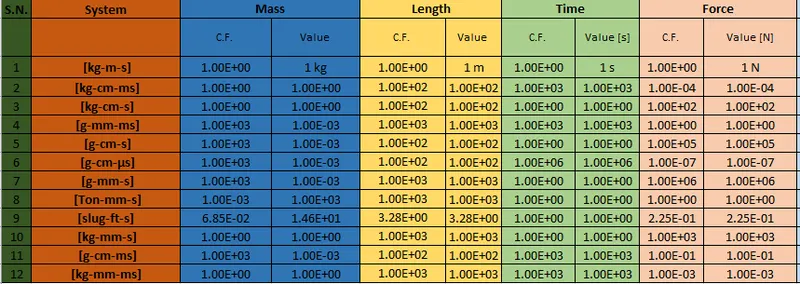
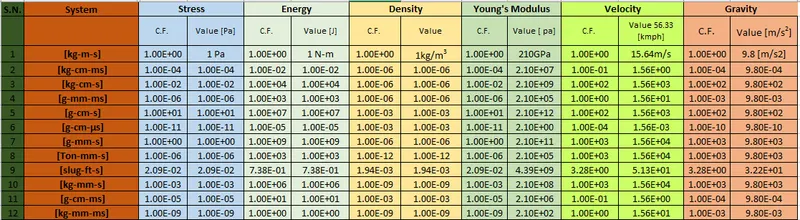
Table: conversion of measurements from SI to different systems.
The excel sheet is attached for reference.
Thank you.