Week 1 Challenge
1. What are different type of foundation in bridges and how selection of type is made?
Foundation transmits the load from the piers or abutments and wings to the ground. It ensures even load distribution on the strata. It should be deep enough to prevent scour caused by the flow in river.
There are two types of fo
undation according to their to breadth and depth.
- Shallow foundation(d ≤ b):
- Combined footing
- Mat footing
- Spread or Isolated footing
- Strip footing
- Strap or cantilever footing
- Deep foundation (d>b):
- Pile Foundation
- Well Foundation
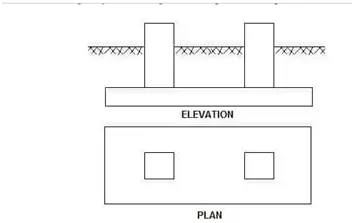
- Combined footing
A combined footing supports two columns. It is used when the two columns are so close to each other that their individual footings would overlap. A combined footing is also provided when the property line is so close to one column that a spread footing would be eccentrically loaded when kept entirely within the property line. By combining it with that of an interior column, the load is evenly distributed. A combined footing may be rectangular or trapezoidal in plan. footing:
2. Mat footing
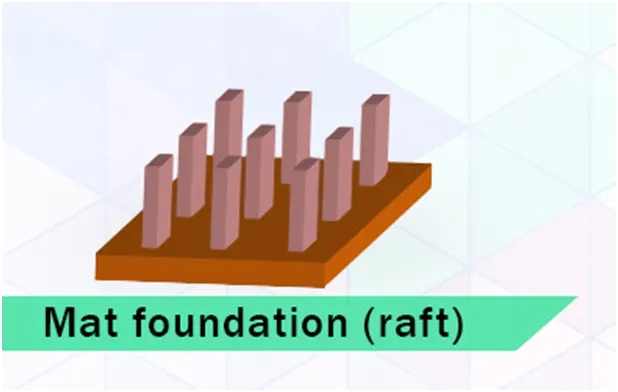
A mat or raft foundation is a large slab supporting a number of columns and walls under the entire structure or a large part of the structure. A mat is required when the allowable soil pressure is low or where the columns and walls are so close that individual footings would overlap or nearly touch each other. Mat foundations are useful in reducing the differential settlements on non-homogeneous soils or where there is a large variation in the loads on individual columns.
3. Spread or Isolated foundation
- A spread footing foundation has a wider bottom portion compared to a load-bearing foundation; the wider bottom "spreads" the weight of the structure over a larger area for greater stability.
- While traditional spot footings only have a single point of contact with the foundation, spread footings extend support continuously across the entire building layout.
- Spread footings are used to support a foundation or set of piers below a building.
- To add additional support, spread footings are constructed with concrete and reinforced with steel. Since spread footing transfers the weight of the building over a large area, spread footings have little risk of failure compared to spot footers.
- Spread footing extends the life of a building by minimizing structural damage. Footings must be designed to carry the column loads and transmit them to the soil safely.
- Spread footings may be circular, square, or rectangular.
- Spread footings are common in residential construction.
4. Strip footing
-
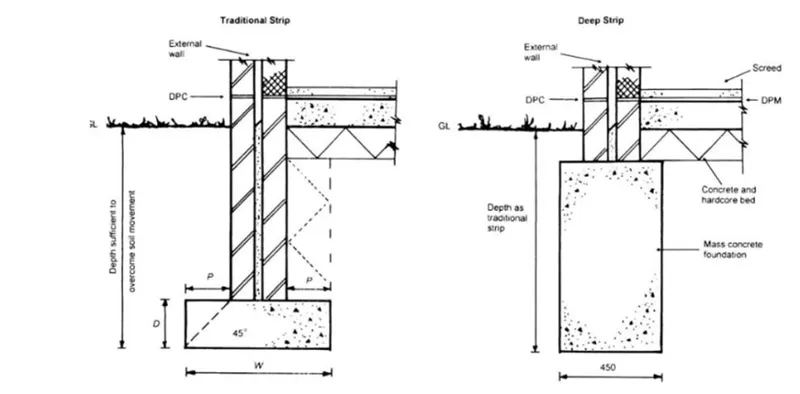
Strip foundations (or strip footings) are a type of shallow foundation that are used to provide a continuous, level (or sometimes stepped) strip of support for linear structures such as walls or closely-spaced rows of columns that are built on top of the foundation, placed centrally along their length.
5. Strap or cantilever footing
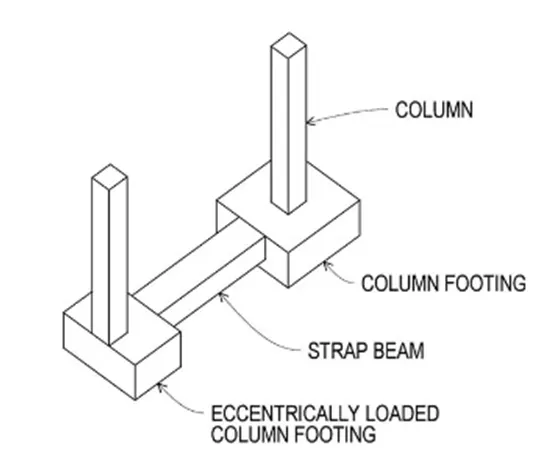
Strap footing is the type of footing constructed to connect the eccentrically loaded footing to interior column footing. Further, these types of footings can be identified as a combined footing as it connects two or more columns.
Strap footing is more common in building construction as we have to construct the building up to the boundary wall. We can not place our foundation in someone else land. Therefore, the column has to be placed at the edge of the footing. It creates load eccentricity.
To overcome this issue, a strap footing foundation is constructed and the induce bending moment and shear forces due to the eccentric load will be transferred to the interior column through the strap beam. There are special procedures to be followed in strap footing design which we discuss in the latter part of this article.
Also, it should be noted that these types of footings are considered as a type of spread footing.
- Pile foundation
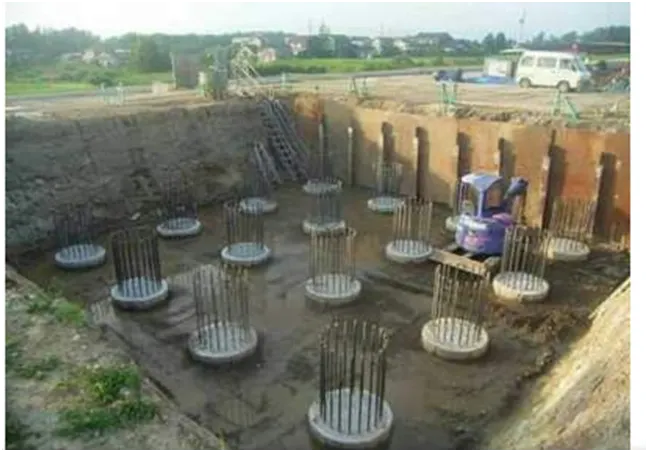
A Pile foundation, a kind of deep foundation, can be defined as a slender column or long cylinder made of materials such as concrete or steel which are used to support the structure and transfer the load at desired depth either by end bearing or skin friction.
- Well foundation:
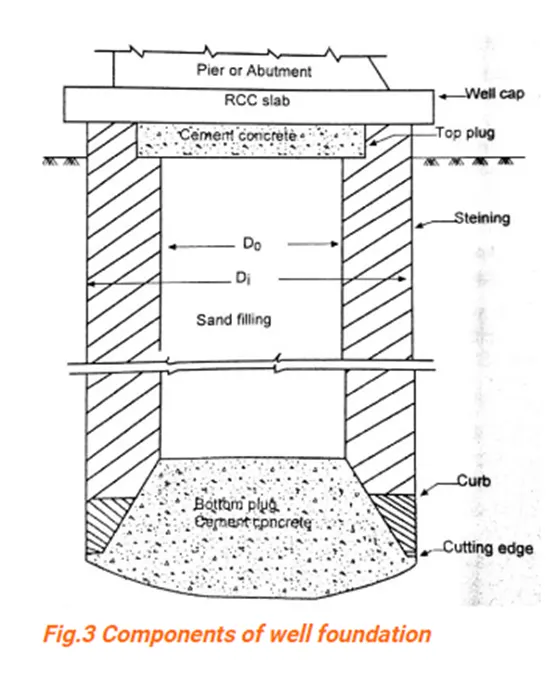
The well foundation is the most commonly adopted foundation for the major bridges. A well foundation is preferred to Pile foundation where the foundation has to resist large lateral forces, the river bed is prone to heavy score, heavy floating debris is expected during floods & where large boulders are embedded in the substrate.
2.Name all the components of a RCC girder bridge resting on open foundation.
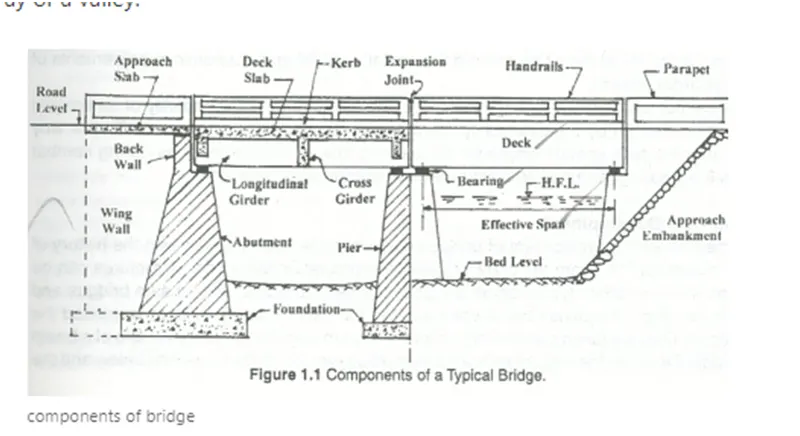
- Parapet wall
- Wearing coat
- Deck slab
- Girders
- Bearings
- Pedastals
- Pier Cap/Abutment cap
- Pier/Abutment
- Foundation
what additional effects it will create if we have seismic case 5,
The characteristics of seismic ground motion expected at any location depend upon the magnitude of earthquake, depth of focus, distance of epicenter and characteristics of the path through which the seismic wave travels. The random ground motion can be resolved in three mutually perpendicular directions. The components are considered to act simultaneously, but independently and their method of combination is described in Clause 218.4. Two horizontal components are taken as of equal magnitude, and vertical component is taken as two third of horizontal component.
In zones IV and V the effects of vertical components shall be considered for all elements of the bridge.
The effect of vertical component may be omitted for all elements in zones II and III, except for the following cases:
- a) prestressed concrete decks
- b) bearings and linkages
- c) horizontal cantilever structural elements
- d) for stability checks and
- e) bridges located in the ‘Near Field Regions’
b)3 span continuous bridge Position all the loads on the bridge having 12 m and 7.5 m carriageway transverse width with to the scale drawings.
Also mention all the clauses of IRC 6
|
Clause No's |
Discription |
|
201 |
Classification |
|
202 |
Loads, Forces and Load Effects |
|
203 |
Dead Load |
|
204 |
Live Loads |
|
205 |
Reduction in the Longitudinal Effect on Bridges Accommodating |
|
more than Two Traffic Lanes |
|
|
206 |
Foot Over Bridges, Footway, Kerb, Railings, Parapet and Crash Barriers |
|
207 |
Tramway Loading |
|
208 |
Impact |
|
209 |
Wind Load |
|
210 |
Horizontal Forces due to Water Currents |
|
211 |
Longitudinal Forces |
|
212 |
Centrifugal Forces |
|
213 |
Buoyancy |
|
214 |
Earth Pressure |
|
215 |
Temperature |
|
216 |
Secondary Effects |
|
217 |
Erection Effects and Construction Loads |
|
218 |
Guidelines for Seismic Design of Road Bridges |
|
219 |
Barge Impact on Bridges |
|
220 |
Snow Load |
|
221 |
Vehicle Collision Loads on Supports of Bridges, Flyover Supports |
|
and Foot over Bridges |
|
|
222 |
Indeterminate Structures and Composite Structures |
|
217 |
Erection Effects and Construction Loads |
|
218 |
Guidelines for Seismic Design of Road Bridges |
|
219 |
Barge Impact on Bridges |
|
220 |
Snow Load |
|
221 |
Vehicle Collision Loads on Supports of Bridges, Flyover Supports |
|
222 |
Indeterminate Structures and Composite Structures |
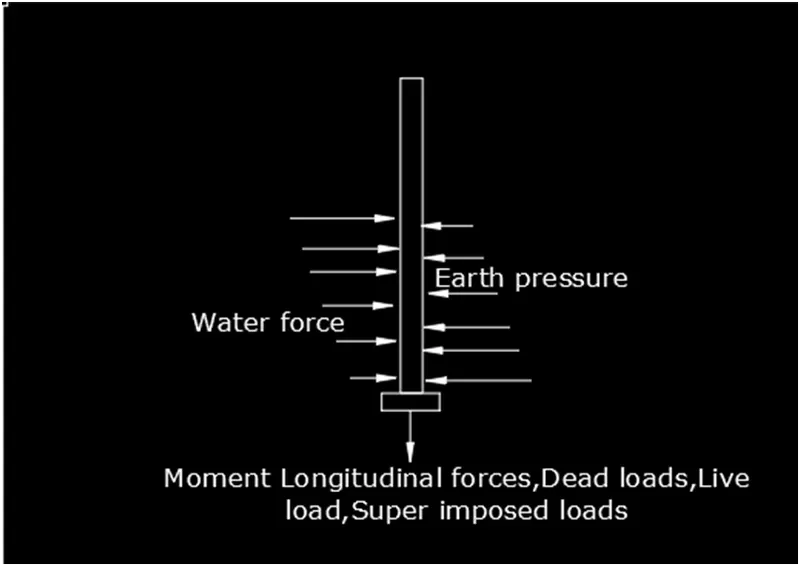
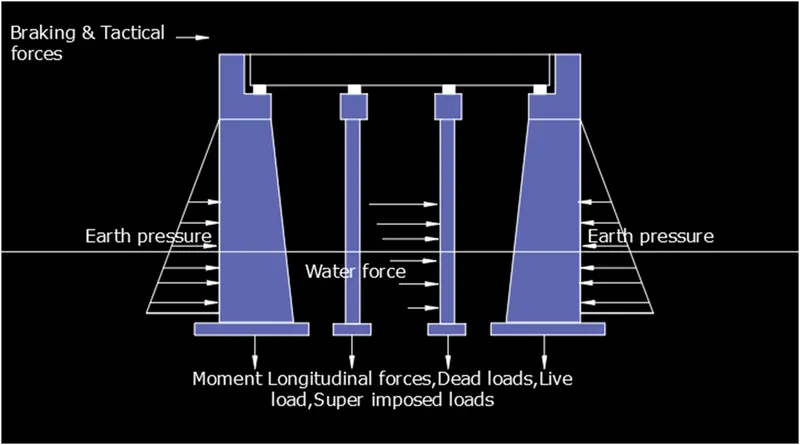
-What are the various forces acting on the shallow foundations. how they will be different in the case free pier, fix pier and abutment. Show a diagram and loads acting on it.
Show the distribution of forces in the footing afterwards due to the loadings.
(Note: Draw all the drawings to the scale and neatly)
- Various type of forces acting on a shallow foundation. The details has been described below.
List of forces to be considered while designing a shallow foundation are as follows:
- Dead loads: it includes weight of superstructure + (pier/abutment) + self weight of foundation.
- Live loads: The design live loads incase of railway bridges are considered as wagon load and For road bridges, the live loads may be specified via standard specifications and code of practice for road bridges i.e. IRC-6.
- Impact loads: The impact loads only in the case of live load shall be considered.
- Wind loads: No wind load effect.
- Water pressure: The water pressure due to water current is acted on the portions of substructure that lies between the HFL and the maximum scour level.
- Uplift Pressure: The uplife pressure in the bottom of the foundation due to presence of water table at shallow depth.
- Longitudinal forces: longitudinal forces results from tractive and braking forces. The longitudinal forces depend on the type of vehicles and bearing. These forces get transferred/transmitted into the substructure via fixed bearings and friction in movable bearings.
- Earth pressure: The earth pressure due to the the retained soil in abutment and the overburden soil has an major impact on the foundation. The overburden soil acts vertically and the retained soil pressure acts as laterally.
- Temperature stresses: The longitudinal forces are resulted because of the temperature changes.
- Seismic forces: seismic forces are vital when the foundations are constructed in seismic zones. The seismic forces act on every members the superstructure. These may act in any direction but generally assumed to act in one direction at a time.
Fixed Piers
Fixed piers support a fixed bearing and subjected both to transverse and longitudinal forces. In case of fixed piers, the structure at the bearing location is fixed so the moment is resisted. So moment will generate at that location due to the application of the above forces.
Free Piers
Free piers support free bearings and transfer only axial forces from the bearing to the foundations. In case of free piers due to free bearings it acts as a simply supported beam where no moment will generate only horizontal and vertocal movements are allowed.
Abutment
Abutment is the component of a bridge which supports earth pressure. In case of abutment all of above forces will act along with earth pressure which is predominant. Due to this their might have chance to overturn the structure. All these loads and forces generally acts on abutments of bridge.