Week 1 Challenge
1. Create a design summary report (DSR) for the following items for any highway you are aware of in your region. Mention the highway name, and location: -
- Category/Class of the road.
- The design speed of the road.
- Terrain classification.
- Travel Lane width.
- Typical min. cross slope.
- Horizontal curve radius without superelevation.
Name of the Road: Mumbai–Nagpur Expressway or Nagpur–Mumbai Super Communication Expressway (Maharashtra Samruddhi Mahamarg)
Category/ Class of the Road: Super Communication Expressway/ Greenfield road project
The design speed of the road: 150 km/hrs at plain terrain and 120 km/hrs at hilly terrain
Terrain classification: Plain & Hilly
Travel Lane width: 6-lane (expandable to 8)with paved and unpaved shoulders on both sides, with each lane width of 3.5m.
Total ROW Available: 120m (90m in hilly terrain) with a central median of 22.5m.
Typical min. cross slope: Minimum Cross Slope of 2.5% would have been adopted as per IRC SP 99
Horizontal curve radius without superelevation: Generally Maximum radius where no SE is needed for 150KMPH design Speed and min cross slope of 2.5% is 4000m
2 What is the typical roadway project life cycle workflow? List out in points. What is the typical roadway design workflow? Also, list out all the experts needed on a roadway project.
The parameters that are included in roadway project workflow are as follows
1. Design summary report
- Road Way (Name, length, Location, Limits)
- Type of work (New construction, Reconstruction, Realignment, Widening, Overlay, Milling)
- Class of roadway
- No. of the traffic lanes
- Lane width
- Shoulder width
- Median width
- Curb & gutter
- Bridge/culvert data
- Stream data
- Railroad & road crossings.
- Intersections
- Right of way
- Utilities
- Type of Terrain
2. Topographical survey
3. Typical sections
4. Geometric design
- Horizontal
- Vertical
- Design speed limit
- Maximum horizontal curve
- Maximum superelevation rate
- K-value (sag/crest)
- Max/min grade
5. Superelevation design
6. Plan set
• Multiple agencies are involved in roadway design projects.
- Survey
- Roadway
- Drainage
- Bridge/Structures
- Utilities
- Traffic
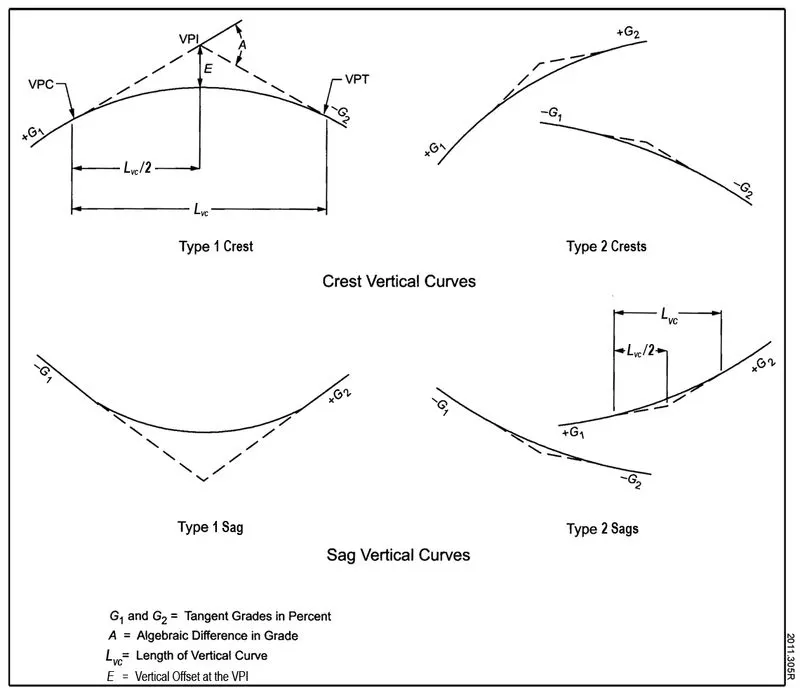
3. What are the important geometrical parameters of a horizontal alignment and vertical profile? When is a vertical curve needed? List the formula with a diagram for the vertical curve. List all types of vertical curves with the diagrams.
Parameters of a horizontal alignment and vertical profile
Horizontal Alignment
Basic elements of horizontal alignment:
- Curve Radius
- Superelevation Rate
- General Considerations:
- Safe, smooth, aesthetically pleasing facilities
Flatter curves
- Caution in using compound curves
- Avoiding compound curves in front of flat simple curves
Vertical Alignment
The curve between two lengths of a straight roadway that possess different gradients. The curve provides a gradual change for haulages from one inclination to the other. The curve leading to the top or brow of an inclined plane would be convex and at the bottom would be concave.
Basic elements of vertical alignment
- Grades
- Vertical curves
Vertical Curves provide gradual changes between tangents of different grades.
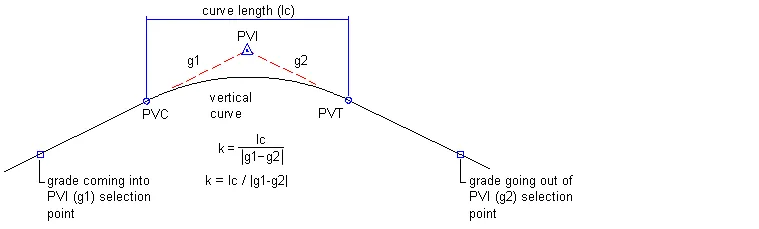
Types of Vertical Curves
Crest Curves
- Crest vertical curves are curves that connect inclined sections of roadway, forming a crest, and they are relatively easy to design. The principal control in the design of crest vertical curves is to ensure that minimum stopping sight distance (SSD) is available throughout the vertical curve.
Sag Curves
- Sag vertical curves are curves that connect descending grades, forming a bowl or a sag. Designing them is very similar to the design of crest vertical curves.
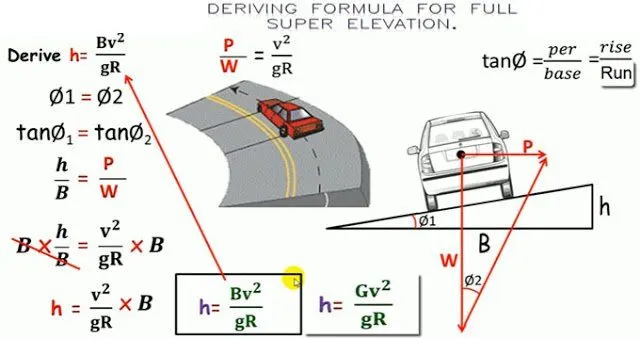
4. When is superelevation necessary? Show diagrammatical presentation of the super concept.
Superelevation or Banking of Road:-
When a vehicle travels in a circular path or curved path, it is subjected to an outward force which makes a vehicle overturn and skid due to Centrifugal force. To overcome this force and for the safe travel of a vehicle, the outer edge of the road is raised above the inner edge. This is known as superelevation or banking of road. SuperElevation / Banking of road reduces the effect of centrifugal force on the running wheels. If superelevation is not provided with the entire centripetal force is produced by the friction between the vehicle’s tires and the roadway, thus results in reduces the speed of a vehicle.
Advantages of providing Superelevation:-
- Superelevation is provided to achieve the higher speed of vehicles. It increases the stability of fast-moving vehicles when they pass through a horizontal curve, and it also decreases the stresses on the foundation.
- In the absence of superelevation on the road along curves, potholes are likely to occur at the outer edge of the road.
- The Indian road congress(IRC) has prescribed the max value of Super Elevation is 1 in 15.
5. List out the typical set of submissions needed for a roadway project.
The typical Set of submissions needed are
Plan Set
- Plan only
- Design cross-sections
- Traffic control plans
- Quantities
- Summary of quantities
Cover Sheet
- Traffic ADT
- Speed
- Approving authorities
- Submitting authority
- Any notes
Index Sheet
- Contents of the submission package
- General drawings
- Roadways drawings
- Traffic drawings
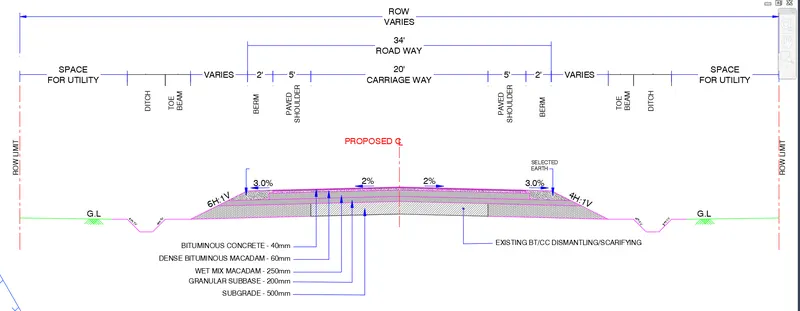
6. Draw a typical cross-section with the following parameters –
- 12’ travel lane
- 10’ shoulder lane
- 2% cross slope
- 2’ berm
- End conditions with cut/fill of 6:1 and 4:1
- Ditch condition of front slope 4:1, back slope 4:1, 3:1