Week 1 Challenge
Question 1:
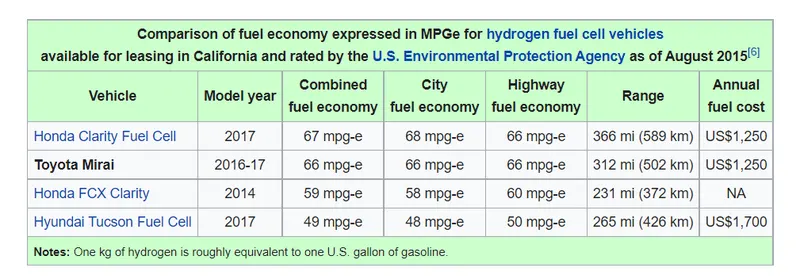
What were the first models of fuel cell vehicles developed in Asia, Europe and North America? What were the specifications of these vehicles? Compare them to the specifications of the current model.
ANSWER:-
A fuel cell vehicle (FCV) or fuel cell electric vehicle (FCEV) is an electric vehicle that uses a fuel cell, sometimes in combination with a small battery or supercapacitor, to power its onboard electric motor. Fuel cells in vehicles generate electricity generally using oxygen from the air and compressed hydrogen. Most fuel cell vehicles are classified as zero-emissions vehicles that emit only water and heat. As compared with internal combustion vehicles, hydrogen vehicles centralize pollutants at the site of the hydrogen production, where hydrogen is typically derived from reformed natural gas. Transporting and storing hydrogen may also create pollutants.
Fuel cells have been used in various kinds of vehicles including forklifts, especially in indoor applications where their clean emissions are important to air quality, and in space applications. The first commercially produced hydrogen fuel cell automobile, the Hyundai ix35 FCEV, was introduced in 2013, Toyota Mirai followed in 2015 and then Honda entered the market.
Fuel cells are being developed and tested in trucks, buses, boats, motorcycles and bicycles, among other kinds of vehicles. As of December 2020, 31,225 passenger FCEVS powered with hydrogen had been sold worldwide.South Korea is the country with the most passenger FCEVs (10,041 units), followed by the United States (9,135), China (5,546) and Japan (4,100). As of 2020, there was limited hydrogen infrastructure, with fewer than fifty hydrogen fueling stations for automobiles publicly available in the U.S., but more hydrogen stations are planned, particularly in California.Critics doubt whether hydrogen will be efficient or cost-effective for automobiles, as compared with other zero emission technologies, and in 2019,The Motley Fool opined "what is tough to dispute is that the hydrogen fuel cell dream is all but dead for the passenger vehicle market."
Hyundai ix35 FCEV
The Hyundai ix35 FCEV or Tucson FCEV is a hydrogen fuel cell electric vehicle developed by Hyundai. The model is a left-hand drive only conversion to the SUV platform it is based on and was the first of its type to be mass-produced and sold commercially in the world. Different versions are known, the previous version was based on the Hyundai Tuscon FCEV, and the upcoming model is based on the current ix35 FCEV. The first generation was introduced in 2001, with the Hyundai Santa Fe FCEV, and had a range of 100 miles (160 km), with a top speed of 78 mph (126 km/h).
The second generation Tucson FCEV was introduced in 2005, used a graphite bipolar plate and had a range of 186 miles (300 km), with a top speed of 93 mph (150 km/h). The third generation is based on the Hyundai ix35 (2009), production was semi automatic and used a metal bipolar plate.
The current version and fourth generation is the 2012 ix35 FCEV. The Tucson ix35 FCEV has a more powerful electric engine rated at 100 kW (134 horsepower), and a range of about 369 miles (594 km). This improvement in range is due in part to the Tucson ix35 FCEV's greater space for holding Hydrogen tanks of compresses hydrogen, higher storage pressure, as well as fuel cell technology advances.
The cars have made use of a "sandwich" design concept, aimed at maximizing room for both passengers and the propulsion components. The fuel cell is a proton exchange membrane fuel cell (PEMFC).
Toyota Mirai
The Toyota Mirai is a mid-size hydrogen fuel cell vehicle (FCV) manufactured by Toyota, and represents one of the first FCV automobiles to be mass produced and sold commercially. The Mirai was unveiled at the November 2014 Los Angeles Auto Show. As of December 2019, global sales totalled 10,250 Mirais. The top-selling markets were the U.S. with 6,200 units, Japan with 3,500 and Europe with 640.
Under the United States Enviromental Protection Agency (EPA) cycle, the 2016 model year Mirai has a total range of 502 km (312 mi) on a full tank, with a combined city/highway fuel economy rating of 66 mpg‑US (3.6 L/100 km; 79 mpg‑imp) equivalent (MPG-equivalent), making the Mirai the most fuel-efficient hydrogen fuel cell vehicle rated at the time by the EPA, and the one with the longest range. The Hyundai Nexo has since surpassed that.
Sales in Japan began on 15 December 2014 at ¥6.7 million (~US$57,400) at Toyota Store and Toyopet Store locations. The Japanese government plans to support the commercialization of fuel-cell vehicles with a subsidy of ¥2 million (~US$19,600). Retail sales in the U.S. began in August 2015 at a price of US$57,500 before any government incentives. Deliveries to retail customers began in California in October 2015. Toyota scheduled to release the Mirai in the Northeastern States in the first half of 2016. As of June 2016, the Mirai is available for retail sales in the UK, Denmark, Germany, Belgium, and Norway. Pricing in Germany starts at €60,000 (~US$75,140) plus VAT (€78,540).
Question 2:
Show the trend of cost in USD per kW of fuel cell production in the past and the prediction of the cost in the future. What are the probable reasons for the improvement?
ANSWER:-
The cost of fuel cell vehicles has been falling dramatically for years. And it will continue to drop within the next decade and beyond.
Even with limited production volume, the price of fuel cell vehicles—especially buses— has been reduced by 65% over the past 10 years.
What has driven this price reduction?
On the fuel cell itself, major gains to date have been driven by innovations in technology and product improvements. With decades of experience, Ballard has been able to deliver these gains in combination with industry leading durability and reliability.
An excellent example of this is Ballard’s eight generation fuel cell power module. The recently launched FCmove™ reduced product total life cycle costs by 35% compared to the previous generation. In fact, with each new generation, we’ve consistently reduced the cost by more than a third.
Additionally, there are a number of other elements that have contributed to the overall cost reduction of fuel cell electric vehicles including:
- Reduced price of the hydrogen storage tank
- Reduced price and improved integration of the vehicle’s electric powertrain
- Fuel cell-battery hybridization of the vehicle—combining a smaller fuel cell with lithium batteries, whose price has also been falling
What about total ownership costs for a commercial fuel cell vehicle?
Today, in certain locations, fuel cell electric buses offer a total cost of ownership (TCO) on par with battery electric buses. The buses in the H2Bus Project in Europe are among those with the lowest TCO for zero-emission vehicles in a number of regions.
Additionally, the recently published Deloitte-Ballard report, Fueling the Future of Mobility and the McKinsey study by the Hydrogen Council projected it will be less expensive to run a fuel cell vehicle than a battery or diesel vehicle within the next 10 years.
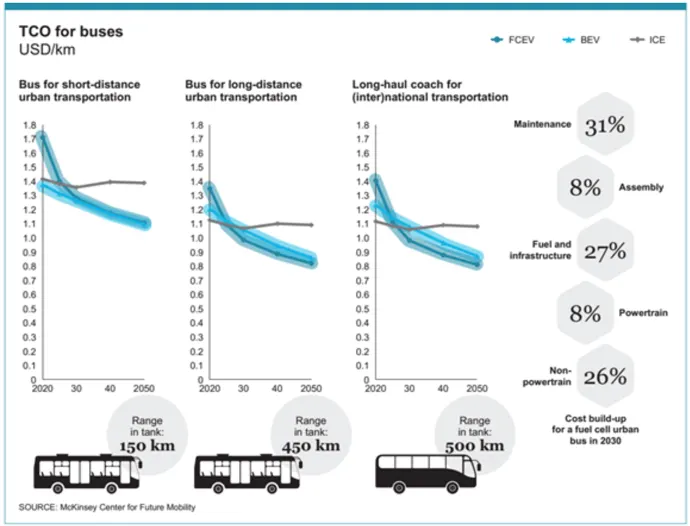
Looking at infrastructure costs, in the case of fuel cell electric buses, today’s higher vehicle purchase cost is offset by the lower cost of the refueling infrastructure at scale. For example, the infrastructure cost for fuel cell buses decreases as volume increases, as the hydrogen infrastructure can be shared by 100 buses or more at the same depot.
Conversely, as the number of deployed battery electric buses per depot increases, the cost of the infrastructure per vehicle also increases due to the need for more power.
Furthermore, the cost of hydrogen fuel is coming down. The production of low-cost renewable energy enables the production of green hydrogen at parity with the price of diesel in some regions.
Since 2010, the cost of electrolysis-produced hydrogen has fallen by 60%, from between USD $10-$15/kg of hydrogen to as low as USD $4-$6/kg today. Recent industry reports show that they will continue to fall; offshore wind-based electrolysis shows another 60% cost reduction from now until 2030.
How do production volumes play a role in fuel cell cost reduction?
According to the McKinsey Study, “a cost reduction of roughly 70-80% for fuel cell vehicles would be possible given an annual production volume of 150,000 vehicles".
Similar reductions could also be reached for the PEM stack and the fuel cell balance of plant. Manufacturers could capture significant fuel cell cost reductions of approximately 60-65% with even relatively small annual production volumes of 10,000 trucks per year.
This is in line with the Deloitte-Ballard report’s findings. We’re confident we can reduce the price of the fuel cell system to be competitive with diesel engines, and meet the US Department of Energy targets of less than $100/kW for annual production of over 150,000 systems/year.
Such cost reductions will be driven mainly by industrialization of the fuel cell system, because unlike batteries, fuel cells have a relatively low dependency on commodities. Instead, fuel cell systems are produced mainly from carbon, steel, and aluminum manufactured parts.