Vehicle Ride 2
GIVEN
Total weight = 1900kg
F/R distribution = 55% front
Unsprung mass in the front = 90kg
Unsprung mass in the rear = 60kg
SOLUTION
Total mass in the front = 55% of 1900 = 1045kg
Total mass in the rear = 1900-1045 = 855kg
Front sprung mass axle = Total mass in the front - unsprung mass in the front = 1045-90 = 955kg
Rear sprung mass axle = Total mass in the rear - unsprung mass in the rear = 855-60 = 795kg
Corner front sprung mass = 955/2 = 477.5kg
Corner rear sprung mass = 795/2 = 397.5kg
Corner front unsprung mass = 90/2 = 45kg
Corner rear unsprung mass = 60/2 = 30kg
FORMULA USED
Critical damping coefficient `c = 2 * sqrt(K*m)`
Ride rate for sprung mass `Kr = (Kt*Ks)/(Ks+Kt)`
Ride rate for unsprung mass `Ke=(Ks+Kt)`
Damping ratio D.R. = (Initial Damping coefficient)/(Critical Damping)
i. Sprung mass critical damping
Front:
Kr = (20*250)/(20+250) = 18.518N/mm
c = 2 sqrt(18518*477.5)
c = 5970.52 Ns/m
Rear:
Kr = (30*250)/(30+250) = 26.785 N/mm
c = 2 sqrt(26785*397.5)
c = 6495.1 Ns/m
ii. Unsprung mass critical damping
Front:
Ke = 20+250 = 270 N/mm
c = 2 sqrt(270000*45)
c = 6971.37 Ns/m
Rear:
Ke = 30+250 = 280 N/mm
c = 2 sqrt(280000*30)
c = 5796.55 Ns/m
iii. Sprung mass initial damping coefficient
Front:
Damping ratio = 0.7
Sprung mass initial damping coefficient = 0.7*5970.52
Sprung mass initial damping coefficient Front = 4179.36 Ns/m
Rear:
Damping ratio = 0.7
Sprung mass initial damping coefficient = 0.7*6495.1
Sprung mass initial damping coefficient Rear = 4546.57 Ns/m
iv. Unsprung mass initial damping coefficient
Front:
Damping ratio = 0.2
Unsprung mass initial damping coefficient = 0.2*6971.37
Unsprung mass initial damping coefficient Front = 1394.27 Ns/m
Rear:
Damping ratio = 0.2
Unsprung mass initial damping coefficient = 0.2*5796.55
Unsprung mass initial damping coefficient Rear = 1159.31 Ns/m
v. Low speed compression damping coefficient
Generally the compression damping coefficient is consiered to be half of the initial damping coefficient.
Low speed is constituted from the sprung mass of the vehicle.
Front:
For Sprung mass = 4179.36/2
Low speed compression damping coefficient (Front sprung mass) = 2089.68 Ns/m
Rear:
For sprung mass = 4546.57/2
Low speed compression damping coefficient (Rear Sprung mass) = 2273.28 Ns/m
vi. High speed compression damping coefficient
Generally the compression damping coefficient is consiered to be half of the initial damping coefficient.
High speed is constituted from the unsprung mass of the vehicle.
Front:
For unsprung mass = 1394.27/2
High speed compression damping coefficient (Front unsprung mass) = 697.13 Ns/m
Rear:
For unsprung mass = 1159.31/2
High speed compression damping coefficient (Rear unsprung mass) = 579.65 Ns/m
vii. Low speed rebound damping coefficient
Using the ratio between rebound and compression given in the question R/C = 3
Low speed is constituted from the sprung mass of the vehicle.
Front:
For sprung mass = 3*4179.36/2
Low speed rebound damping coefficient (Front sprung mass) = 6269.04 Ns/m
Rear:
For sprung mass = 3*4546.57/2
Low speed rebound damping coefficient (Rear sprung mass) = 6819.84 Ns/m
viii. High speed rebound damping coefficient
Using the ratio between rebound and compression given in the question R/C = 3
High speed is constituted from the unsprung mass of the vehicle.
Front:
For unsprung mass = 3*1394.27/2
High speed rebound damping coefficient (Front unsprung mass) = 2091.39 Ns/m
Rear:
For unsprung mass= 3*1159.31/2
High speed rebound damping coefficient (Rear unsprung mass) = 1738.95 Ns/m
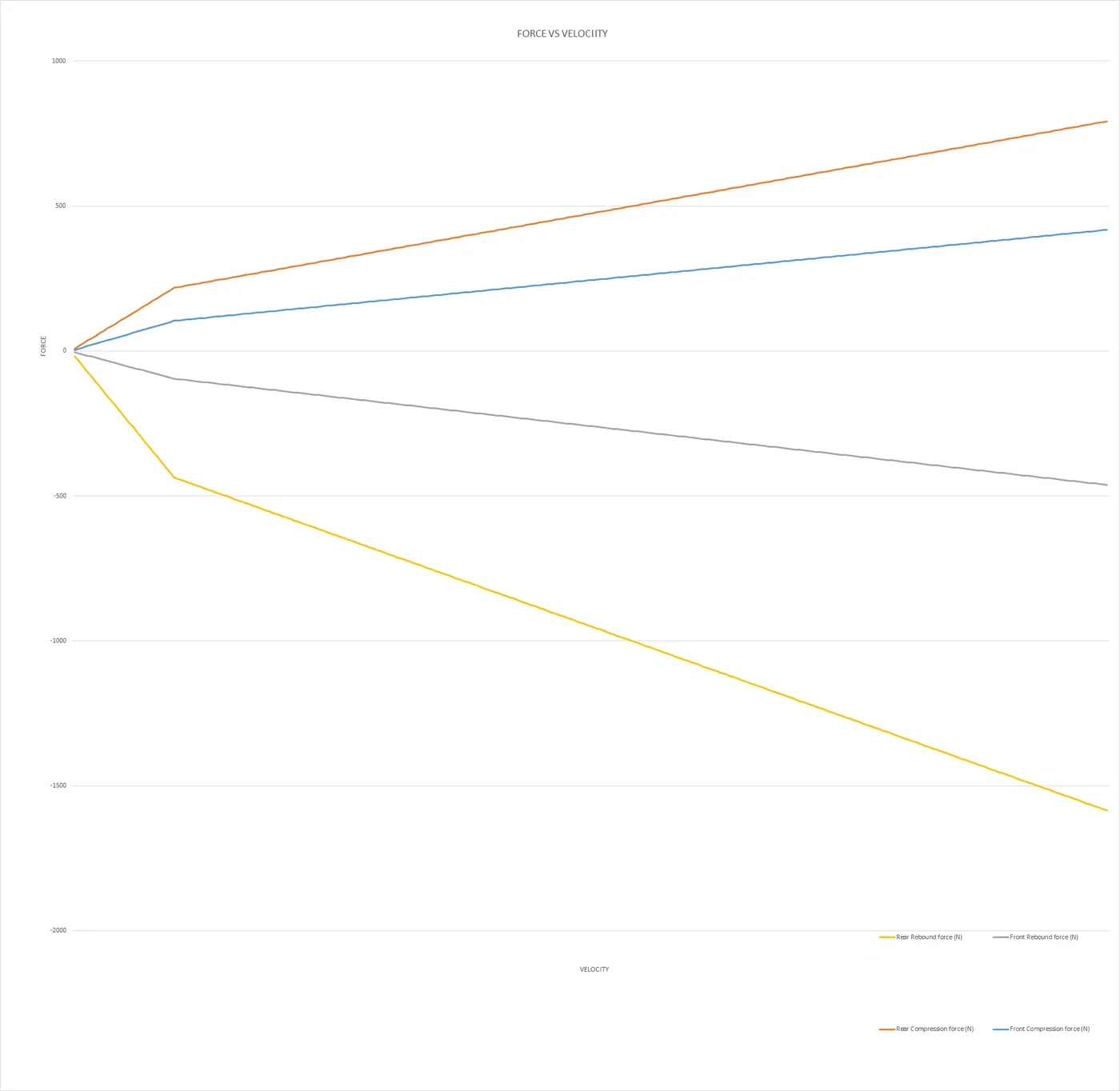
2. Force v Velocity graph 0<=v<=500mm/s
Check the attached file