Vehicle Ride 1
Given Data:
Front sprung masss natural frequency = 1.15Hz
Wheel base = 2700mm = 2.7m
Speed = 60mph = 26.8m/s
Solution:
Frequency = `1/(2pi)* sqrt((riderate)/(eachmass)`.....................(a)
consider design condition
sprung mass each corner = (1825-90-60)/4 = 418.75kg
using this mass in (a)
1.15= `1/(2pi)* sqrt((riderate)/(418.75)`
ride rate front = sqr(7.23)* 418.75 = 21889.3N/m
We know that
`ride rate (sprung mass) = (wheel rate * tire rate) / (wheel rate + tire rate)` .........(b)
21.89N/mm= (245*WR)/(WR+245)
We get (245-21.9)*WR = 5365.5
WR = 24.04N/mm
Using this wheel rate we can deduce the spring rate:
`Wheel rate = (Sprrate) * (motion ratio)^2` ..............(c)
From this we get Spring rate for front desgin condition = 24.04/sqr(0.97)
Spring rate for front desgin condition= 25.4N/mm ...........(iii)
Time lag between front and rear wheel
time taken = 2.7/26.8= 0.1s
Time at which rear wheel comes to the same position as the front wheel = (1/1.15)-0.1
= 0.769s which gives the rear sprung mass frequency
So the recommended rear sprung mass frequency based on the wheelbase and speed at design condition = 1.3Hz (reciprocal of 0.769s) ...............................(i)
Using the same method previously used in front sprung mass frequency
Using (a)
`1.3 = (1/(2pi)) sqrt((rear ride rate)/418.75)`
rear ride rate`= (8.16)^2*418.75`
Rear ride rate = 27.89N/mm
Using (b)
`27.89 = (WR* 245)/(WR+245)`
`WR = 6833.05/217.11`
Rear wheel rate = 31.47N/mm
Using (c)
Spring rate`=`31.47/(0.85)^2`
Rear spring rate = 43.55N/mm .........................(iv)
Consider curb condition (ride rate doesn't change)
using the same method
Sprung mass at each corner = `1/4(1500-90-60) = 337.5kg`
Front sprung mass natural frequency `= (1/2pi)sqrt(21800/337.5)`
Front sprung mass natural frequency = 1.27Hz .................(v)
Rear sprung mass natural frequency `= (1/2pi)sqrt(27890/337.5)`
Rear sprung mass natural frequency = 1.44Hz ....................(vi)
Consider GVW condition (ride rate doesn't change)
using the same method
sprung mass at each corner = `1/4(2000-90-60) = 462.5kg`
Front sprung mass natural frequency = `(1/2pi)sqrt(21800/462.5)`
Front sprung mass natural frequency = 1.092Hz .................(v)
Rear sprung mass natural frequency = `(1/2pi)sqrt(27890/462.5)`
Rear sprung mass natural frequency = 1.23Hz ....................(vi)
Unsprung mass natural frequency:
Unsprung mass ride rate front = 24.04+25.5 = 49.54 N/mm
Using this Front unsprung mass natural frequency
at design = at curb = at GVW =`(1/2pi)sqrt(49.54/(90/2))`
Front unsprung mass at design= curb= GVW = 10.561Hz.............(vii)
Unsprung mass ride rate rear = 31.47+43.55 = 75.02 N/mm
at design = at curb = at GVW = `(1/2pi)sqrt(75.02/(60/2))`
Rear unsprung mass at design= curb= GVW = 15.917Hz..................(viii)
Ratio of frequencies (rear/front)..............................(ix)
Sprung mass
Curb = 1.44/1.27 = 1.13
Design = 1.3/1.15 = 1.13
GVW = 1.23/1.092 = 1.13
Unsprung mass at design = at curb = at GVW = 15.917/10.561 = 1.5
-------------------------------------------------------------------------------------------------------------------------------------------------
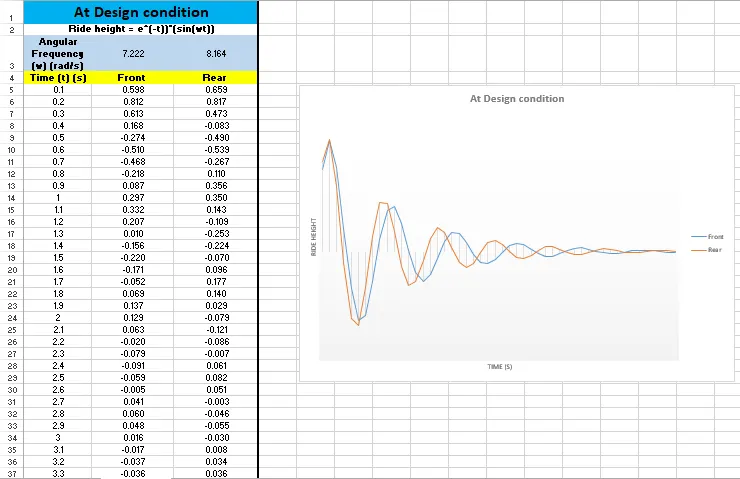
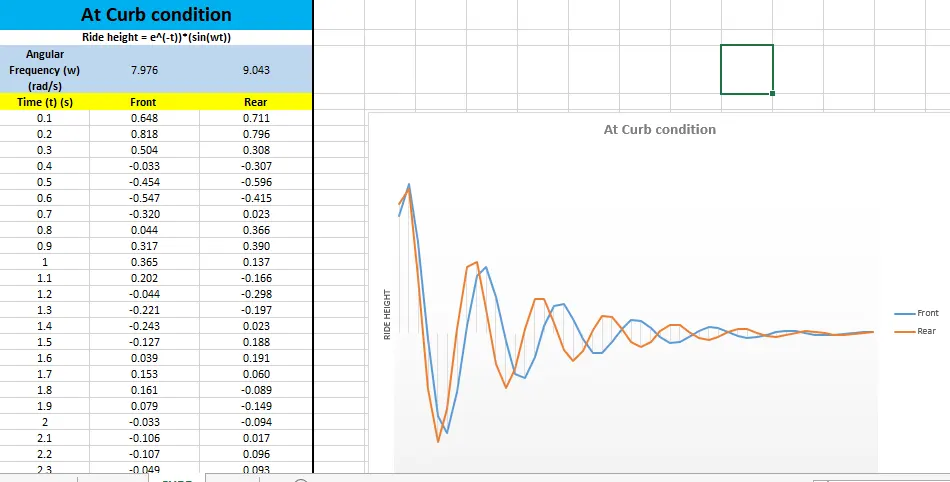
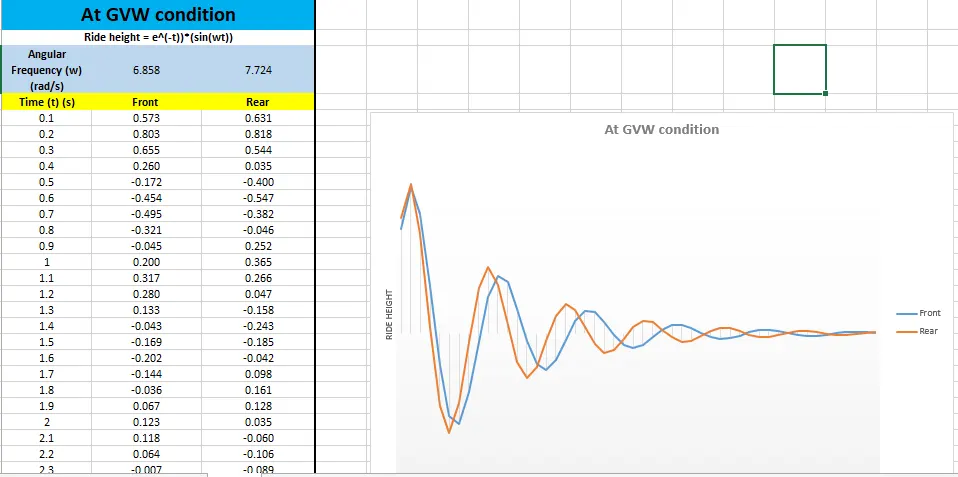
2. The plot is attached in the excel file attached here