Understanding the concepts on Degrees of Freedom
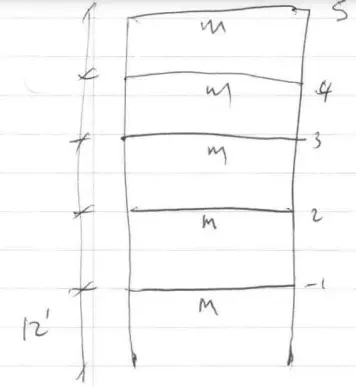
A five storey structure with 5 translational DOF is shown here. Each storey has mass ‘m’. The eigenvalue problem has been solved and the 5 periods of vibration Tn and their corresponding mode shapes, φn has been derived.
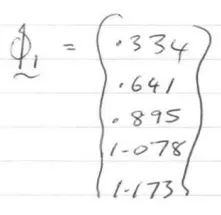
The fundamental period of vibration (T1 = 2 seconds) and its associated mode shape:
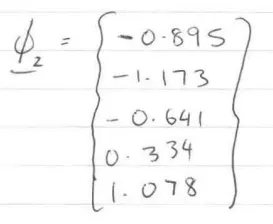
The second mode of vibration (T2 = 0.6852 seconds) and its associated mode shape:
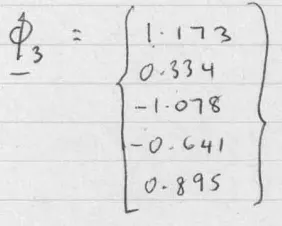
The third mode of vibration (T3 = 0.4346 seconds) and its associated mode shape:
The fourth mode of vibration (T4 = 0.3383 seconds) and its associated mode shape:
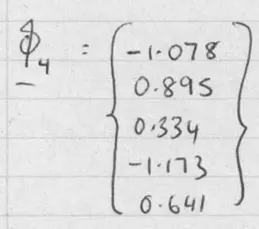
The fifth mode of vibration (T4 = 0.2966 seconds) and its associated mode shape:
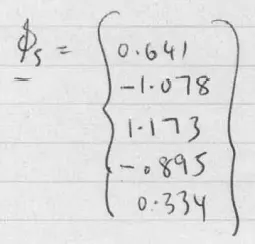
- Ln , Mn and Γn for each of the five modes are to be computed from Equations below.
- Also, calculate the effective modal mass Mn* and the modal mass participating ratio for the 5 modes. The mass matrix will be required to evaluate these parameters.

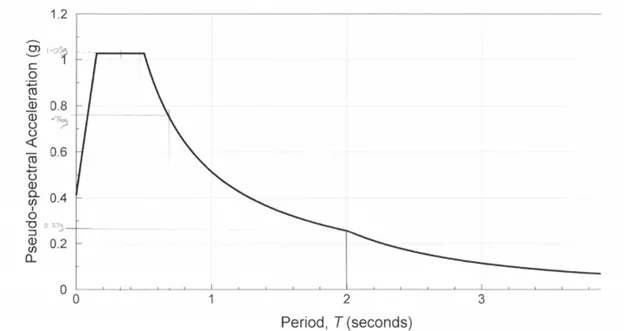
- Finally, obtain the base shear for each of the 5 modes of vibration and the combined base shear as per SRSS rule. The pseudo acceleration design spectrum to obtain the base shear for each mode is provided below.
- How many modes are to be considered such that a modal mass participating ratio of 90% is obtained?
Objective:
- To understand the modes shapes of multi-storey building.
- Manually calculate the base shear of multi-story building for model analysis
- Understand the terminologies involved in model analysis.
As given in question:
- Modes of the shapes (`underset(1)(phi)`,`underset(2)(phi)`,`underset(3)(phi)`,`underset(4)(phi)`,`underset(5)(phi)`)
- The elevation of the building
- We have 5-storey building and each storey has mass of “m”.
- Pseudo acceleration given in terms of g (for vertical loading we have gravitational acceleration), this graph is drawn against the time period t(seconds)
We have to calculate:
- Ln , Mn and Γn for each five modes
- Calculate the effective model mass Mn*
- Model mass participating ratio for five modes (mass matrix will be evaluated)
- Obtain the base shear for each 5 modes of vibration and the combined base shear as per SRSS rules (square root of sum of squares)
- How many modes are to be considered such that your model must participate in ratio of 90% is obtained?
considered mass in every floor as 'm'
forming mass matrix, m=`[[m,0,0,0,0],[0,m,0,0,0],[0,0,m,0,0],[0,0,0,m,0],[0,0,0,0,m]]`
modified mass matrix (M) =`phi n^T*m*phi n`
or the first mode, = `[[0.334,0.641,0.895,1.078,1.173]]``[[m,0,0,0,0],[0,m,0,0,0],[0,0,m,0,0],[0,0,0,m,0],[0,0,0,0,m]]``[[0.334],[0.641],[0.895],[1.078],[1.173]]`, (n=1)
M1=3.861m
Calculation of Model Property:
Model Property (L) = `phin^T*m*i`
where i = influence vector (assuming 100% utilization of seismic force) = `[[1],[1],[1],[1],[1]]`
for the first mode, = `[[0.334,0.641,0.895,1.078,1.173]]``[[m,0,0,0,0],[0,m,0,0,0],[0,0,m,0,0],[0,0,0,m,0],[0,0,0,0,m]]``[[1],[1],[1],[1],[1]]`, (n=1)
L1=4.121m
Calculation of participation factor:
model participation factor (`Gamma`) = `frac{L}{M}`
or the first mode, (`Gamma`) = `frac{L1}{M1}`, (n=1)
`Gamma1=frac{4.121m}{3.861m}`
`Gamma1 = 1.0167`
similarly,
`Gamma2 = -0.335`
`Gamma3 = 0.177`
`Gamma4 = -0.098`
`Gamma5 = 0.045`
Calculation of effective model mass:
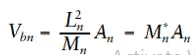
effective model mass (M*) = `frac{L n^2}{Mn}`
for the first mode, M1* = `frac{L1^2}{M1}`, (n=1)
M1* = `frac{(4.121m)^2}{3.861m}`
M1* = 4.398 m
similarly,
M2* = 0.436 m
M3* = 0.121 m
M4* = 0.038 m
M5* = 0.008 m
Calculation of model mass participation ratio:
Model mass participation ratio = `frac {Mn*}{mj}`
where, mj = total mass of the building = m+m+m+m+m = 5m
Model mass participation ratio of the first mode (n=1) = 4.398 m /5 m = 0.88
similarly,
second mode (n=2) = 0.09
third mode (n=3) = 0.02
fourth node (n=4) = 0.01
fifth node (n=5) = 0.002
As per requirement, adding first 2 mode mass participantion ratio and got 0.88+0.09 = 0.97
to achive minimum 90% of modal mass participation ratio, first 2 modes are enough
Calculating base shear:
Base shear (Vb) = Mn* . An
for the first mode, Vb1 = 4.398 m x 0.27, (n=1)
Vb1 = 1.187 mg
similarly,
Vb2 = 0.327 mg
Vb3 = 0.126 mg
Vb4 = 0.039 mg
Vb5 = 0.008 mg
Average base shear is calculated by the method of SRSS (Square root of sum of square)
`sqrt((Vb1)^2 + (Vb2)^2 + (Vb3)^2 + (Vb4)^2 + (Vb5)^2)`
Vb = 1.15 mg