Understanding the concepts on Degrees of Freedom
Q.1: - A five storey structure with 5 translational DOF is shown here. Each storey has mass ‘m’. The eigenvalue problem has been solved and the 5 periods of vibration Tn and their corresponding mode shapes, φn has been derived.
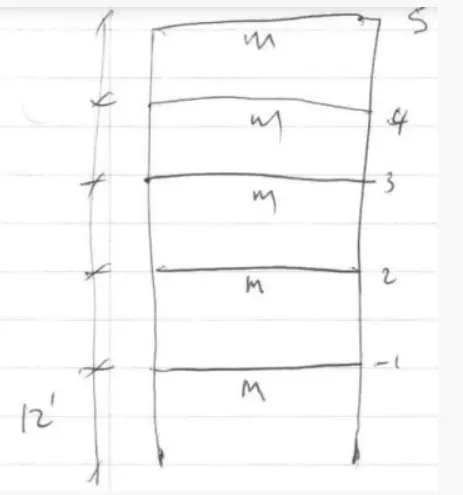
Solution:
(a) Modified Mass Matrix(M):
(i) For the first mode:
Where n=1
The fundamental period of vibration (T1 = 2 seconds) and its associated mode shape:
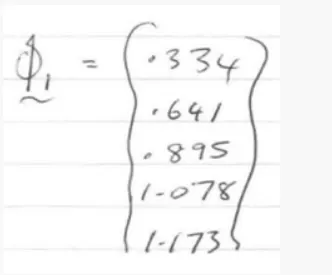
Modified Mass Matrix (Mn) = ϕnT×m×ϕnϕnT×m×ϕn
Mass Matrix (m) =
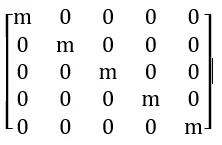
For the first mode (n) = 1
M1= [0.334 0.641 0.895 1.078 1.173]
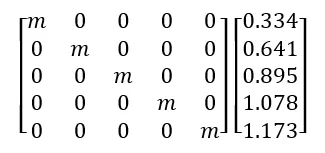
M1= 0.111+0.410+0.801+1.162+1.375
M1= 3.860m
(ii) For the second mode:
Where n = 2
The second mode of vibration (T2 = 0.6852 seconds) and its associated mode shape:
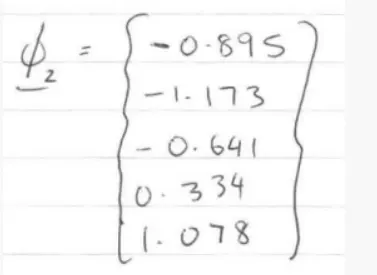
Modified Mass Matrix (Mn) = ϕnT×m×ϕnϕnT×m×ϕn
Mass Matrix (m) =
For the second mode (n) = 2
M2 = [-0.895 -1.173 -0.641 0.334 1.078]
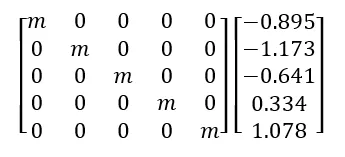
M2 = 0.801+1.375+0.410+0.111+1.16
M2 = 3.860
(iii) For the third mode:
Where n = 3
The third mode of vibration (T3 = 0.4346 seconds) and its associated mode shape:
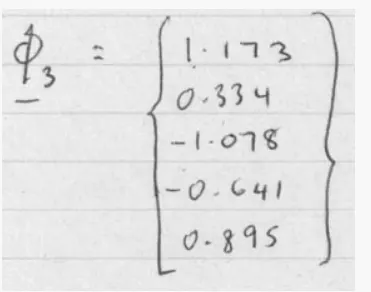
Modified Mass Matrix (Mn) = ϕnT×m×ϕnϕnT×m×ϕn
Mass Matrix (m) =
For the third mode (n) = 3
M3 = [1.173 0.334 -1.078 -0.641 0.895]
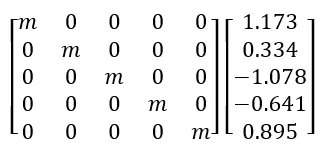
M3 = 1.375+0.111+1.162+0.410+0.801
M3 = 3.860m
(iv) For the fourth mode:
Where n = 4
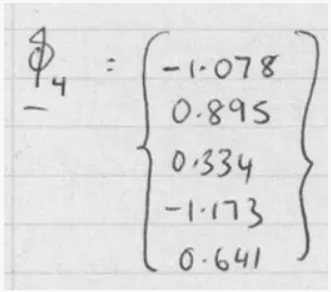
The fourth mode of vibration (T4 = 0.3383 seconds) and its associated mode shape:
Modified Mass Matrix (Mn) = ϕnT×m×ϕnϕnT×m×ϕn
Mass Matrix (m) =
For the fourth mode (n) = 4
M4 = [-1.078 0.895 0.334 -1.173 0.641]
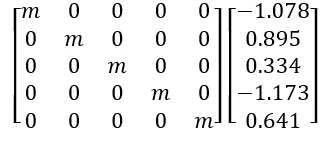
M4 = 1.162+0.801+0.111+1.375+0.410
M4 = 3.860m
(v) For the fifth mode:
Where n = 5
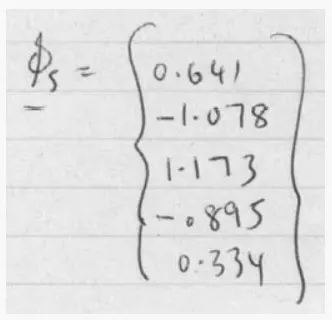
The fifth mode of vibration (T4 = 0.2966 seconds) and its associated mode shape:
Modified Mass Matrix (Mn) = ϕnT×m×ϕnϕnT×m×ϕn
Mass Matrix (m) =
For the fifth mode (n) = 5
M5 = [0.641 -1.078 1.173 -0.895 0.334]
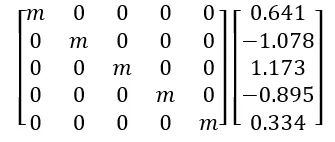
M5 = 0.410+1.162+1.375+0.801+0.111
M5 = 3.860m
(b) Modal Property (Ln):
(i) For the first mode:
Where n = 1
∴Modal Property (Ln) = ϕnT×m×ιϕnT×m×ι
where ι = Influence factor =
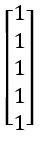
For the first mode (n) = 1
L1 = [0.334 0.641 0.895 1.078 1.173]
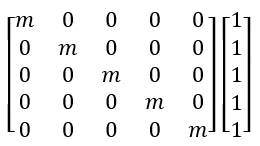
L1 = 0.334+0.641+0.895+1.078+1.173
L1 = 4.121m
(ii) For the second mode:
Where n = 2
∴Modal Property (Ln) = ϕnT×m×ιϕnT×m×ι
where ι = Influence factor =
For the second mode (n) = 2
L2 = [-0.895 -1.173 -0.641 0.334 1.078]
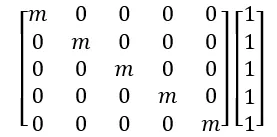
L2 = [0.895]+[-1.173]+[-0.641]+[0.334]+[1.078]
L2 = -1.297m
(iii) For the third mode:
Where n = 3
∴Modal Property (Ln) = ϕnT×m×ιϕnT×m×ι
where ι = Influence factor =
For the third mode (n) = 3
L3 = [1.173 0.334 -1.078 -0.641 0.895]
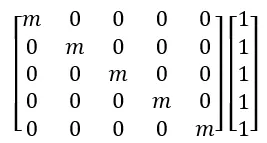
L3 = [1.173]+[0.334]+[-1.078]+[-0.641]+[0.895]
L3 = 0.683m
(iv) For the fourth mode:
Where n = 4
∴Modal Property (Ln) = ϕnT×m×ιϕnT×m×ι
where ι = Influence factor =
For the fourth mode (n) = 4
L4 = [-1.078 0.895 0.334 -1.173 0.641]
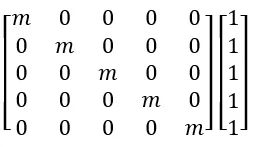
L4 = [-1.078]+[0.895]+[0.334]+[-1.173]+[0.641]
L4 = -0.381m.
(v) For the fifth mode:
Where n = 5
∴Modal Property (Ln) = ϕnT×m×ιϕnT×m×ι
where ι = Influence factor =
For the fifth mode (n) = 5
L5 = [0.641 -1.078 1.173 -0.895 0.334]
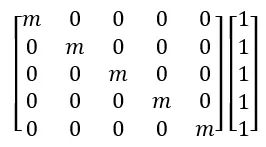
L5 = [0.641]+[-1.078]+[1.173]+[-0.895]+[0.334]
L5 = 0.175m
(c) Modal Participation Factor (Γn):
(i) For the first mode:
Where n = 1
∴Modal Participation Factor (Γn) = Ln/Mn
For the first mode (n) = 1
Γ1 = L1/M1
Γ1 = 4.121m/3.860m
Γ1 = 1.067
(ii) For the second mode:
Where n = 2
∴Modal Participation Factor( Γn ) = Ln/Mn
For the first mode (n) = 2
Γ2 = L2/M2
Γ2 = −1.297m/3.860m
Γ2 = -0.335
(iii) For the third mode:
Where n = 3
∴Modal Participation Factor (Γn) = Ln/Mn
For the first mode (n) = 3
Γ3 = L3/M3
Γ3 = 0.683m/3.860m
Γ3 = 0.177
(iv) For the fourth mode:
Where n = 4
∴Modal Participation Factor (Γn) = Ln/Mn
For the first mode (n) = 4
Γ4 = L4/M4
Γ4 = −0.381m/3.860m
Γ4 = -0.098
(iv) For the fifth mode:
Where n = 5
∴Modal Participation Factor(Γn) = Ln/Mn
For the first mode (n) = 5
Γ5 = L5/M5
Γ5 = −0.175m/3.860m
Γ5 = 0.045
(d) Effective Modal Mass (M*):
(i) For the first mode:
Where n = 1
∴Effective Modal Mass (M*) = Ln2/Mn
M1* = L12/M1
M1* = (4.121m)2/3.860m
M1* = 4.398m
(ii) For the second mode:
Where n = 2
∴Effective Modal Mass (M*) = Ln2/Mn
M2* = L22/M2
M2* = (−1.297m)2/3.860m
M2* = 0.435m
(iii) For the third mode:
Where n = 3
∴Effective Modal Mass (M*) = Ln2/Mn
M3* = L32/M3
M3* = (0.683m)2/3.860m
M3* = 0.121m
(iv) For the fourth mode:
Where n = 4
∴Effective Modal Mass (M*) = Ln2/Mn
M4* = L42/M4
M4* = (−0.381m)2/3.860m
M4* = 0.038m
(v) For the fifth mode:
Where n = 5
∴Effective Modal Mass (M*) = Ln2/Mn
M5* = L52/M5
M5* = (0.175m)2/3.860m
M5* = 0.008m
(e) Modal Mass Participation Ratio:
(i) For the first mode:
Where n = 1
Modal Mass Participation Ratio = Mn*/mj
Whereas mj = Total mass of the building.
mj = m+m+m+m+m
mj = 5m
Modal Mass Participation Ratio = Mn*/mj
Modal Mass Participation Ratio(n) = Mn*/mj
= M1*/mj
Modal Mass Participation Ratio (1) = 4.398m/5m
Modal Mass Participation Ratio (1) = 0.879
(ii) For the second mode:
Where n = 2
Modal Mass Participation Ratio = Mn*/mj
Whereas mj = Total mass of the building.
mj = m+m+m+m+m
mj = 5m.
Modal Mass Participation Ratio = Mn*/mj
For the second mode (n) = 2
Modal Mass Participation Ratio (n) = Mn*/mj
= M2*/mj
Modal Mass Participation Ratio (2) = 0.435m/5m
Modal Mass Participation Ratio (2) = 0.087
(iii) For the third mode:
Where n = 3
Modal Mass Participation Ratio = Mn*/mj
Whereas mj = Total mass of the building.
mj = m+m+m+m+m
mj = 5m.
Modal Mass Participation Ratio = Mn*/mj
For the third mode (n) = 3
Modal Mass Participation Ratio (n) = Mn*/mj
= M3*/mj
Modal Mass Participation Ratio (3) = 0.121m/5m
Modal Mass Participation Ratio (3) = 0.024
(iv) For the fourth mode:
Where n = 4
Modal Mass Participation Ratio = Mn*/mj
Whereas mj = Total mass of the building.
mj = m+m+m+m+m
mj = 5m.
Modal Mass Participation Ratio = Mn*/mj
For the fourth mode (n) = 4
Modal Mass Participation Ratio (n) = Mn*/mj
= M4*/mj
Modal Mass Participation Ratio (4) = 0.038m/5m
Modal Mass Participation Ratio (4) = 0.007
(v) For the fifth mode:
Where n = 5
Modal Mass Participation Ratio = Mn*/mj
Whereas mj = Total mass of the building.
mj = m+m+m+m+m
mj = 5m.
Modal Mass Participation Ratio = Mn*/mj
For the fifth mode (n) = 5
Modal Mass Participation Ratio (n) = Mn*/mj
= M5*/mj
Modal Mass Participation Ratio (5) = 0.008m/5m
Modal Mass Participation Ratio (5) = 0.001
Now we can verify the total mass of the building by adding all the effective modal mass:
Total mass of the building = m+m+m+m+m
= 5m
Whereas the total of the effective total mass is:
= 4.398+0.435+0.121+0.038+0.008
= 5
Hence the total of the effective modal mass = 5
whereas the total mass of the building = 5
Hence O.K.
Now we will be adding the first two mode of the mass participation ratio i.e.; (0.879,0.087)
= 0.879+0.087
= 0.966
= 96.66 %
So in order to achieve the minimum 90% of the modal mass participation ratio, first two modes are enough.
(f) Base Shear (VB):
Base Shear (VB) = Mn*. An
So from the given pseudo-acceleration design spectrum graph, we will be able to find the value of An. The pseudo-acceleration design spectrum graph is given below:
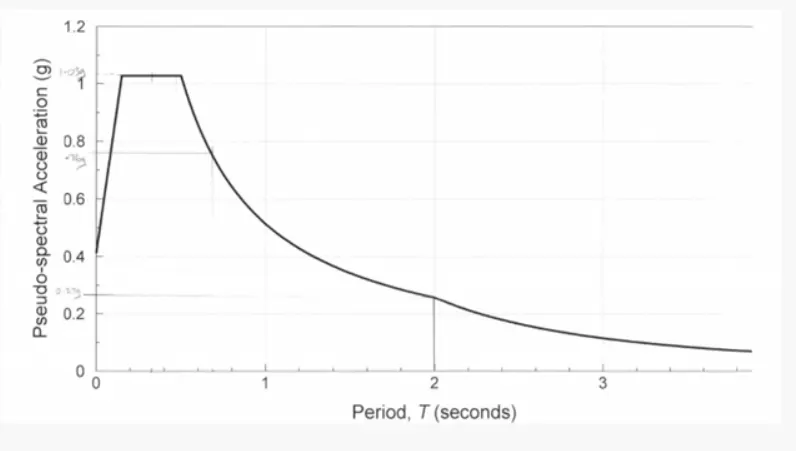
So, for T1:
A1 = 0.27g
For T2:
A2 = 0.76
For T3:
A3 = 1.03
For T4:
A4 = 1.03`
For T5:
A5 = 1.03
(i) For the first mode:
Where n = 1
Base Shear (VB) = Mn*. An
VB1 = M1*.A1
VB1 = 4.398m×0.27g
VB1 = 1.187mg
(ii) For the second mode:
Where n = 2
Base Shear (VB) = Mn*. An
VB2 = M2*.A2
VB2 = 0.435m×0.76g
VB2 = 0.330mg
(iii) For the third mode:
Where n = 3
Base Shear (VB) = Mn*. An
VB3 = M3*.A3
VB3 = 0.121m×1.03g
VB3 = 0.124mg
(iv) For the fourth mode:
Where n = 4
Base Shear (VB) = Mn*. An
VB4 = M4*.A4
VB4 = 0.038m×1.03g
VB4 = 0.039mg
(v) For the fifth mode:
Where n = 5
Base Shear (VB) = Mn*. An
VB5 = M5*.A5
VB5 = 0.008m×1.03g
VB5 = 0.008mg
(f) Average Base Shear (VB):
We can calculate the average base shear by the method of square root of sum of square.
∴ Average Base Shear (VB) = √VB1²+VB2²+VB3²+VB4²+VB5²
= √1.187²+0.330²+0.124²+0.039²+0.008²
Average Base Shear (VB) = 1.23mg