Understanding the concepts on Degrees of Freedom
Question 1:
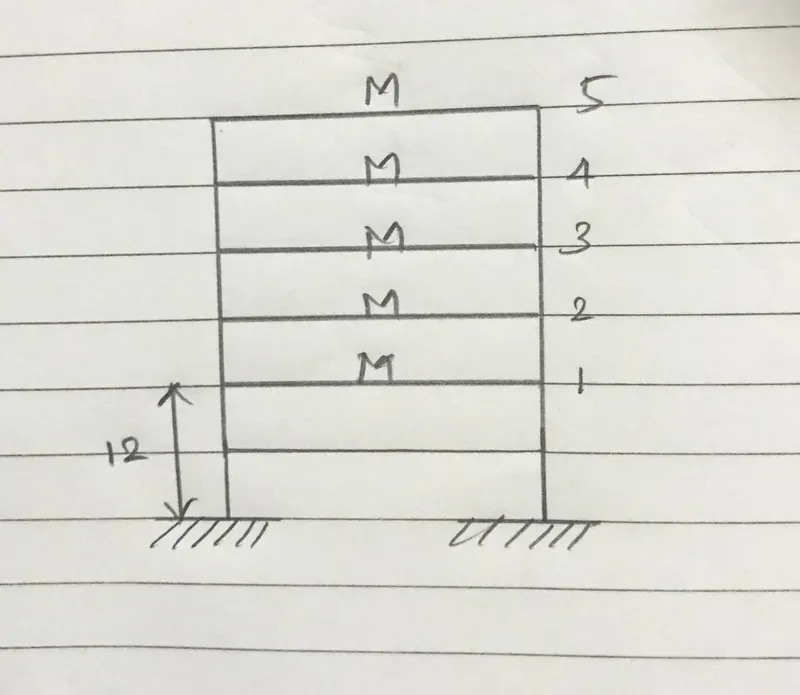
A five storey structure with 5 translational DOF is shown here. Each storey has mass ‘m’. The eigenvalue problem has been solved and the 5 periods of vibration Tn and their corresponding mode shapes, φn has been derived.
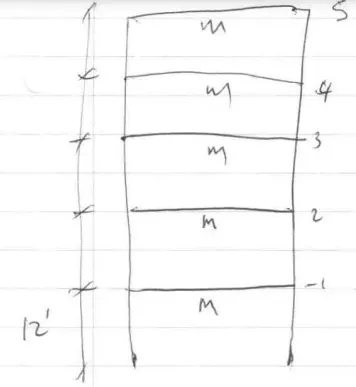
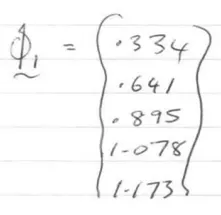
The fundamental period of vibration (T1 = 2 seconds) and its associated mode shape:
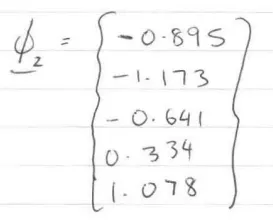
The second mode of vibration (T2 = 0.6852 seconds) and its associated mode shape:
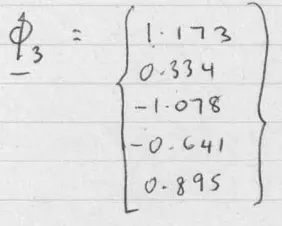
The third mode of vibration (T3 = 0.4346 seconds) and its associated mode shape:
The fourth mode of vibration (T4 = 0.3383 seconds) and its associated mode shape:
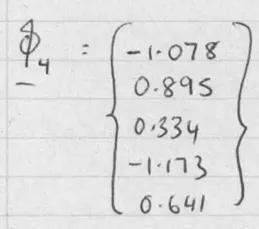
The fifth mode of vibration (T4 = 0.2966 seconds) and its associated mode shape:
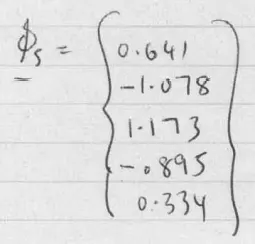
- Ln , Mn and Γn for each of the five modes are to be computed from Equations below.
- Also, calculate the effective modal mass Mn* and the modal mass participating ratio for the 5 modes. The mass matrix will be required to evaluate these parameters.

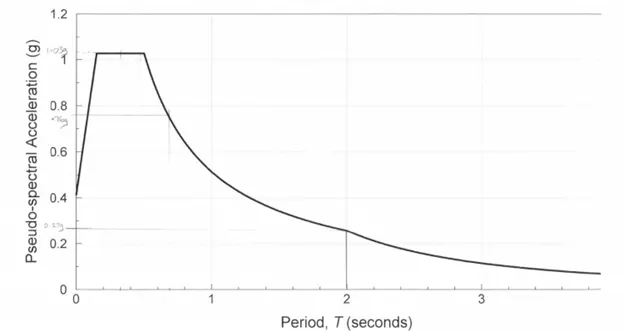
- Finally, obtain the base shear for each of the 5 modes of vibration and the combined base shear as per SRSS rule. The pseudo acceleration design spectrum to obtain the base shear for each mode is provided below.
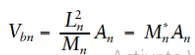
- How many modes are to be considered such that a modal mass participating ratio of 90% is obtained?
Aim:
- To find the Ln , Mn and Γn for each of the five modes are to be computed from Equations.
- And calculate the effective modal mass Mn* and the modal mass participating ratio for the 5 modes.
Solution:
Step I :
Mode 1:
`underset (n) M = phi^T m underset (n)phi`
First mode vibration `( underset (1) T )`= 2 Seconds
`underset (1) phi = [ [0.334], [0.64], [0.895], [1.078], [1.173] ]`
`underset (1) M = underset (1) phi ^ T m underset (1) phi`
`= [0.334, 0.641, 0.895, 1.078, 1.173] [[M, 0, 0, 0, 0], [0, M, 0, 0, 0], [0, 0, M, 0, 0], [0, 0, 0, M, 0], [0, 0, 0, 0, M]] [[0.334], [0.641], [0.895], [1.078], [1.173]]`
Therefore,
`underset (1) M = 3.861M`
Mode 2:
The second mode vibration `(underset (2) T)`= 0.6852 Seconds
`underset (2) phi = [ [-0.895], [-1.173], [-0.641], [0.334], [1.078] ]`
`underset (2) M = underset (2) phi ^ T m underset (2) phi`
`= [-0.895, -1.173, -0.641, 0.334, 1.078] [[M, 0, 0, 0, 0], [0, M, 0, 0, 0], [0, 0, M, 0, 0], [0, 0, 0, M, 0], [0, 0, 0, 0, M]] [[-0.895], [-1.173], [-0.641], [0.334], [1.078]]`
Therefore,
`underset (2) M = 3.861M`
Mode 3:
The Third mode vibration `(underset (3) T)` = 0.4346 Seconds`
`underset (3) phi = [ [1.173], [0.334], [-1.078], [-0.641], [0.895] ]`
`= [1.173, 0.334, -1.078, -0.641, 0.895] [[M, 0, 0, 0, 0], [0, M, 0, 0, 0], [0, 0, M, 0, 0], [0, 0, 0, M, 0], [0, 0, 0, 0, M]] [[1.173], [0.334], [-1.078], [-0.641], [0.895]]`
Therefore,
`underset (3) M = 3.86M`
Mode 4:
The fourth mode vibration `(underset (4) T)` = 0.3383 Seconds`
`underset (4) phi = [ [-1.078], [0.895], [0.334], [-1.173], [0.641] ]`
`= [-1.078, 0.895, 0.334, -1.173, 0.641] [[M, 0, 0, 0, 0], [0, M, 0, 0, 0], [0, 0, M, 0, 0], [0, 0, 0, M, 0], [0, 0, 0, 0, M]] [[-1.078], [0.895], [0.334], [-1.173], [0.641]]`
Therefore,
`underset (4) M = 3.861M`
Mode 5:
The fifth mode vibration `(underset (5) T)` = 0.2966 Seconds`
`underset (5) phi = [ [0.641], [-1.078], [1.173], [-0.895], [0.334] ]`
`= [-0.641, -1.078, 1.173, -0.895, 0.334] [[M, 0, 0, 0, 0], [0, M, 0, 0, 0], [0, 0, M, 0, 0], [0, 0, 0, M, 0], [0, 0, 0, 0, M]] [[-0.641], [-1.078], [1.173], [-0.895], [0.334]]`
Therefore,
`underset (5) M = 3.861M`
Step II:
Mode 1:
`underset (n) L = underset (n) phi^T m iota`
First mode vibration `( underset (1) T )`= 2 Seconds
`underset (1) phi = [ [0.334], [0.64], [0.895], [1.078], [1.173] ]`
`underset (1) L = underset (1) phi ^ T m iota`
`= [0.334, 0.641, 0.895, 1.078, 1.173] [[M, 0, 0, 0, 0], [0, M, 0, 0, 0], [0, 0, M, 0, 0], [0, 0, 0, M, 0], [0, 0, 0, 0, M]] [[1], [1], [1], [1], [1]]`
Therefore,
`underset (1) L = 4.121M`
Mode 2:
The second mode vibration `(underset (2) T)`= 0.6852 Seconds
`underset (2) phi = [ [-0.895], [-1.173], [-0.641], [0.334], [1.078] ]`
`underset (2) L = underset (2) phi ^ T m iota`
`= [-0.895, -1.173, -0.641, 0.334, 1.078] [[M, 0, 0, 0, 0], [0, M, 0, 0, 0], [0, 0, M, 0, 0], [0, 0, 0, M, 0], [0, 0, 0, 0, M]] [[1], [1], [1], [1], [1]]`
Therefore,
`underset (2) L = -1.298M`
Mode 3:
The Third mode vibration `(underset (3) T)` = 0.4346 Seconds`
`underset (3) phi = [ [1.173], [0.334], [-1.078], [-0.641], [0.895] ]`
`underset (3) L = underset (3) phi ^ T m iota`
`= [1.173, 0.334, -1.078, -0.641, 0.895] [[M, 0, 0, 0, 0], [0, M, 0, 0, 0], [0, 0, M, 0, 0], [0, 0, 0, M, 0], [0, 0, 0, 0, M]] [[1], [1], [1], [1], [1]]`
Therefore,
`underset (3) L = 0.687M`
Mode 4:
The fourth mode vibration `(underset (4) T)` = 0.3383 Seconds`
`underset (4) phi = [ [-1.078], [0.895], [0.334], [-1.173], [0.641] ]`
`underset (4) L = underset (4) phi ^ T m iota`
`= [-1.078, 0.895, 0.334, -1.173, 0.641] [[M, 0, 0, 0, 0], [0, M, 0, 0, 0], [0, 0, M, 0, 0], [0, 0, 0, M, 0], [0, 0, 0, 0, M]] [[1], [1], [1], [1], [1]]`
Therefore,
`underset (4) L = -0.381M`
Mode 5:
The fifth mode vibration `(underset (5) T)` = 0.2966 Seconds`
`underset (5) phi = [ [0.641], [-1.078], [1.173], [-0.895], [0.334] ]`
`underset (5) L = underset (5) phi ^ T m iota`
`= [-0.641, -1.078, 1.173, -0.895, 0.334] [[M, 0, 0, 0, 0], [0, M, 0, 0, 0], [0, 0, M, 0, 0], [0, 0, 0, M, 0], [0, 0, 0, 0, M]] [[1], [1], [1], [1], [1]]`
Therefore,
`underset (5) L = 0.175M`
Step III:
`underset (n) Gamma = underset (n) L / underset (n) M`
Mode 1:
`underset (1) Gamma = underset (1) L / underset (1) M`
`= (4.121M)/(3.861M) = 1.067`
Mode 2:
`underset (2) Gamma = underset (2) L / underset (2) M`
`= (-1.298M)/(3.861M) = -0.33`
Mode 3:
`underset (3) Gamma = underset (3) L / underset (3) M`
`= (0.687M)/(3.86M) = 0.178`
Mode 4:
`underset (4) Gamma = underset (4) L / underset (4) M`
`= (-0.381M)/(3.861M) = -0.09`
Mode 5:
`underset (5) Gamma = underset (5) L / underset (5) M`
`= (0.175M)/(3.861M) = 0.04`
Step IV :
`underset (n) M ^ ast = underset (n) L ^2 / underset (n) M`
Mode 1:
`underset (1) M ^ ast = underset (1) L ^2 / underset (1) M`
`underset (1) L = 4.121M, underset (1) M = 3.861M`
`underset (1) M ^ ast = (4.121M)^2/ (3.861M)`
`underset (1) M ^ ast = 4.39M`
Mode 2:
`underset (2) M ^ ast = underset (2) L ^2 / underset (2) M`
`underset (2) L = -0.298M, underset (2) M = 3.861M`
`underset (2) M ^ ast = (-0.298M)^2/ (3.861M)`
`underset (2) M ^ ast = 0.43M`
Mode 3:
`underset (3) M ^ ast = underset (3) L ^2 / underset (3) M`
`underset (3) L = 0.687M, underset (3) M = 3.86M`
`underset (3) M ^ ast = (0.687M)^2/ (3.86M)`
`underset (3) M ^ ast = 0.12M`
Mode 4:
`underset (4) M ^ ast = underset (4) L ^2 / underset (4) M`
`underset (4) L = -0.381M, underset (4) M = 3.861M`
`underset (4) M ^ ast = (-0.381M)^2/ (3.861M)`
`underset (4) M ^ ast = 0.03M`
Mode 5:
`underset (5) M ^ ast = underset (5) L ^2 / underset (5) M`
`underset (5) L = 0.175M, underset (5) M = 3.861M`
`underset (5) M ^ ast = (0.175M)^2/ (3.861M)`
`underset (5) M ^ ast = 0.007M`
Step V :
Model mass participating ratio = `underset (n) M ^ ast / underset (j) M`
`underset (n) M ^ ast`- Effective Model Mass
`underset (j) M`- Total Mass = M+M+M+M+M = 5M
Mode 1 :
Model mass participating ratio
`underset (1) M ^ ast / underset (j) M`
`= (4.39M)/(5M) = 0.88`
`= 88%`
Mode 2 :
Model mass participating ratio
`underset (2) M ^ ast / underset (j) M`
`= (0.43M)/(5M) = 0.086`
`= 8.6%`
Mode 3 :
Model mass participating ratio
`underset (3) M ^ ast / underset (j) M`
`= (0.12M)/(5M) = 0.024`
`= 2.4%`
Mode 4 :
Model mass participating ratio
`underset (4) M ^ ast / underset (j) M`
`= (0.03M)/(5M) = 0.006`
`= 0.6 %`
Mode 5:
Model mass participating ratio
`underset (5) M ^ ast / underset (j) M`
`= (0.007M)/(5M) = 0.001`
`= 0.1%`
Step VI :
To obtain the base shear for each of the 5 modes of vibration, as shown below.
`underset (bn) V = (underset (n) L ^ 2 ) /(underset (n) M) times underset (n) A = underset (n) M ^ ast times underset (n) A`
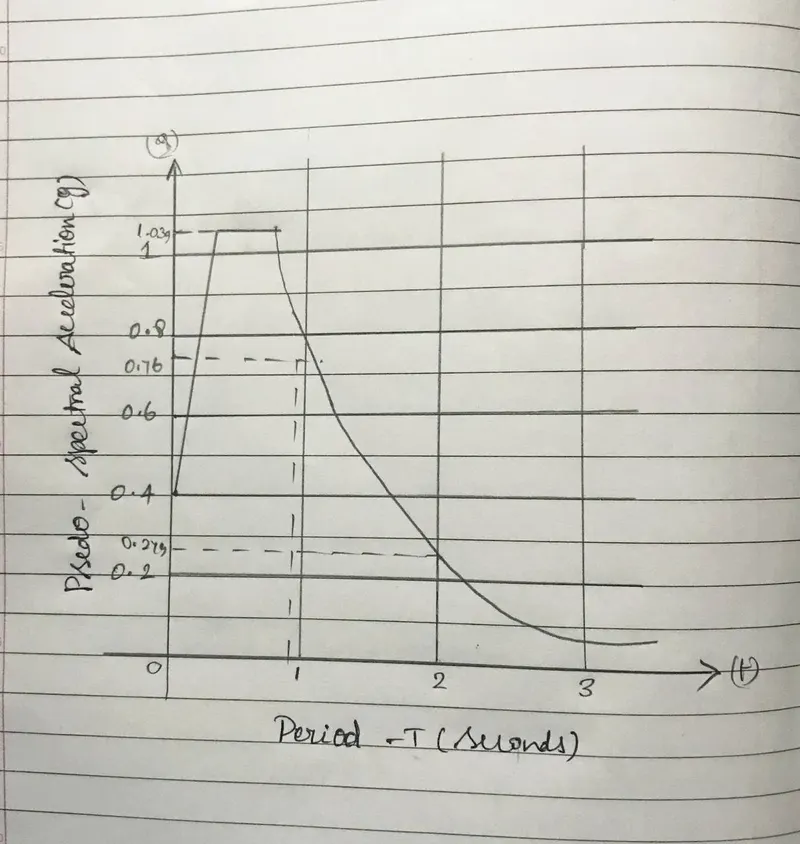
`(underset (1) T)`= 2 Seconds , `underset (1) A = 0.27g`
`(underset (2) T)`= 0.6852 seconds, `underset (2) A = 0.76g`
`(underset (3) T)`= 0.4346 seconds, `underset (3) A = 1.03g`
`(underset (4) T)`= 0.3338 seconds, `underset (4) A = 1.03g`
`(underset (5) T)`= 0.2966 seconds, `underset (5) A = 0.76g`
Mode 1:
`underset (b1) V = ( underset (1) M ^ ast times underset 1 A) = (4.36M times 0.27g)= 2.619 kips`
Mode 2:
`underset (b2) V = ( underset (2) M ^ ast times underset 2 A) = (0.43M times 0.76g)= 0.719 kips`
Mode 3:
`underset (b3) V = ( underset (3) M ^ ast times underset 3 A) = (0.12M times 1.03g)= 0.272 kips`
Mode 4:
`underset (b4) V = ( underset (4) M ^ ast times underset 4 A) = (0.03M times 1.03g)= 0.067 kips`
Mode 5:
`underset (b5) V = ( underset (5) M ^ ast times underset 5 A) = (0.007M times 0.76g)= 0.011 kips`
Step VII :
The combined base shear as per SRSS rule :
`underset b V = sqrt (underset (b1) V^2 + underset (b2) V^2 + underset (b3) V^2 + underset (b4) V^2 + underset (b5) V^2`
`= sqrt ((2.613)^2+ (0.719)^2+(0.272)^2+(0.067)^2+(0.011)^2`
`= 3.20 kips`
Step VIII :
The two modes are to be considered such that a modal mass participating ratio of 90% is obtained.
`= (underset (1) M ^ ast)/(underset (j) M) + (underset (2) M ^ ast)/(underset (j) M)`
`= 88 % + 8.6% = 96.6%`
Result:
1) Ln , Mn and Γn for each of the five modes from the given equations are calculated.
i)
`underset (1) L = 4.121M`
`underset (2) L = -1.298M`
`underset (3) L = 0.687M`
`underset (4) L = -0.381M`
`underset (5) L = 0.175M`
ii)
`underset (1) M = 3.861M`
`underset (2) M = 3.861M`
`underset (3) M = 3.86M`
`underset (4) M = 3.861M`
`underset (5) M = 3.861M`
iii)
`underset (1) Gamma = 1.067`
`underset (2) Gamma = -0.33`
`underset (3) Gamma = 0.178`
`underset (4) Gamma = -0.09`
`underset (5) Gamma = 0.04`
2. The effective modal mass Mn* and the modal mass participating ratio for the 5 modes are calculated.
`underset (1) M ^ ast = 4.39M`
`underset (2) M ^ ast = 0.43M`
`underset (3) M ^ ast = 0.12M`
`underset (4) M ^ ast = 0.03M`
`underset (5) M ^ ast = 0.007M`
3. The base shear for each of the 5 modes of vibration are obtained.
4. As per SRSS rule the combined base shear is obtained.
5. The two modes are to be considered such that a modal mass participating ratio of 90% is obtained.