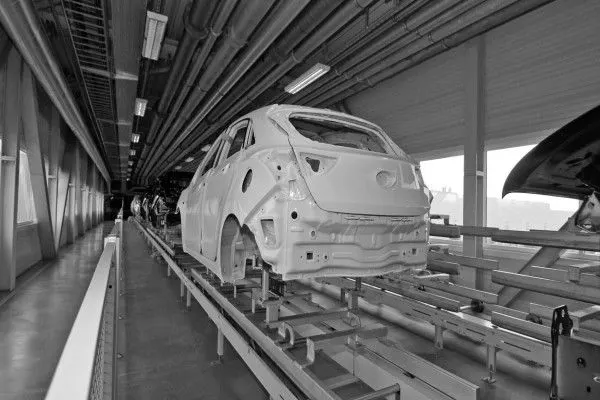
Underbody Coating
Underbody Coating
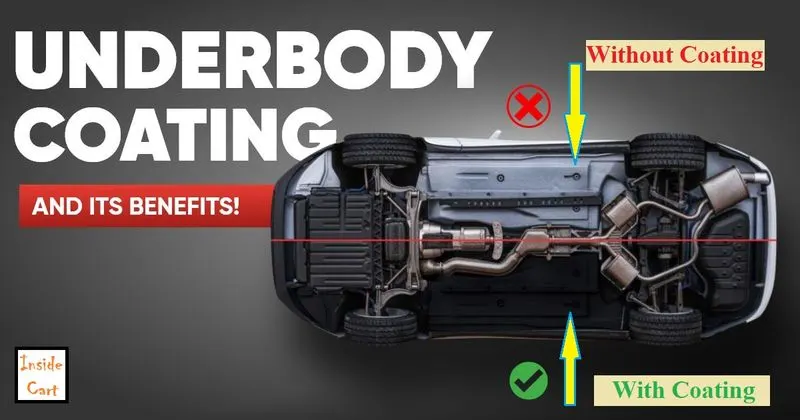
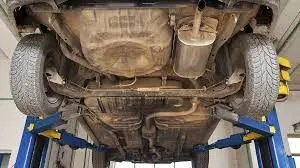
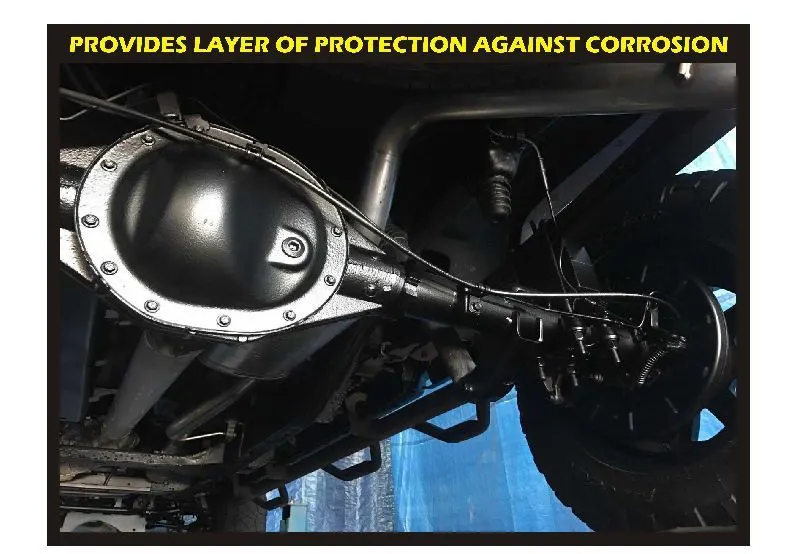
Underbody coating provides long-term protection from corrosion to the car's underbody. It also protects parts like internal body panels, frame rails, and other inner cavities that are not physically accessible but are prone to corrosion.
ABSTRACT:
Automotive coatings and the processes used to coat automobile surfaces exemplify the Avant-grade of technologies that are capable of producing durable surfaces, exceeding customer's expectations of appearance, maximizing efficiency, and meeting environmental regulations. These accomplishments are rooted in 100 years of experience, trial-and-error approaches, technique and technology advancements, and theoretical assessments. Because of advancements directed at understanding the how, why, when, and where of automobile coatings, the progress in controlling droplets and their deposition attributes, and the development of new technologies and paint chemistries, a comprehensive and up-to-date review of automobile coating and coating, technologies were considered to be a value to industrial practitioners and researchers.
Overall the critical performance factors driving the development and use of advanced automotive coatings and coating technologies are
(a) aesthetic characteristics;
(b) corrosion protection;
(c) mass production;
(d) cost and environmental requirements;
(e) appearance and durability.
Although the relative importance of each of these factors is debatable, the perfection of anyone at the expense of another would be unacceptable. Hence, new developments in automotive coatings are described and discussed in the following review, and then related to improvements in production technologies& paints.
Electrodeposition Coating for Automobile Industry (CED Coating):
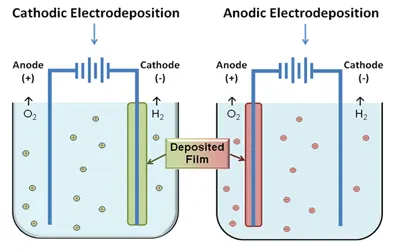
Cathodic Electro Deposition (CED) is a process of coating an object having a conductive surface connected to a circuit as the cathode, by positively charged paint particles suspended in an aqueous medium, under direct current1,2. CED coating is most widely used for automobile Components
It represents modern technology of cathodic electrodeposition coating that is environment-friendly with high property and low cost. Such coating does not contain heavy metals like lead, tin, cadmium, and mercury, etc. It is a two-component, water-dispersed resin, meanwhile, it took in features of previous products, and can adapt galvanized steel sheet perfectly, almost can be applied to foundation coatings of all metal, such as cold and hot rolled steel sheet, galvanized steel sheet, aluminium products, zinc-aluminium alloy sheet, and stainless steel sheet, etc.
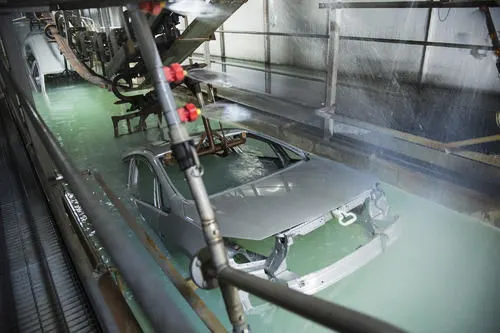
- Film thickness can be controlled by A fully automatic operation.
- Uniform coating.
- Better coverage in the box and inside surfaces.
- Good coverage of sharp corners.
- No flows and slumps.
- No solvent boils.
- Better chip and corrosion protection.
- Almost 100% paint use.
- Superior anti-pollution, safety, health risks.
Dry Film Thickness (DFT):
Dry film thickness (DFT) or coating thickness is arguably the single most important measurement made during the application and inspection of protective coatings. Coatings are designed to perform their intended function when applied within the DFT range as specified by the manufacturer.
DFT Meter:
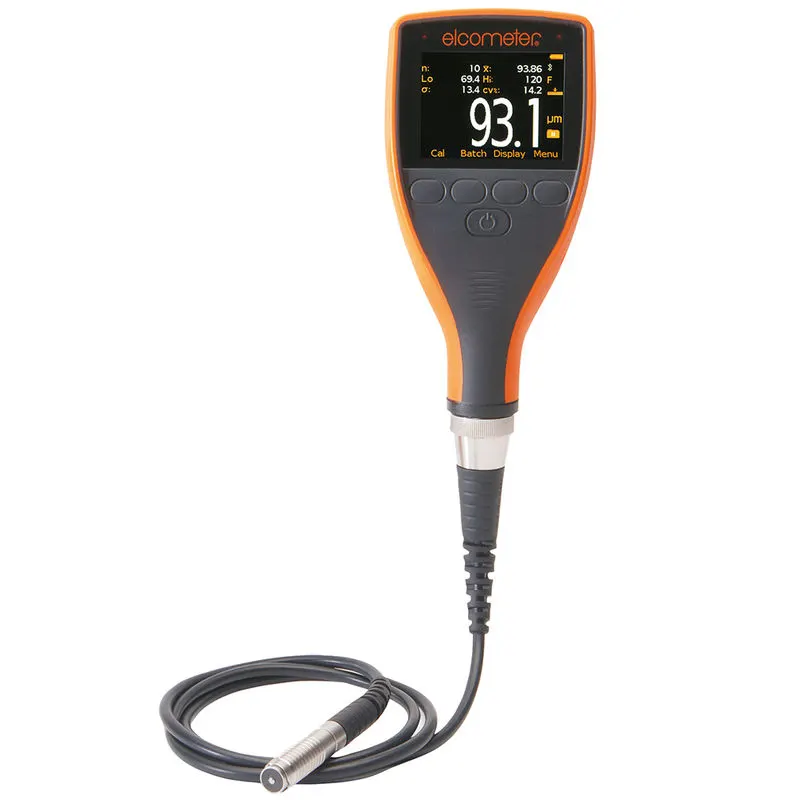
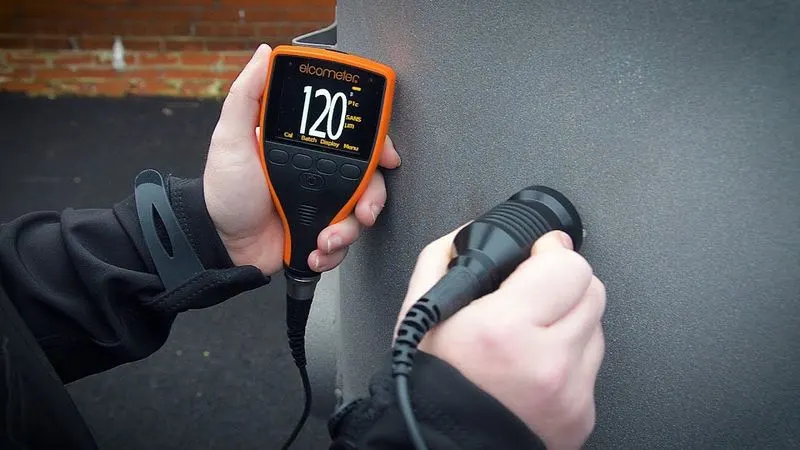
Digital Coating Thickness Gauge is designed for non-destructively measuring the thickness of the coating and paint on any metallic surface. ... -> User can select either continuous measurement mode or single measurement mode.
Elcometer is used to check the coating thickness(DFT) in the Automobile industry.
CED Coating Process:
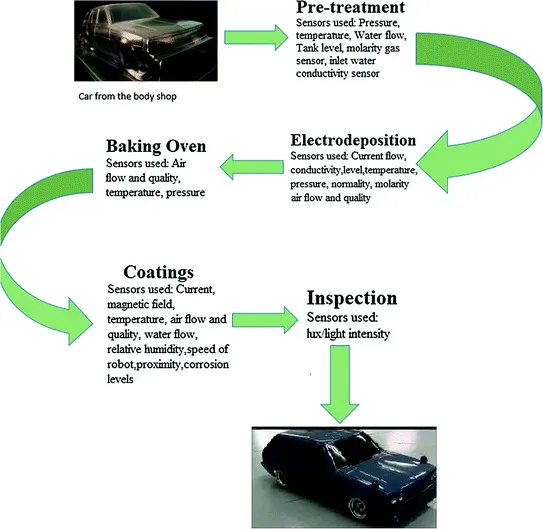
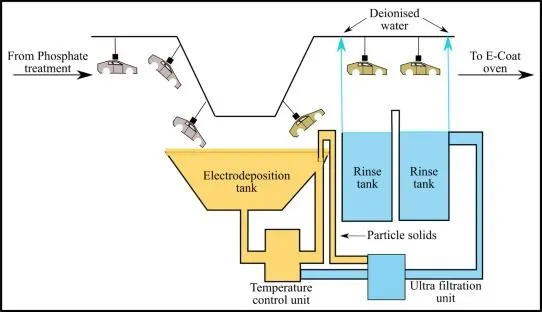
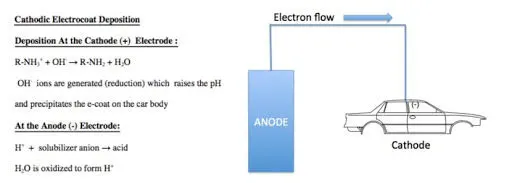
Electro-deposition of primer coating has become universal for a modern automotive paint shop. In ED, charged particles from the paint emulsion move to Anode (AED) or Cathode (CED) under electrical forces. The direct current established through the bath makes the pigment and resin base of the paint wander towards the body surfaces. Coating reaches all the recessed areas. The deposited film does not re-dissolve. However, the un-deposited material is rinsed. Ultra filtrate (UF) equipment is used for ED paint ingredients separation of those not forming film and recovery of Paints. Deposited film after stoving becomes hard, durable polymeric film.
Customers today demand higher quality and durability from the products they buy. Not only do they expect these products to perform well, but they want the finish to look good and resist corrosion for a much longer period of time. This finishing process is designed which is called electrocoating (E-coating).
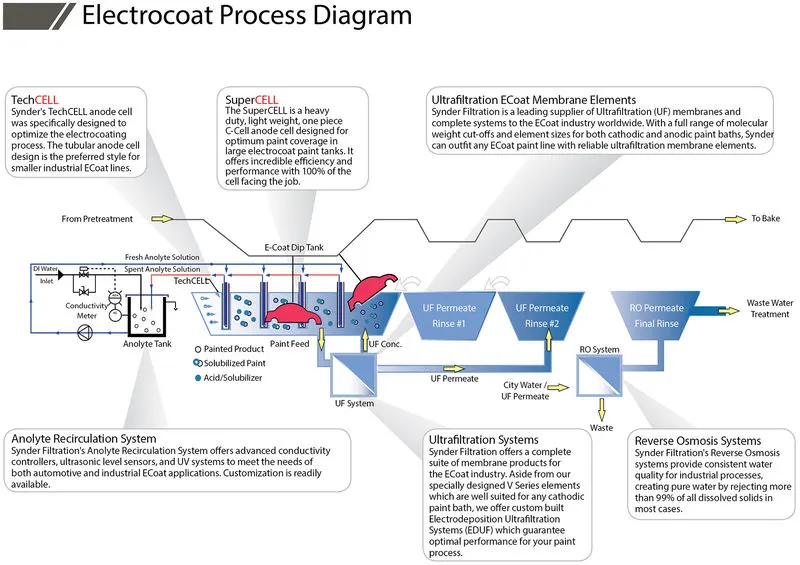
CED Process Flowchart:
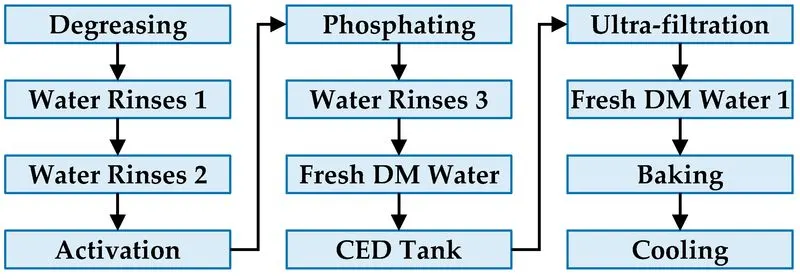
The electrocoat process can be divided into four distinct steps:
- Pretreatment – cleaning and phosphating the metal
- CED/Electrocoat Bath – applying the coating in the bath
- Post Rinses
- Baking
The requirement of pre-treatment before CED Coating on automobile products is due to the following:
- Cleaning of the surface for oil, physical contamination & rust
- Making such a surface condition that has a higher degree of paint-adhesion
- Minimize or eliminate any chance of reaction of paint with the base metal
- Provide the added benefit of the high level of corrosion resistance
HOT WATER RINSE:
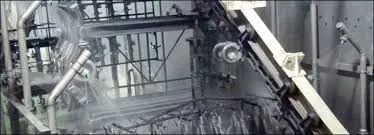
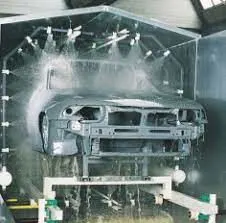
Before the degreasing process, there is a Hot water rinse process in that process the hot water will spray the above component to remove the dust particles and oil content at a temperature of 40 - 45'C because of the car body(Component) directly comes from the weld shop.
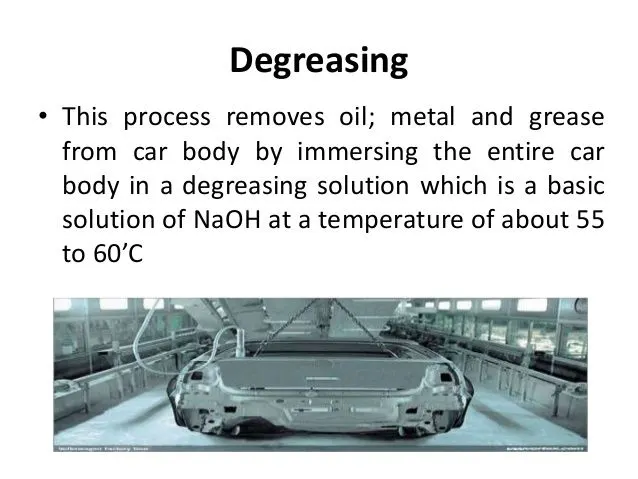
DEGREASING:
WATER RINSE
Rinse water quality is an important part of the pretreatment process. In between stages, it is important to remove residual chemistry before entering the next stage. But it is the final rinse that is most critical.
If the last stage has high conductivity, it may not do an adequate job of rinsing the part. If mineral salts are left on the part surface, they can start corrosion cells and lead to premature failure of the coating. If corrosion resistance is important to you, the final rinse water should below.
ACTIVATION:
Surface Activation chemicals activate the metal to obtain a fine crystalline structure during phosphate coating which will increase corrosion resistance and adhesion properties. Crystalline structure less than 10 Microns always preferable. If we are not using activation rinse, the phosphate crystal size may be large and results in voids in Phosphate coating (Gap between structure will be large). Corrosion will take place at the voids.
Basically, it is a Titanium based weak alkali chemical.
pH and Alkalinity are the parameters to be maintained daily.
PHOSPHATING:
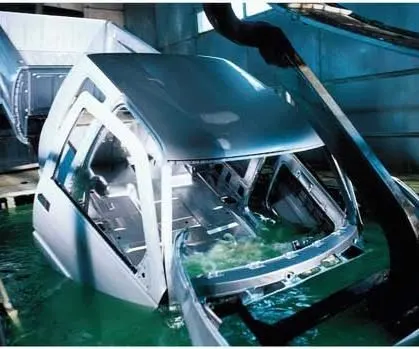
Phosphating is the process of converting a steel surface to iron phosphate. This is mostly used as a pretreatment method in conjunction with another method of corrosion protection. A layer of phosphate coating typically includes iron, zinc, or manganese crystals.
Most phosphate coatings serve as a surface preparation for further coating and/or painting, a function it performs effectively with excellent adhesion and electric isolation. The porosity allows the additional materials to seep into the phosphate coating and become mechanically interlocked after drying. The dielectric nature will electrically isolate anodic and cathodic areas on the surface of the part, minimizing under film corrosion that sometimes occurs at the interface of the paint/coating and the substrate.
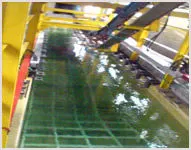
These adhesive coatings provide an excellent base for painting. Coating thickness for zinc phosphate is between 2 - 3 microns and manganese phosphate coatings are typically between.
Why Phosphate:
Adding an iron phosphate stage to your pretreatment can dramatically improve the quality and longevity of your ED coating. Iron phosphate provides increased adhesion. ... Phosphate adds a second layer of protection and can extend the salt-spray rating to 500-1500 hours, depending on the process.
Etching – eliminating fragments of loose, malformed oxide that can encourage corrosion. Pretreatment – stabilizing the aluminium surface to provide a consistent layer that will interact in a positive way with paints, lacquers, or adhesives.
CATHODIC ELECTRO DEPOSITION TANK (CED):
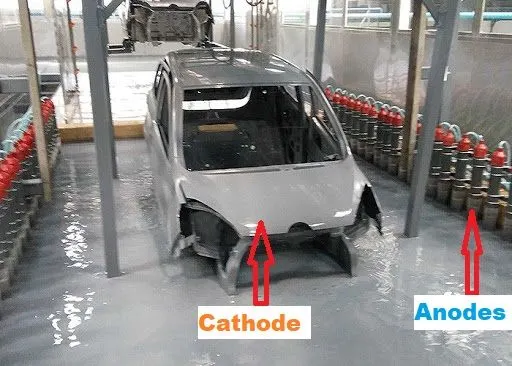
CED is a deposition of a layer of a primer coat on pretreated metal parts by dipping the components inside the positively charged paint bath. The coating is applied via electrodes. The loosely adhering material is washed away with the filtrate recovered from the cathode dip-coating paint.
Paint (Film) attracts the Car Body: (Technical aspects)
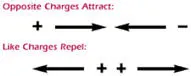
E-coating is a method of painting that uses electrical current to deposit the paint. The process works on the principle of "Opposites Attract". This process is also known as Electro Deposition (ED).
Coating thickness in Every Stage:
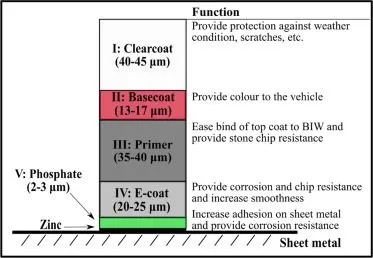
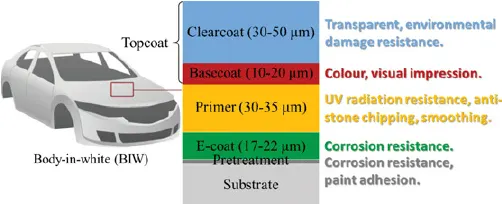
ULTRA FILTRATION:
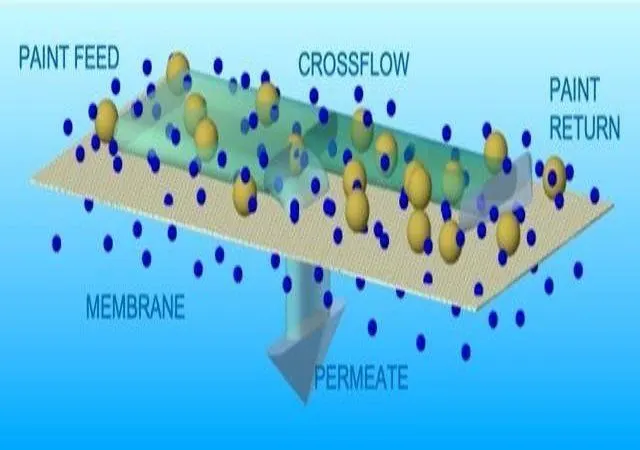
Ultrafiltration is a process for separating a portion of the low molecular weight component of the paint bath from the main paint stream. In electro coat paint systems, the permeate produced by the ultra-filter contains water and paint solubilizers.
Ultrafiltration (UF) is a type of membrane filtration in which hydrostatic pressure forces a liquid against a semipermeable membrane. ... Suspended solids and solutes of high molecular weight are retained, while water and low molecular weight solutes pass through the membrane.
UF Permeate:
Ultrafiltration, like reverse osmosis, is a cross-flow separation process. Here liquid stream to be treated (feed) flows tangentially along the membrane surface, thereby producing two streams. The stream of liquid that comes through the membrane is called permeate.
Benefits of UF:
- The process inevitably restricts the amount of paint being applied. As paint constructs on the surface, an insulating layer is assembled which resists the unseating of excess paint
- In the ultrafiltration process, it is possible to recover almost 98% of all paint that is carried out of the paint tank and into the rinse stages.
FUNCTION OF CED COATING:
- The product is dipped in a bath containing the electrophoretic paint i.e. CED Bath.
- An electric current is passed through both the product & the emulsion.
- The Paint particles that are in contact with the product stick to the surface and build up an electrically insulating layer.
- The product is then removed from the paint bath and baked in an oven.
- With the CED Coating process, the thickness is controlled by voltage once the part is coated and insulated no more coating will take place.
ADVANTAGES OF CED:
1) Fully automatic operation, the film thickness can be controlled
2) Uniform coating, consistency in paint layer on all part to part surfaces.
3) Good coverage of sharp corners
4) Better coverage inbox and interior surface
5) Nearly 100% paint utilization