Underbody Coating
UNDERBODY COATING
Underbody Coating is that type of coating which is mainly done to protect the under surface of a vehicle from getting corroded. It is done using a spraying machine. It is done to protect the vehicle’s undersurface from corrosion for over a long period of time.The parts that are not physically accessible such as the base frame, body panels, propeller shaft, axles etc which are prone to corrosion are protected by using underbody coating. Especially in the monsoon season when heavy rainfall is there, it's highly likely that the car has to run through flooded roads and during which the underbody of the vehicle will be coming in direct contact with high moisture and water content which will lead to corrosion and damage of the parts present in the undersurface of the vehicle. Corrosion in any part will affect the working of adjacent parts also. Hence, in the automotive industry, underbody coating is a high priority. Usually underbody coating thickness is measured using Elcometer and composition is analyzed using NILTON XLT instrument.
Types :
Polyurethane Undercoating
Polyurethane is a very good polymer and is widely used for undercoating in vehicles. In this type, polyurethane-based sealant is used to carry out undercoating. This type of undercoating is an easier process and can be done quickly. It is used to protect the underbody metal surface from getting oxidized and corroded. After this coating, painting can be done over this which gives a smooth and good aesthetic surface.
Rubberized Undercoating
It is the major type of underbody coating that is used in automotive industries as it is the simplest and the best undercoating method which protects vehicles underbody parts from corrosion and damage. Rubberized Undercoating provides a cushioning effect and leads to cancellation of unnecessary sounds and helps in smooth movement of vehicles. It provides a rubbery finish and prevents damage, rust and absorption of moisture.After this coating, painting can be done over this which gives a smooth and good aesthetic surface.
Wax or Paraffin-Based Undercoatings
Wax or paraffin-based undercoating is considered as the easiest, quickest and the cheapest option available which can be used to protect the undercarriage of your vehicle. But it is a kind of temporary coating and will wear off quicker than other types of undercoating. And hence, it needs to get stripped and reapplied on a regular basis that is atleast once in every year.
Asphalt-Based Undercoating
Above mentioned types of undercoating will provide sufficient protection from rust and damage to all the standard vehicles. Asphalt-based undercoating is mainly used in large trucks and heavy machinery, as it provides more durability against rust, irregular roads, rocks and moisture. It helps in reducing noise as it contains rubberized materials in it. But the problem is, it requires more time to get cured than other types of undercoating techniques and it can’t be painted over and hence can only be used in undercoating.
Process-
- First step : First analyze your vehicle’s underbody which is to be coated. Then remove the rust completely using sanding depending on the area and the extent of rust to be removed.
- Second step : Once the rust is removed and prepared our underbody for coating, then give it a quick rinse and make sure no other contaminants are affecting the surface.
- Third step : Then undercoating is applied using a disposable spray gun and is left for some hours so that it can get dried.
- Fourth step : Apply second coating to provide a good and perfect finish.
- Fifth step : Provide ample time so that the undercoating cures completely (usually overnight) before driving your vehicle on the road.
Pros-
- Minimizes Sound: It leads to a smooth running of the car and as a result no noise is heard during the vehicle’s running.
- Increases Life: Provides protection against corrosion and damage and hence increases the life of the vehicle.
- Insulation from heat : Underbody coating of a car does let the heat from the road enter into the vehicle and thereby provides a good temperature inside the car and ensures comfortable running.
Cons-
- Application of underbody coating does not have any particular effect on the already corroded part.
- Underbody coating is expensive.
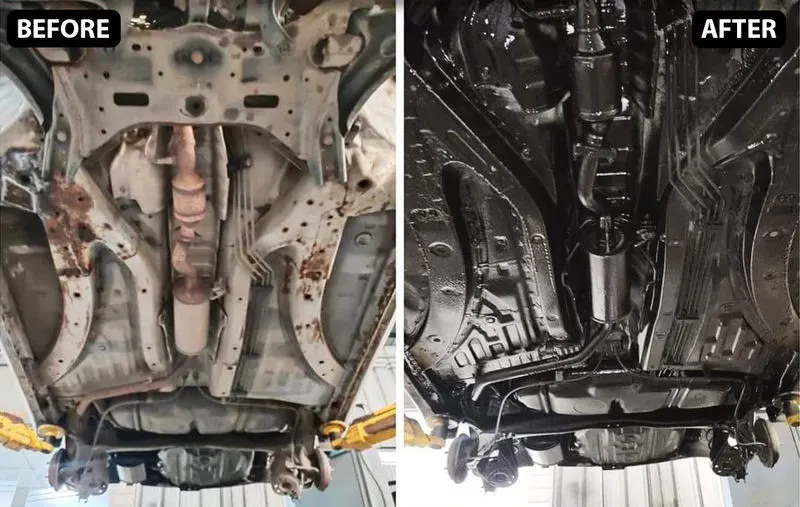
Image courtesy : Skill Lync