Underbody Coating
AIM:
- To make a Detailed report on Underbody coating and its purpose and its types .
Under Body Coating:
- An undercoating is a spraying accessory that protects the vehicle body underneath.
- Its is a thick cladding that is uniformly placed under car underside.
- It prevents corrosion to car underbody
- It also protects parts like internal body panels, frame rails and other inner cavities that are not physically accessible but are prone to corrosion.
Types of UnderBody Coating:
- Rubberized UnderCoating:
- It is easy to apply and offers sound cushioning..
- And It protects underbody from dust, moisture, and dings or dents.
- The coating can be painted over and, if necessary for bodywork, can be easily removed with an undercoating removal spray.
- Rubberized Undercoating provides the simplest and best protective measures against rust and moisture.
2. Polyurethane Undercoating:
- The other option for undercoating your vehicle is to use a Polyurethane based sealant.
- This type of sealant works by seeping into all cracks and seams, displacing salt and moisture and oozing around rusty areas to bond with and protect unoxidized metal.
- The polyurethane used in this product is a high-quality and durable material that is perfect for any weather condition. It is ideal for standard vehicles.
- It has a long lifespan and is resistant to wear and tear
- rickles into cracks and rusty spots already present on the underbelly of your car and fills them, hence protecting the underlying metal
3. Asphalt-Based Undercoating:
- Asphalt-based undercoating generally contains a little bit of rubberized material that sets up firmly and also helps soften noise.
- Generally sold in five gallon containers, this type of undercoating also needs more cure time than the other.
- It reportedly has the most damage-resistant properties. Although asphalt-based undercoating is ideal for trucks, military, and all-terrain vehicles, it will also help protect your car, truck, motorcycle, and heavy machinery from the elements.
- It last long and is best for endurance vehicles that have to undergo heavy road use.
4. Wax or Paraffin-Based Undercoatings:
- A paraffin-based undercoating will be the cheapest and quickest option available with which to protect the undercarriage of your vehicle.
- But it wear's out quickly compared to other undercoating, It needs to be removed and applied ever year.
- Conveniently available in spray guy canisters or aerosol cans.
Steps of UnderBodyCoating:
- Cleaning the UnderBody: You have to remove all debris and contaminants from the chassis to start with the undercoating process.Here is how you can clean the underbody.
- Degreaser: A high-quality commercial-grade degreaser would be helpful in removing oil and grime from the undercarriage.
- Grinding: Now, grind the existing hard contaminants and rust from the undercarriage and other components that you want to treat. You can use a mild grinding pad to remove the debris easily, but remember to wear eye protection while doing it.
- Sanding: After degreasing and grinding, remove those scratches and other stubborn contaminants using a 200 to 400 grit.
2. Applying Primer:
- Primers serve as a basecoat.
- The recommended primers usually contain a high level of zinc. Zinc helps in reducing rusting, even if the protective layer is penetrated.
3.Applying UnderBodyCoating:
- This is the final step. The undercoating sprays are similar to bed liners. Most products are applied in two steps as dual layers. The first layer should be thin, covering the entire surface.
- After this layer has been dried, you can apply the second coat generously.
Advantages of UnderBodyCoating :
1.Prevents Corrosion:
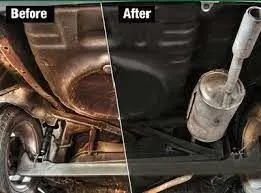
- Underbody coating provides long term protection from corrosion to car’s underbody. It also protects parts like internal body panels, frame rails and other inner cavities that are not physically accessible but are prone to corrosion.
2.Minimizes Sound:
- It minimizes the sound from underneath the car resulting a noiseless, smooth driving experience.
3.Heat Insulation:
- It insulates the interior of the car from extreme temperatures from beneath the vehicle providing a comfortable cabin experience.
4.Anti-chipping property:
- If any stone hits the coating it does not get chipped away hence protects the underbody from exposure to water.
Disadvantages of UnderBodyCoating:
- It is less helpful if corrosion is already present: For an undercoating to be the most effective, it should be in place before the underbelly of your car begins to rust. If you apply it over corrosion, you will still isolate the metal from further moisture and airflow, which is good, but the existing oxidizing/rusting process will still continue to occur. After rust is already present, applying an undercoating will slow the continuation of the corrosion process and will make your vehicle look better… until the rust breaks its way through the layer of undercoating you’ve applied. If you have rust present, it is better to remove the rust and then apply the undercoating.
2.It adds weight to the vehicle:Although the amount of weight added to a vehicle with an undercoating is minimal (between 10 to 20 pounds for most vehicles), there is a small element of fuel economy to consider.
3. Undercoating will work best on new vehicles that have not been exposed to road conditions.